📌 Key Takeaways
- Enterprise apps streamline business operations and improve productivity.
- Custom enterprise solutions enhance security, scalability, and performance.
- AI, cloud, and automation help businesses achieve digital transformation.
- Choosing the right development partner ensures long-term success and ROI.
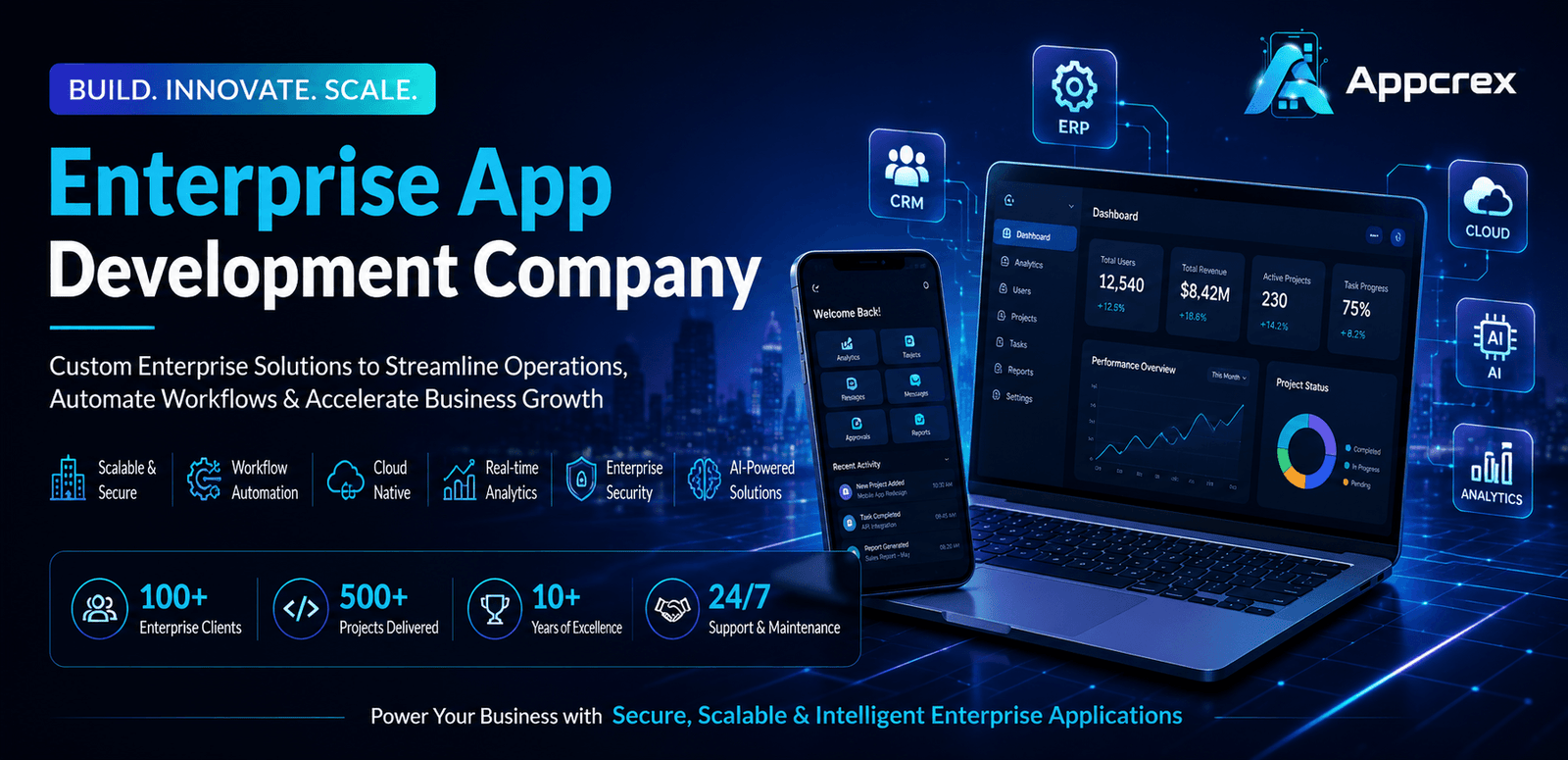
- AppCrex builds secure, scalable, and feature-rich enterprise applications for modern businesses.
Introduction
Modern businesses generate massive amounts of data, manage complex workflows, and serve customers across multiple channels. Traditional software often struggles to meet these growing demands, resulting in disconnected systems, inefficient operations, and reduced productivity. This is where enterprise application development becomes essential.
An Enterprise App Development Company helps organizations build secure, scalable, and customized software solutions that streamline operations, improve collaboration, and accelerate digital transformation. Unlike off-the-shelf software, enterprise applications are designed specifically around a company’s business processes, enabling better efficiency, automation, and long-term growth.
Today’s enterprise applications go beyond managing internal operations. They integrate with cloud platforms, ERP systems, CRM software, AI-powered automation, analytics tools, and third-party services to create a connected digital ecosystem. Whether you’re a startup preparing for rapid growth or a large enterprise modernizing legacy systems, investing in enterprise application development can significantly improve operational performance and customer satisfaction.
In this comprehensive guide, you’ll learn everything about enterprise app development, including its benefits, types, features, technologies, development process, costs, challenges, and future trends in 2026.
What is Enterprise App Development?
Enterprise app development is the process of designing, developing, deploying, and maintaining software applications that support large organizations in managing business operations, employees, customers, and data efficiently.
Unlike consumer applications, enterprise applications focus on improving internal processes, automating workflows, enhancing collaboration, and increasing productivity across multiple departments.
These applications are typically built to handle thousands—or even millions—of users while maintaining high performance, advanced security, and seamless integration with existing business systems.
Enterprise applications can be web-based, mobile-based, cloud-native, or hybrid solutions depending on an organization’s operational requirements.
Why Enterprise App Development is Important?
As businesses grow, managing operations manually becomes increasingly difficult. Departments such as finance, sales, HR, customer support, logistics, and marketing often use separate tools that don’t communicate with each other.
Enterprise applications solve this problem by creating a centralized platform where data, workflows, and teams are connected.
With an enterprise application, businesses can:
- Automate repetitive tasks
- Improve employee productivity
- Enhance customer experiences
- Eliminate data silos
- Increase operational transparency
- Support remote and hybrid workforces
- Improve business intelligence through real-time analytics
- Scale operations without replacing existing systems
As a result, organizations become more agile, data-driven, and competitive.
Types of Enterprise Applications
Different organizations require different enterprise software solutions depending on their industry, business model, and operational goals.
Enterprise Resource Planning (ERP)
ERP systems integrate core business functions into a single platform, allowing organizations to manage operations efficiently.
Common ERP modules include:
- Finance
- Accounting
- Procurement
- Manufacturing
- Inventory
- Supply Chain
- Human Resources
- Reporting
Popular ERP platforms include SAP, Oracle ERP, Microsoft Dynamics 365, and Odoo.
Customer Relationship Management (CRM)
CRM software helps businesses manage customer interactions, sales pipelines, and marketing activities.
Typical CRM features include:
- Lead management
- Sales automation
- Customer support
- Email marketing
- Opportunity tracking
- Customer analytics
Examples include Salesforce, HubSpot, Zoho CRM, and Microsoft Dynamics CRM.
Just Read : How Much Does It Cost to Build an App Like Zoho in 2026? Complete Development Guide
Human Resource Management Systems (HRMS)
HRMS applications simplify workforce management.
Core functionalities include:
- Employee onboarding
- Attendance tracking
- Payroll processing
- Leave management
- Performance evaluation
- Recruitment
- Employee self-service
These systems reduce administrative tasks while improving employee engagement.
Supply Chain Management (SCM)
Supply Chain Management applications help organizations optimize procurement, production, warehousing, logistics, and distribution.
Businesses use SCM software to:
- Forecast demand
- Track shipments
- Manage suppliers
- Reduce operational costs
- Improve inventory planning
Inventory Management Systems
Inventory management applications enable businesses to monitor stock levels in real time.
Key capabilities include:
- Barcode scanning
- Warehouse management
- Stock alerts
- Purchase order management
- Inventory forecasting
- Multi-location inventory tracking
These applications are widely used in retail, manufacturing, healthcare, and logistics.
Business Intelligence (BI) Applications
Business Intelligence software converts raw business data into actionable insights.
Features include:
- Interactive dashboards
- KPI monitoring
- Predictive analytics
- Custom reports
- Data visualization
- Real-time business monitoring
BI solutions empower executives to make faster and more informed decisions.
Project Management Applications
Project management software helps organizations coordinate teams, timelines, resources, and budgets.
Popular features include:
- Task management
- Resource allocation
- Gantt charts
- Time tracking
- Team collaboration
- Performance reporting
These applications improve project visibility and delivery efficiency.
Enterprise Collaboration Applications
Modern organizations require seamless communication across distributed teams.
Enterprise collaboration software provides:
- Instant messaging
- Video conferencing
- File sharing
- Knowledge management
- Team workspaces
- Workflow approvals
These platforms improve communication and accelerate decision-making.
Also Read : Enterprise Software Development: Complete Guide for Growing Businesses
Benefits of Enterprise App Development
Custom enterprise applications provide far more value than generic software because they are tailored to specific business processes and long-term goals.
Improved Productivity
One of the biggest advantages of enterprise application development is increased productivity.
By automating repetitive tasks, employees spend less time on manual processes and more time on strategic work.
For example:
- Automated invoice generation
- Employee onboarding workflows
- Approval processes
- Customer follow-ups
- Report generation
Automation reduces delays, minimizes errors, and improves operational efficiency.
Workflow Automation
Enterprise applications streamline business operations by automating complex workflows across departments.
Examples include:
- Sales approvals
- Purchase requests
- HR onboarding
- Customer support tickets
- Inventory replenishment
- Compliance reporting
Automated workflows improve consistency while reducing administrative effort.
Better Customer Experience
Customer expectations continue to rise, making fast and personalized service essential.
Enterprise applications help organizations deliver exceptional customer experiences through:
- Faster response times
- Personalized recommendations
- Self-service portals
- AI-powered chatbots
- Omnichannel communication
- Real-time support
Improved customer satisfaction often leads to higher retention and increased revenue.
Enhanced Data Security
Enterprise applications are designed with advanced security measures to protect sensitive business information.
Security features typically include:
- End-to-end encryption
- Multi-factor authentication
- Role-based access control
- Secure APIs
- Audit logs
- Data backup and recovery
- Compliance with regulations such as GDPR, HIPAA, and SOC 2
Strong security helps organizations reduce risks and maintain customer trust.
Scalability
As businesses grow, software must scale with increasing users, data, and transactions.
Custom enterprise applications are built with scalable architectures that support:
- Business expansion
- Multi-location operations
- Cloud deployments
- International users
- High traffic volumes
- Future integrations
This ensures long-term performance without requiring a complete system replacement.
Key Features of Enterprise Applications
A successful enterprise application is much more than a digital tool—it becomes the backbone of business operations. To support complex organizational processes, enterprise applications must include features that improve efficiency, security, collaboration, and scalability.
Below are the essential features every modern enterprise application should have.
Role-Based Access Control (RBAC)
Enterprise applications often handle sensitive business information. Not every employee should have access to every part of the system.
Role-Based Access Control (RBAC) ensures users only access the data and functionality relevant to their roles.
For example:
- HR teams can access employee records.
- Finance teams can manage invoices and payroll.
- Sales teams can view customer information.
- Executives can access company-wide analytics.
RBAC enhances security while simplifying permission management.
Cloud Integration
Modern businesses rely heavily on cloud infrastructure to support remote teams and global operations.
Cloud-enabled enterprise applications provide:
- Anywhere access
- Automatic backups
- High availability
- Faster deployment
- Easy scalability
- Reduced infrastructure costs
Cloud platforms such as AWS, Microsoft Azure, and Google Cloud help businesses scale their applications without investing in expensive on-premise hardware.
AI-Powered Automation
Artificial Intelligence is transforming enterprise software by automating repetitive tasks and improving business intelligence.
Modern enterprise applications use AI for:
- Customer support automation
- Document processing
- Intelligent search
- Predictive analytics
- Demand forecasting
- Fraud detection
- Recommendation engines
- Workflow automation
AI-powered enterprise applications improve decision-making while reducing operational costs.
Real-Time Analytics & Reporting
Businesses need instant visibility into operations.
Enterprise applications provide interactive dashboards that display:
- Revenue
- Sales performance
- Employee productivity
- Inventory levels
- Customer engagement
- Operational KPIs
Real-time analytics enable executives to make faster and more informed business decisions.
API Integration
Enterprise software rarely works in isolation.
Modern enterprise applications integrate with systems such as:
- ERP platforms
- CRM software
- Accounting systems
- HR platforms
- Payment gateways
- Marketing tools
- Logistics software
- Communication platforms
API integration eliminates manual data entry while improving operational efficiency.
Enterprise-Grade Security
Security remains one of the most important aspects of enterprise application development.
Essential security features include:
- End-to-end encryption
- Multi-factor authentication (MFA)
- Single Sign-On (SSO)
- Data encryption at rest and in transit
- Secure API authentication
- Audit trails
- Activity monitoring
- Compliance management
These capabilities help organizations protect sensitive information and meet regulatory requirements.
Cross-Platform Accessibility
Employees work across desktops, laptops, tablets, and smartphones.
Enterprise applications should provide consistent performance across:
- Web browsers
- Android devices
- iPhones and iPads
- Windows systems
- macOS devices
Cross-platform compatibility improves employee productivity and user experience.
Offline Functionality
Not every business environment has continuous internet access.
Offline capabilities allow users to:
- Capture data
- Update records
- Complete workflows
Once connectivity is restored, the application automatically synchronizes the latest changes with the central database.
Push Notifications
Real-time notifications help employees respond quickly to important events.
Examples include:
- Task assignments
- Approval requests
- Inventory alerts
- Payment confirmations
- Customer inquiries
- System updates
Push notifications improve collaboration and reduce delays.
Enterprise App Development Process
Developing an enterprise application requires a strategic approach that aligns technology with business goals. A structured development process helps reduce risks, improve quality, and ensure successful implementation.
Step 1: Business Discovery & Requirement Analysis
Every successful project begins with understanding the client’s business objectives.
During this phase, the development team identifies:
- Business goals
- Existing challenges
- User requirements
- Operational workflows
- Security requirements
- Compliance standards
- Integration needs
This information forms the foundation for the entire project.
Step 2: Planning & Solution Architecture
Once the requirements are finalized, the technical architecture is designed.
This includes:
- Application architecture
- Database structure
- Cloud infrastructure
- Security model
- API strategy
- Scalability planning
- Technology stack selection
A well-planned architecture ensures long-term maintainability and performance.
Step 3: UI/UX Design
An intuitive user interface is essential for employee adoption.
UI/UX designers create:
- Wireframes
- Interactive prototypes
- User journeys
- Dashboard layouts
- Responsive interfaces
The focus is on creating a simple, efficient, and user-friendly experience.
Step 4: Enterprise Application Development
During development, engineers build the application’s frontend, backend, APIs, and integrations.
Common development activities include:
- Frontend development
- Backend development
- Database implementation
- API development
- Third-party integrations
- Authentication setup
- Security implementation
Agile development methodologies are commonly used to deliver features incrementally.
Step 5: Quality Assurance & Testing
Before deployment, the application undergoes comprehensive testing.
Testing includes:
- Functional testing
- Performance testing
- Security testing
- Compatibility testing
- Integration testing
- User Acceptance Testing (UAT)
Rigorous testing ensures the application is reliable, secure, and ready for production.
Step 6: Deployment
After successful testing, the application is deployed to the production environment.
Deployment activities include:
- Cloud configuration
- Server setup
- Database migration
- Security verification
- Performance monitoring
A phased rollout helps minimize disruptions to business operations.
Step 7: Ongoing Maintenance & Support
Enterprise applications require continuous updates to remain secure and efficient.
Post-launch services typically include:
- Bug fixes
- Performance optimization
- Feature enhancements
- Security updates
- Infrastructure monitoring
- Technical support
Regular maintenance ensures the application continues to meet evolving business needs.
Technologies Used in Enterprise App Development
Choosing the right technology stack is critical for building secure, scalable, and high-performing enterprise applications.
Frontend Technologies
Popular frontend frameworks include:
- React.js
- Angular
- Vue.js
- Next.js
These technologies provide responsive and interactive user interfaces.
Mobile App Development
For enterprise mobile applications, businesses often choose:
- Flutter
- React Native
- Kotlin (Android)
- Swift (iOS)
Cross-platform frameworks like Flutter and React Native reduce development time while maintaining a native-like user experience.
Also Read : React Native vs Flutter: Which Framework Should You Choose for Mobile App Development in 2026?
Backend Technologies
The backend powers business logic, APIs, and database operations.
Common backend technologies include:
- Node.js
- Python (Django/FastAPI)
- Java (Spring Boot)
- .NET
- PHP (Laravel)
The choice depends on scalability, performance, and existing enterprise infrastructure.
Databases
Enterprise applications commonly use:
- PostgreSQL
- MySQL
- Microsoft SQL Server
- MongoDB
- Redis
The database selection depends on the type of data, scalability requirements, and performance needs.
Cloud Platforms
Cloud-native applications are increasingly becoming the standard.
Leading cloud providers include:
- Amazon Web Services (AWS)
- Microsoft Azure
- Google Cloud Platform (GCP)
These platforms offer scalability, security, disaster recovery, and managed services.
AI & Automation Technologies
To build intelligent enterprise applications, organizations integrate advanced AI tools and frameworks such as:
- OpenAI GPT
- Google Gemini
- Anthropic Claude
- LangChain
- CrewAI
- LangGraph
- Model Context Protocol (MCP)
- Vector Databases for Retrieval-Augmented Generation (RAG)
These technologies enable AI-powered search, workflow automation, intelligent assistants, predictive analytics, and decision support.
Industries That Benefit from Enterprise App Development
Enterprise applications are used across industries to improve operational efficiency, automate workflows, and deliver better customer experiences. Below are some of the sectors where enterprise software creates the greatest business impact.
Healthcare
Healthcare organizations rely on enterprise applications to manage patient records, appointments, billing, and clinical workflows while ensuring compliance with regulations such as HIPAA.
Common enterprise healthcare solutions include:
- Electronic Health Records (EHR)
- Hospital Management Systems
- Telemedicine Platforms
- Patient Portals
- Pharmacy Management Systems
- Medical Billing Software
Benefits include improved patient care, faster administration, and secure data management.
Banking & Financial Services
Banks and financial institutions require highly secure enterprise applications capable of processing millions of transactions.
Typical enterprise banking applications include:
- Digital Banking Platforms
- Loan Management Systems
- Fraud Detection Systems
- Risk Management Software
- Payment Processing Platforms
- Investment Management Solutions
AI-powered enterprise software also helps financial organizations detect fraud, automate compliance, and improve customer service.
Retail & E-commerce
Retail businesses use enterprise applications to streamline operations across multiple sales channels.
Popular retail solutions include:
- Inventory Management
- POS Systems
- Order Management
- Warehouse Management
- Customer Loyalty Programs
- CRM Platforms
Enterprise software helps retailers optimize stock levels, personalize customer experiences, and improve operational efficiency.
Manufacturing
Manufacturers depend on enterprise applications to manage production, quality control, inventory, and supply chain operations.
Common manufacturing solutions include:
- Manufacturing Execution Systems (MES)
- Production Planning
- Quality Management Systems
- Inventory Tracking
- Predictive Maintenance
- Supply Chain Management
These systems reduce downtime, improve product quality, and increase production efficiency.
Logistics & Transportation
Logistics companies use enterprise software to coordinate complex delivery operations.
Applications include:
- Fleet Management
- Route Optimization
- Warehouse Automation
- Shipment Tracking
- Driver Management
- Supply Chain Analytics
These solutions improve delivery speed while reducing transportation costs.
Education
Educational institutions are adopting enterprise applications to digitize administration and enhance learning experiences.
Examples include:
- Learning Management Systems (LMS)
- Student Information Systems
- Online Examination Platforms
- Attendance Management
- Faculty Management
- Fee Management
Enterprise applications simplify academic administration while improving communication between students, teachers, and administrators.
How Much Does Enterprise App Development Cost?
One of the most common questions businesses ask is: How much does it cost to develop an enterprise application?
The answer depends on several factors, including project complexity, required features, integrations, security standards, and technology stack.
Factors Affecting Enterprise App Development Cost
Several variables influence the total project cost.
Application Complexity
Simple enterprise applications cost significantly less than enterprise-wide digital transformation platforms with advanced workflows and AI capabilities.
Number of Features
Features such as:
- User authentication
- Dashboards
- Reports
- Notifications
- Workflow automation
- AI integration
- Analytics
- Offline mode
can significantly impact development costs.
Third-Party Integrations
Integrating enterprise software with:
- SAP
- Salesforce
- Microsoft Dynamics
- QuickBooks
- Stripe
- ERP systems
- CRM platforms
requires additional development effort.
Security & Compliance
Applications handling sensitive information require:
- Data encryption
- Multi-factor authentication
- Audit logs
- GDPR compliance
- HIPAA compliance
- SOC 2 compliance
Advanced security increases both development time and cost.
Team Size
Enterprise projects often involve:
- Business Analysts
- Project Managers
- UI/UX Designers
- Frontend Developers
- Backend Developers
- QA Engineers
- DevOps Engineers
- AI Engineers
Larger teams enable faster delivery but increase project costs.
Estimated Enterprise App Development Cost
| Project Type | Estimated Cost | Timeline |
|---|---|---|
| Basic Enterprise MVP | $15,000 – $30,000 | 6–8 Weeks |
| Medium Business Solution | $30,000 – $80,000 | 3–5 Months |
| Large Enterprise Platform | $80,000 – $250,000+ | 6–12 Months |
Note: These are estimated ranges. The final cost depends on business requirements, integrations, security, and customization.
Best Practices for Enterprise App Development
Building enterprise software requires more than writing code. Following industry best practices ensures long-term success.
Understand Business Goals First
Technology should solve business problems rather than add unnecessary complexity.
Start by identifying:
- Business objectives
- Pain points
- User expectations
- Workflow requirements
- Success metrics
Design for Scalability
Enterprise applications should support future growth without requiring major redevelopment.
Scalable architecture enables:
- More users
- More data
- More integrations
- Multiple business locations
- International expansion
Prioritize Security
Security should be integrated throughout the development lifecycle.
Recommended practices include:
- End-to-end encryption
- Secure coding standards
- Penetration testing
- API security
- Regular vulnerability assessments
Use Cloud-Native Architecture
Cloud-native applications provide:
- Better scalability
- Automatic updates
- Disaster recovery
- High availability
- Lower infrastructure costs
Integrate AI Where It Adds Value
Artificial Intelligence can enhance enterprise applications through:
- Intelligent search
- Customer support chatbots
- Document processing
- Predictive analytics
- Workflow automation
- AI assistants
The goal should be to improve productivity and decision-making, not simply add AI for its own sake.
Future Trends in Enterprise App Development (2026)
Enterprise software is evolving rapidly as organizations adopt AI, automation, and cloud technologies.
Key trends shaping the future include:
AI-Powered Enterprise Applications
AI will become a standard feature in enterprise software, enabling predictive analytics, intelligent automation, and personalized user experiences.
Multi-Agent AI Systems
Businesses will increasingly deploy multiple AI agents that collaborate to automate complex workflows, improve decision-making, and reduce manual effort.
Hyperautomation
Organizations will automate end-to-end business processes by combining AI, robotic process automation (RPA), APIs, and workflow engines.
Low-Code & No-Code Development
Low-code platforms will enable businesses to develop internal tools faster while reducing development costs.
Cloud-Native Enterprise Solutions
Cloud-first strategies will continue to dominate due to scalability, security, and cost efficiency.
IoT Integration
Enterprise applications will integrate with IoT devices to enable real-time monitoring, predictive maintenance, and operational insights across industries.
Why Choose AppCrex for Enterprise App Development?
Choosing the right development partner is critical to the success of your enterprise software project. At AppCrex, we specialize in delivering secure, scalable, and future-ready enterprise applications tailored to your business goals.
Our services include:
- Enterprise Application Development
- Enterprise Mobile App Development
- Custom Software Development
- AI Integration Services
- Cloud Application Development
- API Development & Integration
- ERP & CRM Development
- SaaS Product Development
- Enterprise Modernization
- Ongoing Maintenance & Support
Why Businesses Trust AppCrex
- Experienced enterprise developers
- AI-powered development expertise
- Agile project management
- Secure and scalable architecture
- Transparent communication
- Flexible engagement models
- Dedicated post-launch support
Whether you’re building an internal business platform, modernizing legacy systems, or developing an enterprise mobile application, AppCrex delivers solutions designed for long-term growth.
(FAQs)
Q. What is enterprise app development?
Enterprise app development involves creating custom software solutions that help organizations manage business operations, automate workflows, and improve collaboration.
Q. Why should businesses choose custom enterprise applications?
Custom applications are designed specifically for your business processes, offering better flexibility, security, scalability, and integration than off-the-shelf software.
Q. How long does enterprise app development take?
Development timelines typically range from 6 weeks for an MVP to 12 months or more for complex enterprise platforms.
Q. How much does enterprise app development cost?
Costs generally range from $15,000 to $250,000+, depending on project complexity, integrations, features, and security requirements.
Q. Which technologies are used for enterprise application development?
Popular technologies include React, Angular, Flutter, React Native, Node.js, Python, Java, .NET, PostgreSQL, MongoDB, AWS, Azure, Google Cloud, and AI frameworks such as OpenAI GPT, Gemini, and LangGraph.
Q. Can enterprise applications integrate with existing software?
Yes. Enterprise applications can integrate with ERP, CRM, HRMS, accounting software, payment gateways, cloud platforms, and third-party APIs.
Q. Are enterprise applications secure?
Yes. Modern enterprise applications include encryption, authentication, role-based access control, audit logs, and compliance features to protect sensitive business data.
Q. Which industries benefit from enterprise applications?
Healthcare, finance, retail, logistics, manufacturing, education, real estate, travel, and government organizations all benefit from enterprise software.
Q. What is the difference between enterprise software and regular business software?
Enterprise software is designed for large-scale operations, multiple users, complex workflows, high security, and integration with other business systems, while regular business software typically addresses smaller, standalone tasks.
Q. Why choose AppCrex for enterprise app development?
AppCrex provides end-to-end enterprise application development services with expertise in AI, cloud technologies, enterprise integrations, and scalable software architecture.
Conclusion
Enterprise applications have become the foundation of modern digital businesses. From automating workflows and improving collaboration to strengthening security and enabling data-driven decisions, they help organizations operate more efficiently and remain competitive in an increasingly digital world.
As technologies such as Artificial Intelligence, cloud computing, Multi-Agent AI, and workflow automation continue to evolve, enterprise software will become even more intelligent and capable. Businesses that invest in custom enterprise application development today will be better equipped to scale, innovate, and meet changing customer expectations tomorrow.
Whether you’re building a new enterprise platform, modernizing legacy systems, or integrating AI into existing business processes, partnering with an experienced Enterprise App Development Company can make all the difference.
AppCrex delivers secure, scalable, and customized enterprise application development services that empower businesses to accelerate digital transformation and achieve long-term success.