
📌 Key Takeaways
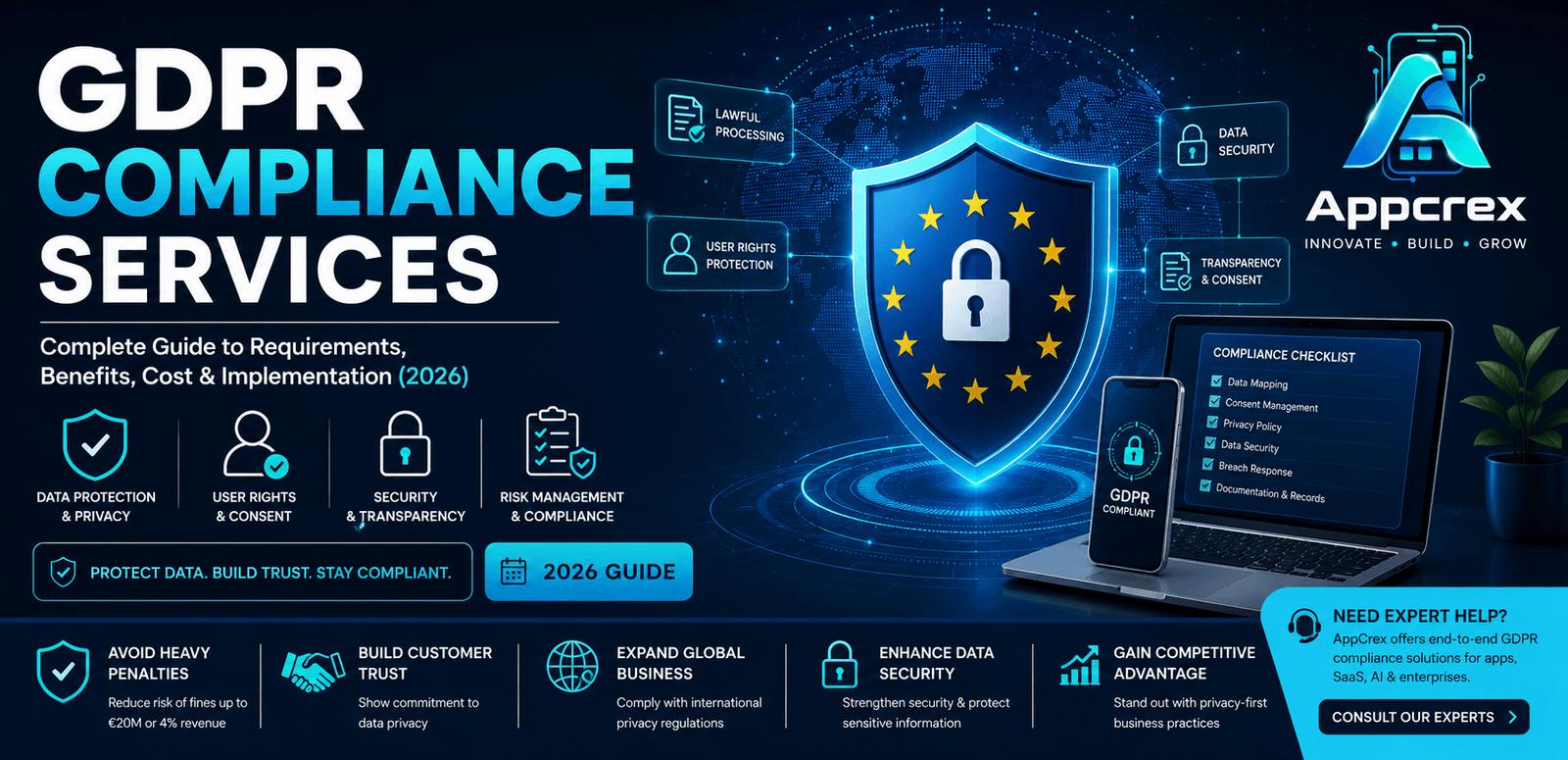
- GDPR protects the personal data and privacy rights of EU residents.
- Businesses worldwide may need GDPR compliance if they process EU customer data.
- Compliance helps improve security, customer trust, and regulatory readiness.
- Mobile apps, SaaS platforms, healthcare systems, and AI applications must implement GDPR best practices.
- Investing in GDPR compliance services reduces legal risks and supports long-term business growth.
In today’s digital-first world, data has become one of the most valuable business assets. Organizations collect customer information through websites, mobile apps, SaaS platforms, eCommerce stores, healthcare systems, and AI-powered solutions. While data helps businesses improve customer experiences and make informed decisions, it also creates significant responsibilities regarding privacy and security.
With increasing concerns about data breaches and misuse of personal information, governments worldwide have introduced strict data protection regulations. Among them, the General Data Protection Regulation (GDPR) remains the most influential and widely recognized privacy law.
Whether you’re running a startup, enterprise, SaaS platform, healthcare application, fintech solution, or mobile app, GDPR compliance is no longer optional if you process data belonging to European Union (EU) residents.
Businesses that fail to comply may face severe penalties, legal challenges, and loss of customer trust. On the other hand, organizations that prioritize GDPR compliance can strengthen security, improve brand reputation, and gain a competitive advantage.
This comprehensive guide explains everything you need to know about GDPR compliance services, including requirements, benefits, implementation strategies, costs, and best practices for 2026.
What is GDPR Compliance?
GDPR stands for General Data Protection Regulation, a comprehensive privacy law introduced by the European Union to protect personal data and individual privacy rights.
The regulation came into effect on May 25, 2018, and applies to organizations worldwide that collect, process, store, or manage personal information belonging to EU citizens.
GDPR compliance refers to the process of ensuring that an organization’s data handling practices align with GDPR requirements and standards.
Unlike traditional privacy laws that primarily focus on local businesses, GDPR has a global reach. Even if your company is located outside Europe, you may still need to comply if you serve EU customers.
Main Objectives of GDPR
The regulation was designed to:
- Protect personal information and privacy rights
- Increase transparency in data collection and processing
- Give individuals greater control over their data
- Strengthen cybersecurity and data protection measures
- Hold organizations accountable for privacy practices
- Standardize privacy regulations across EU member states
Today, GDPR serves as a model for many privacy regulations worldwide, including data protection laws in the United Kingdom, California, Brazil, and other regions.
Also Read : HIPAA-Compliant Healthcare App Development: Complete Guide
Why GDPR Compliance Matters for Businesses in 2026?
As businesses continue to embrace digital transformation, the amount of personal information being collected has grown exponentially.
From online shopping and healthcare consultations to AI-powered applications and cloud software, customer data is now central to business operations.
This makes GDPR compliance more important than ever.
1. Building Customer Trust
Modern consumers are increasingly aware of privacy risks.
Customers prefer organizations that:
- Protect personal information
- Provide transparency
- Offer secure digital experiences
- Respect privacy preferences
GDPR compliance demonstrates a commitment to protecting user data, helping businesses build long-term trust.
2. Avoiding Regulatory Penalties
Non-compliance can lead to substantial fines.
Organizations may face penalties of up to:
- €10 million or 2% of annual global turnover
- €20 million or 4% of annual global turnover
The higher amount generally applies.
3. Improving Data Security
GDPR encourages businesses to implement robust security measures such as:
- Encryption
- Access controls
- Security monitoring
- Vulnerability testing
- Incident response planning
These measures reduce the risk of cyberattacks and data breaches.
4. Supporting Global Expansion
Organizations planning to enter European markets must comply with GDPR requirements.
Compliance simplifies international business operations and demonstrates credibility to global customers.
Key Principles of GDPR
GDPR is built on several core principles that guide responsible data management practices.
1. Lawfulness, Fairness, and Transparency
Organizations must process personal data lawfully and transparently.
Users should clearly understand:
- What data is being collected
- Why it is collected
- How it will be used
2. Purpose Limitation
Personal information should only be collected for specific and legitimate purposes.
Businesses cannot use collected data for unrelated activities without proper consent.
3. Data Minimization
Organizations should only collect information that is necessary.
Excessive data collection increases compliance risks and security challenges.
4. Accuracy
Businesses must ensure personal information remains accurate and up-to-date.
Incorrect information should be corrected promptly.
5. Storage Limitation
Data should not be retained longer than necessary.
Organizations should establish clear retention policies and deletion procedures.
6. Integrity and Confidentiality
Businesses must protect data against:
- Unauthorized access
- Data breaches
- Accidental loss
- Cyberattacks
7. Accountability
Organizations must demonstrate compliance through documentation, policies, training, and security controls.
Who Needs GDPR Compliance?
Many organizations mistakenly assume GDPR only applies to European companies.
In reality, GDPR affects businesses worldwide.
1. Mobile App Development Companies
Apps frequently collect personal information such as:
- Names
- Email addresses
- Phone numbers
- Location data
- Device identifiers
Therefore, GDPR compliance is critical for app developers.
2. SaaS Companies
Software-as-a-Service platforms continuously process customer data.
Common examples include:
- CRM systems
- Project management tools
- HR software
- Marketing automation platforms
Healthcare Organizations
Healthcare providers handle highly sensitive patient information.
GDPR requires strict safeguards for medical records and health-related data.
3. Fintech Businesses
Financial applications often process:
- Banking information
- Payment details
- Transaction histories
Strong compliance measures are essential.
4. E-commerce Platforms
Online stores collect customer information during:
- Registration
- Purchases
- Marketing activities
- Customer support interactions
5. AI and Machine Learning Platforms
AI systems often rely on large datasets containing personal information.
Organizations must ensure ethical and compliant data usage.
Also Read : Custom Software Development Company: Complete Guide to Services, Process, Cost & Benefits (2026)
GDPR Compliance Requirements
To achieve compliance, businesses must implement various technical, organizational, and legal measures.
1. Consent Management
Users must provide clear and informed consent before personal information is collected.
Consent should be:
- Freely given
- Specific
- Informed
- Unambiguous
Pre-checked boxes and hidden consent mechanisms are prohibited.
2. Privacy Policies
Organizations must provide clear privacy notices explaining:
- Data collection practices
- Processing purposes
- User rights
- Retention periods
- Security measures
3. Data Security Measures
Strong cybersecurity controls are required, including:
- Encryption
- Secure authentication
- Role-based access controls
- Security monitoring
- Vulnerability assessments
4. Data Breach Reporting
Organizations must notify regulators within 72 hours after discovering certain data breaches.
Affected individuals may also need to be informed.
5. Data Processing Agreements
Businesses working with third-party vendors should establish legally compliant agreements regarding data handling responsibilities.
6. User Rights Management
Organizations must provide mechanisms that allow users to:
- Access personal data
- Correct inaccurate information
- Request deletion
- Transfer data
- Withdraw consent
GDPR Compliance for Mobile App Development
Mobile applications collect significant amounts of personal information, making privacy protection essential.
Common Data Collected by Mobile Apps
Most applications gather:
- User profiles
- Contact information
- Behavioral analytics
- GPS location data
- Device identifiers
- Payment information
Best Practices for GDPR-Compliant Apps
Privacy by Design
Privacy considerations should be incorporated from the beginning of the development process.
Data Minimization
Collect only the information required for app functionality.
Secure Authentication
Implement:
- Multi-factor authentication
- Strong password requirements
- Secure session management
User Consent Management
Provide transparent permission requests and consent options.
Encryption
Protect sensitive information both in transit and at rest.
GDPR Compliance for SaaS Applications
SaaS companies process large volumes of customer information daily.
Compliance requires a comprehensive approach to privacy and security.
Multi-Tenant Data Security
SaaS platforms must ensure proper separation of customer data.
User Access Management
Role-based permissions help prevent unauthorized access.
Audit Trails
Detailed logs provide visibility into data processing activities.
Secure Cloud Infrastructure
Cloud environments should include:
- Encryption
- Backup systems
- Monitoring tools
- Disaster recovery plans
Customer Data Controls
Users should have the ability to manage, export, and delete their information.
GDPR Compliance for AI Applications
Artificial Intelligence introduces unique privacy challenges.
Organizations must balance innovation with responsible data practices.
AI Transparency
Users should understand:
- How AI systems use their data
- Why decisions are made
- What information influences outcomes
Automated Decision-Making
GDPR grants individuals rights regarding automated decisions that significantly impact them.
Ethical AI Development
Organizations should focus on:
- Fairness
- Transparency
- Accountability
- Bias reduction
Data Governance
AI systems should only access necessary information and follow strict retention policies.
Common GDPR Compliance Challenges
Many organizations struggle during implementation.
Legacy Systems
Older technologies may lack modern privacy controls.
Third-Party Vendors
External service providers can introduce compliance risks.
Cross-Border Data Transfers
International data transfers require additional safeguards.
Data Discovery
Many businesses lack visibility into where personal information is stored.
Employee Awareness
Human error remains a leading cause of privacy incidents.
Regular training is essential.
Also Read : Cost to Develop a FinTech App: Complete Development Guide, Features & Pricing (2026)
GDPR Compliance Implementation Process
Step 1: Conduct a Data Audit
Identify:
- What data is collected
- Where it is stored
- Who has access
- Why it is processed
Step 2: Perform Risk Assessment
Evaluate privacy and security risks associated with data processing activities.
Step 3: Update Policies and Procedures
Create GDPR-compliant:
- Privacy policies
- Data retention policies
- Security procedures
Step 4: Strengthen Security Controls
Implement:
- Encryption
- Authentication controls
- Monitoring systems
- Backup strategies
Step 5: Establish Consent Management
Deploy tools that track and manage user consent.
Step 6: Train Employees
Educate teams about privacy obligations and security practices.
Step 7: Continuous Monitoring
Compliance is an ongoing process requiring regular reviews and updates.
GDPR Compliance Cost
Compliance costs vary depending on company size, industry, and complexity.
Small Businesses
Typical investment:
$2,000 – $15,000
Mid-Sized Companies
Typical investment:
$15,000 – $100,000
Enterprise Organizations
Typical investment:
$100,000 – $1 Million+
Cost factors include:
- Legal consulting
- Security audits
- Compliance software
- Employee training
- Technology upgrades
- Documentation management
Benefits of GDPR Compliance Services
Enhanced Customer Confidence
Customers are more likely to trust organizations that prioritize privacy.
Stronger Security Framework
Compliance drives improvements in cybersecurity infrastructure.
Reduced Legal Risks
Proper compliance minimizes exposure to penalties and lawsuits.
Better Data Governance
Organizations gain improved control over information assets.
Competitive Advantage
Privacy-conscious businesses stand out in competitive markets.
Global Readiness
GDPR compliance helps prepare organizations for emerging privacy regulations worldwide.
GDPR Compliance Statistics and Market Trends
Data privacy has become a top priority for organizations worldwide. Recent industry reports indicate that consumers are increasingly concerned about how businesses collect, store, and use their personal information.
Some important trends shaping GDPR compliance in 2026 include:
- Growing adoption of privacy-first business models.
- Increased investment in cybersecurity and data protection tools.
- Rising demand for GDPR compliance consulting services.
- Expansion of privacy regulations across multiple countries.
- Greater focus on AI governance and responsible data usage.
As privacy expectations continue to evolve, businesses that proactively invest in compliance are more likely to gain customer trust and maintain a competitive advantage.
GDPR Compliance Checklist for Businesses
Organizations can use the following GDPR compliance checklist to evaluate their readiness.
1. Data Collection
- Identify all personal data being collected.
- Document the purpose of data collection.
- Verify lawful processing grounds.
- Eliminate unnecessary information.
2. User Consent
- Obtain clear and explicit consent.
- Record consent details.
- Provide consent withdrawal options.
- Update cookie consent mechanisms.
3. Data Security
- Encrypt sensitive information.
- Enable multi-factor authentication.
- Conduct regular security assessments.
- Implement access controls.
4. User Rights
- Support data access requests.
- Allow data correction requests.
- Enable data deletion requests.
- Facilitate data portability.
5. Documentation
- Maintain processing activity records.
- Update privacy policies.
- Create breach response procedures.
- Document compliance efforts.
GDPR Compliance for Different Industries
While GDPR applies broadly, implementation requirements vary by industry.
1. GDPR Compliance for Healthcare Organizations
Healthcare providers process highly sensitive patient information.
Key compliance priorities include:
- Medical record protection.
- Secure telemedicine platforms.
- Patient consent management.
- Health data encryption.
- Secure information sharing.
Healthcare organizations should implement strict access controls and comprehensive audit trails to safeguard patient information.
2. GDPR Compliance for Fintech Companies
Financial institutions handle large volumes of sensitive customer data.
Important compliance requirements include:
- Transaction security.
- Fraud prevention systems.
- Secure payment processing.
- Identity verification controls.
- Financial data protection.
Fintech businesses must balance security requirements with seamless customer experiences.
3. GDPR Compliance for E-commerce Businesses
Online stores collect information during browsing, registration, and purchasing activities.
Compliance considerations include:
- Cookie consent management.
- Marketing consent tracking.
- Customer account security.
- Payment information protection.
- Third-party vendor compliance.
4. GDPR Compliance for SaaS Companies
SaaS businesses often process customer data continuously.
Best practices include:
- Role-based access management.
- Secure cloud infrastructure.
- Data backup systems.
- Audit logging.
- User-controlled privacy settings.
5. GDPR Compliance for AI Companies
AI applications create unique privacy challenges.
Organizations should focus on:
- Transparent AI decision-making.
- Ethical data usage.
- Bias mitigation.
- Data minimization.
- Explainable AI systems.
6. GDPR vs CCPA: Understanding the Difference
Businesses operating internationally often encounter multiple privacy regulations.
| Feature | GDPR | CCPA |
|---|---|---|
| Region | European Union | California, USA |
| Scope | Personal Data Protection | Consumer Privacy Rights |
| Consent Requirement | Strong Consent Rules | Opt-Out Approach |
| User Rights | Extensive Rights | Consumer Rights |
| Penalties | Up to €20 Million or 4% Revenue | Significant Financial Penalties |
| Global Reach | Applies Worldwide for EU Data | Focused on California Residents |
Organizations serving global audiences should consider compliance strategies that address multiple privacy regulations simultaneously.
Also Read : Cross-Platform App Development Cost: Complete Pricing Guide (2026)
Common GDPR Mistakes Businesses Should Avoid
Many organizations struggle with compliance due to avoidable mistakes.
1. Collecting Too Much Data
Businesses often gather information that is not necessary for operations.
This increases compliance risks and security exposure.
2. Poor Consent Management
Users must understand exactly what they are agreeing to.
Hidden consent clauses can create compliance violations.
3. Weak Security Controls
Inadequate cybersecurity practices remain one of the leading causes of GDPR penalties.
4. Ignoring Third-Party Vendors
Organizations remain responsible for how vendors handle personal information.
Vendor risk assessments should be performed regularly.
5. Lack of Employee Training
Human error is a major contributor to data breaches.
Regular training programs help reduce risks.
Also Read : What is SaaS Application Development? A Complete Guide (2026)
How GDPR Compliance Services Help Businesses?
Professional GDPR compliance services help organizations streamline implementation and reduce risks.
GDPR Assessment and Gap Analysis
Experts evaluate existing privacy practices and identify compliance gaps.
Data Mapping and Discovery
Organizations gain visibility into:
- Collected data.
- Storage locations.
- Processing activities.
- Sharing practices.
Policy Development
Consultants create:
- Privacy policies.
- Cookie policies.
- Data retention policies.
- Incident response procedures.
Security Enhancement
Compliance specialists recommend technical safeguards including:
- Encryption.
- Monitoring solutions.
- Identity management.
- Secure infrastructure.
Employee Awareness Programs
Training helps employees understand their privacy responsibilities.
GDPR Compliance Implementation Roadmap
Organizations can follow a structured roadmap for successful compliance implementation.
Phase 1: Assessment
- Conduct data inventory.
- Review privacy practices.
- Identify risks.
- Define compliance objectives.
Phase 2: Planning
- Develop implementation strategy.
- Assign responsibilities.
- Create timelines.
- Establish governance structure.
Phase 3: Execution
- Update policies.
- Deploy security controls.
- Implement consent management.
- Train employees.
Phase 4: Testing
- Conduct security testing.
- Verify user rights workflows.
- Review compliance documentation.
- Perform audits.
Phase 5: Continuous Monitoring
- Monitor regulatory changes.
- Review vendor compliance.
- Update security measures.
- Conduct regular assessments.
Why Businesses Should Invest in GDPR Compliance in 2026?
The digital economy continues to evolve rapidly.
Organizations that prioritize privacy gain several advantages:
1. Increased Customer Trust
Consumers prefer companies that demonstrate responsible data handling.
2. Reduced Security Risks
Strong privacy programs improve overall cybersecurity.
3. Better Operational Efficiency
Data governance initiatives improve information management.
4. Stronger Brand Reputation
Privacy-focused organizations are viewed more favorably by customers and partners.
5. Improved Market Access
GDPR compliance supports expansion into European and international markets.
Also Read : AI Integration Services: Complete Guide to Benefits, Use Cases, Cost & Implementation (2026)
Why Choose AppCrex for GDPR Compliance Services?
At AppCrex, we help businesses build secure, scalable, and GDPR-compliant digital solutions.
Our services include:
- GDPR consulting and assessment
- Mobile app compliance implementation
- SaaS compliance solutions
- Privacy-first software development
- AI governance frameworks
- Security audits and testing
- Consent management integration
- Ongoing compliance monitoring
Our team ensures privacy and security are integrated into every stage of development, helping businesses reduce risks while maintaining exceptional user experiences.
Future Trends in GDPR Compliance
The privacy landscape continues to evolve rapidly.
1. AI Regulation Expansion
Governments are introducing stricter oversight for AI technologies.
2. Privacy-First Development
Organizations increasingly prioritize privacy during product design.
3. Zero Trust Security
Zero Trust frameworks are becoming standard security practices.
4. Automated Compliance Monitoring
AI-powered compliance tools help organizations identify risks proactively.
5. Global Privacy Regulations
More countries are introducing GDPR-inspired legislation.
Businesses that establish strong compliance foundations today will be better prepared for future requirements.
Frequently Asked Questions
What is GDPR compliance?
GDPR compliance refers to following the General Data Protection Regulation requirements for collecting, processing, storing, and protecting personal data.
Does GDPR apply outside Europe?
Yes. Any organization processing personal data belonging to EU residents may be subject to GDPR requirements.
Why is GDPR important for mobile apps?
Mobile apps often collect personal information, making privacy protection and consent management essential.
Can small businesses be fined under GDPR?
Yes. Company size does not exempt organizations from GDPR obligations.
What are the penalties for GDPR violations?
Organizations may face fines of up to €20 million or 4% of annual global turnover.
Is GDPR compliance mandatory for SaaS companies?
If the platform processes data belonging to EU residents, GDPR compliance is generally required.
What is Privacy by Design?
Privacy by Design means integrating privacy and security considerations into systems from the beginning of development.
How long does GDPR implementation take?
Depending on business complexity, implementation can take several weeks to several months.
Does GDPR apply to AI applications?
Yes. AI systems processing personal information must comply with GDPR requirements.
How can AppCrex help with GDPR compliance?
AppCrex provides GDPR consulting, secure software development, compliance implementation, privacy assessments, and ongoing support.
Conclusion
GDPR compliance is no longer simply a legal requirement—it is a critical component of modern business operations. As organizations continue to collect and process increasing amounts of personal data, maintaining transparency, security, and accountability becomes essential.
From mobile apps and SaaS platforms to healthcare systems and AI-powered solutions, GDPR compliance helps businesses protect customer information, reduce legal risks, strengthen cybersecurity, and build lasting trust. By investing in GDPR compliance services and adopting privacy-first development practices, organizations can confidently navigate the evolving digital landscape and achieve sustainable growth in 2026 and beyond.