📌 Key Takeaways
- EHR integration centralizes patient records, enabling healthcare providers to access accurate data quickly and improve care coordination.
- Real-time data sharing improves patient outcomes by supporting faster diagnoses, treatment decisions, and follow-up care.
- Automation reduces administrative workload by eliminating duplicate data entry and streamlining clinical workflows.
- Strong security and compliance measures help healthcare organizations meet HIPAA, GDPR, and other regulatory requirements.
- Successful implementation requires careful planning, the right technology stack, and strategies to overcome interoperability challenges.
Healthcare organizations are rapidly embracing digital transformation to improve patient care, streamline operations, and enhance data accessibility. One of the most important innovations driving this transformation is Electronic Health Records (EHR) Integration.
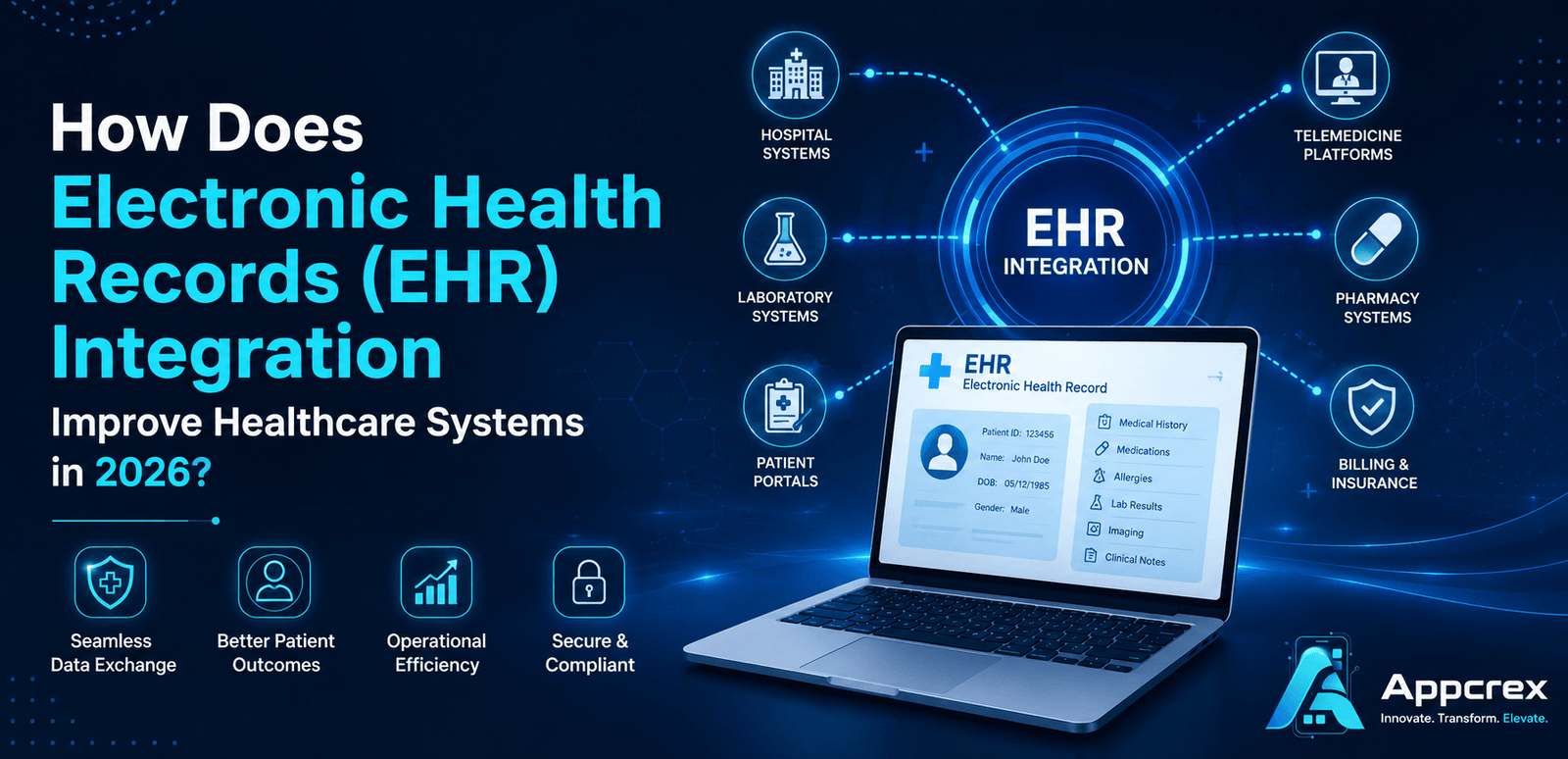
Modern healthcare providers rely on multiple software systems, including hospital management systems, telemedicine platforms, patient portals, laboratory systems, billing software, pharmacy management solutions, and healthcare mobile applications. Without proper integration, these systems often operate independently, creating data silos that can impact efficiency and patient outcomes.
Electronic Health Records (EHR) Integration solves this challenge by enabling seamless communication and data exchange between healthcare applications and EHR systems. It ensures that patient information is accessible, accurate, secure, and available whenever healthcare professionals need it.
As healthcare organizations continue investing in interoperability and connected care, EHR integration has become a critical requirement for hospitals, clinics, healthcare startups, telemedicine providers, and digital health companies.
This comprehensive guide explores everything you need to know about EHR integration, including its benefits, implementation process, technologies, costs, challenges, and future trends in 2026.
What is Electronic Health Records (EHR) Integration?
Electronic Health Records (EHR) Integration refers to the process of connecting healthcare applications, software platforms, and medical systems with Electronic Health Record systems to enable secure and seamless data exchange.
An EHR system stores comprehensive patient information, including:
- Patient demographics
- Medical history
- Diagnoses
- Medications
- Allergies
- Laboratory reports
- Imaging records
- Treatment plans
- Clinical notes
- Billing information
EHR integration allows healthcare providers to access this information from multiple systems without manual data entry.
Instead of switching between different platforms, healthcare professionals can view and update patient records through connected applications in real time.
Why EHR Integration Matters in Modern Healthcare?
Healthcare organizations generate massive amounts of patient data every day.
Without integration, information often becomes fragmented across multiple systems.
This creates challenges such as:
- Duplicate data entry
- Medical errors
- Delayed treatments
- Inaccurate records
- Reduced productivity
- Poor patient experiences
EHR integration eliminates these issues by creating a unified healthcare ecosystem where information flows seamlessly between systems.
Key Objectives of EHR Integration
- Improve patient care quality
- Increase operational efficiency
- Enhance clinical decision-making
- Reduce administrative workload
- Support healthcare interoperability
- Improve data accuracy
- Ensure regulatory compliance
Benefits of Electronic Health Records (EHR) Integration
Healthcare organizations that implement EHR integration experience significant operational and clinical improvements.
1. Improved Patient Care
Healthcare providers gain instant access to complete patient information.
This allows clinicians to:
- Make informed decisions
- Reduce treatment delays
- Improve diagnosis accuracy
- Provide personalized care
Having comprehensive patient data available in real time enhances overall healthcare outcomes.
2. Reduced Medical Errors
Incomplete or outdated patient records can lead to serious medical mistakes.
EHR integration helps reduce errors by ensuring:
- Accurate medication records
- Updated allergy information
- Current treatment histories
- Real-time clinical updates
3. Enhanced Operational Efficiency
Manual data entry consumes valuable staff time.
Integrated systems automate information sharing, allowing healthcare professionals to focus more on patient care.
4. Better Patient Experience
Patients benefit from:
- Faster appointments
- Reduced paperwork
- Improved communication
- Coordinated healthcare services
A connected healthcare ecosystem creates a smoother patient journey.
5. Increased Revenue Cycle Efficiency
EHR integration streamlines billing and claims processing by ensuring accurate patient and treatment information is available across financial systems.
EHR Integration Benefits for Different Stakeholders
Electronic Health Records (EHR) Integration benefits every participant in the healthcare ecosystem. From doctors and nurses to patients and insurance providers, integrated healthcare systems improve collaboration, efficiency, and patient outcomes.
1. Benefits for Doctors
Healthcare professionals often struggle with fragmented patient information spread across multiple systems. EHR integration provides a unified view of patient records, helping doctors make faster and more accurate decisions.
Key benefits include:
- Real-time access to patient records
- Faster diagnosis and treatment planning
- Reduced paperwork
- Improved clinical efficiency
- Better patient care coordination
2. Benefits for Patients
Patients expect convenient access to healthcare services and medical information. EHR integration enhances patient engagement by providing secure access to health records, appointments, prescriptions, and lab results.
Benefits for patients include:
- Improved healthcare experience
- Faster treatment decisions
- Reduced medical errors
- Better communication with providers
- Access to personal health information
3. Benefits for Hospitals
Hospitals handle large volumes of patient information daily. EHR integration improves workflow efficiency by enabling seamless communication across departments.
Benefits include:
- Streamlined operations
- Reduced administrative workload
- Better resource utilization
- Improved patient outcomes
- Enhanced compliance management
4. Benefits for Healthcare Administrators
Administrative teams benefit from improved visibility into healthcare operations and patient data management.
Benefits include:
- Improved reporting capabilities
- Better data accuracy
- Enhanced operational efficiency
- Faster decision-making
- Reduced operational costs
5. Benefits for Insurance Providers
Insurance companies require accurate healthcare information for claims processing and coverage verification.
Benefits include:
- Faster claims approvals
- Reduced fraud risks
- Accurate patient information
- Improved collaboration with providers
- Better compliance management
Types of EHR Integration
Healthcare organizations can implement different integration approaches depending on their requirements.
1. API-Based EHR Integration
Application Programming Interfaces (APIs) allow healthcare applications to communicate directly with EHR systems.
Benefits include:
- Real-time data exchange
- Faster implementation
- Scalability
- Improved flexibility
API-based integration is increasingly becoming the preferred approach.
2. HL7 Integration
Health Level Seven (HL7) is one of the most widely used healthcare communication standards.
HL7 enables healthcare systems to exchange information consistently and securely.
Common use cases include:
- Patient admissions
- Laboratory reports
- Clinical data exchange
4. FHIR Integration
Fast Healthcare Interoperability Resources (FHIR) is a modern healthcare data standard designed to improve interoperability.
FHIR offers:
- API-friendly architecture
- Cloud compatibility
- Mobile support
- Faster development
Many modern healthcare applications now prioritize FHIR integration.
5. Middleware Integration
Middleware acts as a bridge between multiple healthcare systems.
This approach is useful when organizations operate various legacy applications that require connectivity.
EHR vs EMR Integration: What’s the Difference?
Many healthcare organizations use the terms EHR and EMR interchangeably. However, there are significant differences between the two.
| Feature | EHR Integration | EMR Integration |
|---|---|---|
| Scope | Comprehensive patient records | Individual practice records |
| Data Sharing | High | Limited |
| Interoperability | Excellent | Moderate |
| Multi-Provider Access | Yes | Limited |
| Patient-Centric Approach | Strong | Basic |
| Care Coordination | Advanced | Limited |
Electronic Health Records are designed for interoperability and data sharing across healthcare providers, while Electronic Medical Records primarily focus on information within a single practice or organization.
For healthcare organizations seeking connected care and seamless information exchange, EHR integration offers greater long-term value.
Key Components of EHR Integration
Successful EHR integration requires several essential components.
Patient Data Synchronization
Ensures consistent patient information across systems.
Clinical Workflow Integration
Supports seamless workflows for physicians, nurses, and administrative staff.
Security and Access Control
Protects sensitive healthcare information from unauthorized access.
Data Mapping
Aligns information fields between systems to ensure consistency.
Real-Time Communication
Enables immediate data updates across connected platforms.
EHR Integration for Telemedicine Platforms
Telemedicine has experienced significant growth in recent years.
Virtual care platforms require seamless access to patient records to deliver effective consultations.
Benefits of EHR Integration in Telemedicine
- Access to complete patient histories
- Real-time prescription management
- Improved clinical decisions
- Reduced documentation burden
- Better continuity of care
Healthcare providers can conduct virtual consultations while maintaining access to comprehensive medical information.
EHR Integration for Healthcare Mobile Apps
Healthcare mobile applications are transforming patient engagement.
Examples include:
- Patient portals
- Appointment scheduling apps
- Medication tracking apps
- Remote monitoring solutions
- Chronic disease management apps
EHR integration enables these applications to provide real-time health information directly to patients.
Key Features
- Medical record access
- Appointment management
- Prescription tracking
- Lab result viewing
- Secure messaging
EHR Integration for Hospital Management Systems
Hospitals rely on numerous software solutions for daily operations.
Integrated EHR systems help connect:
- Registration systems
- Laboratory management
- Radiology systems
- Pharmacy software
- Billing platforms
- Clinical applications
This creates a unified healthcare environment with improved efficiency and coordination.
EHR Integration Use Cases
The demand for EHR integration continues to grow as healthcare organizations adopt digital technologies.
Remote Patient Monitoring
Remote monitoring devices generate valuable patient data such as heart rate, blood pressure, glucose levels, and oxygen saturation.
EHR integration enables healthcare providers to access this information in real time and respond proactively to patient needs.
Pharmacy Management Systems
Integrated pharmacy solutions help providers access medication histories, monitor prescriptions, and reduce medication errors.
Benefits include:
- Faster prescription management
- Improved medication safety
- Better patient adherence tracking
Laboratory Information Systems
Laboratories generate critical diagnostic information that must be available to healthcare providers quickly.
EHR integration enables:
- Automated report sharing
- Faster diagnoses
- Reduced manual data entry
Healthcare CRM Systems
Healthcare customer relationship management platforms improve patient engagement and communication.
Integration helps synchronize patient information across systems.
Telemedicine Applications
Telemedicine providers require immediate access to patient records during virtual consultations.
Integrated EHR systems improve diagnosis accuracy and treatment quality.
Healthcare Mobile Applications
Patients increasingly use mobile healthcare applications for appointment scheduling, medication tracking, and medical record access.
EHR integration ensures real-time synchronization of healthcare information.
Technologies Used in EHR Integration
Several technologies support modern EHR integration projects.
1. REST APIs
Enable secure communication between applications.
2. HL7 Standards
Facilitate healthcare data exchange.
3. FHIR Framework
Supports interoperability across modern healthcare platforms.
4. Cloud Computing
Provides scalable infrastructure for healthcare applications.
5. Artificial Intelligence
Helps automate data processing and improve decision-making.
6. Data Encryption
Protects patient information during transmission and storage.
EHR Integration Process: Step-by-Step Guide
Implementing EHR integration requires careful planning and execution.
Step 1: Requirement Analysis
Identify:
- Business goals
- Workflow requirements
- Compliance needs
- Integration objectives
Step 2: System Assessment
Evaluate existing infrastructure and software systems.
Step 3: Choose Integration Method
Select:
- API Integration
- HL7 Integration
- FHIR Integration
- Middleware Solutions
Step 4: Data Mapping
Define how information will flow between systems.
Step 5: Development and Configuration
Build integration workflows and establish secure connections.
Step 6: Testing
Conduct:
- Functional testing
- Security testing
- Performance testing
- Interoperability testing
Step 7: Deployment
Launch integration into the production environment.
Step 8: Monitoring and Maintenance
Continuously monitor system performance and security.
Common Challenges in EHR Integration
Despite its benefits, EHR integration can present challenges.
Legacy Systems
Many healthcare organizations still use outdated software.
These systems may require additional customization for integration.
Data Standardization
Different systems often store information in varying formats.
Proper data mapping is critical.
Security Concerns
Healthcare organizations must protect sensitive patient information.
Strong cybersecurity measures are essential.
Regulatory Compliance
Healthcare providers must comply with regulations such as:
Integration Complexity
Large healthcare ecosystems may involve numerous interconnected systems.
EHR Integration Challenges and Solutions
While EHR integration delivers significant benefits, healthcare organizations often face technical and operational challenges.
1. Challenge: Data Silos
Many healthcare systems operate independently, creating isolated information repositories.
Solution: Implement interoperability standards such as HL7 and FHIR to enable seamless data exchange.
2. Challenge: Legacy Systems
Older healthcare applications may not support modern integration methods.
Solution: Use middleware platforms and API gateways to bridge legacy and modern systems.
3. Challenge: Security Risks
Healthcare organizations are prime targets for cyberattacks due to the sensitive nature of patient data.
Solution: Implement encryption, multi-factor authentication, security monitoring, and regular vulnerability assessments.
4. Challenge: Regulatory Compliance
Healthcare providers must comply with regulations such as HIPAA, GDPR, and HITECH.
Solution: Develop compliance-focused integration strategies and conduct regular audits.
5. Challenge: Data Quality Issues
Inconsistent or duplicate records can affect patient care and reporting accuracy.
Solution: Implement data validation, cleansing, and governance frameworks.
EHR Integration Security Best Practices
Protecting patient information is a top priority.
1. Implement End-to-End Encryption
Encrypt data both in transit and at rest.
2. Enable Multi-Factor Authentication
Strengthen access controls for healthcare professionals.
3. Conduct Regular Security Audits
Identify and address vulnerabilities proactively.
4. Apply Role-Based Access Controls
Restrict access based on job responsibilities.
5. Monitor System Activity
Track user actions and security events.
EHR Integration Cost
The cost of EHR integration varies depending on project complexity and requirements.
Small Healthcare Practices
Estimated Cost:
$10,000 – $30,000
Mid-Sized Clinics
Estimated Cost:
$30,000 – $100,000
Hospitals and Enterprises
Estimated Cost:
$100,000 – $500,000+
Factors influencing costs include:
- Number of integrations
- EHR platform selection
- Custom development requirements
- Compliance needs
- Security implementation
- Third-party APIs
Popular EHR Systems for Integration
Healthcare organizations commonly integrate with leading EHR platforms such as:
- Epic
- Cerner
- Athenahealth
- eClinicalWorks
- NextGen Healthcare
- Allscripts
- Meditech
Each platform offers unique APIs and integration capabilities.
Why Healthcare Startups Need EHR Integration?
Healthcare startups are transforming the industry through innovative digital solutions. However, without EHR integration, these solutions may struggle to deliver a seamless healthcare experience.
Modern healthcare startups often develop:
- Telemedicine platforms
- Mental health applications
- Remote patient monitoring solutions
- Healthcare marketplaces
- Digital therapeutics platforms
- Patient engagement applications
Integrating these platforms with Electronic Health Records allows startups to access accurate patient information while improving healthcare workflows.
Faster Product Adoption
Healthcare providers prefer solutions that integrate seamlessly with existing systems.
Improved User Experience
Patients and healthcare professionals gain access to unified healthcare information.
Enhanced Data Accuracy
Integrated systems reduce manual data entry and improve record consistency.
Better Clinical Outcomes
Providers can make informed decisions using complete patient information.
Competitive Advantage
Startups offering EHR integration capabilities are more attractive to hospitals, clinics, and healthcare organizations.
As digital healthcare continues evolving, EHR integration has become a critical feature for healthcare startups seeking long-term growth and success.
Future Trends in EHR Integration (2026)
Healthcare technology continues to evolve rapidly.
1. AI-Powered Clinical Decision Support
AI will help healthcare providers analyze patient data more effectively.
2. FHIR Adoption Growth
FHIR is becoming the preferred interoperability standard.
3. Cloud-Based Healthcare Ecosystems
More organizations are moving healthcare infrastructure to the cloud.
4. Remote Patient Monitoring
Integrated EHR systems will support real-time health monitoring.
5. Predictive Healthcare Analytics
Advanced analytics will improve preventive care and treatment planning.
6. Interoperability Expansion
Governments and healthcare organizations continue promoting seamless data exchange.
Why Choose AppCrex for EHR Integration Services?
AppCrex specializes in healthcare software development and EHR integration solutions.
Our expertise includes:
- EHR Integration Development
- HL7 and FHIR Integration
- Telemedicine Platform Development
- Healthcare Mobile App Development
- Hospital Management Systems
- HIPAA-Compliant Software Solutions
- Healthcare API Development
- Security and Compliance Consulting
Our team helps healthcare organizations build secure, scalable, and interoperable healthcare solutions that improve patient care and operational efficiency.
Frequently Asked Questions (FAQs)
Q. What is EHR integration?
EHR integration connects healthcare applications and systems with Electronic Health Record platforms to enable secure data sharing.
Q. Why is EHR integration important?
It improves patient care, reduces errors, enhances efficiency, and supports healthcare interoperability.
Q. What is the difference between EHR and EMR?
EMR typically refers to records within a single practice, while EHR supports broader information sharing across healthcare organizations.
Q. What is FHIR in EHR integration?
FHIR is a modern healthcare interoperability standard that enables efficient data exchange between systems.
Q. Is EHR integration secure?
Yes, when implemented with encryption, authentication, access controls, and regulatory compliance measures.
Q. How long does EHR integration take?
Projects can range from several weeks to several months depending on complexity.
Q. What industries benefit from EHR integration?
Hospitals, clinics, telemedicine providers, healthcare startups, laboratories, pharmacies, and insurance companies.
Q. How much does EHR integration cost?
Costs typically range from $10,000 to over $500,000 depending on scope and requirements.
Q. Can EHR integration support mobile healthcare apps?
Yes. Mobile apps can securely access and update patient information through integrated EHR systems.
Q. Why choose AppCrex for EHR integration?
AppCrex provides end-to-end EHR integration, healthcare software development, interoperability solutions, and compliance-focused implementation services.
Conclusion
Electronic Health Records (EHR) Integration has become a cornerstone of modern healthcare transformation. By connecting healthcare systems, applications, and digital platforms, EHR integration enables seamless data exchange, improves clinical workflows, enhances patient experiences, and supports better healthcare outcomes.
From hospitals and clinics to telemedicine platforms and healthcare mobile apps, organizations that invest in EHR integration gain significant advantages in efficiency, interoperability, and patient care. As healthcare technology continues evolving in 2026 and beyond, EHR integration will remain essential for delivering connected, secure, and data-driven healthcare services.
Businesses looking to build future-ready healthcare solutions should prioritize EHR integration as a critical component of their digital health strategy.