
📌 Key Takeaways
- Hospital management apps automate appointments, billing, records, and daily healthcare operations.
- EHR integration and telemedicine improve patient care and communication.
- Digital solutions help hospitals reduce costs and increase operational efficiency.
- Development costs depend on features, integrations, security, and compliance requirements.
- AI, cloud technology, and analytics are driving the future of healthcare app development.
Introduction
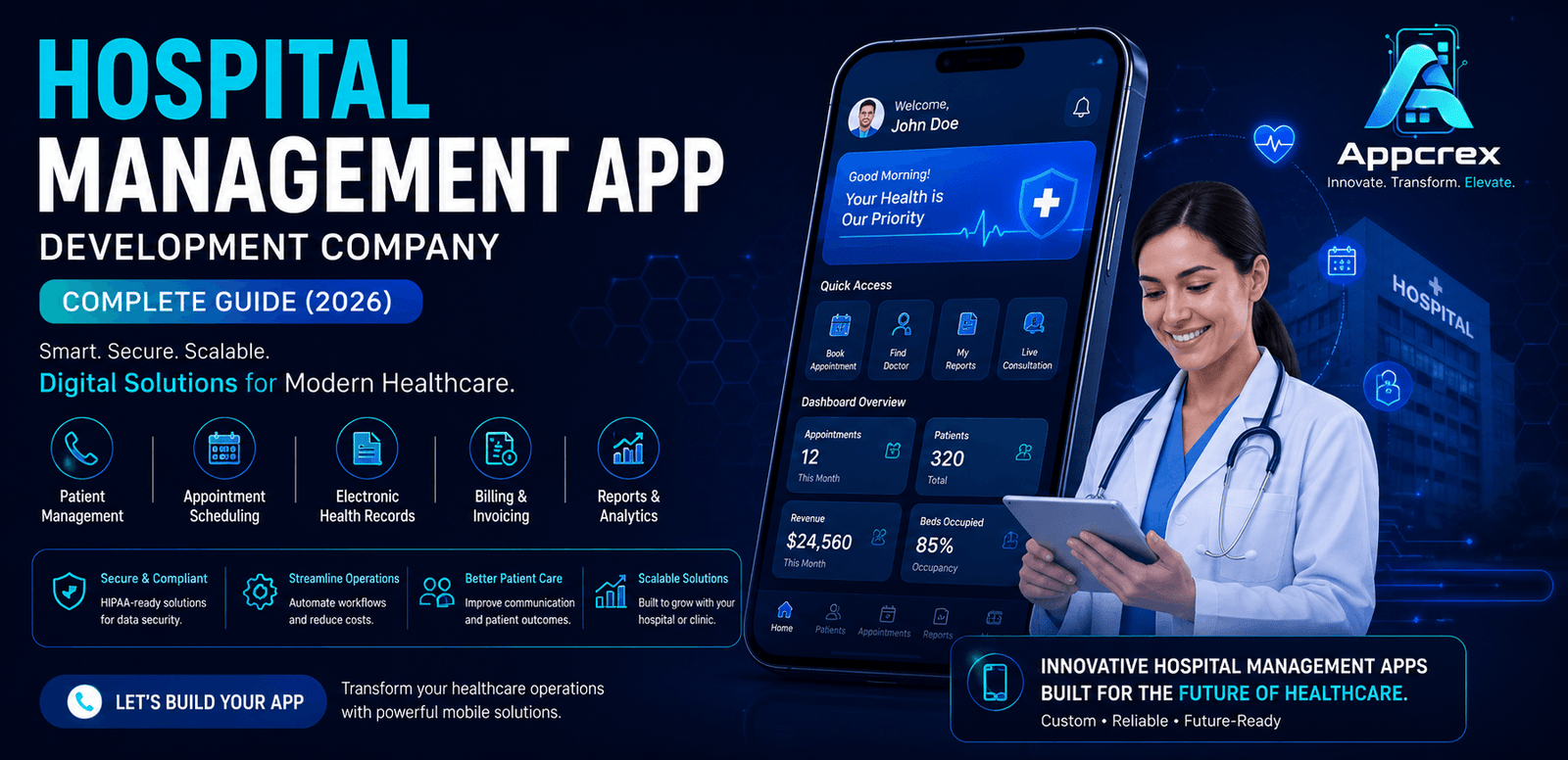
The healthcare industry is rapidly embracing digital transformation, and hospitals are leading the way by adopting smart technologies to improve patient care and streamline operations. A Hospital Management App helps hospitals manage appointments, patient records, billing, pharmacy, laboratory services, staff scheduling, and telemedicine through a single digital platform.
Whether you’re a private hospital, multi-specialty clinic, diagnostic centre, or healthcare startup, investing in a hospital management application can significantly improve efficiency while enhancing the patient experience.
As a trusted Hospital Management App Development Company, AppCrex builds secure, scalable, and HIPAA/GDPR-ready hospital management solutions tailored to the unique needs of healthcare providers worldwide.
What Is a Hospital Management App?
A Hospital Management App is a digital platform designed to automate hospital operations and simplify communication between patients, doctors, nurses, pharmacists, laboratory staff, and administrators.
Instead of relying on manual paperwork, hospitals can digitally manage:
- Patient Registration
- Doctor Appointments
- Electronic Health Records (EHR)
- Medical Billing
- Pharmacy Management
- Laboratory Reports
- Telemedicine
- Bed Management
- Staff Scheduling
- Inventory Management
- Insurance Claims
- Emergency Services
These applications reduce administrative workload while improving healthcare delivery and patient satisfaction.
Why Hospitals Need a Hospital Management App
Healthcare organisations manage thousands of daily operations. Without automation, hospitals often face challenges such as long waiting times, misplaced records, billing errors, and inefficient communication.
A hospital management app helps healthcare providers:
- Improve patient care
- Reduce paperwork
- Increase operational efficiency
- Automate hospital workflows
- Minimise human errors
- Enable digital patient records
- Enhance communication
- Increase staff productivity
- Improve revenue management
- Deliver better patient experiences
Key Features of a Hospital Management App
1. Patient Registration
- Digital Patient Profiles
- Medical History
- Insurance Details
- Contact Information
- Document Upload
2. Appointment Scheduling
Patients can:
- Book Appointments
- Choose Doctors
- Select Time Slots
- Receive Appointment Reminders
- Reschedule Visits
3. Doctor Dashboard
Doctors can:
- View Patient History
- Write Digital Prescriptions
- Access Lab Reports
- Update Medical Notes
- Manage Daily Appointments
4. Electronic Health Records (EHR)
Securely manage:
- Medical Reports
- Prescriptions
- Vaccination Records
- Lab Results
- Imaging Reports
- Treatment History
5. Telemedicine Integration
Enable virtual healthcare with:
- Video Consultations
- Voice Calls
- Secure Chat
- Online Prescriptions
- Digital Follow-ups
6. Pharmacy Management
Features include:
- Medicine Inventory
- Prescription Tracking
- Stock Alerts
- Billing Integration
- Medicine Availability
7. Laboratory Management
Manage:
- Test Requests
- Sample Tracking
- Digital Reports
- Report Sharing
- Laboratory Billing
8. Hospital Billing
Automate:
- Patient Billing
- Insurance Claims
- Payment Gateway Integration
- Invoice Generation
- Online Payments
9. Staff Management
Manage:
- Doctors
- Nurses
- Reception Staff
- Departments
- Shift Scheduling
- Attendance
10. Admin Dashboard
Hospital administrators can monitor:
- Revenue
- Patient Admissions
- Occupancy Rates
- Staff Performance
- Reports & Analytics
Advanced Features
Modern hospital management applications include advanced technologies like:
AI Chatbot
Answer patient questions instantly.
AI Appointment Scheduling
Automatically assign doctors based on availability.
Voice Search
Book appointments using voice commands.
Wearable Device Integration
Monitor patient health remotely.
AI Diagnostics
Assist doctors with data-driven insights.
ePrescription
Generate secure digital prescriptions.
Multi-Hospital Management
Manage multiple branches from one dashboard.
Ambulance Tracking
Real-time ambulance location.
Emergency Alerts
Instant notifications during emergencies.
Health Analytics Dashboard
Track KPIs using real-time data.
Benefits of Hospital Management App Development
Improved Patient Experience
Patients enjoy:
- Faster Appointments
- Reduced Waiting Time
- Digital Reports
- Online Billing
- Telemedicine Access
Increased Operational Efficiency
Automation reduces manual work and improves productivity.
Better Data Security
Healthcare apps use:
- Data Encryption
- Secure Authentication
- Access Control
- Cloud Backup
Reduced Operational Costs
Digital workflows lower paperwork, administrative expenses, and manual errors.
Faster Decision Making
Hospital administrators gain real-time insights through analytics dashboards.
Modules Included in Hospital Management Software
- Patient Management
- Doctor Management
- Nurse Management
- Appointment Management
- Laboratory Management
- Pharmacy Management
- Billing Management
- Insurance Management
- Inventory Management
- Emergency Management
- Telemedicine Module
- Reports & Analytics
- HR Management
- Payroll Management
Hospital Management App Development Process
Step 1: Requirement Analysis
Understand hospital workflows, compliance requirements, and business goals.
Step 2: UI/UX Design
Create intuitive interfaces for patients, doctors, and administrators.
Step 3: Development
Build secure Android, iOS, and web applications using modern technologies.
Step 4: API Integration
Integrate with:
- Payment Gateways
- EHR Systems
- Pharmacy Systems
- Laboratory Software
- SMS Services
- Video Calling APIs
Step 5: Testing
Perform:
- Functional Testing
- Security Testing
- Performance Testing
- Compliance Testing
- User Acceptance Testing
Step 6: Deployment
Launch the application on:
- Apple App Store
- Google Play Store
- Web Platform
Step 7: Maintenance
Provide ongoing:
- Bug Fixes
- Feature Updates
- Security Patches
- Performance Optimisation
Technologies We Use
Mobile Development
- React Native
- Flutter
- Swift
- Kotlin
Backend
- Node.js
- Laravel
- Python
- .NET
Database
- PostgreSQL
- MySQL
- MongoDB
- Firebase
Cloud
- AWS
- Microsoft Azure
- Google Cloud Platform
Healthcare Compliance & Security
A hospital management app must comply with healthcare regulations and security standards.
We build applications that support:
- HIPAA Compliance
- GDPR Compliance
- HL7 Integration
- FHIR Standards
- Role-Based Access Control (RBAC)
- Multi-Factor Authentication (MFA)
- End-to-End Encryption
- Secure Cloud Infrastructure
- Audit Logs
- Data Backup & Disaster Recovery
How Much Does Hospital Management App Development Cost?
The cost depends on the number of modules, integrations, compliance requirements, and overall complexity.
| App Type | Estimated Cost |
|---|---|
| Basic Hospital Management App | $20,000 – $40,000 |
| Medium Complexity Solution | $40,000 – $80,000 |
| Enterprise Hospital Management Platform | $80,000 – $250,000+ |
Cost Factors
- Number of Features
- Android/iOS/Web Platforms
- AI Integration
- Telemedicine
- EHR Integration
- Third-Party APIs
- Cloud Infrastructure
- Security & Compliance
- UI/UX Complexity
- Maintenance Requirements
Why Choose AppCrex as Your Hospital Management App Development Company?
AppCrex delivers secure, scalable, and future-ready healthcare solutions designed for hospitals, clinics, and healthcare providers.
Our Expertise Includes:
- Hospital Management App Development
- Telemedicine App Development
- Healthcare Software Development
- EHR/EMR Solutions
- AI Healthcare Applications
- HIPAA-Compliant Development
- Custom Healthcare CRM
- Patient Portal Development
- Medical Billing Software
- Pharmacy Management Systems
- Laboratory Information Systems
Frequently Asked Questions
How long does it take to develop a hospital management app?
A basic application typically takes 3–5 months, while an enterprise-grade solution with advanced modules may require 6–12 months, depending on complexity.
Is HIPAA compliance mandatory?
If your application stores or processes protected health information (PHI) for healthcare providers in the United States, HIPAA compliance is essential. Other regions may require standards such as GDPR or local healthcare regulations.
Can you integrate telemedicine into a hospital management app?
Yes. We can integrate secure video consultations, online appointment booking, e-prescriptions, digital payments, and patient messaging into your platform.
Which platforms do you support?
We develop hospital management applications for:
- Android
- iOS
- Web
- Tablet Devices
- Smart TVs (where applicable)
- Cross-platform solutions using React Native and Flutter
Can the app integrate with existing hospital systems?
Absolutely. We integrate with EHR/EMR systems, laboratory software, pharmacy management systems, insurance providers, payment gateways, wearable devices, and other third-party healthcare platforms.
Conclusion
A modern hospital management app is no longer just a convenience—it’s a critical tool for delivering efficient, patient-centred healthcare. From appointment scheduling and electronic health records to telemedicine and AI-powered analytics, the right solution can improve operational efficiency, enhance patient outcomes, and support long-term digital transformation.
At AppCrex, we specialise in developing secure, scalable, and compliant healthcare applications tailored to the needs of hospitals, clinics, and healthcare organisations. Whether you’re building a new platform or modernising an existing system, our team delivers end-to-end Hospital Management App Development services that help your organisation stay ahead in the evolving healthcare landscape.