📌 Key Takeaways
- Seamless interoperability reduces manual data entry and administrative workloads.
- Healthcare providers can improve operational efficiency and patient outcomes.
- EHR integration costs vary depending on system complexity and API requirements.
- AI and automation are transforming fintech apps by improving personalization, security, and customer engagement.
- AppCrex develops secure, scalable, and compliant EHR integration solutions.
Introduction
The healthcare industry is becoming increasingly digital. Hospitals, clinics, diagnostic centers, telemedicine providers, and healthcare organizations are generating vast amounts of patient data every day. However, when this information is stored across disconnected systems, healthcare professionals often struggle to access accurate and up-to-date patient records.
This is where Electronic Health Records (EHR) Integration plays a crucial role.
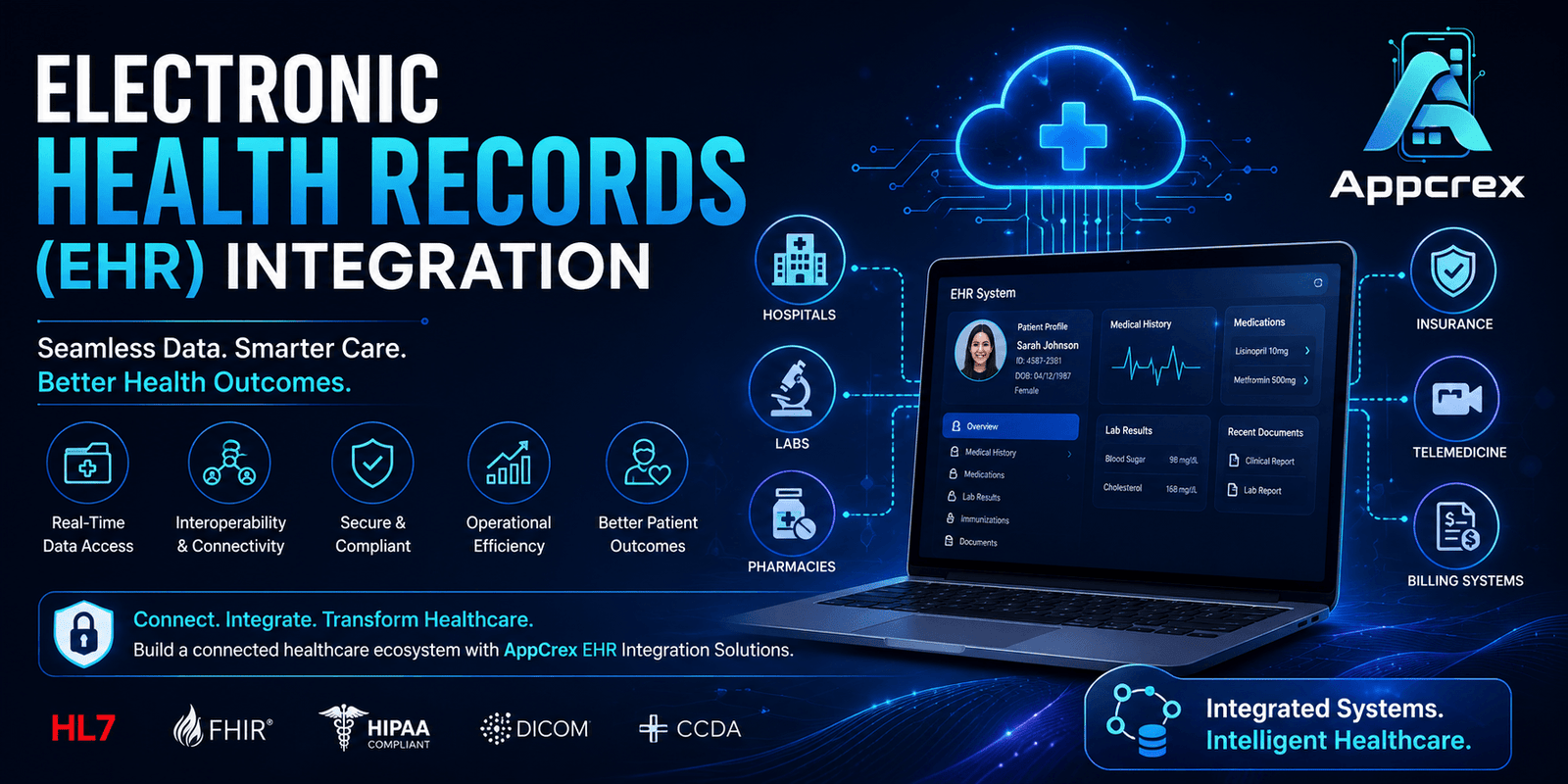
EHR integration enables healthcare systems, applications, and software platforms to securely exchange patient information in real time. By connecting Electronic Health Record systems with healthcare applications, providers gain a unified view of patient data, improve care coordination, reduce administrative burdens, and enhance patient outcomes.
At AppCrex, we help healthcare organizations build secure, scalable, and compliant EHR integration solutions that streamline workflows and support digital transformation initiatives.
In this guide, we’ll explore everything you need to know about Electronic Health Records (EHR) Integration, including benefits, integration methods, development process, costs, challenges, and future trends.
What is Electronic Health Records (EHR) Integration?
Electronic Health Records (EHR) Integration is the process of connecting EHR systems with other healthcare applications, software platforms, medical devices, and third-party services to enable seamless data exchange.
Instead of manually transferring information between systems, integrated EHR solutions automatically synchronize patient data across healthcare ecosystems.
Common integrations include:
- Telemedicine Platforms
- Patient Portals
- Healthcare Mobile Apps
- Billing Systems
- Laboratory Information Systems
- Pharmacy Management Systems
- Insurance Platforms
- Medical Devices
- CRM Software
- Practice Management Systems
The primary goal is to ensure healthcare providers have timely access to accurate patient information whenever it’s needed.
Why EHR Integration is Important
Healthcare organizations rely on multiple software systems to manage operations.
Without integration, providers often face:
- Data Silos
- Duplicate Records
- Manual Data Entry
- Communication Delays
- Increased Errors
- Poor Patient Experiences
EHR integration solves these challenges by creating a connected healthcare ecosystem.
Improved Patient Care
Providers can access comprehensive patient records in real time.
Enhanced Clinical Decision Making
Accurate data enables better diagnoses and treatment plans.
Increased Operational Efficiency
Automation reduces administrative workloads.
Better Care Coordination
Healthcare teams can collaborate more effectively across departments.
Reduced Costs
Eliminating redundant processes lowers operational expenses.
Benefits of Electronic Health Records (EHR) Integration
Real-Time Data Access
Healthcare professionals can instantly access:
- Patient Histories
- Diagnoses
- Medications
- Lab Results
- Treatment Plans
Improved Patient Experience
Patients receive faster and more personalized healthcare services.
Reduced Administrative Work
Automation minimizes manual data entry and repetitive tasks.
Better Data Accuracy
Integrated systems reduce errors caused by duplicate or outdated records.
Enhanced Compliance
EHR integrations help maintain healthcare data security and regulatory compliance.
Streamlined Workflows
Healthcare organizations can optimize clinical and administrative processes.
Types of EHR Integration
Patient Portal Integration
Allows patients to:
- Access Medical Records
- View Test Results
- Schedule Appointments
- Communicate with Providers
Telemedicine Integration
Supports virtual healthcare delivery through:
- Video Consultations
- Patient Monitoring
- Digital Prescriptions
Billing & Insurance Integration
Connects EHR systems with financial platforms.
Benefits include:
- Faster Claims Processing
- Payment Tracking
- Insurance Verification
Laboratory Integration
Automatically syncs:
- Lab Orders
- Test Results
- Diagnostic Reports
Pharmacy Integration
Supports:
- Prescription Management
- Medication Tracking
- Refill Requests
Mobile Health App Integration
Connects patient-facing mobile applications with EHR systems.
Common EHR Systems Used Worldwide
Healthcare providers commonly use:
- Epic
- Cerner
- Athenahealth
- Allscripts
- eClinicalWorks
- NextGen Healthcare
- Meditech
- Practice Fusion
At AppCrex, we develop integrations with leading EHR platforms and custom healthcare systems.
Key Features of EHR Integration Solutions
Secure Data Exchange
Protect patient information through:
- Encryption
- Authentication
- Access Controls
API Connectivity
Enable seamless communication between systems.
Also Read : What Is API Integration? A Complete Guide to Benefits, Types & Best Practices (2026)
Data Synchronization
Ensure information remains updated across platforms.
Role-Based Access
Control access based on user responsibilities.
Audit Trails
Track system activities for compliance and security.
Reporting & Analytics
Generate insights from integrated healthcare data.
EHR Integration Standards
Healthcare interoperability relies on industry standards.
HL7
One of the most widely used healthcare data exchange standards.
FHIR (Fast Healthcare Interoperability Resources)
Modern API-based standard designed for healthcare interoperability.
Benefits include:
- Faster Integration
- Better Scalability
- Real-Time Data Exchange
DICOM
Used for medical imaging data.
CDA
Supports clinical document sharing.
Modern healthcare applications increasingly use FHIR due to its flexibility and API-driven architecture.
EHR Integration Development Process
At AppCrex, we follow a structured approach for healthcare integration projects.
Step 1: Requirements Analysis
Identify:
- Business Goals
- Data Requirements
- Compliance Needs
- Integration Scope
Step 2: System Assessment
Evaluate existing healthcare infrastructure.
Step 3: Architecture Design
Design secure and scalable integration frameworks.
Step 4: API Development & Integration
Connect healthcare systems using modern APIs and interoperability standards.
Step 5: Testing
Conduct:
- Functional Testing
- Security Testing
- Performance Testing
- Interoperability Validation
Step 6: Deployment
Launch integration solutions in production environments.
Step 7: Ongoing Maintenance
Provide:
- Monitoring
- Updates
- Security Improvements
- Technical Support
Technologies Used in EHR Integration
Frontend Technologies
- React
- Angular
- Vue.js
Backend Technologies
- Node.js
- Python
- Django
- .NET
- Laravel
Healthcare Standards
- HL7
- FHIR
- DICOM
Databases
- PostgreSQL
- MySQL
- MongoDB
Cloud Platforms
- AWS
- Microsoft Azure
- Google Cloud
EHR Integration Cost
The cost of EHR integration depends on:
- Number of Systems
- Data Complexity
- API Availability
- Security Requirements
- Compliance Standards
Basic Integration
Estimated Cost: $10,000 – $30,000
Mid-Level Integration
Estimated Cost: $30,000 – $100,000
Enterprise Healthcare Integration
Estimated Cost: $100,000 – $500,000+
AI-Powered Healthcare Ecosystem
Estimated Cost: $150,000 – $750,000+
Challenges in EHR Integration
Data Security Risks
Healthcare data requires advanced protection.
Legacy Systems
Older healthcare systems often lack modern APIs.
Compliance Requirements
Organizations must adhere to strict healthcare regulations.
Data Standardization
Different systems may use varying data formats.
Scalability
Growing healthcare networks require flexible integration solutions.
AI and the Future of EHR Integration
Artificial Intelligence is transforming healthcare interoperability.
AI-Powered Data Mapping
Automates data conversion and synchronization.
Predictive Analytics
Supports proactive healthcare decision-making.
Intelligent Clinical Insights
Analyzes patient data to identify trends and risks.
Healthcare Virtual Assistants
Improve patient engagement and support.
Automated Documentation
Reduce administrative burdens through AI-generated records.
Why Choose AppCrex for Electronic Health Records (EHR) Integration?
AppCrex specializes in healthcare software development and interoperability solutions.
Our EHR Integration Services Include:
- EHR Integration Development
- FHIR API Development
- HL7 Integration
- Telemedicine Integration
- Patient Portal Integration
- Healthcare Mobile App Development
- CRM & EHR Integration
- Healthcare Analytics Solutions
- Cloud-Based Healthcare Platforms
- Ongoing Maintenance & Support
Our healthcare technology experts help organizations build secure, compliant, and scalable integration ecosystems that improve efficiency and patient outcomes.
Also Read : Healthcare CRM Software Development: Complete Guide to Features, Benefits, Cost & AI Integration
Frequently Asked Questions
What is EHR Integration?
EHR Integration connects Electronic Health Record systems with healthcare applications and services to enable seamless data sharing and interoperability.
Why is EHR integration important?
It improves patient care, reduces administrative work, enhances data accuracy, and supports better clinical decision-making.
What is FHIR in healthcare?
FHIR (Fast Healthcare Interoperability Resources) is a modern healthcare standard that enables secure and efficient data exchange between systems.
How much does EHR integration cost?
Costs typically range from $10,000 to $500,000+ depending on project complexity and integration requirements.
How long does EHR integration take?
Basic integrations may take a few weeks, while enterprise-level healthcare integrations can take several months.
Does AppCrex provide custom EHR integration services?
Yes. AppCrex develops custom EHR integration solutions for hospitals, clinics, healthcare startups, telemedicine providers, and enterprise healthcare organizations.
Final Thoughts
Electronic Health Records (EHR) Integration has become a critical component of modern healthcare infrastructure. By connecting healthcare systems, improving interoperability, and enabling real-time access to patient information, EHR integration helps organizations deliver better care while improving operational efficiency.
As healthcare continues to embrace digital transformation, organizations that invest in secure and scalable EHR integration solutions will be better positioned to improve patient outcomes, reduce costs, and support future innovation.
Looking for a trusted EHR Integration partner? Contact AppCrex today and discover how our healthcare technology experts can help you build a connected healthcare ecosystem.