📌 Key Takeaways
- Boost User Engagement: Push notifications help re-engage users with timely, personalized messages.
- Choose the Right Notification Type: Use transactional, promotional, reminder, and behavioral notifications based on your goals.
- Personalize Every Message: Targeted notifications improve open rates, conversions, and user satisfaction.
- Time Your Notifications Wisely: Sending messages at the right time increases engagement and reduces opt-outs.
- Track and Optimize Performance: Monitor delivery, open rates, CTR, and conversions to continually improve your push notification strategy.
In today’s digital world, grabbing a user’s attention has become more challenging than ever. With thousands of apps competing for engagement, businesses need an effective way to reconnect with users, increase retention, and drive conversions. This is where push notifications play a crucial role.
Whether it’s reminding customers about abandoned carts, announcing a flash sale, confirming an appointment, or sharing personalized recommendations, push notifications enable businesses to deliver timely and relevant messages directly to users’ devices.
When used strategically, push notifications can significantly improve customer engagement, encourage repeat visits, boost sales, and strengthen brand loyalty. However, sending too many irrelevant notifications can have the opposite effect, leading users to disable notifications or uninstall the app.
What Are Push Notifications?
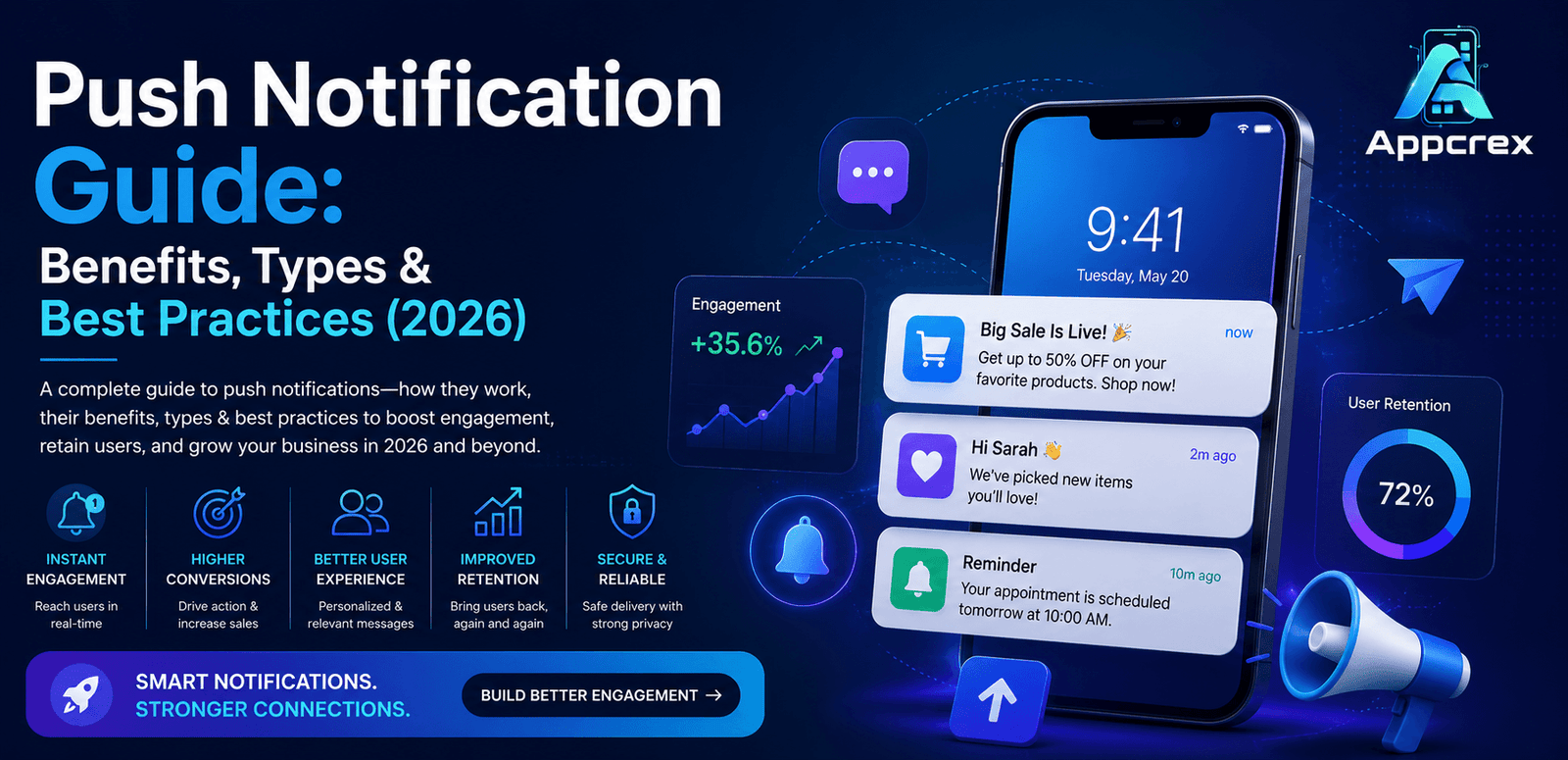
Push notifications are short, clickable messages sent directly to a user’s smartphone, tablet, desktop, or web browser—even when the application isn’t actively open.
Unlike emails or SMS messages, push notifications appear instantly on a user’s device, making them one of the most effective communication channels for businesses.
These notifications can include:
- Promotional offers
- Order updates
- Appointment reminders
- Payment confirmations
- Breaking news
- Personalized recommendations
- Security alerts
- Event notifications
Push notifications help businesses maintain regular communication with users while encouraging them to return to the app or website.
How Do Push Notifications Work?
Push notifications rely on a communication process between an application, a notification service, and the user’s device.
Step 1: User Grants Permission
The user installs the application or visits a website and allows notifications.
Step 2: Device Registration
The device registers with a push notification service and receives a unique token.
Step 3: Notification Creation
The business creates a notification through its admin dashboard or automated system.
Step 4: Delivery
The notification service delivers the message to the user’s device.
Step 5: User Interaction
The user views the notification and can tap it to open a specific screen, offer, or action within the app.
This process happens in just a few seconds, making push notifications one of the fastest ways to reach users.
Benefits of Push Notifications
Push notifications offer far more than simple alerts. They help businesses engage users, improve customer experiences, and increase revenue.
1. Higher User Engagement
Push notifications encourage users to return to your application by delivering timely and relevant updates.
Examples include:
- New product launches
- Limited-time discounts
- Content updates
- Personalized recommendations
2. Increased Customer Retention
Regular communication helps keep users engaged over time.
Sending valuable reminders and personalized content reduces app abandonment and improves retention rates.
3. Improved Conversion Rates
Well-timed notifications can encourage users to complete purchases, book appointments, or subscribe to premium services.
Common examples include:
- Abandoned cart reminders
- Flash sales
- Limited-time offers
- Renewal reminders
4. Personalized User Experience
Modern push notification platforms use customer behavior, preferences, location, and purchase history to deliver highly relevant messages.
Examples:
- Recommended products
- Birthday offers
- Location-based promotions
- Personalized content
5. Real-Time Communication
Businesses can instantly notify users about important updates, including:
- Order confirmations
- Delivery tracking
- Payment success
- Account security alerts
- Appointment reminders
6. Cost-Effective Marketing
Compared to SMS and email campaigns, push notifications offer an affordable way to reach users while delivering excellent engagement rates.
7. Better Customer Experience
Relevant and timely notifications improve customer satisfaction by keeping users informed without requiring them to actively check the app.
Types of Push Notifications
Not all push notifications serve the same purpose. Businesses use different notification types depending on their goals and user interactions.
1. Promotional Notifications
Designed to drive sales and increase conversions.
Examples:
- Holiday discounts
- Flash sales
- Coupon codes
- Product launches
2. Transactional Notifications
These provide essential updates related to user actions.
Examples include:
- Payment confirmation
- Order status
- Booking confirmation
- Delivery updates
3. Reminder Notifications
Reminder notifications help users complete important tasks.
Examples:
- Appointment reminders
- Subscription renewals
- Bill payment reminders
- Event reminders
4. Behavioral Notifications
Triggered automatically based on user activity.
Examples:
- Abandoned cart reminders
- Inactive user reminders
- Recently viewed products
- Personalized recommendations
5. Location-Based Notifications
These notifications are triggered when users enter a specific geographic location.
Examples:
- Nearby store offers
- Restaurant promotions
- Local event updates
- Branch-specific announcements
6. Rich Push Notifications
Rich notifications include multimedia elements such as:
- Images
- GIFs
- Videos
- Product previews
- Interactive buttons
Rich notifications generally achieve higher engagement than text-only messages.
7. Silent Push Notifications
Silent notifications update application content in the background without displaying a visible alert.
Common uses include:
- Data synchronization
- App updates
- Content refresh
- Background processing
Push Notification Best Practices
Implementing push notifications is easy, but making them effective requires the right strategy. Follow these best practices to improve engagement and avoid overwhelming your users.
1. Personalize Every Notification
Generic messages are often ignored. Use user data such as name, location, browsing history, and purchase behavior to create personalized notifications.
Example:
- Hi Sarah! Your favorite sneakers are back in stock.
2. Send Notifications at the Right Time
Timing plays a critical role in notification performance. Analyze user activity and send messages when users are most likely to engage.
Best Practice:
- Avoid sending notifications late at night or during working hours unless they are urgent.
3. Keep Messages Short and Clear
Users should understand your message within a few seconds.
Good Example:
- 🎉 Get 20% Off Today Only! Shop Now.
4. Segment Your Audience
Different users have different interests. Divide your audience into segments based on:
- Location
- Purchase history
- Interests
- Device type
- User activity
- Subscription plan
Segmentation improves relevance and increases click-through rates.
5. Include a Clear Call-to-Action (CTA)
Every notification should encourage users to take a specific action.
Examples:
- Shop Now
- Book Appointment
- Read More
- Claim Offer
- Update App
6. Don’t Send Too Many Notifications
Sending excessive notifications can frustrate users and lead them to disable notifications or uninstall the app.
Recommended Frequency:
- 2–5 notifications per week (adjust based on your industry and user preferences).
7. Use Rich Media
Enhance notifications with:
- Images
- GIFs
- Product photos
- Videos
- Action buttons
Rich notifications typically attract more attention than plain text.
8. Test and Optimize
Continuously monitor notification performance and experiment with different headlines, CTAs, send times, and audience segments.
Track metrics such as:
- Open Rate
- Click-Through Rate (CTR)
- Conversion Rate
- Opt-Out Rate
Push Notification Examples
Here are some examples across different industries.
eCommerce
Sale Alert
🔥 Flash Sale! Save 30% on all electronics. Offer ends tonight.
Abandoned Cart
You left items in your cart. Complete your purchase and enjoy free shipping.
Healthcare
Appointment Reminder
Your appointment with Dr. Smith is tomorrow at 10:30 AM.
Medication Reminder
It’s time to take your evening medication.
Food Delivery
🍕 Your order is on the way! Track your delivery in real time.
Banking & FinTech
₹5,000 has been credited to your account.
Travel
Your flight to Dubai is scheduled to depart in 3 hours. Check in now.
Education
Your live class begins in 15 minutes. Join now.
Industries That Benefit from Push Notifications
Almost every industry can use push notifications to improve customer engagement and communication.
eCommerce
- Flash sales
- Order updates
- Product recommendations
- Cart reminders
Healthcare
- Appointment reminders
- Telemedicine alerts
- Prescription notifications
- Health tips
Finance
- Payment alerts
- Fraud detection
- Investment updates
- Account activity
Education
- Assignment reminders
- Course updates
- Exam schedules
- Learning recommendations
Travel & Hospitality
- Booking confirmations
- Flight updates
- Hotel check-in reminders
- Travel offers
Food Delivery
- Order confirmation
- Delivery tracking
- Restaurant promotions
- Loyalty rewards
Real Estate
- Property alerts
- New listings
- Appointment reminders
- Price drop notifications
SaaS Businesses
- Feature releases
- Subscription renewals
- Product updates
- Onboarding reminders
Common Push Notification Mistakes to Avoid
Avoid these mistakes to maximize the effectiveness of your push notification strategy.
1. Sending Too Many Notifications
Bombarding users with constant alerts can result in notification fatigue and app uninstalls.
2. Poor Timing
Sending notifications at inconvenient times often leads to lower engagement and higher opt-out rates.
3. Generic Messaging
One-size-fits-all messages fail to capture user interest. Personalization significantly improves engagement.
4. Weak Call-to-Action
Without a clear CTA, users may not know what action to take next.
5. Ignoring Analytics
Regularly reviewing notification performance helps identify what works and where improvements are needed.
Push Notification Trends in 2026
Businesses are using AI and automation to make notifications smarter and more relevant.
1. AI-Powered Personalization
Artificial Intelligence analyzes user behavior to deliver highly targeted notifications.
2. Predictive Notifications
AI predicts user needs and sends notifications before users take action.
3. Interactive Notifications
Users can reply, approve, book, or purchase directly from a notification without opening the app.
5. Rich Media Notifications
Images, videos, GIFs, and interactive elements continue to improve engagement.
6. Cross-Channel Messaging
Businesses combine push notifications with email, SMS, and in-app messaging to create a seamless customer experience.
Also Read : What is SaaS Application Development? A Complete Guide (2026)
Why Choose AppCrex for Push Notification Integration?
At AppCrex, we help businesses implement intelligent push notification systems that increase user engagement and improve customer retention.
Our services include:
- Custom push notification integration
- Android & iOS implementation
- Firebase Cloud Messaging (FCM) setup
- Apple Push Notification service (APNs) integration
- Audience segmentation
- Personalized notification campaigns
- Analytics and performance tracking
- Ongoing support and optimization
Whether you’re developing a new mobile application or enhancing an existing one, our team delivers secure, scalable, and high-performing push notification solutions tailored to your business goals.
Conclusion
Push notifications remain one of the most effective ways to engage users, drive conversions, and build long-term customer relationships. When delivered at the right time with personalized content and a clear call-to-action, they can significantly improve app retention and user satisfaction.
By following best practices, leveraging AI-driven personalization, and continuously analyzing performance, businesses can create notification strategies that deliver real value instead of overwhelming users.
If you’re looking to integrate a robust push notification system into your mobile app, partnering with an experienced development company like AppCrex ensures a seamless implementation that supports your growth objectives.
Frequently Asked Questions (FAQs)
1. What is a push notification?
A push notification is a short message sent directly to a user’s mobile device or web browser to provide updates, reminders, promotions, or alerts.
2. Are push notifications better than email?
Push notifications typically have higher open rates and deliver messages instantly, making them ideal for time-sensitive communication. Email is better suited for longer-form content.
3. How often should I send push notifications?
The ideal frequency depends on your audience and industry, but sending 2–5 relevant notifications per week is a good starting point.
4. Can push notifications be personalized?
Yes. Businesses can personalize notifications using user behavior, location, preferences, and purchase history to improve engagement.
5. Which industries benefit the most from push notifications?
eCommerce, healthcare, finance, education, travel, food delivery, real estate, and SaaS businesses all benefit significantly from push notifications.
6. Which platforms support push notifications?
Push notifications can be implemented on Android, iOS, web browsers, desktops, tablets, and wearable devices.
Ready to Boost User Engagement?
Whether you’re building a new app or improving an existing one, AppCrex can help you implement secure, scalable, and personalized push notification solutions. Contact our team today to create a notification strategy that keeps users engaged, improves retention, and drives business growth.