📌 Key Takeaways
- Multi-agent AI enables multiple AI agents to work together efficiently.
- Automates complex workflows and improves business productivity.
- Scales easily as your business and AI needs grow.
- Enhances decision-making through intelligent collaboration.
- AppCrex builds secure, scalable, and custom multi-agent AI solutions.
Introduction
Artificial Intelligence has evolved rapidly over the last few years, moving beyond simple chatbots and virtual assistants to highly autonomous systems capable of solving complex business problems. In 2026, one of the biggest advancements in enterprise AI is Multi-Agent AI Development. Instead of relying on a single AI model to perform every task, businesses are adopting multiple AI agents that collaborate, communicate, and coordinate to achieve shared goals.
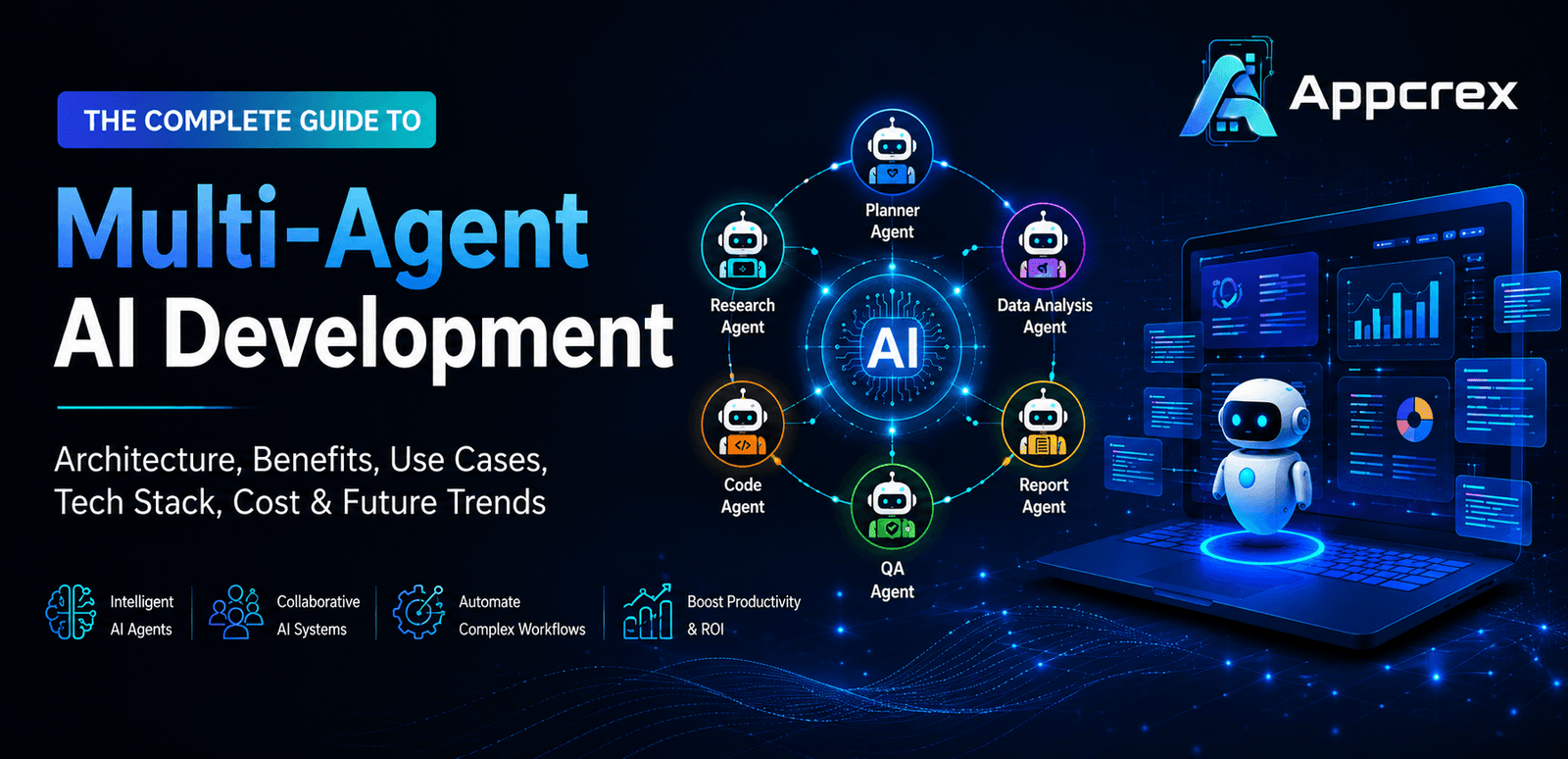
A Multi-Agent AI system consists of several intelligent agents, each designed with specialized skills. One agent may analyze data, another may conduct research, a third may generate reports, while another interacts with customers. Together, these agents create an intelligent ecosystem that is more scalable, accurate, and efficient than a single AI assistant.
Organizations across healthcare, finance, manufacturing, logistics, retail, education, and customer service are investing in Multi-Agent AI solutions to automate workflows, improve decision-making, reduce operational costs, and increase productivity. As Large Language Models (LLMs), Retrieval-Augmented Generation (RAG), Model Context Protocol (MCP), and advanced AI orchestration frameworks continue to evolve, Multi-Agent AI is becoming a key driver of enterprise digital transformation.
This comprehensive guide explores everything you need to know about Multi-Agent AI Development, including its architecture, components, benefits, use cases, technology stack, development process, estimated costs, challenges, and future trends for 2026.
What is Multi-Agent AI Development?
Multi-Agent AI Development is the process of designing and building intelligent systems where multiple autonomous AI agents work together to accomplish tasks that would be difficult or inefficient for a single AI agent.
Unlike traditional AI applications that rely on one model to handle all requests, Multi-Agent AI systems divide responsibilities among specialized agents. Each agent is assigned a specific role, enabling the system to solve complex problems more efficiently.
For example, imagine an AI-powered customer support platform:
- One AI agent receives customer requests.
- Another agent retrieves relevant information from company documents.
- A third agent determines the best solution.
- Another agent drafts the response.
- A quality assurance agent verifies accuracy before the response is sent.
This collaborative approach improves response quality, speeds up workflows, and reduces errors.
Multi-Agent AI systems can operate independently or under the supervision of a central orchestration engine, depending on business requirements.
Key Characteristics of Multi-Agent AI Systems
A well-designed Multi-Agent AI solution typically includes the following characteristics:
Autonomous Decision-Making
Each AI agent can make decisions independently within its assigned responsibilities, reducing reliance on centralized processing.
Collaboration
Agents continuously exchange information and coordinate with one another to achieve common objectives.
Specialization
Instead of performing every task, each AI agent focuses on a specific function such as planning, coding, research, reasoning, customer communication, or quality assurance.
Scalability
Organizations can easily add or remove AI agents as business requirements evolve without redesigning the entire system.
Continuous Learning
Modern AI agents can improve performance over time by leveraging feedback, historical interactions, and updated knowledge sources.
Why Multi-Agent AI Matters in 2026?
As businesses become more data-driven and digitally connected, managing complex workflows with a single AI model becomes increasingly challenging. Multi-Agent AI addresses these limitations by distributing tasks among multiple specialized agents, enabling faster decision-making, improved collaboration, and greater scalability.
Several factors are driving the rapid adoption of Multi-Agent AI in 2026:
Growing Enterprise Automation
Organizations are automating end-to-end business processes rather than isolated tasks. Multi-Agent AI enables different agents to handle research, analysis, approvals, reporting, and execution simultaneously.
More Powerful Large Language Models
Modern LLMs such as GPT, Claude, Gemini, and Llama provide advanced reasoning capabilities. Multi-Agent architectures leverage these models for specialized roles instead of relying on a single model for every function.
Increased Demand for AI Workflows
Businesses now require AI systems capable of managing complete workflows rather than simply answering questions. Multi-Agent AI supports planning, task delegation, collaboration, and execution across departments.
Improved Customer Experience
Organizations can deliver faster, more personalized customer experiences by assigning dedicated AI agents to customer support, recommendations, billing, and follow-up communications.
Lower Operational Costs
By automating repetitive business operations, companies reduce manual effort, minimize errors, and improve overall operational efficiency.
Single-Agent AI vs Multi-Agent AI
Understanding the difference between Single-Agent AI and Multi-Agent AI is essential before planning an enterprise AI solution.
| Feature | Single-Agent AI | Multi-Agent AI |
|---|---|---|
| Number of AI Agents | One | Multiple |
| Task Execution | Performs all tasks alone | Tasks are distributed among specialized agents |
| Collaboration | Not available | Agents communicate and collaborate |
| Scalability | Limited | Highly scalable |
| Performance | Suitable for simple workflows | Excellent for complex workflows |
| Decision Making | Centralized | Distributed |
| Fault Tolerance | Lower | Higher |
| Enterprise Automation | Limited | Excellent |
| Productivity | Moderate | High |
For simple applications like FAQ chatbots or content generation tools, a single AI agent may be sufficient. However, enterprises dealing with large-scale operations, cross-functional workflows, and complex decision-making benefit significantly from Multi-Agent AI systems.
Also Read : AI App Development Guide: Features, Cost & Process (2026)
How Multi-Agent AI Systems Work?
A Multi-Agent AI system follows a structured workflow where multiple intelligent agents collaborate to solve problems efficiently.
A typical workflow looks like this:
- A user submits a request through a web application, mobile app, or enterprise platform.
- A coordinator or orchestrator agent analyzes the request and assigns tasks.
- Specialized AI agents execute their assigned responsibilities.
- Agents communicate with each other and share intermediate results.
- Information is validated and combined into a final output.
- The completed response is delivered to the user or integrated into business workflows.
This distributed architecture allows organizations to handle multiple tasks simultaneously while maintaining high accuracy and reliability.
Multi-Agent AI Architecture
A robust Multi-Agent AI system consists of several interconnected layers, each responsible for a specific function.
Agent Layer
The Agent Layer contains specialized AI agents responsible for completing individual tasks. Examples include:
- Research Agent
- Customer Support Agent
- Data Analysis Agent
- Coding Agent
- Content Generation Agent
- Quality Assurance Agent
- Planning Agent
- Reporting Agent
Each agent operates independently while collaborating with others when necessary.
Orchestration Layer
The Orchestration Layer acts as the central coordinator. It manages task distribution, monitors agent performance, resolves conflicts, and ensures that workflows are completed efficiently.
Popular orchestration frameworks include LangGraph, CrewAI, Microsoft AutoGen, and Semantic Kernel.
Communication Layer
Agents exchange messages, share context, and synchronize tasks through the communication layer. This ensures seamless collaboration and prevents duplicate work.
Memory Layer
The Memory Layer stores:
- Previous conversations
- Workflow history
- Business rules
- Customer preferences
- Contextual information
Persistent memory enables AI agents to make better decisions over time.
Core Components of a Multi-Agent AI System
A successful Multi-Agent AI solution relies on several interconnected components that enable AI agents to work collaboratively while maintaining efficiency, security, and scalability. Understanding these components is essential for businesses planning enterprise AI adoption.
AI Agents
AI agents are the foundation of a Multi-Agent AI system. Each agent is designed to perform a specific responsibility rather than attempting to handle an entire workflow independently.
For example, an enterprise customer support platform may include:
- Customer Support Agent
- Knowledge Retrieval Agent
- Ticket Classification Agent
- Billing Agent
- Translation Agent
- Quality Assurance Agent
- Escalation Agent
Since each agent specializes in a particular task, the overall system delivers higher accuracy and faster response times.
Large Language Models (LLMs)
Most Multi-Agent AI platforms are powered by advanced Large Language Models (LLMs). These models provide reasoning, natural language understanding, content generation, summarization, and decision-making capabilities.
Popular LLMs include:
- OpenAI GPT
- Claude
- Google Gemini
- Meta Llama
- Mistral AI
- DeepSeek
Also Read : Large Language Model (LLM) Integration Services: Complete Guide to Benefits, Process, Cost & Use Cases
Many enterprises combine multiple LLMs, assigning different models to different agents based on performance, cost, or task complexity.
AI Orchestrator
The orchestrator acts as the project manager of the entire Multi-Agent ecosystem.
Its responsibilities include:
- Assigning tasks to appropriate agents
- Monitoring workflow progress
- Managing communication between agents
- Preventing duplicate work
- Handling failures
- Prioritizing urgent requests
Without orchestration, multiple AI agents would struggle to coordinate effectively.
Memory Management
Memory enables AI agents to retain context beyond a single interaction.
There are generally three types of memory used in enterprise Multi-Agent AI systems:
Short-Term Memory
Stores information related to the current task or conversation.
Example:
A customer continues asking questions during the same support session.
Long-Term Memory
Stores historical information that helps personalize future interactions.
Examples include:
- Customer preferences
- Previous support tickets
- Business workflows
- User behavior
- Company policies
Allows multiple AI agents to access the same information repository.
For example:
If a Research Agent gathers market data, the Report Generation Agent and Decision Agent can immediately access the same information without repeating the research process.
Knowledge Base and RAG
Most enterprise AI systems require access to company-specific information.
Instead of relying solely on LLM knowledge, businesses implement Retrieval-Augmented Generation (RAG), allowing AI agents to retrieve real-time information from:
- Internal documents
- PDFs
- Knowledge bases
- CRMs
- ERP systems
- Wikis
- Databases
- APIs
This significantly improves response accuracy while reducing hallucinations.
Tool Integration
Modern AI agents rarely operate in isolation.
They interact with external tools such as:
- CRM platforms
- Email systems
- Slack
- Microsoft Teams
- Payment gateways
- ERP software
- Calendar applications
- Analytics dashboards
- Cloud storage
Tool integration transforms AI agents from simple conversational assistants into autonomous business assistants capable of completing real tasks.
Human-in-the-Loop (HITL)
Although AI has become highly capable, certain business processes still require human approval.
Human-in-the-Loop enables organizations to maintain governance by allowing employees to review critical actions before execution.
Examples include:
- Financial approvals
- Legal document generation
- Healthcare recommendations
- High-value sales proposals
- HR decisions
This approach improves trust while minimizing business risks.
Benefits of Multi-Agent AI Development
Organizations across industries are adopting Multi-Agent AI because it offers significant operational and financial advantages over traditional AI systems.
Improved Productivity
Instead of waiting for one AI model to complete multiple tasks sequentially, specialized agents work simultaneously.
For example:
- One agent performs research.
- Another analyzes data.
- A third drafts content.
- Another reviews quality.
This parallel execution dramatically reduces turnaround time.
Better Decision-Making
Multiple AI agents contribute different perspectives before reaching a conclusion.
For example:
A finance AI system may involve:
- Risk Assessment Agent
- Compliance Agent
- Market Analysis Agent
- Investment Recommendation Agent
The final recommendation becomes more reliable because it incorporates multiple expert evaluations.
Higher Accuracy
Specialized AI agents are generally more accurate than a single general-purpose assistant.
Each agent focuses on one domain, reducing confusion and minimizing hallucinations.
Scalability
As business requirements grow, organizations can simply add more specialized agents without rebuilding the entire platform.
Examples include:
- Fraud Detection Agent
- Compliance Agent
- Marketing Agent
- Inventory Agent
- Recruitment Agent
This modular architecture supports continuous expansion.
Faster Automation
Multiple agents working simultaneously significantly accelerate business processes.
For example, an insurance claim that previously required several days can now be processed within minutes using multiple collaborating AI agents.
Reduced Operational Costs
Businesses can automate repetitive and time-consuming activities such as:
- Data entry
- Document processing
- Customer support
- Report generation
- Workflow management
- Scheduling
- Internal approvals
This reduces labor costs while improving operational efficiency.
Continuous Availability
Unlike human teams, AI agents operate 24/7.
Organizations benefit from:
- Instant responses
- Global customer support
- Automated monitoring
- Continuous reporting
- Real-time analytics
Personalized Customer Experiences
Different AI agents collaborate to understand customer preferences and deliver tailored recommendations.
For example:
- Recommendation Agent
- Customer History Agent
- Pricing Agent
- Support Agent
Together, they create a highly personalized customer journey.
Real-World Use Cases of Multi-Agent AI
Multi-Agent AI is no longer a future concept. It is actively transforming businesses across industries.
Customer Support Automation
Customer service is one of the most common applications.
Typical workflow:
- Inquiry Agent receives customer requests.
- Classification Agent identifies issue type.
- Knowledge Agent retrieves relevant documentation.
- Resolution Agent prepares the response.
- QA Agent validates accuracy.
- Escalation Agent forwards unresolved cases to human representatives.
This reduces response times while improving customer satisfaction.
Software Development
Development teams use multiple AI agents to accelerate coding projects.
Example workflow:
- Requirement Analysis Agent
- Code Generation Agent
- Code Review Agent
- Testing Agent
- Documentation Agent
- Deployment Agent
This improves software quality while reducing development time.
Healthcare
Hospitals and healthcare providers use Multi-Agent AI for:
- Patient scheduling
- Medical record summarization
- Clinical documentation
- Treatment recommendations
- Insurance verification
- Diagnostic support
By automating administrative tasks, healthcare professionals can spend more time on patient care.
Financial Services
Banks and fintech companies leverage Multi-Agent AI for:
- Fraud detection
- Loan processing
- Risk assessment
- Customer onboarding
- Regulatory compliance
- Investment analysis
Multiple agents continuously monitor financial activities to detect anomalies and improve decision-making.
Retail and E-commerce
Online retailers use AI agents to manage:
- Product recommendations
- Inventory forecasting
- Dynamic pricing
- Customer support
- Order tracking
- Marketing campaigns
The result is a smoother shopping experience and increased sales.
Manufacturing
Manufacturers deploy AI agents to optimize:
- Production planning
- Equipment monitoring
- Predictive maintenance
- Supply chain coordination
- Quality inspections
- Inventory management
These capabilities reduce downtime and improve operational efficiency.
Logistics and Supply Chain
Logistics companies use Multi-Agent AI to:
- Optimize delivery routes
- Forecast demand
- Track shipments
- Manage warehouses
- Allocate resources
- Predict delays
Real-time collaboration between agents ensures more efficient supply chain operations.
Marketing and Sales
Marketing teams rely on specialized AI agents for:
- Lead qualification
- Audience segmentation
- Campaign optimization
- Personalized content creation
- Email automation
- Performance analytics
Sales teams benefit from improved lead conversion and faster customer engagement.
Also Read : AI Chatbot Development Company: Complete Guide to Features, Benefits, Cost & Trends (2026)
Industries Using Multi-Agent AI
As AI adoption continues to accelerate, Multi-Agent AI is transforming nearly every industry. Businesses are moving beyond simple automation and implementing intelligent AI ecosystems that improve productivity, reduce operational costs, and enhance decision-making.
Below are some of the industries benefiting the most from Multi-Agent AI Development.
Healthcare
Healthcare organizations manage vast amounts of patient data, medical records, insurance claims, and appointment scheduling every day. Multi-Agent AI helps automate these complex workflows while improving patient care.
Common use cases include:
- Patient appointment scheduling
- Electronic Health Records (EHR) management
- Medical report summarization
- Clinical decision support
- Insurance verification
- Patient follow-up automation
- Hospital resource planning
By allowing multiple AI agents to collaborate, healthcare providers can reduce administrative workloads and focus more on patient outcomes.
Banking and Financial Services
Financial institutions require secure, intelligent, and real-time decision-making.
Multi-Agent AI enables banks and fintech companies to automate operations while maintaining regulatory compliance.
Popular applications include:
- Fraud detection
- Loan approval workflows
- Credit risk assessment
- Customer onboarding
- KYC verification
- Regulatory compliance monitoring
- Investment portfolio analysis
Different AI agents monitor transactions, assess risks, and generate recommendations simultaneously, improving both speed and accuracy.
Retail and E-commerce
Retail businesses handle millions of customer interactions every day.
Multi-Agent AI can manage:
- Product recommendations
- Personalized shopping experiences
- Dynamic pricing
- Inventory forecasting
- Customer support
- Marketing automation
- Order tracking
This leads to increased customer satisfaction and higher conversion rates.
Manufacturing
Manufacturers use Multi-Agent AI to optimize production and improve operational efficiency.
Common implementations include:
- Predictive maintenance
- Production scheduling
- Supply chain coordination
- Inventory management
- Quality control
- Equipment monitoring
Multiple AI agents continuously analyze production data to reduce downtime and improve product quality.
Logistics and Transportation
Logistics companies benefit from intelligent coordination between AI agents responsible for:
- Route optimization
- Shipment tracking
- Warehouse management
- Fleet monitoring
- Demand forecasting
- Delivery scheduling
These systems help reduce transportation costs while improving delivery performance.
Education
Educational institutions and EdTech platforms use Multi-Agent AI to personalize learning experiences.
Examples include:
- AI tutors
- Assignment evaluation
- Student performance tracking
- Learning path recommendations
- Course planning
- Administrative automation
This creates a more engaging and efficient learning environment.
Real Estate
Real estate businesses use AI agents to automate property management and improve customer engagement.
Typical use cases include:
- Property recommendations
- Market analysis
- Lead qualification
- Virtual property assistants
- Document processing
- Investment forecasting
Travel and Hospitality
Travel companies use Multi-Agent AI for:
- Travel itinerary planning
- Hotel recommendations
- Flight booking assistance
- Customer support
- Dynamic pricing
- Travel policy compliance
The result is a smoother and more personalized travel experience.
Technology Stack for Multi-Agent AI Development
Selecting the right technology stack is critical to building scalable and reliable Multi-Agent AI solutions.
AI Frameworks
Several modern frameworks simplify the development of Multi-Agent AI systems.
CrewAI
CrewAI is designed specifically for building collaborative AI teams. Developers can assign roles, goals, and responsibilities to multiple agents, making it ideal for enterprise workflow automation.
Best for:
- Business automation
- Content generation
- Research workflows
- Customer support
LangGraph
LangGraph extends LangChain with graph-based orchestration, enabling developers to create complex AI workflows with persistent state and advanced reasoning.
Best for:
- Enterprise AI systems
- Multi-step reasoning
- Stateful AI workflows
- Agent collaboration
Microsoft AutoGen
AutoGen provides a framework for creating conversational AI agents that communicate and collaborate with one another.
Best for:
- Software development
- Code generation
- Research automation
- AI assistants
Semantic Kernel
Semantic Kernel helps integrate Large Language Models into enterprise applications while supporting memory, planning, and plugins.
Best for:
- Enterprise AI integration
- Microsoft ecosystem
- Business process automation
Large Language Models (LLMs)
Choosing the right LLM depends on business requirements, performance expectations, security needs, and budget.
Popular options include:
- OpenAI GPT
- Anthropic Claude
- Google Gemini
- Meta Llama
- Mistral AI
- DeepSeek
Many enterprises adopt a hybrid strategy, using different LLMs for different tasks to optimize cost and performance.
Vector Databases
Vector databases enable semantic search and Retrieval-Augmented Generation (RAG) by storing embeddings instead of traditional relational data.
Popular choices include:
- Pinecone
- Weaviate
- Milvus
- ChromaDB
- Qdrant
These databases allow AI agents to retrieve relevant information quickly and accurately.
Backend Technologies
Common backend technologies include:
- Python
- FastAPI
- Node.js
- Java
- Go
- .NET
Python remains the preferred choice due to its extensive AI and machine learning ecosystem.
Cloud Platforms
Cloud infrastructure provides the scalability required for enterprise Multi-Agent AI deployments.
Common platforms include:
- AWS
- Microsoft Azure
- Google Cloud Platform (GCP)
These services offer GPU resources, managed databases, serverless computing, and AI development tools.
Step-by-Step Multi-Agent AI Development Process
Developing a Multi-Agent AI solution requires careful planning and execution. A structured approach ensures scalability, security, and long-term success.
Step 1: Define Business Objectives
Start by identifying the business problem you want to solve.
Questions to consider:
- Which workflows need automation?
- What challenges exist today?
- Which departments will use the system?
- What measurable outcomes are expected?
Clear objectives help define the scope and success metrics for the project.
Step 2: Design the Agent Architecture
Determine the roles and responsibilities of each AI agent.
For example:
- Planner Agent
- Research Agent
- Analysis Agent
- Decision Agent
- QA Agent
- Reporting Agent
A well-designed architecture minimizes overlap and improves collaboration.
Step 3: Select the Technology Stack
Choose the appropriate:
- AI framework
- LLM
- Database
- Cloud provider
- APIs
- Security tools
Technology decisions should align with scalability, performance, and compliance requirements.
Step 4: Build Individual AI Agents
Develop each agent independently, focusing on its specific responsibilities.
Each agent should have:
- Defined objectives
- Input/output formats
- Memory management
- Tool integrations
- Error handling
Testing agents individually before integration helps identify issues early.
Step 5: Implement Agent Communication
Enable agents to exchange information securely and efficiently.
Communication methods may include:
- API calls
- Event-driven messaging
- Shared memory
- Message queues
Effective communication ensures seamless collaboration.
Step 6: Integrate External Systems
Connect AI agents with business applications such as:
- CRM
- ERP
- Email platforms
- Payment gateways
- Analytics tools
- Internal knowledge bases
This integration enables AI agents to perform real-world tasks instead of providing recommendations alone.
Step 7: Test the System
Comprehensive testing should cover:
- Functional testing
- Performance testing
- Security testing
- Load testing
- Integration testing
- User acceptance testing (UAT)
Testing ensures the system performs reliably under real-world conditions.
Step 8: Deploy and Monitor
Deploy the solution in a secure production environment and continuously monitor:
- Response times
- Resource usage
- AI accuracy
- Error rates
- User feedback
Regular updates and retraining help maintain long-term performance.
How Much Does Multi-Agent AI Development Cost?
The cost of developing a Multi-Agent AI system depends on several factors, including project complexity, number of agents, integrations, infrastructure, and customization requirements.
Key Cost Factors
Several variables influence the overall investment:
- Number of AI agents
- Workflow complexity
- Choice of LLM
- Third-party integrations
- Data preparation
- Security requirements
- Compliance standards
- Cloud infrastructure
- Maintenance and support
Estimated Development Cost
| Project Type | Estimated Cost (USD) | Timeline |
|---|---|---|
| Basic Multi-Agent AI MVP | $15,000 – $30,000 | 6–10 Weeks |
| Medium Enterprise Solution | $30,000 – $80,000 | 3–5 Months |
| Advanced Enterprise Platform | $80,000 – $250,000+ | 6–12 Months |
These estimates vary based on customization, integrations, and business requirements.
Common Challenges in Multi-Agent AI Development
Despite its advantages, Multi-Agent AI introduces several technical and operational challenges.
Agent Coordination
As the number of AI agents grows, coordinating tasks and preventing conflicts becomes more complex.
Communication Overhead
Frequent communication between agents can increase latency if not optimized properly.
Data Security
AI agents often access sensitive business data. Organizations must implement strong authentication, encryption, and access controls.
Scalability
Supporting thousands of concurrent workflows requires robust infrastructure and efficient orchestration.
AI Hallucinations
Even advanced LLMs can generate inaccurate responses. Combining RAG, validation layers, and human oversight helps improve reliability.
Future Trends in Multi-Agent AI Development
Multi-Agent AI is evolving rapidly, and the coming years will bring even more sophisticated capabilities. As businesses seek greater automation, better decision-making, and intelligent collaboration, Multi-Agent AI systems will become a core part of enterprise technology strategies.
Here are some of the key trends shaping the future of Multi-Agent AI.
AI Agent Marketplaces
Organizations will increasingly use pre-built AI agents available through marketplaces instead of developing every agent from scratch.
Businesses will be able to purchase specialized agents for:
- Customer support
- Finance
- HR
- Marketing
- Sales
- Legal
- Healthcare
- Software development
This will reduce development time while accelerating AI adoption.
Multi-LLM Agent Systems
Instead of relying on a single Large Language Model, enterprises will combine multiple models within one ecosystem.
For example:
- GPT for reasoning
- Claude for document analysis
- Gemini for multimodal understanding
- Llama for private deployments
Each AI agent will use the model best suited for its specific responsibilities.
Autonomous Business Operations
Future Multi-Agent AI systems will automate complete business processes with minimal human intervention.
Examples include:
- Processing customer orders
- Managing supply chains
- Conducting financial analysis
- Generating reports
- Monitoring compliance
- Optimizing marketing campaigns
Human involvement will shift from performing routine tasks to supervising AI-driven operations.
Deeper Enterprise Integrations
AI agents will connect seamlessly with enterprise systems such as:
- ERP platforms
- CRM software
- HR management systems
- Accounting tools
- Business intelligence dashboards
- Cloud applications
This integration will enable end-to-end automation across departments.
Smarter AI Collaboration
Future AI agents will become more collaborative, dynamically assigning tasks, sharing context, resolving conflicts, and optimizing workflows without requiring constant human guidance.
This will lead to faster problem-solving and improved business efficiency.
Stronger AI Governance and Security
As AI adoption grows, governance, transparency, and security will become top priorities.
Organizations will invest in:
- Explainable AI (XAI)
- Role-based access controls
- Audit logs
- AI policy management
- Regulatory compliance
- Ethical AI practices
These measures will help build trust while ensuring responsible AI deployment.
Why Choose AppCrex for Multi-Agent AI Development?
Building a successful Multi-Agent AI solution requires expertise in AI architecture, Large Language Models (LLMs), workflow orchestration, cloud infrastructure, and enterprise integrations. At AppCrex, we help businesses design and develop scalable AI systems tailored to their unique operational needs.
Our development approach focuses on delivering intelligent, secure, and future-ready AI solutions that improve efficiency and accelerate digital transformation.
Our Multi-Agent AI Development Services
We offer end-to-end services, including:
- AI strategy and consulting
- Custom Multi-Agent AI development
- AI workflow automation
- LLM integration
- RAG implementation
- AI orchestration
- Model Context Protocol (MCP) integration
- API and third-party software integration
- AI testing and optimization
- Ongoing maintenance and support
Why Businesses Choose AppCrex?
Businesses partner with AppCrex because we provide:
- Experienced AI engineers
- Customized enterprise AI solutions
- Secure and scalable architectures
- Modern AI frameworks and technologies
- Transparent development process
- Agile project delivery
- Long-term technical support
Whether you’re building an AI-powered customer support platform, enterprise workflow automation system, intelligent research assistant, or industry-specific AI solution, our team can help you turn your vision into reality.
Frequently Asked Questions (FAQs)
Q. What is Multi-Agent AI?
Multi-Agent AI is an artificial intelligence system where multiple autonomous AI agents collaborate to solve complex tasks. Each agent performs a specialized role while communicating with other agents to achieve shared objectives.
Q. How is Multi-Agent AI different from Single-Agent AI?
Single-Agent AI relies on one AI model to complete all tasks, whereas Multi-Agent AI distributes responsibilities among multiple specialized agents. This approach improves scalability, efficiency, and overall performance.
Q. Which industries benefit most from Multi-Agent AI?
Industries such as healthcare, banking, finance, retail, manufacturing, logistics, education, real estate, insurance, and customer service are rapidly adopting Multi-Agent AI to automate workflows and improve operational efficiency.
Q. Which frameworks are commonly used for Multi-Agent AI development?
Popular frameworks include CrewAI, LangGraph, Microsoft AutoGen, and Semantic Kernel. The right framework depends on your project requirements, workflow complexity, and integration needs.
Q. Can Multi-Agent AI integrate with existing business software?
Yes. Multi-Agent AI systems can integrate with CRM platforms, ERP systems, cloud applications, databases, APIs, communication tools, and other enterprise software to automate business processes.
Q. How long does it take to build a Multi-Agent AI system?
Development timelines vary based on project complexity. A basic MVP may take 6–10 weeks, while a large-scale enterprise solution can require 6–12 months.
Q. How much does Multi-Agent AI development cost?
Costs depend on the number of AI agents, integrations, infrastructure, security requirements, and customization. Projects typically range from $15,000 for an MVP to $250,000+ for enterprise-grade platforms.
Q. Is Multi-Agent AI secure?
Yes, when implemented correctly. Security measures such as encryption, authentication, role-based access control, audit logging, and compliance with standards like GDPR or HIPAA help protect sensitive data.
Q. What technologies are used in Multi-Agent AI development?
Common technologies include Python, FastAPI, CrewAI, LangGraph, AutoGen, GPT, Claude, Gemini, Llama, vector databases, RAG, cloud platforms, APIs, and containerization tools like Docker and Kubernetes.
Q. Is Multi-Agent AI suitable for small businesses?
Absolutely. Small businesses can start with a limited number of AI agents to automate customer support, sales, or internal workflows, and then expand the system as their needs grow.
Conclusion
Multi-Agent AI is reshaping how modern businesses automate processes, collaborate across teams, and make intelligent decisions. By distributing responsibilities among specialized AI agents, organizations can achieve higher efficiency, better accuracy, and greater scalability than traditional AI systems.
As enterprise adoption continues to grow in 2026 and beyond, Multi-Agent AI will play a vital role in customer service, healthcare, finance, manufacturing, logistics, education, and countless other industries. Companies that invest in intelligent AI ecosystems today will be better positioned to improve productivity, reduce operational costs, and deliver exceptional customer experiences.
Whether you’re exploring AI-driven workflow automation or planning a large-scale enterprise solution, adopting the right Multi-Agent AI strategy is essential for long-term success.
If you’re looking to build a secure, scalable, and future-ready Multi-Agent AI solution, AppCrex is here to help. Our AI experts can design, develop, and deploy customized systems tailored to your business goals, ensuring you stay ahead in an increasingly AI-powered world.