📌 Key Takeaways
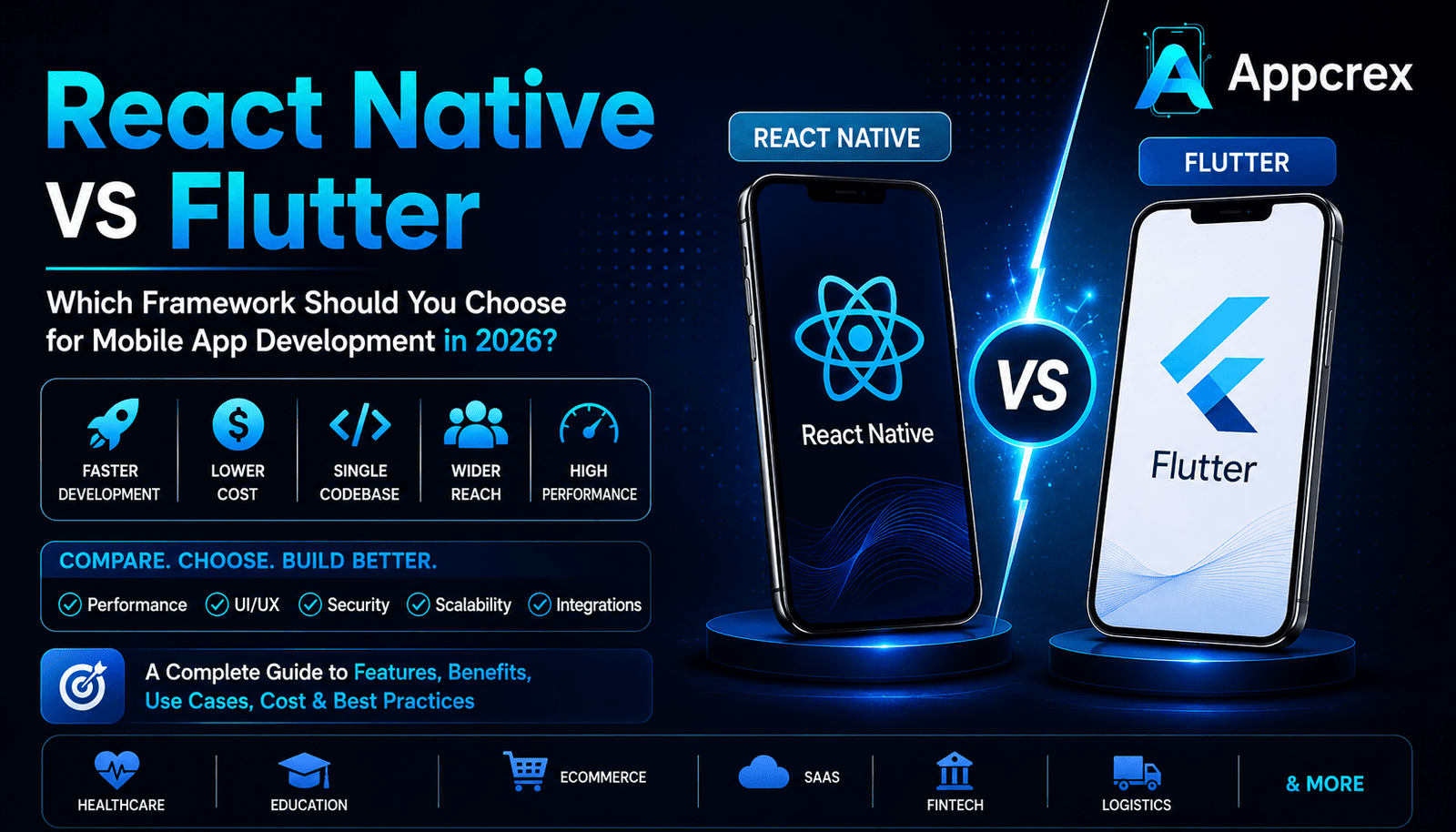
- React Native and Flutter are the leading cross-platform frameworks in 2026.
- React Native uses JavaScript, while Flutter uses Dart.
- Flutter excels in UI customization and animation performance.
- React Native offers a larger ecosystem, lower development costs, and stronger enterprise adoption.
- The best framework depends on your business goals, technical requirements, and long-term growth strategy.
Introduction
The mobile app industry continues to grow rapidly, with businesses across healthcare, education, eCommerce, fintech, logistics, and SaaS investing heavily in digital solutions. As competition increases, companies are looking for ways to build high-quality applications faster, reduce development costs, and reach users on both Android and iOS platforms simultaneously.
This shift has led to the rise of cross-platform app development, where a single codebase is used to create applications for multiple operating systems. Among the many frameworks available today, React Native and Flutter dominate the market.
If you’re planning to launch a mobile application in 2026, one question inevitably arises:
Should you choose React Native or Flutter?
Both frameworks offer significant advantages, but the right choice depends on your business goals, budget, scalability requirements, user experience expectations, and long-term development strategy.
As a leading mobile app development company, Appcrex helps startups, enterprises, healthcare organizations, and educational institutions select the best technology stack for their applications. In this comprehensive guide, we’ll compare React Native and Flutter in detail to help you make an informed decision.
What is React Native?
React Native is an open-source framework developed by Meta (formerly Facebook) that enables developers to build cross-platform mobile applications using JavaScript and React.
Instead of creating separate codebases for Android and iOS, developers can write most of the code once and deploy it across both platforms.
Since its launch, React Native has become one of the most widely adopted frameworks for business applications due to its flexibility, speed, and strong ecosystem.
Key Features of React Native
- Single Codebase Development
- JavaScript Support
- Native UI Components
- Hot Reloading
- Strong Community Support
- Third-Party Plugin Ecosystem
- Easy API Integration
- Faster Development Cycle
Popular Apps Built with React Native
- Shopify
- Discord
- Bloomberg
These companies use React Native to deliver reliable and scalable user experiences to millions of users worldwide.
What is Flutter?
Flutter is Google’s open-source UI toolkit designed for building mobile, web, desktop, and embedded applications from a single codebase.
Unlike React Native, Flutter uses its own rendering engine and relies on the Dart programming language.
Flutter is particularly popular among businesses that prioritize highly customized user interfaces and visually rich mobile experiences.
Key Features of Flutter
- Dart Programming Language
- Custom Widget Library
- High Performance Rendering
- Hot Reload
- Multi-Platform Development
- Rich UI Components
- Strong Google Support
- Consistent User Experience
Popular Apps Built with Flutter
- Google Pay
- Alibaba
- BMW
- Toyota
- eBay Motors
Flutter continues to gain popularity among startups and enterprises looking to create visually appealing applications.
Why Cross-Platform App Development Matters in 2026
Before comparing React Native and Flutter, it’s important to understand why cross-platform development has become the preferred approach for modern businesses.
Faster Time-to-Market
Developing a single application for Android and iOS significantly reduces development time.
Businesses can launch products faster and gain a competitive advantage.
Lower Development Costs
Maintaining one codebase requires fewer development resources compared to separate native applications.
This leads to lower development and maintenance costs.
Easier Maintenance
Bug fixes, feature updates, and performance improvements can be applied across platforms simultaneously.
Wider Market Reach
Cross-platform applications allow businesses to target Android and iOS users from day one.
Consistent User Experience
Users receive a similar experience regardless of the device or operating system they use.
React Native vs Flutter: Architecture Comparison
The underlying architecture of a framework affects performance, scalability, and development flexibility.
React Native Architecture
React Native uses a bridge-based architecture.
The JavaScript code communicates with native components through a bridge that translates instructions between the two environments.
Advantages
- Native UI Components
- Strong Flexibility
- Easy Integration with Existing Apps
- Mature Ecosystem
Challenges
- Additional communication layer
- Slight performance limitations in highly complex applications
Flutter Architecture
Flutter uses the Skia rendering engine and compiles directly into native machine code.
It does not rely on native UI components.
Advantages
- Faster Rendering
- Smooth Animations
- Consistent UI Across Platforms
- Reduced Platform Dependencies
Challenges
- Larger App Sizes
- More Resource Consumption
React Native vs Flutter: Performance Comparison
Performance is often one of the biggest deciding factors for businesses.
React Native Performance
React Native delivers near-native performance suitable for most applications.
It performs exceptionally well for:
- Healthcare Apps
- Education Apps
- SaaS Platforms
- eCommerce Applications
- Enterprise Software
Strengths
- Fast Rendering
- Efficient Resource Usage
- Excellent User Experience
Flutter Performance
Flutter is known for exceptional rendering speed because it compiles directly into machine code.
Strengths
- High FPS Animations
- Smooth UI Rendering
- Better Graphics Performance
Best For
- Animation-Heavy Apps
- Gaming Interfaces
- Custom UI Experiences
Winner
Flutter has a slight advantage in raw performance benchmarks.
React Native vs Flutter: Development Speed
Development speed directly impacts project cost and launch timelines.
React Native
React Native benefits from:
- JavaScript Familiarity
- Large Library Ecosystem
- Extensive Documentation
- Faster Hiring
Many development teams can begin working with React Native immediately.
Flutter
Flutter offers:
- Hot Reload
- Rich Widget Library
- Comprehensive Development Tools
However, developers unfamiliar with Dart may require additional training.
Winner
React Native generally enables faster development for most businesses.
React Native vs Flutter: UI and User Experience
User experience plays a critical role in customer retention and engagement.
React Native
React Native uses actual native components provided by Android and iOS.
Benefits include:
- Natural Platform Feel
- Familiar User Experience
- Better Operating System Integration
Flutter
Flutter uses custom widgets to render interfaces.
Benefits include:
- Pixel-Perfect Designs
- Consistent Appearance
- Unlimited Customization
Winner
Flutter wins for highly customized and visually rich applications.
React Native vs Flutter: Community & Ecosystem
Community support influences development efficiency and long-term maintenance.
React Native
Advantages:
- Massive Developer Community
- Thousands of Libraries
- Extensive Tutorials
- Enterprise Adoption
Flutter
Advantages:
- Rapidly Growing Community
- Strong Google Backing
- Active Open-Source Contributions
Winner
React Native currently maintains a larger ecosystem and broader adoption.
React Native vs Flutter for Different Industries
Choosing the right framework isn’t just about performance or development speed. Different industries have unique requirements, and the framework you choose should align with your business objectives, scalability needs, and user expectations.
Let’s explore how React Native and Flutter perform across various industries.
React Native vs Flutter for Healthcare App Development
The healthcare industry demands applications that are secure, scalable, reliable, and capable of integrating with multiple healthcare systems.
Healthcare applications often include:
- Telemedicine Platforms
- Patient Portals
- Appointment Booking Systems
- Remote Patient Monitoring
- Electronic Health Records (EHR)
- Prescription Management
Why Healthcare Companies Prefer React Native
React Native is widely adopted for healthcare solutions because of its:
- Strong API integration capabilities
- Faster development cycles
- Easy maintenance
- Cross-platform support
- Large developer ecosystem
Healthcare organizations frequently need integrations with:
- EHR Systems
- Pharmacy Platforms
- Insurance Providers
- Payment Gateways
- Video Consultation Services
React Native makes these integrations easier due to its mature ecosystem.
Recommended Framework
✅ React Native
React Native vs Flutter for Education App Development
The education sector has experienced significant digital transformation in recent years.
Modern education apps include:
- Virtual Classrooms
- Learning Management Systems (LMS)
- Video Streaming
- Student Portals
- Online Assessments
- Interactive Learning Tools
React Native Benefits
- Faster deployment
- Easier API integration
- Better scalability
- Lower maintenance costs
Flutter Benefits
- Engaging UI
- Interactive animations
- Better custom learning experiences
Recommended Framework
✅ React Native for large-scale education platforms
✅ Flutter for highly interactive educational experiences
React Native vs Flutter for SaaS Applications
Software-as-a-Service (SaaS) businesses require mobile applications that integrate seamlessly with cloud infrastructure.
Common SaaS requirements include:
- User Authentication
- Real-Time Data Synchronization
- Cloud Connectivity
- Analytics
- Subscription Billing
Why React Native Excels
React Native is highly suitable for SaaS platforms because:
- JavaScript is already widely used in SaaS development
- Strong cloud integration support
- Easier maintenance
- Large developer pool
Recommended Framework
✅ React Native
React Native vs Flutter for eCommerce Applications
eCommerce apps require:
- Product Catalogs
- Secure Payments
- Order Tracking
- Customer Accounts
- Push Notifications
- Recommendation Engines
React Native Advantages
- Faster API integration
- Mature payment gateway support
- Better ecosystem for commerce apps
- Faster development
Flutter Advantages
- Attractive UI
- Enhanced shopping experiences
- Smooth animations
Recommended Framework
✅ React Native
Most eCommerce businesses prioritize speed, integrations, and scalability.
React Native vs Flutter for Fintech Applications
Financial applications demand:
- High Security
- Data Protection
- Real-Time Transactions
- Regulatory Compliance
Examples include:
- Banking Apps
- Investment Platforms
- Digital Wallets
- Payment Apps
React Native Benefits
- Enterprise adoption
- Mature security practices
- Faster integration with banking APIs
Flutter Benefits
- Smooth interfaces
- Better animation support
Recommended Framework
✅ React Native
Security and ecosystem maturity often outweigh UI considerations in fintech.
React Native vs Flutter for Logistics Applications
Logistics apps require:
- GPS Tracking
- Route Optimization
- Real-Time Notifications
- Fleet Management
- Delivery Tracking
React Native’s strong third-party integration capabilities make it highly suitable for logistics applications.
Recommended Framework
✅ React Native
React Native vs Flutter for Startups
Startups usually focus on three things:
- Speed
- Budget
- Scalability
They need to validate ideas quickly while minimizing risk.
Why Startups Choose React Native
Lower Development Costs
JavaScript developers are widely available, reducing hiring costs.
Faster MVP Development
React Native helps launch MVPs quickly.
Easier Scaling
Businesses can add features without rebuilding the application.
Better Talent Availability
Finding React Native developers is generally easier than finding Flutter developers.
Recommended Framework
✅ React Native
React Native vs Flutter for Enterprises
Enterprise applications require:
- Security
- Scalability
- Reliability
- Long-Term Support
Examples include:
- ERP Systems
- CRM Applications
- Healthcare Platforms
- Internal Business Apps
React Native Enterprise Advantages
- Mature ecosystem
- Proven enterprise adoption
- Easy integration with enterprise software
- Strong community support
Flutter Enterprise Advantages
- Consistent UI
- Excellent performance
Recommended Framework
✅ React Native
Many Fortune 500 companies continue investing in React Native because of its flexibility and ecosystem maturity.
React Native vs Flutter: Security Comparison
Security is one of the most important considerations for modern applications.
React Native Security Features
React Native supports:
- Secure Data Storage
- OAuth Authentication
- Biometric Login
- SSL/TLS Encryption
- Multi-Factor Authentication
It also benefits from mature security libraries and community support.
Flutter Security Features
Flutter offers:
- Code Obfuscation
- Secure Storage
- SSL/TLS Encryption
- Biometric Authentication
Both frameworks can support enterprise-grade security.
Winner
🏆 Tie
Security depends more on implementation than framework choice.
React Native vs Flutter: Third-Party Integration Comparison
Modern applications depend heavily on external services.
Examples include:
- Stripe
- PayPal
- Razorpay
- Google Maps
- Firebase
- Twilio
- Salesforce
- HubSpot
- AWS
React Native
Advantages:
- Large plugin ecosystem
- Mature integrations
- Faster implementation
Flutter
Advantages:
- Growing package ecosystem
- Excellent Google integrations
Winner
🏆 React Native
React Native vs Flutter: Development Cost Comparison
Cost remains one of the biggest decision-making factors.
React Native Development Cost
React Native benefits from:
- Large talent pool
- Faster onboarding
- Lower hiring costs
- Faster development cycles
Estimated Cost
| Project Type | Estimated Cost |
|---|---|
| MVP App | $10,000–$25,000 |
| Mid-Level App | $25,000–$60,000 |
| Enterprise App | $60,000+ |
Flutter Development Cost
Flutter development may require specialized Dart developers.
Estimated Cost
| Project Type | Estimated Cost |
|---|---|
| MVP App | $12,000–$30,000 |
| Mid-Level App | $30,000–$70,000 |
| Enterprise App | $70,000+ |
Winner
🏆 React Native
For most businesses, React Native provides better ROI and lower development costs.
Real-World Business Use Cases
When React Native is the Better Choice
Choose React Native if you need:
- Healthcare Applications
- SaaS Platforms
- eCommerce Apps
- Education Apps
- Enterprise Software
- Fast MVP Development
When Flutter is the Better Choice
Choose Flutter if you need:
- Highly Customized UI
- Animation-Heavy Applications
- Brand-Centric Consumer Apps
- Interactive Experiences
React Native vs Flutter: Pros, Cons, Future Trends & Final Verdict
By now, we’ve explored architecture, performance, development speed, industry-specific use cases, security, integrations, and cost comparisons. However, choosing the right framework also requires understanding long-term factors such as scalability, maintenance, community support, and future growth.
Let’s dive deeper into the final comparison.
React Native vs Flutter: Pros & Cons
Every framework has strengths and limitations. Understanding both helps businesses make informed decisions.
React Native Pros
Large Developer Community
React Native has one of the largest mobile development communities in the world.
Benefits include:
- Extensive documentation
- Thousands of libraries
- Faster problem-solving
- Easy hiring
JavaScript-Based Development
JavaScript remains one of the most popular programming languages globally.
This allows businesses to:
- Find developers easily
- Reduce hiring costs
- Speed up development
Faster Development
React Native offers:
- Reusable Components
- Hot Reloading
- Faster Iterations
- Strong Ecosystem
This significantly reduces time-to-market.
Better Third-Party Integrations
React Native supports seamless integration with:
- Payment Gateways
- CRM Systems
- ERP Platforms
- Healthcare APIs
- Cloud Services
Strong Enterprise Adoption
Many large organizations rely on React Native for mission-critical applications.
React Native Cons
Native Modules May Be Required
For highly complex features, developers may occasionally need platform-specific code.
UI Consistency Challenges
Different operating systems may occasionally render components differently.
Flutter Pros
Highly Customizable UI
Flutter allows complete control over application design.
Benefits include:
- Beautiful Interfaces
- Consistent Design
- Rich User Experiences
Excellent Performance
Flutter compiles directly into native machine code.
This provides:
- Smooth Animations
- Fast Rendering
- Better Graphics Performance
Consistent Cross-Platform Experience
Flutter applications often look identical across Android and iOS devices.
Growing Ecosystem
Google continues investing heavily in Flutter’s ecosystem and capabilities.
Flutter Cons
Smaller Developer Pool
Compared to JavaScript developers, Dart developers are less common.
Larger App Sizes
Flutter applications generally have larger installation sizes.
Limited Enterprise Adoption
Although growing rapidly, Flutter still trails React Native in enterprise adoption.
React Native vs Flutter: Scalability Comparison
Scalability determines how well an application handles increasing users, data, and functionality over time.
React Native Scalability
React Native has proven scalability across:
- Healthcare Platforms
- Social Networks
- SaaS Applications
- eCommerce Platforms
- Enterprise Systems
Major companies such as Facebook and Instagram demonstrate its scalability.
Advantages
- Flexible Architecture
- Strong Community Support
- Enterprise Readiness
- Cloud Compatibility
Flutter Scalability
Flutter also supports scalable application development.
Benefits include:
- Consistent Performance
- Multi-Platform Deployment
- Flexible Architecture
However, enterprise adoption is still maturing.
Winner
🏆 React Native
For large-scale business applications, React Native currently offers a stronger track record.
React Native vs Flutter: Maintenance Comparison
Maintenance directly impacts long-term development costs.
React Native Maintenance
Advantages:
- Easier Developer Availability
- Faster Updates
- Extensive Community Support
- Mature Libraries
Businesses can find support and resources quickly.
Flutter Maintenance
Advantages:
- Consistent Codebase
- Strong Google Support
- Stable Development Environment
Challenges:
- Smaller talent pool
- Fewer third-party resources
Winner
🏆 React Native
Lower maintenance costs often make React Native more attractive for growing businesses.
Future of React Native and Flutter in 2026
Cross-platform development continues to dominate the mobile app industry.
Both frameworks are expected to remain industry leaders throughout 2026 and beyond.
React Native Trends
New Architecture Adoption
React Native’s new architecture improves:
- Performance
- Startup Time
- Memory Usage
- Native Communication
TypeScript Growth
More companies are adopting TypeScript with React Native for better scalability and maintainability.
AI Integration
Businesses increasingly integrate:
- ChatGPT APIs
- AI Assistants
- Recommendation Engines
- Automation Tools
React Native supports these integrations exceptionally well.
Enterprise Expansion
More enterprises are adopting React Native to reduce development costs and accelerate innovation.
Flutter Trends
Improved Web Development
Flutter continues enhancing web support.
Desktop Expansion
Flutter is gaining traction for desktop application development.
Better Tooling
Google regularly introduces improvements that simplify development and testing.
Enhanced Performance
Future releases are expected to deliver even faster rendering and better resource optimization.
Why Businesses Prefer React Native in 2026
While Flutter has made significant progress, React Native remains one of the most practical choices for many organizations.
Businesses prefer React Native because it offers:
- Faster Development
- Lower Costs
- Large Developer Community
- Extensive Integrations
- Enterprise Readiness
- Strong Ecosystem
- Proven Scalability
For industries such as healthcare, education, SaaS, fintech, and eCommerce, React Native continues to deliver exceptional value.
Why Choose Appcrex for React Native & Flutter Development?
Choosing the right development partner is just as important as choosing the right framework.
At Appcrex, we help businesses evaluate their requirements and build future-ready applications using both React Native and Flutter.
Our Services
- React Native App Development
- Flutter App Development
- Cross-Platform App Development
- Healthcare App Development
- Education App Development
- SaaS App Development
- UI/UX Design
- API Integration
- Cloud Integration
- App Maintenance & Support
Why Appcrex?
- Experienced Mobile App Developers
- Agile Development Process
- Scalable Architecture
- Transparent Communication
- Dedicated Support
- Cost-Effective Solutions
- Industry-Specific Expertise
Whether you’re launching a startup MVP or building an enterprise-grade platform, our team can help you select and implement the right technology stack.
Final Thoughts
The React Native vs Flutter debate doesn’t have a universal winner because both frameworks serve different business needs. Flutter shines when creating visually rich applications with highly customized user interfaces and advanced animations. React Native excels in development speed, ecosystem maturity, third-party integrations, scalability, and cost efficiency.
For most businesses building healthcare applications, educational platforms, SaaS products, fintech solutions, eCommerce apps, and enterprise software, React Native remains the preferred choice due to its extensive community support, lower development costs, and proven success in large-scale deployments.
Ultimately, the best framework is the one that aligns with your business objectives, budget, timeline, and user expectations. Partnering with an experienced mobile app development company like Appcrex ensures that you choose the right technology and build an application that supports long-term success.
Frequently Asked Questions (FAQs)
1. Which is better, React Native or Flutter?
Both are excellent frameworks. React Native is often preferred for business applications, while Flutter excels in custom UI development.
2. Is React Native faster than Flutter?
Flutter generally offers slightly better rendering performance, but React Native provides excellent real-world performance for most applications.
3. Which framework is more cost-effective?
React Native is usually more cost-effective because JavaScript developers are widely available.
4. Is Flutter replacing React Native?
No. Both frameworks continue to grow and are widely adopted across different industries.
5. Which framework is best for startups?
React Native is often preferred for startups because of faster development and lower costs.
6. Which framework is better for healthcare apps?
React Native is commonly chosen for healthcare applications due to its strong integration capabilities and enterprise adoption.
7. Can Flutter build enterprise applications?
Yes. Flutter can build enterprise-grade applications, although React Native currently has broader enterprise adoption.
8. Which framework has a larger community?
React Native has a larger global developer community and ecosystem.
9. Which framework is easier to learn?
React Native is generally easier for developers familiar with JavaScript and React.
10. Which framework should I choose in 2026?
Choose React Native for scalability, integrations, and business applications. Choose Flutter if advanced UI customization and animations are your highest priorities.