📌 Key Takeaways
- Custom inventory software streamlines stock management and reduces manual errors.
- Real-time inventory tracking helps prevent stockouts and overstocking.
- Automated workflows improve operational efficiency and save time.
- Integration with ERP, POS, and eCommerce platforms ensures seamless business operations.
- Scalable and secure inventory solutions support business growth and data accuracy.
Inventory Management Software Development Company
Inventory is one of the most valuable assets for businesses dealing with physical products. Whether you’re operating a retail store, eCommerce business, manufacturing plant, wholesale distribution company, or healthcare organization, effective inventory management directly impacts profitability, customer satisfaction, and operational efficiency.
Many businesses still rely on spreadsheets or outdated software to manage inventory, which often leads to stock inaccuracies, delayed deliveries, excess inventory, and lost revenue. As customer expectations continue to rise in 2026, businesses require smarter, faster, and more automated inventory solutions to remain competitive.
This is where a professional Inventory Management Software Development Company plays a crucial role. Custom inventory software helps businesses automate stock tracking, manage warehouses, monitor inventory in real time, forecast demand, and streamline procurement—all from a centralized platform.
At AppCrex, we develop scalable, secure, and AI-powered inventory management software tailored to your business workflows. Whether you’re a startup looking for a lightweight inventory solution or an enterprise managing multiple warehouses across different regions, our development team creates software that improves efficiency and drives long-term growth.
In this complete guide, you’ll learn everything about inventory management software, its benefits, essential features, development process, costs, technologies, and why custom software is a smart investment for modern businesses.
What is Inventory Management Software?
Inventory Management Software is a digital system that enables businesses to monitor, organize, and control inventory throughout the entire supply chain. It provides complete visibility into stock levels, warehouse operations, purchase orders, supplier activities, product movement, and customer orders in real time.
Unlike manual inventory tracking methods, modern inventory software automates routine tasks such as stock updates, reorder notifications, barcode scanning, warehouse transfers, and inventory reporting. This automation minimizes human error while significantly improving operational efficiency.
A custom inventory management solution can also integrate with your existing ERP, CRM, POS, eCommerce platforms, accounting software, and shipping providers, creating a connected ecosystem that keeps your business running smoothly.
Businesses can access inventory information through web applications, mobile apps, or cloud-based dashboards, ensuring complete control over inventory anytime and from anywhere.
Why Businesses Need Inventory Management Software?
Managing inventory manually may work for small businesses in the beginning, but as operations grow, it quickly becomes inefficient. Expanding product catalogs, multiple warehouses, and increasing customer orders make manual inventory tracking difficult and error-prone.
Custom inventory management software helps businesses overcome these challenges while improving overall productivity.
Here are some of the biggest reasons businesses invest in inventory management software:
1. Real-Time Inventory Visibility
Know exactly how much inventory is available across warehouses, retail outlets, and distribution centers. Real-time tracking helps prevent stock discrepancies and supports faster business decisions.
2. Reduce Stockouts and Overstocking
Running out of products leads to lost sales, while excess inventory ties up valuable capital. Smart inventory software maintains optimal stock levels using automated reorder points and forecasting.
3. Faster Order Processing
Integrated inventory systems instantly update stock after every sale, making order fulfillment quicker and more accurate.
4. Better Warehouse Efficiency
Warehouse staff can easily locate products using barcode scanners, QR codes, RFID tracking, and smart warehouse mapping.
5. Improved Business Decision-Making
Inventory analytics provide valuable insights into sales performance, seasonal demand, supplier reliability, and purchasing trends.
6. Enhanced Customer Experience
Customers receive accurate product availability, faster deliveries, and fewer order cancellations due to inventory issues.
Common Inventory Management Challenges Businesses Face
Without the right software, businesses often encounter operational problems that affect profitability and customer satisfaction.
1. Manual Data Entry Errors
Updating spreadsheets manually increases the chances of incorrect inventory counts, duplicate entries, and misplaced stock information.
2. Lack of Inventory Visibility
Businesses struggle to track products across multiple warehouses or retail locations, leading to inaccurate stock records.
3. Overstocking
Buying more inventory than required increases storage costs and locks up working capital.
4. Stock Shortages
Running out of popular products can result in lost revenue and dissatisfied customers who may turn to competitors.
5. Poor Warehouse Organization
Without proper inventory organization, warehouse staff spend more time locating products, delaying shipments and increasing labor costs.
6. Inefficient Supplier Management
Tracking purchase orders, supplier deliveries, and vendor performance manually often results in delays and procurement issues.
7. No Demand Forecasting
Without historical data analysis, businesses cannot accurately predict future demand, resulting in poor inventory planning.
8. Limited Reporting
Traditional systems provide limited insights, making it difficult to understand inventory turnover, product performance, or warehouse efficiency.
Benefits of Custom Inventory Management Software
Choosing a custom solution instead of off-the-shelf software allows businesses to build a platform that perfectly matches their workflows and operational requirements.
1. Tailored to Your Business
Every business has unique inventory processes. Custom software is designed specifically for your products, warehouse structure, sales channels, and operational goals.
2. Increased Productivity
Automation eliminates repetitive manual tasks, allowing employees to focus on more strategic activities such as customer service and business growth.
3. Improved Inventory Accuracy
Real-time synchronization and automated updates significantly reduce inventory discrepancies and improve stock accuracy.
4. Scalable Architecture
As your business grows, your inventory management system can easily support additional warehouses, users, products, and sales channels without performance issues.
5. Lower Operational Costs
By reducing manual work, minimizing inventory waste, and improving purchasing decisions, businesses can significantly lower operating expenses.
6. Better Data Security
Custom inventory software includes advanced security features such as role-based permissions, encrypted databases, multi-factor authentication, and secure cloud storage to protect sensitive business data.
7. Seamless Integration
A custom inventory management system can integrate with:
- ERP Software
- CRM Systems
- Accounting Software
- POS Systems
- eCommerce Platforms
- Shipping Providers
- Payment Gateways
- Barcode & RFID Devices
This creates a unified business ecosystem where data flows automatically between systems, reducing manual effort and improving operational efficiency.
Why Invest in Inventory Management Software in 2026?
The demand for intelligent inventory solutions continues to grow as businesses embrace automation, cloud computing, artificial intelligence, and real-time analytics. Companies that invest in modern inventory management software gain a competitive advantage through faster operations, improved customer satisfaction, lower costs, and better business insights.
Partnering with an experienced Inventory Management Software Development Company like AppCrex ensures you receive a customized, future-ready solution built with the latest technologies and designed to scale with your business.
Core Features of Inventory Management Software
The success of an inventory management system depends on the features it offers. Modern businesses need more than just stock tracking—they require a centralized platform that automates inventory operations, improves warehouse efficiency, and provides real-time insights for better decision-making.
As a leading Inventory Management Software Development Company, AppCrex develops feature-rich inventory management solutions tailored to businesses of all sizes. Whether you’re managing a single warehouse or a global supply chain, the right software can simplify your operations and improve productivity.
Below are the must-have features of a modern inventory management system.
1. Centralized Dashboard
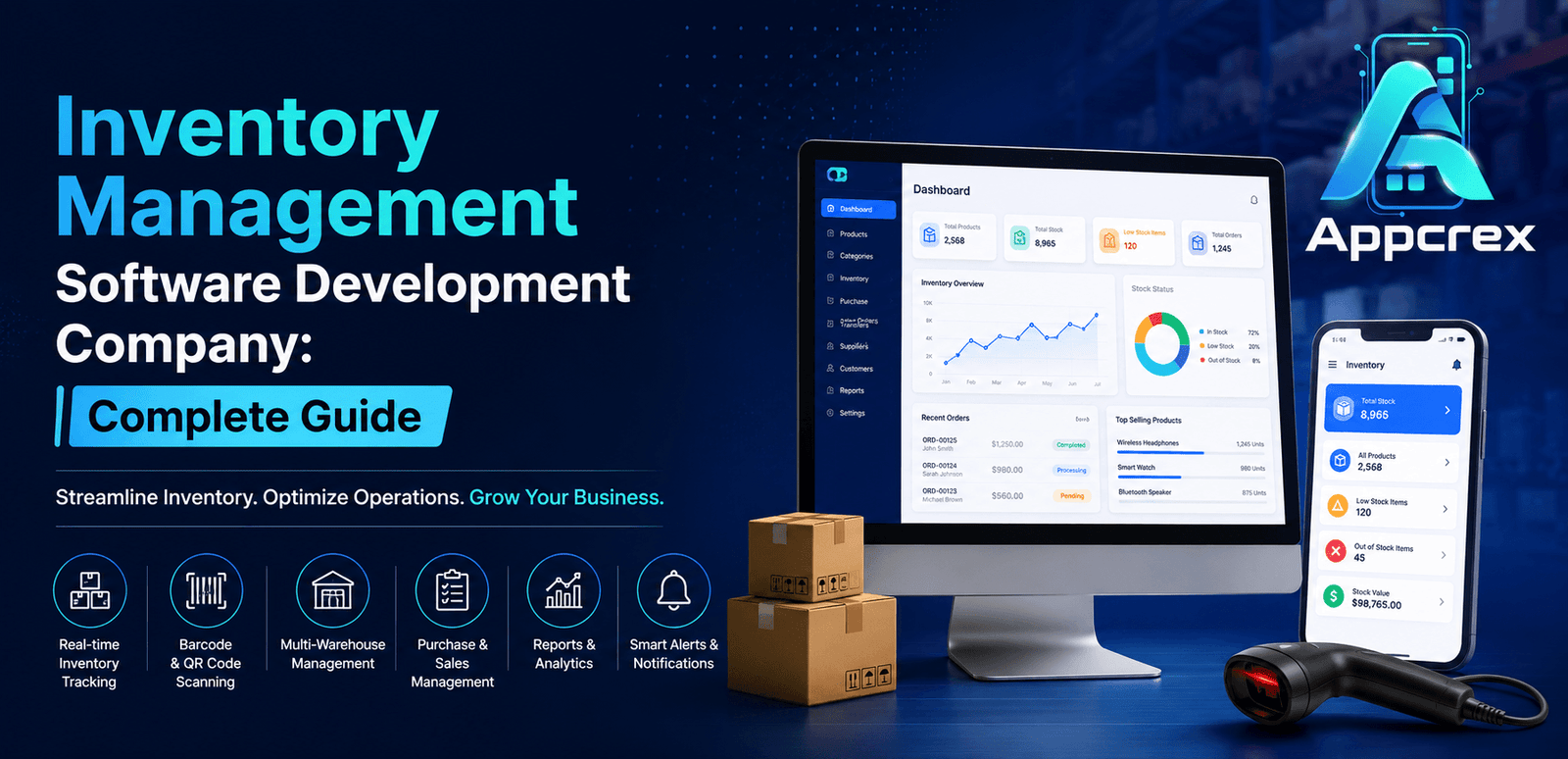
A user-friendly dashboard gives you a complete overview of your inventory in one place. Business owners and managers can monitor stock levels, warehouse activity, purchase orders, sales performance, and inventory value without switching between multiple systems.
The dashboard typically displays:
- Current inventory status
- Low-stock products
- Recent orders
- Purchase requests
- Warehouse transfers
- Sales performance
- Inventory valuation
- Product movement reports
Interactive charts and KPIs help decision-makers quickly identify trends and make informed business decisions.
2. Product & SKU Management
Managing thousands of products manually is time-consuming. Inventory software allows businesses to organize products using categories, unique SKUs, serial numbers, and product variants.
Features include:
- Product categories
- Product images
- SKU generation
- Product descriptions
- Size and color variants
- Batch and lot management
- Unit pricing
- Product status
This makes searching, updating, and tracking products much easier.
3. Real-Time Inventory Tracking
Real-time inventory tracking is one of the most valuable features of custom inventory software.
Every inventory movement—whether it’s a purchase, sale, return, transfer, or damaged item—is updated instantly.
Businesses can monitor:
- Available stock
- Reserved inventory
- Incoming inventory
- Outgoing shipments
- Returned products
- Damaged inventory
- Warehouse transfers
This ensures accurate inventory records and reduces costly errors.
4. Barcode & QR Code Scanning
Barcode and QR code technology eliminates manual inventory entry and significantly improves warehouse productivity.
Employees can quickly:
- Scan incoming products
- Update stock quantities
- Track product movement
- Process customer orders
- Conduct stock audits
- Manage returns
The result is faster inventory handling with fewer mistakes.
5. Warehouse Management
Businesses with multiple storage locations need a powerful warehouse management module.
Custom inventory management software allows you to manage:
- Multiple warehouses
- Shelf locations
- Bin management
- Warehouse transfers
- Storage optimization
- Inventory movement
- Warehouse capacity
Managers can easily identify where products are stored and optimize warehouse operations.
6. Purchase Order Management
The software automates procurement by generating purchase orders when inventory reaches predefined reorder levels.
Key capabilities include:
- Purchase request creation
- Supplier selection
- Purchase approvals
- Delivery tracking
- Invoice management
- Goods received notes (GRN)
- Purchase history
This helps prevent stock shortages while maintaining healthy inventory levels.
7. Supplier Management
Maintaining strong supplier relationships is essential for smooth inventory operations.
Inventory software stores supplier information in a centralized database, including:
- Vendor profiles
- Contact information
- Product catalogs
- Pricing agreements
- Delivery timelines
- Payment history
- Purchase history
- Supplier performance metrics
Businesses can compare suppliers and make better purchasing decisions.
8. Sales Order Management
An integrated sales order module ensures inventory is automatically updated whenever a sale occurs.
The system can:
- Create customer orders
- Reserve inventory
- Generate invoices
- Track deliveries
- Process returns
- Update stock automatically
This minimizes manual work while improving customer satisfaction.
9. Inventory Alerts & Notifications
Automated notifications help businesses stay ahead of inventory issues.
Alerts can be configured for:
- Low stock
- Out-of-stock items
- Overstock situations
- Expiring products
- Delayed supplier deliveries
- Pending purchase orders
- Slow-moving inventory
- Warehouse transfer requests
These proactive alerts help prevent costly disruptions.
10. Reports & Business Analytics
Modern inventory software transforms raw data into actionable insights through advanced reporting.
Businesses can generate reports on:
- Inventory valuation
- Product performance
- Sales trends
- Purchase history
- Warehouse efficiency
- Inventory turnover
- Dead stock
- Profit margins
- Supplier performance
- Demand forecasting
Custom dashboards and downloadable reports help managers make data-driven decisions.
11. Role-Based Access Control
Not every employee should have access to all inventory data.
Role-based permissions allow businesses to assign access based on job responsibilities.
Examples include:
- Super Admin
- Inventory Manager
- Warehouse Staff
- Purchasing Team
- Sales Team
- Finance Department
- Store Managers
This improves security while ensuring employees only access relevant information.
12. Mobile Inventory Management
Inventory operations are no longer limited to desktop computers.
A mobile inventory application enables users to:
- Scan barcodes
- Update inventory
- Approve purchase orders
- Track shipments
- View reports
- Manage warehouse transfers
- Receive notifications
This allows warehouse teams and managers to work efficiently from anywhere.
13. Multi-Location Inventory Management
For businesses operating across multiple branches or warehouses, centralized inventory control is essential.
The software allows you to:
- Track inventory across locations
- Transfer products between warehouses
- View stock availability in real time
- Monitor branch performance
- Prevent duplicate stock orders
This feature is especially useful for retail chains, distributors, and enterprise businesses.
14. Cloud-Based Inventory Management
Cloud deployment offers flexibility, scalability, and accessibility.
Benefits include:
- Secure cloud storage
- Automatic backups
- Remote access
- Easy software updates
- Reduced infrastructure costs
- High system availability
Cloud-based inventory software is ideal for businesses with distributed teams and multiple locations.
Why These Features Matter?
A feature-rich inventory management solution doesn’t just track stock—it streamlines your entire supply chain. By automating routine tasks, reducing manual errors, and providing real-time visibility, businesses can improve efficiency, cut operational costs, and deliver a better customer experience.
At AppCrex, we design custom inventory management software with advanced features that align with your business processes, ensuring a scalable and future-ready solution.
Industries That Need Inventory Management Software
Inventory management is no longer limited to retail businesses. Today, organizations across industries rely on custom inventory management software to improve operational efficiency, reduce waste, and gain real-time visibility into stock movement.
As a trusted Inventory Management Software Development Company, AppCrex develops industry-specific inventory solutions that address unique business challenges and workflows.
Let’s explore the industries that benefit the most.
1. Retail & Supermarkets
Retail businesses manage thousands of products daily, making inventory accuracy critical for customer satisfaction and profitability.
Inventory management software helps retailers:
- Track stock in real time
- Manage multiple store locations
- Sync online and offline inventory
- Prevent stock shortages
- Generate automatic purchase orders
- Analyze fast-moving products
- Manage seasonal inventory
Whether it’s a supermarket, fashion store, electronics retailer, or department store, automation simplifies inventory control.
Also Read : eCommerce App Development Cost in 2026: Features, Pricing, Timeline & Complete Cost Breakdown
2. eCommerce Businesses
Online businesses receive orders around the clock, making real-time inventory updates essential.
A custom inventory system enables eCommerce companies to:
- Sync inventory across Amazon, Shopify, WooCommerce, Magento, and other marketplaces
- Prevent overselling
- Track returns and exchanges
- Automate order fulfillment
- Manage warehouse inventory
- Monitor shipping status
This creates a seamless shopping experience while reducing operational errors.
3. Manufacturing Companies
Manufacturers deal with raw materials, work-in-progress inventory, and finished goods simultaneously.
Inventory software helps manufacturers:
- Track raw materials
- Monitor production inventory
- Manage Bills of Materials (BOM)
- Forecast material requirements
- Reduce production delays
- Improve procurement planning
This leads to smoother production cycles and reduced manufacturing costs.
4. Healthcare & Pharmaceuticals
Hospitals, clinics, and pharmacies require accurate inventory management to ensure patient safety.
The software can manage:
- Medicines
- Medical devices
- Surgical equipment
- Vaccines
- Laboratory supplies
- Expiry dates
- Batch numbers
Automated alerts help prevent medicine shortages and reduce expired stock.
5. Food & Beverage Industry
Restaurants, food distributors, and food manufacturers must carefully monitor inventory with expiration dates.
Inventory software provides:
- Batch tracking
- Expiry management
- Cold storage inventory
- Supplier management
- Waste tracking
- Purchase forecasting
This reduces food waste and improves profitability.
Also Read : Cost to Develop an App Like Toing Food Delivery App: Complete Guide
6. Wholesale & Distribution
Distributors handle large product volumes across multiple warehouses and delivery routes.
Custom software allows businesses to:
- Manage bulk inventory
- Track shipments
- Optimize warehouse operations
- Process large purchase orders
- Improve supplier communication
This ensures faster deliveries and better customer service.
7. Automotive Industry
Automotive companies manage thousands of spare parts and accessories.
Inventory software helps by:
- Tracking serial numbers
- Managing spare parts
- Organizing warehouses
- Monitoring supplier deliveries
- Reducing inventory shortages
This improves service center efficiency and customer satisfaction.
Inventory Management Software Development Process
Building custom inventory software requires a structured development approach to ensure scalability, performance, and long-term success.
At AppCrex, we follow an agile development process that keeps clients involved at every stage.
Step 1: Business Analysis
Our experts begin by understanding your business model, inventory workflows, operational challenges, and long-term goals.
During this phase, we identify:
- Inventory processes
- Warehouse operations
- User roles
- Required integrations
- Business objectives
- Reporting requirements
A detailed requirement analysis forms the foundation of the project.
Step 2: UI/UX Design
A clean, intuitive interface improves user adoption and productivity.
Our design team creates:
- User journeys
- Wireframes
- Interactive prototypes
- Dashboard layouts
- Mobile-friendly interfaces
The goal is to make inventory management simple and efficient for every user.
Step 3: Software Architecture
Our developers design a scalable architecture capable of supporting future business growth.
The architecture includes:
- Cloud infrastructure
- Database design
- API development
- Security layers
- Third-party integrations
- Performance optimization
A well-planned architecture ensures reliability and scalability.
Step 4: Development
This is where the actual coding begins.
Modules developed include:
- Inventory Management
- Warehouse Management
- Product Catalog
- Purchase Orders
- Sales Orders
- Reporting Dashboard
- Notifications
- Mobile Applications
- Admin Panel
Each module is tested continuously during development.
Step 5: Quality Assurance
Before deployment, our QA team performs comprehensive testing to ensure software quality.
Testing includes:
- Functional testing
- Security testing
- Performance testing
- API testing
- Compatibility testing
- User Acceptance Testing (UAT)
This ensures a bug-free and reliable solution.
Step 6: Deployment
Once approved, the software is deployed to your preferred environment.
Deployment options include:
- Cloud Hosting
- AWS
- Microsoft Azure
- Google Cloud Platform
- On-Premise Servers
The deployment process minimizes downtime and ensures a smooth launch.
Step 7: Maintenance & Support
Software development doesn’t end after launch.
AppCrex provides:
- Performance monitoring
- Security updates
- Feature enhancements
- Bug fixes
- Technical support
- System optimization
This ensures your inventory software remains secure and up to date.
Technology Stack for Inventory Management Software
Choosing the right technology stack is essential for performance, scalability, and security.
Frontend
- React.js
- Angular
- Vue.js
- Next.js
Mobile Development
- Flutter
- React Native
- Kotlin
- Swift
Backend
- Node.js
- Python (Django/FastAPI)
- Laravel (PHP)
- ASP.NET Core
- Java Spring Boot
Database
- PostgreSQL
- MySQL
- MongoDB
- Microsoft SQL Server
Cloud Platforms
- Amazon Web Services (AWS)
- Google Cloud Platform (GCP)
- Microsoft Azure
DevOps & CI/CD
- Docker
- Kubernetes
- Jenkins
- GitHub Actions
Also Read : Custom Software Development Company: Complete Guide to Services, Process, Cost & Benefits (2026)
AI & Automation Features
Artificial Intelligence is transforming inventory management by improving forecasting, automation, and decision-making.
Modern inventory systems can include:
- AI-powered demand forecasting
- Predictive inventory planning
- Automated stock replenishment
- Intelligent reorder recommendations
- Sales trend analysis
- Slow-moving inventory detection
- Customer demand prediction
- Smart warehouse optimization
- Automated purchase planning
- Business intelligence dashboards
These features help businesses reduce waste, lower costs, and improve inventory accuracy.
Third-Party Integrations
An effective inventory management solution integrates seamlessly with other business tools.
Common integrations include:
- ERP Systems
- CRM Platforms
- Accounting Software (QuickBooks, Xero)
- POS Systems
- Shopify
- WooCommerce
- Magento
- Amazon Marketplace
- Payment Gateways
- Shipping Providers (FedEx, UPS, DHL)
- Barcode & RFID Devices
- Email & SMS Services
These integrations eliminate manual work and ensure data consistency across departments.
Security & Compliance
Inventory systems often store sensitive business and customer data. Security must be a top priority.
AppCrex builds secure software with:
- End-to-end encryption
- Multi-factor authentication (MFA)
- Role-based access control
- Secure APIs
- Regular security audits
- Automatic backups
- Disaster recovery plans
- GDPR-ready architecture
- Audit logs and activity tracking
These measures protect your business against data breaches and unauthorized access.
Future Trends in Inventory Management Software
The future of inventory management is driven by automation and intelligent technologies.
Key trends include:
- AI-powered inventory optimization
- IoT-enabled smart warehouses
- RFID-based real-time tracking
- Blockchain for supply chain transparency
- Robotics in warehouse operations
- Predictive analytics
- Voice-enabled inventory management
- Digital twins for warehouse simulation
- Sustainable inventory planning
- Hyper-automation across the supply chain
Businesses that adopt these innovations will be better positioned to improve efficiency and remain competitive.
Why Choose AppCrex as Your Inventory Management Software Development Company?
Selecting the right technology partner is just as important as choosing the right software. Your inventory management system should be scalable, secure, easy to use, and flexible enough to adapt as your business grows.
At AppCrex, we specialize in building custom inventory management software that helps businesses automate operations, improve inventory accuracy, and gain complete visibility across their supply chain. Our solutions are tailored to your workflows instead of forcing your business to adapt to generic software.
Whether you need a cloud-based inventory platform, warehouse management system, mobile inventory app, or enterprise-grade inventory solution, our experienced developers deliver software that drives measurable business results.
Why Businesses Choose AppCrex?
- Custom-built inventory management solutions
- Experienced developers and solution architects
- Scalable cloud-based architecture
- AI-powered inventory forecasting
- Seamless ERP, CRM, POS, and eCommerce integrations
- Enterprise-grade security
- Intuitive UI/UX design
- Agile development methodology
- Dedicated post-launch support and maintenance
- Transparent communication and on-time delivery
With AppCrex, you’re investing in a long-term technology partner committed to helping your business grow.
How Much Does Inventory Management Software Development Cost?
The cost of developing inventory management software depends on several factors, including features, integrations, platform, complexity, and business requirements.
Below is a general estimate for 2026.
| Software Type | Estimated Cost |
|---|---|
| Basic Inventory Management Software | $10,000 – $25,000 |
| Medium-Scale Inventory Solution | $25,000 – $60,000 |
| Enterprise Inventory Management System | $60,000 – $150,000+ |
| AI-Powered Inventory Management Platform | $80,000 – $250,000+ |
Factors That Affect Development Cost
- Number of features
- Web and mobile application development
- Custom dashboard requirements
- Number of user roles
- AI and machine learning capabilities
- Barcode or RFID integration
- ERP and CRM integrations
- Multi-warehouse functionality
- Third-party API integrations
- Cloud infrastructure
- Security and compliance requirements
- Maintenance and future upgrades
Investing in custom inventory software often delivers a strong return by reducing operational costs, minimizing inventory errors, and improving productivity.
Why Invest in Custom Inventory Management Software?
Many businesses begin with off-the-shelf inventory tools, but as operations grow, these solutions often become limiting.
Custom inventory software offers significant long-term advantages:
- Designed specifically for your business processes
- No unnecessary features or licensing costs
- Better scalability as your business grows
- Higher security and data ownership
- Seamless integration with existing systems
- Improved user experience
- Greater flexibility for future enhancements
A custom solution gives your business complete control over inventory management while supporting future expansion.
(FAQs)
1. What is inventory management software?
Inventory management software is a digital solution that helps businesses track, manage, and optimize inventory across warehouses, retail stores, and supply chains in real time.
2. Who needs inventory management software?
Retailers, wholesalers, manufacturers, healthcare providers, eCommerce businesses, logistics companies, food distributors, and automotive businesses can all benefit from inventory management software.
3. What are the key features of inventory management software?
Essential features include:
- Real-time inventory tracking
- Warehouse management
- Barcode scanning
- Purchase order management
- Supplier management
- Sales order management
- Reports and analytics
- Mobile accessibility
- AI-powered forecasting
- Cloud-based storage
4. How long does it take to develop inventory management software?
Development timelines vary depending on project complexity.
- Basic software: 2–3 months
- Medium-sized solution: 4–6 months
- Enterprise platform: 6–12 months
5. Can inventory management software integrate with ERP and CRM systems?
Yes. Custom inventory management software can integrate with ERP platforms, CRM software, accounting systems, eCommerce platforms, payment gateways, shipping providers, barcode scanners, and other third-party applications.
6. Is cloud-based inventory software better than on-premise software?
Cloud-based software offers remote access, automatic updates, scalability, secure backups, and lower infrastructure costs, making it the preferred choice for most modern businesses.
7. Can AI improve inventory management?
Absolutely. AI can forecast demand, optimize stock levels, automate reordering, identify slow-moving products, and generate intelligent business insights for better decision-making.
8. Is inventory management software secure?
Yes. A professionally developed solution includes features such as encrypted data storage, role-based access control, multi-factor authentication, secure APIs, audit logs, and regular security updates.
9. Why choose custom inventory software instead of ready-made software?
Custom software is tailored to your business needs, integrates seamlessly with your existing systems, scales with growth, and provides greater flexibility than generic solutions.
10. Why choose AppCrex for inventory management software development?
AppCrex combines industry expertise, modern technologies, and a client-focused approach to deliver scalable, secure, and fully customized inventory management software that supports long-term business success.
Conclusion
Efficient inventory management is essential for businesses that want to reduce costs, improve productivity, and deliver exceptional customer experiences. As supply chains become more complex and customer expectations continue to rise, relying on manual inventory tracking or outdated systems is no longer practical.
A custom inventory management solution provides real-time visibility, automates routine tasks, enhances warehouse operations, and empowers businesses with data-driven insights. From retail and eCommerce to manufacturing and healthcare, organizations across industries can benefit from a scalable, secure, and intelligent inventory platform.
Partnering with an experienced Inventory Management Software Development Company ensures your software is built around your unique operational needs while remaining flexible enough to support future growth.
At AppCrex, we build innovative inventory management software that streamlines operations, integrates with your existing business systems, and leverages the latest technologies such as AI, cloud computing, and automation. Whether you’re launching a new inventory solution or modernizing an existing one, our team is ready to help you achieve your goals.
Ready to Build Your Inventory Management Software?
Looking for a reliable Inventory Management Software Development Company?
AppCrex delivers custom inventory management solutions designed to improve accuracy, automate workflows, and support business growth.
Our Services Include:
- Custom Inventory Management Software Development
- Warehouse Management System (WMS) Development
- Inventory Mobile App Development
- AI-Powered Inventory Solutions
- Barcode & RFID Integration
- ERP, CRM, and POS Integration
- Cloud-Based Inventory Systems
- Inventory Software Modernization & Support
Contact AppCrex today to discuss your project and build a secure, scalable, and future-ready inventory management solution tailored to your business needs.