📌 Key Takeaways
- Developing an app like Toing typically costs between $20,000 and $200,000+.
- Customer, restaurant, driver, and admin panels are essential components of a food delivery platform.
- AI-powered recommendations, chatbots, and route optimization can improve user experience and operational efficiency.
- Flutter, React Native, Node.js, PostgreSQL, and AWS are among the most popular technologies for food delivery app development.
- Food delivery apps generate revenue through commissions, delivery fees, subscriptions, advertisements, and featured listings.
Introduction
The food delivery industry has experienced tremendous growth over the last decade. Consumers increasingly rely on mobile applications to order meals, groceries, and beverages from their favorite restaurants. Platforms like Toing have simplified the entire ordering process by connecting customers, restaurants, and delivery partners through a single digital ecosystem.
With changing customer expectations and rising smartphone adoption, food delivery apps have become one of the most profitable segments in the mobile app industry. Businesses are investing heavily in food delivery app development to reach a larger audience, improve customer convenience, and generate recurring revenue.
As a result, many entrepreneurs and restaurant chains are asking:
How much does it cost to develop an app like Toing?
The answer depends on multiple factors including:
- Features and functionality
- Mobile platforms
- UI/UX design
- Third-party integrations
- Real-time tracking
- AI capabilities
- Development team location
In this comprehensive guide, we’ll explore everything you need to know about developing a food delivery app like Toing in 2026.
What Is Toing Food Delivery App?
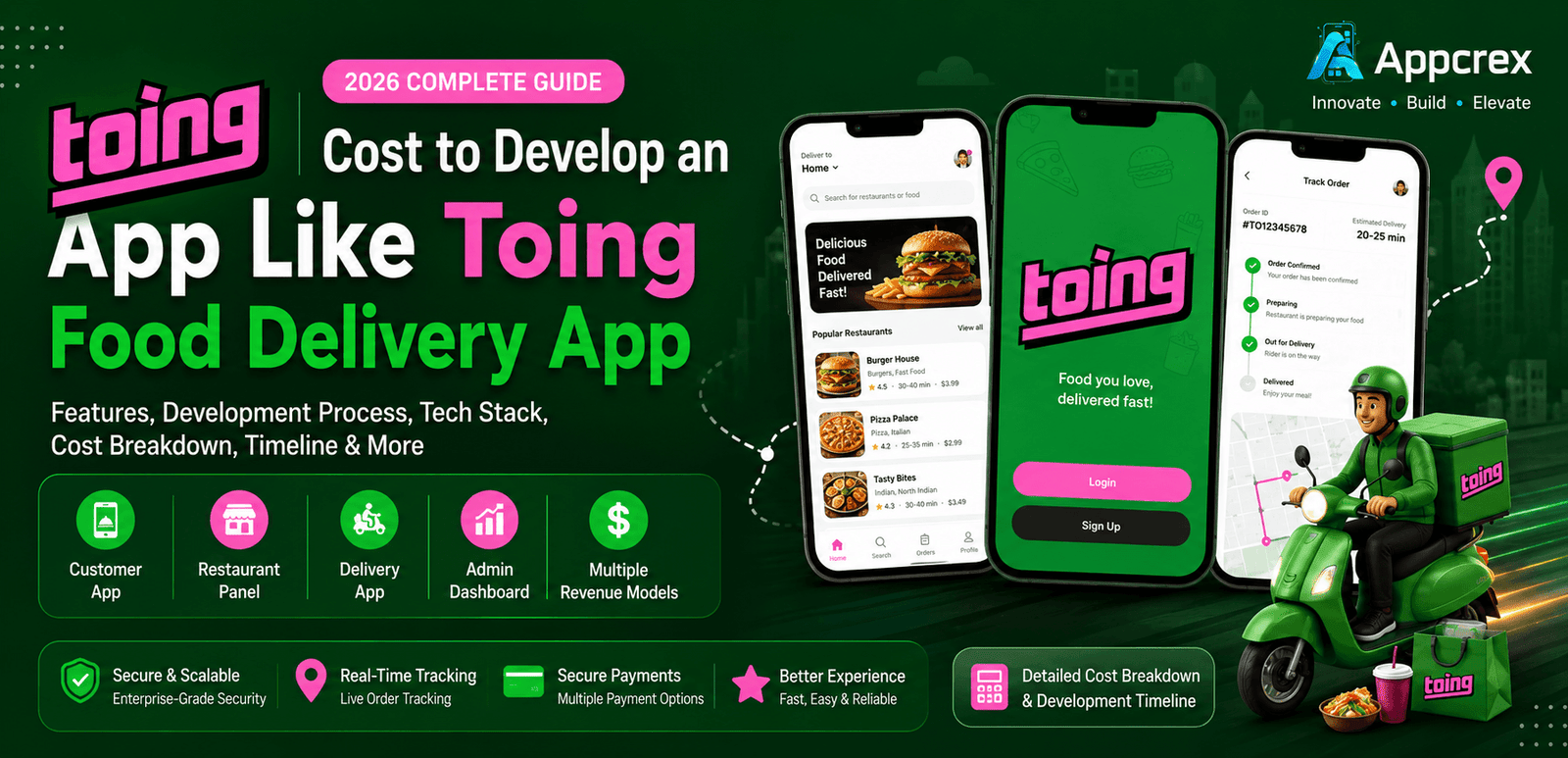
Toing is a food delivery platform that allows customers to browse restaurants, order food online, make payments, and track deliveries in real time.
Like most successful food delivery applications, Toing operates through multiple interfaces:
Customer Application
Used by customers to discover restaurants and place orders.
Restaurant Dashboard
Used by restaurants to manage menus and incoming orders.
Delivery Partner Application
Used by drivers to accept and deliver orders.
Admin Panel
Used by platform administrators to monitor operations.
Together, these components create a seamless food ordering experience.
Why Invest in Food Delivery App Development?
The online food delivery market continues to grow worldwide.
Key Market Drivers
Increasing Smartphone Usage
More consumers are ordering food through mobile apps.
Demand for Convenience
Customers prefer food delivered directly to their homes.
Digital Payments Growth
Cashless transactions have become increasingly popular.
Urban Lifestyle Changes
Busy lifestyles increase demand for food delivery services.
Restaurant Digitalization
Restaurants are investing more in online ordering systems.
Benefits of Building a Food Delivery App Like Toing
1. Wider Customer Reach
Mobile apps help restaurants reach customers beyond their physical locations.
2. Increased Revenue
Online ordering creates additional revenue opportunities.
3. Better Customer Experience
Food delivery apps provide convenience and faster service.
4. Customer Retention
Loyalty programs and personalized offers improve retention.
5. Valuable Business Insights
Analytics help businesses understand customer behavior and preferences.
Business Models for Food Delivery Apps
Before starting development, it’s important to understand different business models.
1. Restaurant-to-Customer Model
Restaurants manage deliveries themselves.
Examples
- Domino’s
- Pizza Hut
2. Aggregator Model
Restaurants join a platform and handle deliveries.
Examples
- Zomato (early model)
3. Marketplace with Delivery Model
Platform manages delivery logistics.
Examples
- Uber Eats
- DoorDash
- Toing
This is the most popular model today.
Essential Features for the Customer App
The customer app is the heart of any food delivery platform.
1. User Registration & Login
Users should be able to register through:
- Phone Number
- Google Login
- Apple Login
- Facebook Login
Benefits
Fast onboarding improves user acquisition.
2. User Profiles
Users can manage:
- Personal information
- Delivery addresses
- Payment methods
- Order history
3. Restaurant Discovery
Customers should easily find restaurants.
Search Filters
- Cuisine Type
- Distance
- Ratings
- Delivery Time
- Price Range
4. Restaurant Listings
Each restaurant profile should include:
- Restaurant Name
- Photos
- Ratings
- Delivery Time
- Menu Categories
5. Menu Management
Customers should be able to:
- Browse food items
- View images
- Read descriptions
- Select add-ons
- Customize orders
6. Shopping Cart
Cart functionality should allow users to:
- Add products
- Remove items
- Update quantities
- Apply discount codes
7. Secure Payment Gateway
Popular payment options include:
- Credit Cards
- Debit Cards
- PayPal
- Stripe
- Apple Pay
- Google Pay
8. Real-Time Order Tracking
One of the most important features.
Customers should track:
- Order Confirmation
- Food Preparation
- Driver Assignment
- Delivery Progress
- Order Completion
9. Push Notifications
Notifications keep customers informed.
Examples:
- Order Confirmed
- Food Prepared
- Driver Assigned
- Delivery Arriving
10. Ratings & Reviews
Allow customers to review:
- Restaurants
- Delivery Experience
- Food Quality
Reviews improve platform credibility.
Features for Restaurant Owners
Restaurants need dedicated tools to manage operations efficiently.
1. Restaurant Registration
Easy onboarding process.
Requirements:
- Business Details
- Tax Information
- Bank Details
2. Menu Management
Restaurants should be able to:
- Add Products
- Edit Prices
- Upload Images
- Manage Availability
3. Order Management
Restaurant staff can:
- Accept Orders
- Reject Orders
- Update Preparation Status
4. Sales Dashboard
Track:
- Daily Sales
- Weekly Revenue
- Top-Selling Items
- Customer Insights
5. Inventory Management
Advanced platforms can track ingredient availability.
Why User Experience Matters?
Food delivery is a highly competitive market.
A poor user experience can result in:
- Lower retention
- Reduced orders
- Negative reviews
Good UI/UX should focus on:
✔ Fast ordering
✔ Simple navigation
✔ Attractive visuals
✔ Smooth checkout process
✔ Quick search functionality
Cost Impact of Customer Features
| Feature | Estimated Cost |
|---|---|
| Registration/Login | $1,000–$3,000 |
| User Profiles | $1,500–$4,000 |
| Restaurant Listings | $3,000–$8,000 |
| Menu Management | $3,000–$10,000 |
| Cart System | $2,000–$5,000 |
| Payment Gateway | $2,000–$8,000 |
| Order Tracking | $5,000–$15,000 |
| Reviews & Ratings | $1,500–$4,000 |
Delivery Partner App Features
The delivery partner application is one of the most important components of a food delivery platform.
Without an efficient delivery system, customer satisfaction can quickly decline.
The delivery app helps drivers accept orders, navigate routes, and manage earnings efficiently.
1. Driver Registration & Verification
Before accepting deliveries, drivers must complete registration and verification.
Information Required
- Personal Details
- Phone Number
- Vehicle Information
- Driving License
- Identity Verification
- Bank Details
Benefits
- Platform security
- Fraud prevention
- Better operational management
Estimated Cost
$2,000 – $5,000
2. Order Notifications
Drivers should receive instant order requests.
Features
- New Order Alerts
- Order Acceptance
- Order Rejection
- Delivery Updates
Benefits
Faster response times improve delivery efficiency.
Estimated Cost
$2,000 – $6,000
Real-time navigation is essential for successful deliveries.
Features
- Route Guidance
- Turn-by-Turn Navigation
- Live Traffic Updates
- Distance Calculation
Popular APIs
- Google Maps API
- Mapbox
Estimated Cost
$4,000 – $10,000
4. Earnings Dashboard
Drivers need visibility into their earnings.
Features
- Daily Earnings
- Weekly Earnings
- Completed Deliveries
- Bonus Tracking
- Incentives
Estimated Cost
$2,000 – $5,000
5. Delivery History
Drivers can review previous deliveries.
Benefits
- Better transparency
- Performance tracking
- Earnings verification
Estimated Cost
$1,500 – $4,000
Admin Dashboard Features
The admin panel serves as the central control center of the entire platform.
Administrators manage customers, restaurants, delivery partners, revenue, and operations from a single dashboard.
1. User Management
Administrators can manage:
- Customers
- Restaurants
- Drivers
Features
- User Approval
- Account Suspension
- Verification Management
Estimated Cost
$3,000 – $8,000
2. Restaurant Management
Admin can:
- Approve Restaurants
- Manage Menus
- Review Performance
Estimated Cost
$3,000 – $8,000
3. Order Monitoring
Track all orders in real time.
Features
- Live Order Status
- Delivery Monitoring
- Issue Resolution
Estimated Cost
$3,000 – $10,000
4. Revenue Management
Monitor platform earnings.
Dashboard Metrics
- Commission Revenue
- Delivery Charges
- Subscription Revenue
- Promotional Campaign Results
Estimated Cost
$3,000 – $8,000
5. Marketing & Promotions
Admin can create:
- Coupons
- Discounts
- Referral Programs
- Loyalty Campaigns
Estimated Cost
$2,000 – $6,000
Advanced Features for Food Delivery Apps in 2026
Competition in the food delivery industry is intense.
Modern food delivery platforms increasingly rely on artificial intelligence and automation.
1. AI-Powered Food Recommendations
AI can suggest restaurants and dishes based on:
- Order History
- User Preferences
- Location
- Time of Day
Benefits
- Increased order value
- Better customer engagement
- Higher retention rates
Estimated Cost
$5,000 – $20,000
2. AI Chatbot Support
Chatbots provide instant customer support.
Use Cases
- Order Tracking
- Refund Requests
- Frequently Asked Questions
- Restaurant Information
Benefits
- Reduced support costs
- Faster response times
- Improved customer satisfaction
Estimated Cost
$5,000 – $15,000
3. Smart Route Optimization
AI can help drivers find the most efficient routes.
Benefits
- Faster deliveries
- Reduced fuel consumption
- Improved customer experience
Estimated Cost
$5,000 – $20,000
4. Predictive Analytics
AI can forecast:
- Peak Order Times
- Customer Demand
- Popular Food Categories
Benefits
- Better resource planning
- Improved restaurant operations
Estimated Cost
$5,000 – $15,000
Technology Stack for Toing-Like Food Delivery App Development
Selecting the right technology stack impacts performance, scalability, and future growth.
1. Frontend Development
Frontend technologies create the customer-facing interface.
Popular Choices
Flutter
Benefits:
- Single Codebase
- Fast Development
- Lower Costs
React Native
Benefits:
- Cross-Platform Support
- Strong Community
- Faster Time-to-Market
For most startups, Flutter is often the preferred choice.
2. Backend Development
The backend manages:
- Orders
- Users
- Payments
- Notifications
Popular Technologies
- Node.js
- Python
- Java
- .NET
Recommended Choice
Node.js is widely used for food delivery app development due to its speed and scalability.
3. Database Technologies
Food delivery platforms handle large amounts of data.
Popular Databases
- PostgreSQL
- MySQL
- MongoDB
Recommended Database
PostgreSQL offers excellent reliability and performance.
4. Cloud Infrastructure
Cloud hosting enables scalability and high availability.
Popular Providers
- AWS
- Google Cloud
- Microsoft Azure
Benefits
- Global Infrastructure
- Automatic Scaling
- Better Security
5. Third-Party Integrations
Most food delivery apps integrate external services.
Common Integrations
Payment Gateways
- Stripe
- PayPal
- Razorpay
SMS Services
- Twilio
- MessageBird
Push Notifications
- Firebase Cloud Messaging
- Google Maps
- Mapbox
Food Delivery App Development Process
A structured development process ensures successful project execution.
Phase 1: Market Research
Research helps identify:
- Competitors
- Market Opportunities
- Customer Needs
Duration
1–2 Weeks
Phase 2: Requirement Analysis
Define:
- Features
- User Flows
- Business Goals
Duration
1–2 Weeks
Phase 3: UI/UX Design
Design includes:
- Wireframes
- User Journeys
- Interactive Prototypes
Duration
3–5 Weeks
Phase 4: Development
Build:
- Customer App
- Restaurant Dashboard
- Driver App
- Admin Panel
Duration
10–20 Weeks
Phase 5: Testing
Testing includes:
- Functional Testing
- Security Testing
- Performance Testing
Duration
2–4 Weeks
Phase 6: Deployment
Launch applications on:
- App Store
- Google Play Store
- Cloud Servers
Duration
1 Week
Also Read : Custom Software Development Company: Complete Guide to Services, Process, Cost & Benefits (2026)
Cost to Develop an App Like Toing
The final cost depends on features, platforms, and business requirements.
Basic MVP Food Delivery App
Features:
- Customer App
- Restaurant Dashboard
- Basic Admin Panel
- Payment Gateway
Cost
$20,000 – $40,000
Mid-Level Food Delivery Platform
Features:
- Real-Time Tracking
- Loyalty Program
- Reviews
- Driver Application
Cost
$40,000 – $80,000
Advanced Toing-Like Platform
Features:
- AI Recommendations
- Route Optimization
- Advanced Analytics
- Multi-City Support
- Enterprise Security
Cost
$80,000 – $200,000+
Detailed Development Cost Breakdown
| Component | Estimated Cost |
|---|---|
| Market Research | $2,000 – $5,000 |
| UI/UX Design | $5,000 – $15,000 |
| Customer App | $10,000 – $40,000 |
| Restaurant Dashboard | $8,000 – $25,000 |
| Driver App | $8,000 – $25,000 |
| Admin Dashboard | $5,000 – $20,000 |
| Payment Integration | $2,000 – $8,000 |
| GPS Tracking | $3,000 – $10,000 |
| AI Features | $5,000 – $30,000 |
| QA Testing | $3,000 – $10,000 |
How Long Does It Take to Build an App Like Toing?
| Project Type | Timeline |
|---|---|
| MVP | 2–4 Months |
| Mid-Level Platform | 4–8 Months |
| Enterprise Platform | 8–12 Months |
How Food Delivery Apps Make Money?
One of the biggest reasons entrepreneurs invest in food delivery app development is the potential for recurring revenue.
A successful food delivery platform generates income from multiple sources.
1. Restaurant Commission
This is the most common revenue model.
The platform charges restaurants a commission on every order.
Example
If a customer places a $20 order and the platform charges a 20% commission:
- Restaurant receives: $16
- Platform earns: $4
Benefits
- Recurring revenue
- Scales with order volume
- Highly profitable
2. Delivery Charges
Customers pay a delivery fee for each order.
The fee may vary depending on:
- Distance
- Demand
- Delivery Speed
Benefits
Provides additional revenue beyond commissions.
3. Subscription Programs
Food delivery platforms often introduce membership plans.
Examples
Users pay monthly or yearly subscriptions for:
- Free Delivery
- Priority Support
- Exclusive Discounts
- Loyalty Rewards
Benefits
Creates predictable recurring income.
4. Featured Restaurant Listings
Restaurants pay to appear at the top of search results.
Benefits
- Higher restaurant visibility
- Additional platform revenue
5. In-App Advertising
Platforms can generate advertising revenue by promoting:
- Restaurants
- New Food Items
- Special Offers
Benefits
Highly scalable advertising model.
6. Surge Pricing
During peak hours, delivery fees may increase.
Examples
- Lunch Rush
- Dinner Rush
- Weekends
- Holidays
Benefits
Improves profitability during high-demand periods.
Also Read : React Native App Development Company: Complete Guide to Cross-Platform App Development (2026)
Factors Affecting Food Delivery App Development Cost
The final development budget depends on numerous factors.
Number of Platforms
Development costs vary based on platform selection.
Single Platform
- Android Only
- iOS Only
Lower development cost.
Cross-Platform
- Flutter
- React Native
Moderate cost with broader reach.
Native Development
- Separate Android App
- Separate iOS App
Highest development cost.
Feature Complexity
Basic food ordering systems cost significantly less than enterprise-grade solutions.
Examples of advanced features include:
- AI Recommendations
- Real-Time Tracking
- Loyalty Programs
- Multi-Restaurant Ordering
- Advanced Analytics
UI/UX Design Requirements
Custom designs increase development effort.
Premium designs generally improve:
- User engagement
- Retention
- Conversion rates
Third-Party Integrations
Food delivery apps often require integrations with:
- Payment Gateways
- GPS Services
- SMS Providers
- Push Notification Systems
Each integration adds development effort.
Development Team Location
Development rates vary globally.
Approximate Hourly Rates
| Region | Hourly Rate |
|---|---|
| USA | $100–$250 |
| UK | $80–$200 |
| Australia | $80–$180 |
| Europe | $50–$120 |
| India | $20–$60 |
Many startups choose offshore development to reduce costs while maintaining quality.
Challenges in Food Delivery App Development
Building a successful food delivery platform involves several technical and operational challenges.
1. Real-Time Order Tracking
Customers expect accurate tracking information.
Challenges include:
- GPS Accuracy
- Live Updates
- Driver Connectivity
2. Delivery Logistics
Managing drivers efficiently becomes increasingly difficult as the platform grows.
Challenges include:
- Driver Availability
- Route Optimization
- Peak Hour Demand
3. Restaurant Management
Maintaining restaurant quality and consistency requires ongoing monitoring.
Challenges include:
- Menu Accuracy
- Delivery Readiness
- Customer Complaints
4. User Retention
Acquiring customers is expensive.
Retaining them requires:
- Loyalty Programs
- Personalized Offers
- Excellent Service
5. Scalability
As order volume increases, infrastructure must support:
- More Users
- More Restaurants
- More Deliveries
Cloud-native architecture is essential.
Future Trends in Food Delivery Apps (2026)
The food delivery industry continues to evolve rapidly.
Businesses planning food delivery app development should consider future trends.
1. AI-Powered Personalization
Artificial Intelligence is transforming customer experiences.
AI can:
- Recommend Restaurants
- Suggest Meals
- Predict Preferences
- Improve Upselling
Benefits
Higher customer engagement and increased order values.
2. Voice Ordering
Voice assistants are becoming increasingly popular.
Customers can place orders using:
- Google Assistant
- Siri
- Alexa
Benefits
Faster ordering experience.
3. Hyperlocal Delivery
Consumers increasingly expect ultra-fast delivery.
Many platforms now target:
- 10–30 Minute Deliveries
- Local Restaurants
- Neighborhood Stores
4. Drone and Autonomous Deliveries
Several companies are experimenting with:
- Delivery Drones
- Autonomous Vehicles
- Robotics
While still emerging, these technologies may reshape logistics in the future.
5. Sustainability Features
Eco-friendly initiatives are becoming important.
Examples include:
- Electric Delivery Vehicles
- Sustainable Packaging
- Carbon Footprint Tracking
6. AI Customer Support
AI-powered chatbots are becoming standard.
Benefits include:
- Instant Responses
- Reduced Costs
- 24/7 Availability
Why Choose AppCrex for Food Delivery App Development?
At AppCrex, we help startups and enterprises build scalable food delivery platforms tailored to their business goals.
Our Services Include
- Food Delivery App Development
- Custom Mobile App Development
- Flutter App Development
- React Native Development
- On-Demand App Development
- SaaS Development
- AI Integration Services
Why Businesses Choose AppCrex?
✔ Experienced Mobile App Developers
✔ Agile Development Methodology
✔ Scalable Architecture
✔ Enterprise-Grade Security
✔ Cost-Effective Solutions
✔ Ongoing Support & Maintenance
Whether you’re building an MVP or a large-scale food delivery ecosystem, AppCrex can help transform your idea into a successful digital product.
Also Read : What Is an MVP in App Development? A Complete Guide
Frequently Asked Questions
Q. How much does it cost to develop an app like Toing?
The cost typically ranges from $20,000 to $200,000+, depending on features, platforms, and complexity.
Q. How long does it take to build a food delivery app like Toing?
Development timelines usually range from 2 months to 12 months.
Q. Which technology is best for food delivery app development?
Popular technologies include:
- Flutter
- React Native
- Node.js
- PostgreSQL
- AWS
Q. Can AI be integrated into a food delivery app?
Yes. AI can power:
- Food Recommendations
- Chatbots
- Route Optimization
- Demand Forecasting
Q. How do food delivery apps generate revenue?
Common revenue streams include:
- Restaurant Commissions
- Delivery Charges
- Membership Plans
- Advertising
- Featured Listings
Q. Is food delivery app development profitable?
Yes. The online food delivery market continues to grow globally, creating strong business opportunities.
Q. Should startups launch an MVP first?
Absolutely.
Launching an MVP helps:
- Validate Ideas
- Reduce Costs
- Gather User Feedback
- Reach Market Faster
Q. What is the biggest cost factor?
Feature complexity and platform selection typically have the greatest impact on development costs.
Q. Can I build a food delivery app for a single city?
Yes. Many successful food delivery startups begin by focusing on a specific geographic area before expanding.
Q. What maintenance costs should I expect?
Annual maintenance typically costs 15–20% of the initial development budget.
Final Cost Summary
| Platform Type | Estimated Cost |
|---|---|
| Basic MVP | $20,000 – $40,000 |
| Mid-Level Platform | $40,000 – $80,000 |
| Advanced Food Delivery App | $80,000 – $200,000+ |
Conclusion
The food delivery industry continues to present significant opportunities for startups, restaurant chains, and entrepreneurs. Apps like Toing have demonstrated how digital platforms can simplify food ordering, improve customer convenience, and create scalable business models.
The cost to develop an app like Toing depends on various factors, including features, technology stack, platform selection, integrations, and scalability requirements. A basic MVP can cost around $20,000–$40,000, while a fully-featured enterprise platform may require an investment of $200,000 or more.
Businesses that focus on user experience, real-time tracking, AI-driven personalization, and scalable architecture will be better positioned to succeed in the competitive food delivery market. Partnering with an experienced mobile app development company like AppCrex can help reduce risks, accelerate development, and ensure long-term success.