📌 Key Takeaways
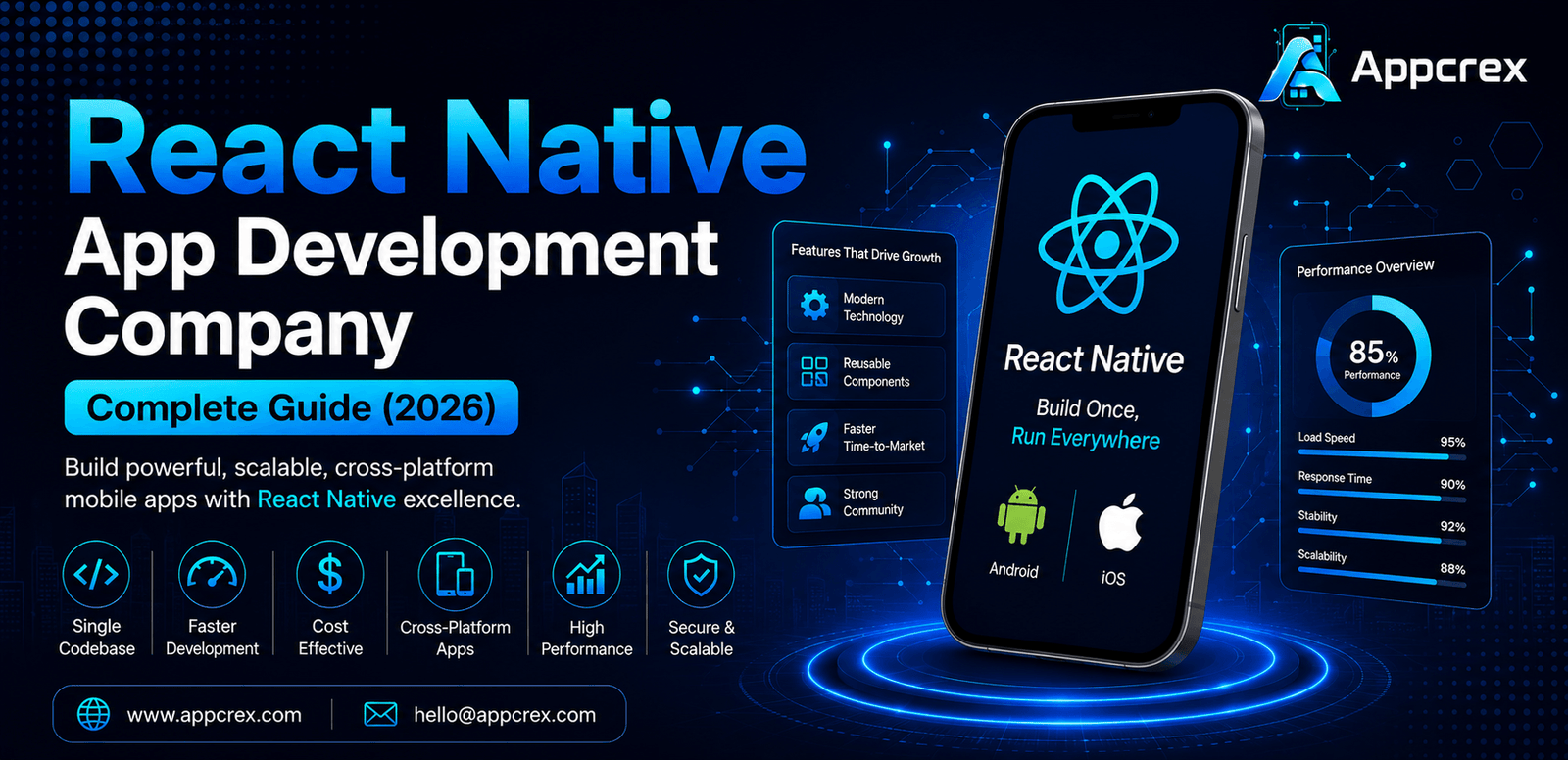
- React Native enables Android and iOS app development using a single codebase.
- Businesses can reduce development costs by up to 40%.
- React Native offers near-native performance and faster time-to-market.
- It is suitable for startups, SMEs, and enterprise applications.
- AppCrex helps businesses build scalable and feature-rich React Native apps.
Introduction
In today’s mobile-first world, businesses need applications that can reach users across multiple platforms while maintaining performance, scalability, and cost efficiency. Developing separate applications for Android and iOS often requires larger budgets, longer timelines, and multiple development teams.
This is why many businesses choose React Native.
Developed by Meta (formerly Facebook), React Native is one of the most popular frameworks for building cross-platform mobile applications. It enables developers to create Android and iOS apps using a single codebase, reducing development costs and accelerating product launches.
As demand for mobile solutions continues to grow, businesses increasingly seek a trusted React Native app development company to build modern, scalable applications.
In this guide, we’ll explore React Native development services, benefits, costs, industries, and everything you need to know before starting your project.
What is React Native?
React Native is an open-source mobile application development framework developed by Meta.
It allows developers to build:
- Android Applications
- iOS Applications
- Cross-Platform Mobile Apps
using JavaScript and React.
Unlike traditional mobile development approaches, React Native enables businesses to use a single codebase for multiple platforms, reducing development effort and maintenance costs.
Since its launch, React Native has become a preferred framework for startups, enterprises, and global brands.
Why Businesses Choose React Native?
Companies choose React Native because it offers an ideal balance between performance, speed, and cost efficiency.
Traditional development often requires:
- Separate Android Development
- Separate iOS Development
- Larger Teams
- Higher Costs
React Native solves these challenges by allowing developers to reuse code across platforms.
Benefits include:
- Faster Development
- Reduced Costs
- Easier Maintenance
- Faster Product Launches
- Consistent User Experience
This makes React Native a powerful solution for businesses of all sizes.
Global Adoption of React Native
React Native is trusted by some of the world’s leading organizations.
Popular companies using React Native include:
- Meta
- Shopify
- Tesla
- Discord
- Bloomberg
Its popularity continues to grow because of its flexibility, scalability, and strong developer ecosystem.
Also Read : How Much Does It Cost to Develop an App in 2026? Complete Pricing Guide
Benefits of React Native App Development
Single Codebase Development
One of React Native’s biggest advantages is code reusability.
Developers can use one codebase for:
- Android Apps
- iOS Apps
This reduces development time and simplifies maintenance.
Business Benefits
- Lower Development Costs
- Faster Launch
- Easier Updates
- Reduced Maintenance
Faster Development Process
React Native accelerates development through reusable components and extensive libraries.
Businesses can:
- Launch Products Faster
- Reduce Development Cycles
- Release Updates Efficiently
Faster development often leads to better business outcomes.
Cost-Effective Mobile App Development
Since one team can build applications for both Android and iOS, businesses save significant development costs.
Estimated Savings
Companies can often reduce development expenses by:
30–40%
compared to native development.
1. Near-Native Performance
React Native delivers excellent performance for most business applications.
Benefits include:
- Fast User Interfaces
- Smooth Navigation
- Responsive Experiences
- Optimized Performance
This makes it suitable for a wide variety of mobile applications.
2. Large Developer Community
React Native benefits from a massive global developer ecosystem.
Advantages include:
- Faster Problem Solving
- Continuous Updates
- Extensive Libraries
- Strong Community Support
This ensures long-term stability and scalability.
3. Faster Time-to-Market
Businesses often choose React Native because it enables rapid product launches.
This is especially beneficial for:
- Startups
- MVP Development
- Product Validation
- Competitive Markets
Launching faster can provide a significant business advantage.
Industries Using React Native
React Native supports applications across multiple industries.
1. Healthcare
Healthcare companies use React Native for:
- Telemedicine Apps
- Patient Portals
- Appointment Scheduling
- Health Tracking Apps
2. FinTech
Financial organizations use React Native for:
- Mobile Banking
- Payment Applications
- Digital Wallets
- Investment Platforms
3. eCommerce
Retail businesses use React Native for:
- Shopping Apps
- Online Marketplaces
- Loyalty Programs
- Order Tracking
4. Education
Educational institutions use React Native for:
- Learning Apps
- Virtual Classrooms
- Student Portals
- Online Course Platforms
5. Logistics
Logistics companies use React Native for:
- Delivery Tracking
- Fleet Management
- Route Optimization
- Shipment Monitoring
6. Real Estate
Real estate businesses use React Native for:
- Property Listings
- Virtual Tours
- Agent Portals
- Lead Management Systems
Why Startups Prefer React Native?
Startups often have limited budgets and tight launch timelines.
React Native helps by providing:
Faster MVP Development
Launch products quickly.
Reduced Costs
Lower development expenses.
Easier Scaling
Expand applications as the business grows.
Faster Market Validation
Test business ideas efficiently.
These advantages make React Native a popular choice among startups worldwide.
Also Read : React Native vs Flutter: Which Framework Should You Choose for Mobile App Development in 2026?
React Native vs Flutter
One of the most common questions businesses ask is whether they should choose React Native or Flutter.
Both frameworks support cross-platform development but have different strengths.
1. React Native
Developed by Meta.
Programming Language:
- JavaScript
Benefits:
- Large Developer Community
- Faster Hiring
- Extensive Third-Party Libraries
- Strong Ecosystem
2. Flutter
Developed by Google.
Programming Language:
- Dart
Benefits:
- Better UI Customization
- Rich Widgets
- Consistent Design Across Platforms
- Excellent Performance
Comparison Table
| Feature | React Native | Flutter |
|---|---|---|
| Owner | Meta | |
| Language | JavaScript | Dart |
| Community | Very Large | Large |
| UI Flexibility | High | Very High |
| Performance | Excellent | Excellent |
| Development Speed | Fast | Fast |
| Learning Curve | Easier | Moderate |
For businesses already using JavaScript technologies, React Native is often the preferred choice.
React Native vs Native Development
Native development requires building separate applications for Android and iOS.
Native Technologies
- Android: Kotlin
- iOS: Swift
While native apps offer maximum platform-specific control, they also require:
- Separate Teams
- Higher Budgets
- Longer Timelines
React Native Advantages
Single Codebase
Develop once and deploy across multiple platforms.
Lower Costs
Reduce development expenses significantly.
Faster Development
Launch products more quickly.
Easier Maintenance
Update one codebase instead of two.
For most business applications, React Native provides an excellent balance between performance and cost.
React Native App Development Services
A professional React Native development company offers end-to-end services tailored to business needs.
1. Custom React Native App Development
Every business has unique requirements.
Custom development includes:
- Business-Specific Features
- Custom Workflows
- Unique User Experiences
- Scalable Architecture
Custom applications help organizations gain a competitive advantage.
2. Enterprise React Native App Development
Large organizations require robust and scalable mobile solutions.
Enterprise applications often include:
- CRM Integration
- ERP Integration
- Advanced Analytics
- Role-Based Access
- Cloud Infrastructure
React Native supports enterprise-grade application development effectively.
3. MVP Development
Startups often begin with a Minimum Viable Product (MVP).
Benefits of MVP development include:
- Faster Market Entry
- Reduced Risk
- Lower Initial Investment
- User Feedback Collection
React Native is an ideal framework for rapid MVP launches.
4. UI/UX Design Services
User experience directly impacts app adoption and retention.
React Native UI/UX services include:
- Wireframing
- Prototyping
- User Flow Design
- Mobile Interface Design
- Usability Testing
A well-designed application improves engagement and customer satisfaction.
5. App Migration Services
Businesses with older applications often migrate to React Native.
Migration benefits include:
- Reduced Maintenance Costs
- Improved Performance
- Better User Experience
- Modern Technology Stack
Migration can be performed from:
- Legacy Mobile Apps
- Native Applications
- Hybrid Applications
6. Maintenance & Support Services
Post-launch support is essential for long-term success.
Maintenance includes:
- Bug Fixes
- Security Updates
- Performance Optimization
- Feature Enhancements
- OS Compatibility Updates
Regular maintenance ensures applications remain secure and competitive.
React Native App Development Process
Successful projects follow a structured development methodology.
1. Discovery & Planning
The project begins with understanding business goals and user requirements.
Activities include:
- Requirement Analysis
- Market Research
- Competitor Analysis
- Feature Planning
Deliverables:
- Project Roadmap
- Technical Specifications
- Development Strategy
2. UI/UX Design
Designers create user-friendly experiences before development begins.
Activities include:
- Wireframes
- Interactive Prototypes
- User Journeys
- Mobile UI Design
The objective is to ensure a seamless user experience.
3. React Native Development
The development phase includes both frontend and backend implementation.
Frontend Development
Includes:
- Screens
- Navigation
- User Interactions
- Animations
Backend Development
Includes:
- APIs
- Databases
- Authentication
- Admin Panels
API Integration
Modern applications depend heavily on third-party integrations.
Common integrations include:
Payment Gateways
- Stripe
- PayPal
- Razorpay
- PayTabs
Communication Tools
- WhatsApp APIs
- SMS Services
- Email Services
- Google Maps
- Mapbox
Analytics Platforms
- Firebase Analytics
- Google Analytics
API integrations improve functionality and user experience.
Cloud Integration
Cloud infrastructure enables applications to scale efficiently.
Popular cloud platforms include:
Amazon Web Services (AWS)
Benefits:
- High Availability
- Scalability
- Security
Google Cloud Platform
Benefits:
- AI Capabilities
- Reliable Infrastructure
- Global Reach
Microsoft Azure
Benefits:
- Enterprise Security
- Hybrid Cloud Support
- Advanced Analytics
Cloud integration is essential for modern business applications.
Testing & Quality Assurance
Quality assurance ensures reliable performance across devices and operating systems.
Testing activities include:
Functional Testing
Verifies all features operate correctly.
Performance Testing
Measures application speed and responsiveness.
Security Testing
Identifies vulnerabilities and security risks.
Compatibility Testing
Ensures smooth operation across multiple devices.
A trusted React Native app development company prioritizes quality before deployment.
Security Best Practices
Security is a critical component of mobile application development.
Best practices include:
- Secure Authentication
- Data Encryption
- Secure API Communication
- Role-Based Access Control
- Compliance Standards
These measures help protect user data and business information.
React Native for Startups
React Native is particularly attractive to startups because it offers:
Lower Development Costs
Build Android and iOS apps with one team.
Faster Launches
Bring products to market quickly.
Easier Scaling
Expand functionality as user demand grows.
Faster Validation
Test ideas before large investments.
React Native for Enterprises
Large organizations benefit from:
- Scalable Architecture
- Enterprise Integrations
- Security Controls
- Advanced Analytics
- Multi-Platform Reach
React Native enables enterprises to deliver modern mobile experiences efficiently.
How Much Does React Native App Development Cost?
One of the primary reasons businesses choose React Native is its ability to reduce development costs without sacrificing performance.
Since React Native uses a single codebase for Android and iOS, businesses can save significant resources compared to native development.
The actual React Native app development cost depends on project scope, complexity, integrations, and design requirements.
| App Type | Estimated Cost |
|---|---|
| Basic React Native App | $5,000 – $15,000 |
| Medium Complexity App | $15,000 – $40,000 |
| Advanced App | $40,000 – $100,000 |
| Enterprise Application | $100,000+ |
Cost by App Complexity
1. Basic React Native Apps
Suitable for startups and small businesses.
Features
- User Registration
- Login System
- User Profiles
- Push Notifications
- Content Management
Timeline
1–3 Months
Estimated Cost
$5,000 – $15,000
2. Medium Complexity Apps
Ideal for growing businesses.
Features
- Payment Gateway Integration
- GPS Tracking
- Booking Systems
- Chat Features
- Analytics Dashboard
Timeline
3–6 Months
Estimated Cost
$15,000 – $40,000
3. Advanced React Native Applications
Designed for enterprises and large-scale digital products.
Features
- AI Integration
- Video Streaming
- Real-Time Tracking
- Enterprise Integrations
- Advanced Security
Timeline
6–12 Months
Estimated Cost
$40,000 – $100,000+
Factors Affecting React Native App Development Cost
Several factors determine the final project budget.
1. App Complexity
More features require additional development effort.
Examples include:
- FinTech Apps
- Healthcare Platforms
- Marketplaces
- Social Networks
Complex applications naturally require larger budgets.
2. UI/UX Design
Custom design influences both development effort and user engagement.
Design activities include:
- Wireframes
- User Flows
- Interactive Prototypes
- Custom Visual Design
A strong user experience can significantly improve customer retention.
3. Third-Party Integrations
Many applications require integration with external services.
Examples include:
- Payment Gateways
- CRM Systems
- ERP Platforms
- Messaging Services
- Cloud Solutions
The more integrations required, the higher the development cost.
4. Backend Development
Backend infrastructure powers application functionality.
Common backend components include:
- Databases
- Authentication Systems
- APIs
- Admin Panels
- Reporting Dashboards
More advanced backend requirements increase project costs.
5. AI Integration
AI-powered features are becoming increasingly popular.
Examples include:
- AI Chatbots
- Recommendation Engines
- Predictive Analytics
- Voice Assistants
Also Read : AI Chatbot Development Company: Complete Guide to Features, Benefits, Cost & Trends (2026)
These features add value but also require additional development resources.
Industries That Use React Native
React Native supports applications across various industries.
1. Healthcare
Healthcare organizations use React Native for:
- Telemedicine Apps
- Patient Portals
- Appointment Scheduling
- Health Monitoring Applications
Benefits:
- Cross-Platform Reach
- Faster Development
- Cost Efficiency
2. FinTech
Financial companies use React Native for:
- Mobile Banking
- Digital Wallets
- Investment Platforms
- Payment Applications
Benefits:
- Secure Transactions
- Excellent Performance
- Scalable Architecture
3. eCommerce
Retail businesses use React Native for:
- Shopping Apps
- Multi-Vendor Marketplaces
- Loyalty Programs
- Order Tracking
Benefits:
- Faster Product Launches
- Better User Experience
- Lower Costs
4. Education
Educational organizations use React Native for:
- E-Learning Platforms
- Student Portals
- Virtual Classrooms
- Learning Management Systems
Benefits:
- Easy Maintenance
- Broad Device Compatibility
- Interactive Experiences
5. Logistics
Logistics companies use React Native for:
- Fleet Tracking
- Route Optimization
- Delivery Management
- Shipment Monitoring
Benefits:
- Real-Time Functionality
- Operational Efficiency
- Scalability
6. Real Estate
Real estate businesses use React Native for:
- Property Listing Apps
- Virtual Tours
- Agent Management
- Lead Tracking Systems
Benefits:
- Rich User Interfaces
- Easy Feature Expansion
- Faster Updates
Why React Native is Ideal for Startups?
Startups need to move quickly while controlling costs.
React Native helps achieve both goals.
1. Faster MVP Development
Launch products quickly and validate ideas.
2. Reduced Development Costs
Build Android and iOS apps with one development team.
3. Easier Scaling
Add new features as the business grows.
4. Faster Market Validation
Collect user feedback early and improve continuously.
For startups, React Native often delivers an excellent return on investment.
Why Choose AppCrex as Your React Native App Development Company?
Choosing the right technology partner can significantly impact project success.
At AppCrex, we help startups, SMEs, and enterprises build scalable React Native applications that deliver exceptional user experiences.
Our React Native Development Services
- Custom React Native App Development
- Enterprise Application Development
- MVP Development
- UI/UX Design
- API Integration
- Cloud Integration
- App Migration Services
- Maintenance & Support
Why Businesses Choose AppCrex?
1. Experienced React Native Developers
Our team has extensive experience building modern mobile applications.
2. Agile Development Approach
We deliver projects faster through agile methodologies.
3. Scalable Architecture
Applications are designed for long-term growth.
4. Transparent Communication
Clients remain informed throughout the project lifecycle.
5. Ongoing Support
We provide maintenance, upgrades, and technical assistance after launch.
6. Cost-Effective Solutions
Our focus is on delivering maximum value while maintaining quality.
Frequently Asked Questions
Q. What is React Native?
React Native is an open-source framework developed by Meta for building Android and iOS applications using a single JavaScript codebase.
Q. Why should I choose React Native for app development?
React Native offers faster development, lower costs, code reusability, and near-native performance.
Q. How much does React Native app development cost?
React Native app development typically ranges from $5,000 to $100,000+, depending on project complexity and features.
Q. Is React Native better than Flutter?
Both frameworks are excellent. React Native benefits from JavaScript’s large ecosystem, while Flutter offers stronger UI customization.
Q. Can React Native be used for enterprise applications?
Yes. React Native supports enterprise-grade applications with advanced integrations, security controls, and scalability.
Q. Is React Native suitable for startups?
Absolutely. React Native is ideal for startups because it reduces development costs and accelerates product launches.
Q. Can React Native integrate with AI?
Yes. React Native applications can integrate AI-powered features such as chatbots, recommendation engines, predictive analytics, and automation tools.
Q. How long does it take to develop a React Native app?
Most React Native projects take between 2 and 8 months, depending on complexity and business requirements.
Conclusion
React Native has become one of the most popular frameworks for cross-platform mobile application development. Its ability to reduce costs, accelerate development, and deliver near-native performance makes it an excellent choice for startups, growing businesses, and enterprises.
Whether you’re building a healthcare application, eCommerce platform, FinTech solution, logistics system, or AI-powered mobile app, partnering with an experienced React Native app development company can help ensure project success.
At AppCrex, we combine technical expertise, modern development practices, and business-focused strategies to create high-performance React Native applications that drive growth and deliver measurable results.