📌 Key Takeaways
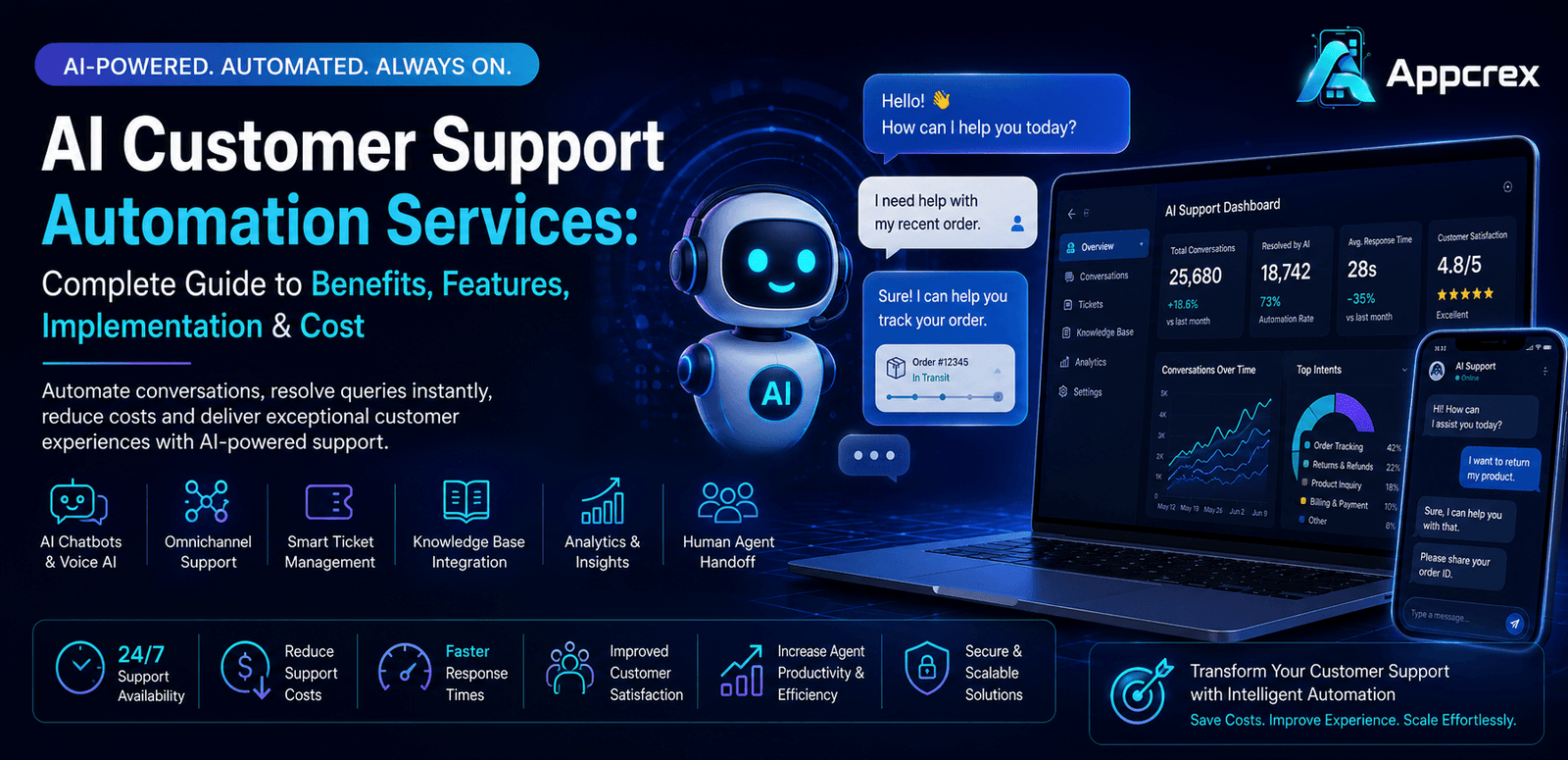
- AI customer support automates responses and improves service quality.
- 24/7 AI-powered assistance reduces response times and support costs.
- Smart chatbots and AI agents handle repetitive customer queries efficiently.
- AI integrates with CRM, helpdesk, and business tools for seamless support.
- AppCrex delivers secure, scalable, and custom AI customer support automation solutions.
Introduction
Customer expectations have changed dramatically over the past few years. Today’s customers expect businesses to respond instantly, provide personalized assistance, and resolve issues across multiple channels—whether through websites, mobile apps, email, social media, or messaging platforms. Delivering this level of service using only human support teams is becoming increasingly difficult and expensive.
This is where AI Customer Support Automation Services are transforming the customer experience.
Powered by Artificial Intelligence (AI), Large Language Models (LLMs), Natural Language Processing (NLP), Machine Learning (ML), and Generative AI, AI-powered customer support solutions can automate repetitive tasks, answer customer questions instantly, route complex issues to the right departments, and assist support teams with intelligent recommendations.
Unlike traditional chatbots that rely on predefined scripts, modern AI customer support systems understand context, remember previous conversations, retrieve information from company knowledge bases, and provide human-like responses. They can work 24/7, handle thousands of conversations simultaneously, and continuously improve through learning and feedback.
Businesses across industries—including healthcare, banking, eCommerce, SaaS, education, travel, logistics, and telecommunications—are adopting AI customer support automation to reduce operational costs, improve customer satisfaction, and increase agent productivity.
In this comprehensive guide, you’ll learn everything about AI Customer Support Automation Services, including how they work, their key features, benefits, implementation process, technology stack, development costs, real-world use cases, best practices, and future trends in 2026.
What is AI Customer Support Automation?
AI Customer Support Automation is the use of Artificial Intelligence technologies to automate customer service processes, reduce manual effort, and provide fast, accurate, and personalized support across multiple communication channels.
Instead of relying entirely on human agents, businesses deploy AI-powered virtual assistants, intelligent chatbots, voice bots, and AI agents that can understand customer intent, answer questions, retrieve information, create support tickets, process requests, and even perform actions such as refund processing or appointment scheduling.
Modern AI customer support systems are capable of handling both simple and complex interactions while working alongside human support teams. When an issue requires human intervention, the AI seamlessly transfers the conversation along with the full context, ensuring a smooth customer experience.
Just read : Multi-Agent AI Development: Complete Guide to Architecture, Benefits, Cost & Use Cases
Why AI Customer Support Automation Matters in 2026
Customer support has evolved from being a reactive service function to a strategic business advantage. Companies that deliver faster, more personalized support are more likely to retain customers, increase loyalty, and strengthen their brand reputation.
Several trends are driving the rapid adoption of AI Customer Support Automation in 2026:
Rising Customer Expectations
Customers expect immediate responses regardless of the time of day. AI-powered systems enable businesses to provide 24/7 support without increasing staffing costs.
Growing Support Volumes
As businesses expand, customer inquiries increase across websites, mobile apps, email, live chat, WhatsApp, and social media. AI can manage thousands of simultaneous conversations, helping organizations scale efficiently.
Cost Optimization
Hiring and training large customer support teams is expensive. AI automation reduces repetitive workloads, allowing human agents to focus on complex and high-value interactions.
Advances in Generative AI
Large Language Models such as GPT, Claude, Gemini, and Llama have significantly improved conversational AI. These models understand context, generate natural responses, and support multilingual communication, making AI-powered customer service more effective than ever.
Omnichannel Customer Engagement
Customers interact with businesses through multiple channels. AI customer support platforms provide consistent experiences across web chat, mobile apps, email, voice assistants, and messaging platforms, ensuring seamless communication.
How AI Customer Support Automation Works?
AI Customer Support Automation combines several advanced technologies to understand customer requests, retrieve relevant information, and provide accurate responses.
A typical workflow includes:
- A customer submits a query through a website, mobile app, live chat, email, or messaging platform.
- The AI system analyzes the message using Natural Language Processing (NLP) to determine the customer’s intent.
- The AI retrieves relevant information from a knowledge base, CRM, or connected business systems using Retrieval-Augmented Generation (RAG).
- The Large Language Model generates a contextual and human-like response.
- If the issue is simple, the AI resolves it automatically. For complex cases, the conversation is escalated to a human agent along with the conversation history and relevant context.
- The AI learns from interactions and continuously improves its performance over time.
This intelligent workflow enables businesses to deliver faster, more accurate, and highly personalized customer support.
Core Technologies Behind AI Customer Support Automation
Modern AI customer support solutions rely on several technologies working together.
Large Language Models (LLMs)
LLMs are the intelligence behind AI-powered conversations. They understand natural language, generate responses, summarize conversations, and assist with complex problem-solving.
Popular LLMs include:
- OpenAI GPT
- Anthropic Claude
- Google Gemini
- Meta Llama
- Mistral AI
Natural Language Processing (NLP)
NLP enables AI to understand customer language, including intent, sentiment, grammar, and context. It allows the system to interpret questions even when phrased differently.
Retrieval-Augmented Generation (RAG)
Rather than relying only on pre-trained knowledge, RAG allows AI to retrieve the latest information from:
- Company documentation
- FAQs
- Help centers
- Product manuals
- Internal databases
- CRM systems
- Knowledge bases
This significantly improves response accuracy and reduces AI hallucinations.
Machine Learning (ML)
Machine Learning enables AI systems to improve continuously by learning from historical interactions, customer feedback, and support outcomes.
Over time, the AI becomes better at identifying customer intent, recommending solutions, and predicting common issues.
AI Agent Orchestration
Advanced customer support platforms use multiple AI agents working together.
For example:
- Greeting Agent
- Intent Detection Agent
- Knowledge Retrieval Agent
- Troubleshooting Agent
- Ticket Creation Agent
- Escalation Agent
- Feedback Collection Agent
This Multi-Agent AI architecture improves efficiency and enables specialized handling of different tasks.
CRM and Help Desk Integration
AI customer support solutions integrate with platforms such as:
- Salesforce
- HubSpot
- Zendesk
- Freshdesk
- Zoho CRM
- Microsoft Dynamics 365
These integrations provide AI with access to customer profiles, purchase history, previous interactions, and support tickets, allowing for more personalized and effective assistance.
Key Features of AI Customer Support Automation
A successful AI customer support solution should do much more than answer basic customer questions. Modern AI platforms are designed to automate complex support operations, improve agent productivity, and deliver exceptional customer experiences.
Below are the essential features every AI Customer Support Automation solution should include.
Intelligent AI Chatbots
AI chatbots are the first point of contact for many customers. Unlike traditional rule-based chatbots, AI-powered chatbots understand natural language, maintain context throughout conversations, and provide personalized responses.
Key capabilities include:
- Human-like conversations
- Context awareness
- Multi-turn conversations
- Personalized recommendations
- Product guidance
- FAQ automation
- Appointment scheduling
- Order status updates
Modern AI chatbots can also understand spelling mistakes, slang, and conversational language, creating a more natural customer experience.
Omnichannel Customer Support
Customers interact with businesses through multiple communication channels. AI customer support platforms ensure consistent service regardless of where the conversation starts.
Supported channels include:
- Website live chat
- Mobile applications
- Facebook Messenger
- Telegram
- SMS
- Voice assistants
- Contact center software
With omnichannel support, conversations remain synchronized even when customers switch between channels.
AI-Powered Ticket Management
Managing thousands of customer tickets manually can overwhelm support teams. AI automates the entire ticket lifecycle.
The system can:
- Automatically create tickets
- Categorize requests
- Assign priority levels
- Route tickets to the correct department
- Detect duplicate tickets
- Recommend solutions
- Close resolved cases automatically
This significantly reduces response times while improving operational efficiency.
Smart Knowledge Base Search
One of the most valuable capabilities of AI customer support is intelligent information retrieval.
Instead of asking customers to search lengthy help articles, AI instantly retrieves relevant answers from:
- Product documentation
- FAQs
- User manuals
- Internal knowledge bases
- Company policies
- Technical guides
This enables customers to resolve issues faster while reducing support workload.
Sentiment Analysis
AI doesn’t just understand words—it also understands emotions.
Sentiment analysis helps businesses identify whether a customer is:
- Happy
- Confused
- Frustrated
- Angry
- Satisfied
- Urgent
If the AI detects negative sentiment, it can automatically escalate the conversation to a human support representative before the situation worsens.
Personalized Customer Support
Modern AI platforms integrate with CRM systems to understand customer history.
Before responding, AI can access:
- Previous conversations
- Purchase history
- Subscription plans
- Support tickets
- Customer preferences
- Loyalty status
This allows AI to provide highly personalized assistance rather than generic responses.
Voice AI Support
Customer support is no longer limited to text-based interactions.
Voice AI enables businesses to automate incoming phone calls using conversational AI.
Voice AI can:
- Answer calls
- Verify customer identity
- Understand spoken language
- Book appointments
- Process service requests
- Transfer calls
- Provide account information
Voice AI significantly reduces call center workloads while maintaining high-quality customer service.
Also Read : Voice AI Integration: Complete Guide to Benefits, Use Cases, Cost & Implementation (2026)
AI Agent Assistance
AI doesn’t replace human agents—it empowers them.
During live conversations, AI assists support representatives by:
- Recommending answers
- Summarizing conversations
- Suggesting knowledge articles
- Detecting customer sentiment
- Drafting email responses
- Recommending next actions
This reduces average handling time while improving support quality.
Multilingual Support
Global businesses require customer support in multiple languages.
AI-powered systems can communicate with customers in dozens of languages without requiring dedicated multilingual support teams.
This improves customer satisfaction while expanding international reach.
Analytics & Reporting
Business leaders need visibility into customer service performance.
AI customer support dashboards provide insights such as:
- Average response time
- First Contact Resolution (FCR)
- Customer Satisfaction (CSAT)
- Net Promoter Score (NPS)
- Ticket volume
- Agent productivity
- Automation rate
- Escalation percentage
These insights help organizations continuously improve customer service.
Benefits of AI Customer Support Automation
AI-powered customer support offers measurable business benefits beyond reducing costs. It enhances customer experiences, improves operational efficiency, and supports business growth.
24/7 Customer Support
Customers expect assistance at any time of the day.
AI-powered support systems work around the clock without breaks, holidays, or time zone limitations.
Businesses can serve global customers while maintaining consistent service quality.
Faster Response Times
Traditional customer support often involves waiting in long queues.
AI can respond within seconds by:
- Answering FAQs
- Retrieving customer information
- Processing requests
- Escalating urgent issues
Faster responses lead to improved customer satisfaction and higher retention rates.
Reduced Support Costs
Hiring, training, and managing large customer support teams can be expensive.
AI automates repetitive tasks such as:
- Password resets
- Order tracking
- Billing inquiries
- Appointment scheduling
- Product recommendations
- Basic troubleshooting
This allows businesses to reduce operational costs while enabling human agents to focus on high-value interactions.
Increased Agent Productivity
AI acts as an intelligent assistant for support teams.
Instead of manually searching documentation, agents receive instant recommendations, conversation summaries, and suggested responses.
This reduces workload and improves productivity.
Improved Customer Satisfaction
Customers appreciate:
- Instant responses
- Personalized service
- Accurate information
- Consistent communication
- Shorter wait times
AI helps businesses deliver these experiences at scale, improving Customer Satisfaction (CSAT) and customer loyalty.
Higher First Contact Resolution (FCR)
Because AI has access to company knowledge bases, CRM data, and previous conversations, many issues can be resolved during the first interaction.
Higher First Contact Resolution reduces follow-up requests and improves customer confidence.
Better Scalability
Customer inquiries often increase during:
- Product launches
- Holiday sales
- Marketing campaigns
- Seasonal demand
Unlike traditional support teams, AI can handle thousands of conversations simultaneously without requiring additional staff.
Consistent Customer Experience
Human agents naturally vary in experience and communication style.
AI follows standardized workflows, ensuring every customer receives accurate and consistent support.
This improves brand trust and service quality.
Valuable Business Insights
Every customer interaction generates useful business intelligence.
AI analyzes conversations to identify:
- Frequently asked questions
- Product issues
- Customer pain points
- Emerging trends
- Service gaps
These insights help businesses improve products, services, and support processes.
AI Chatbots vs AI Customer Support Automation
Many businesses confuse AI chatbots with AI customer support automation. While related, they are not the same.
| Feature | AI Chatbot | AI Customer Support Automation |
|---|---|---|
| Purpose | Answer basic customer questions | Automate the complete customer support process |
| Intelligence | Moderate | Advanced AI reasoning and automation |
| CRM Integration | Limited | Extensive |
| Ticket Management | Basic | Fully automated |
| Voice Support | Usually unavailable | Supported |
| Workflow Automation | Limited | Advanced |
| Human Agent Collaboration | Basic | Intelligent handoff with full context |
| Analytics | Basic | Advanced reporting and insights |
| Scalability | Moderate | Enterprise-grade |
AI chatbots are one component of a broader AI customer support automation strategy. A complete solution includes intelligent routing, ticket management, CRM integration, analytics, voice AI, and workflow automation.
Industries Using AI Customer Support Automation
AI Customer Support Automation is no longer limited to technology companies. Organizations across industries are using AI to improve response times, reduce operational costs, and deliver personalized customer experiences.
Healthcare
Healthcare providers receive thousands of patient inquiries every day regarding appointments, prescriptions, insurance, lab reports, and medical records.
AI-powered customer support can automate:
- Appointment booking
- Patient registration
- Insurance verification
- Prescription refill requests
- Telemedicine assistance
- Medical FAQ responses
- Follow-up reminders
By automating repetitive administrative tasks, healthcare staff can focus more on delivering quality patient care.
Banking & Financial Services
Banks and financial institutions require secure, accurate, and always-available customer support.
AI helps automate:
- Account balance inquiries
- Card activation
- Loan application status
- Fraud alerts
- KYC assistance
- Credit card support
- Transaction history
- EMI calculations
AI also detects suspicious behavior and instantly escalates sensitive issues to human representatives.
E-commerce & Retail
Online retailers often receive thousands of customer questions before and after purchases.
AI customer support automates:
- Product recommendations
- Order tracking
- Return & refund requests
- Delivery status
- Discount inquiries
- Inventory availability
- Exchange requests
- Customer feedback collection
This improves customer satisfaction while reducing support costs.
Also Read : eCommerce App Development Cost in 2026: Features, Pricing, Timeline & Complete Cost Breakdown
SaaS Companies
Software companies rely heavily on customer support to improve product adoption and reduce churn.
AI can assist users by:
- Answering product questions
- Guiding onboarding
- Resolving technical issues
- Resetting passwords
- Explaining software features
- Recommending knowledge base articles
AI-powered support significantly reduces the workload of technical support teams.
Also Read : What is SaaS Application Development? A Complete Guide (2026)
Travel & Hospitality
Travel businesses must manage inquiries around the clock.
AI automates:
- Flight bookings
- Hotel reservations
- Travel itinerary updates
- Cancellation requests
- Visa information
- Loyalty program support
- Travel policy guidance
Customers receive instant assistance regardless of time zones.
Logistics & Transportation
Logistics companies use AI to automate customer communication related to shipments.
Common use cases include:
- Shipment tracking
- Delivery updates
- Warehouse inquiries
- Driver communication
- Delivery rescheduling
- Proof of delivery assistance
AI improves operational efficiency while keeping customers informed in real time.
Telecommunications
Telecom providers receive high volumes of repetitive customer requests.
AI helps customers with:
- Bill payments
- Recharge assistance
- SIM activation
- Network troubleshooting
- Plan recommendations
- Complaint registration
- Service outage updates
This reduces call center traffic while improving customer satisfaction.
Education
Educational institutions use AI to support students, parents, and faculty.
AI can automate:
- Admission inquiries
- Course recommendations
- Fee payment assistance
- Examination schedules
- Student portal support
- Learning resources
- Certificate requests
Educational organizations improve student engagement while reducing administrative workloads.
AI Customer Support Automation Implementation Process
Implementing AI Customer Support Automation requires more than installing a chatbot. A successful implementation involves careful planning, integration, testing, and continuous optimization.
Step 1: Identify Business Goals
The first step is understanding what you want to achieve.
Typical objectives include:
- Reduce response times
- Improve customer satisfaction
- Lower operational costs
- Increase agent productivity
- Automate repetitive support requests
Clearly defined goals help determine the scope of the AI solution.
Step 2: Analyze Customer Support Workflows
Review your existing customer support process to identify opportunities for automation.
Questions to consider:
- Which inquiries occur most frequently?
- Which tasks are repetitive?
- Where are customers experiencing delays?
- Which support channels are most active?
This analysis helps prioritize automation opportunities.
Step 3: Choose the Right AI Technologies
Select technologies that align with your business requirements.
Typical technology stack includes:
- Large Language Models (LLMs)
- Natural Language Processing (NLP)
- Retrieval-Augmented Generation (RAG)
- Voice AI
- CRM Integration
- AI Agent Orchestration
- Knowledge Base Search
Choosing the right technologies ensures long-term scalability and performance.
Step 4: Build and Train the AI
The AI system should be trained using your organization’s:
- FAQs
- Product documentation
- Customer support history
- Help center articles
- Policies
- Knowledge base
- Internal documentation
The more relevant the training data, the better the AI performs.
Step 5: Integrate with Business Systems
To provide personalized support, AI should integrate with existing platforms such as:
- Salesforce
- HubSpot
- Zendesk
- Freshdesk
- Zoho CRM
- ERP systems
- Payment gateways
- Inventory software
- Appointment systems
These integrations allow AI to perform real business tasks instead of only answering questions.
Step 6: Test Before Deployment
Comprehensive testing should include:
- Functional testing
- Security testing
- Integration testing
- Performance testing
- User Acceptance Testing (UAT)
Testing ensures the AI delivers accurate responses while maintaining data security.
Step 7: Launch and Continuously Improve
AI should not remain static after deployment.
Organizations should continuously monitor:
- Customer satisfaction (CSAT)
- Resolution rates
- Response times
- AI accuracy
- Escalation rates
- Customer feedback
Continuous optimization improves long-term performance and customer experience.
Technology Stack for AI Customer Support Automation
Building a robust AI customer support platform requires a modern and scalable technology stack.
Frontend Technologies
- React.js
- Next.js
- Angular
- Vue.js
These frameworks provide responsive and user-friendly interfaces.
Backend Technologies
- Python
- Node.js
- Java
- .NET
- Go
Python remains the preferred choice due to its strong AI ecosystem.
AI Frameworks
Popular AI development frameworks include:
- LangChain
- LangGraph
- CrewAI
- Microsoft AutoGen
- Semantic Kernel
These frameworks simplify the development of intelligent AI workflows.
Large Language Models
Businesses can choose from:
- OpenAI GPT
- Anthropic Claude
- Google Gemini
- Meta Llama
- Mistral AI
The selection depends on business requirements, security needs, and budget.
Vector Databases
For Retrieval-Augmented Generation (RAG), common vector databases include:
- Pinecone
- Weaviate
- Milvus
- ChromaDB
- Qdrant
These databases enable AI to retrieve relevant information quickly and accurately.
Cloud Infrastructure
Enterprise AI solutions are commonly deployed on:
- Amazon Web Services (AWS)
- Microsoft Azure
- Google Cloud Platform (GCP)
Cloud infrastructure provides scalability, reliability, and enterprise-grade security.
How Much Does AI Customer Support Automation Cost?
The cost of implementing AI Customer Support Automation depends on several factors, including project complexity, AI capabilities, integrations, and deployment requirements.
Factors That Affect Cost
Key cost factors include:
- Number of communication channels
- AI model selection
- CRM integrations
- Knowledge base size
- Voice AI implementation
- Multi-language support
- Security requirements
- Compliance standards
- Custom workflows
- Ongoing maintenance
Estimated Development Cost
| Project Type | Estimated Cost | Timeline |
|---|---|---|
| AI Chatbot MVP | $10,000–$20,000 | 4–6 Weeks |
| Business AI Support Platform | $20,000–$60,000 | 2–4 Months |
| Enterprise AI Customer Support Solution | $60,000–$200,000+ | 4–8 Months |
The final investment depends on the level of customization, integrations, and AI capabilities required.
Best Practices for AI Customer Support Automation
Implementing AI customer support is not just about deploying a chatbot. Businesses need a well-planned strategy to ensure the AI delivers accurate, secure, and customer-friendly experiences.
Define Clear Business Objectives
Before implementing AI, identify what you want to achieve.
Common objectives include:
- Reduce support costs
- Improve Customer Satisfaction (CSAT)
- Reduce Average Handling Time (AHT)
- Increase First Contact Resolution (FCR)
- Improve agent productivity
- Provide 24/7 customer support
Having measurable goals helps evaluate the success of your AI investment.
Build a High-Quality Knowledge Base
An AI system is only as effective as the information it can access.
Maintain a centralized knowledge base that includes:
- FAQs
- Product documentation
- Help center articles
- Troubleshooting guides
- Company policies
- Training materials
Regularly update the content to ensure AI responses remain accurate and relevant.
Keep Human Agents in the Loop
AI should enhance—not replace—human support teams.
Design workflows where AI handles repetitive inquiries while automatically transferring complex, emotional, or sensitive cases to experienced human agents with full conversation history.
This hybrid approach delivers better customer experiences and improves trust.
Prioritize Security and Compliance
Customer support systems often process sensitive personal and financial information.
Implement security measures such as:
- End-to-end encryption
- Role-Based Access Control (RBAC)
- Multi-Factor Authentication (MFA)
- Secure API authentication
- Audit logging
- Data masking
- Regular security audits
Businesses operating in regulated industries should also comply with standards such as GDPR, HIPAA, SOC 2, or PCI DSS where applicable.
Continuously Monitor AI Performance
AI should be continuously optimized using real-world customer interactions.
Track metrics such as:
- Customer Satisfaction (CSAT)
- Net Promoter Score (NPS)
- First Contact Resolution (FCR)
- Average Response Time
- Average Handling Time
- Automation Rate
- Escalation Rate
- AI Accuracy
- Customer Feedback
Regular analysis helps improve AI performance over time.
Challenges of AI Customer Support Automation
While AI offers significant advantages, businesses should be aware of common implementation challenges.
Poor Training Data
Incomplete or outdated documentation can result in inaccurate or misleading responses.
Keeping your knowledge base current is essential for maintaining response quality.
Complex Customer Queries
AI performs well with structured and repetitive tasks but may struggle with unique or emotionally sensitive situations.
A clear escalation process ensures customers receive appropriate assistance when needed.
Integration Complexity
Many organizations use multiple software systems, including CRM, ERP, payment gateways, and help desk platforms.
Connecting AI with these systems requires careful API planning and testing to ensure smooth data flow.
Customer Trust
Some users still prefer speaking with human agents.
Businesses should clearly communicate when customers are interacting with AI and make it easy to request human assistance.
Ongoing Maintenance
AI systems require regular updates as products, policies, and customer expectations evolve.
Continuous monitoring, retraining, and optimization are essential for long-term success.
Future Trends in AI Customer Support Automation (2026)
AI-powered customer service continues to evolve rapidly. Several emerging technologies are shaping the future of customer support.
Multi-Agent AI Systems
Instead of relying on a single AI assistant, organizations are adopting Multi-Agent AI systems where specialized agents collaborate to resolve customer issues.
For example:
- Greeting Agent
- Authentication Agent
- Knowledge Retrieval Agent
- Billing Agent
- Technical Support Agent
- Escalation Agent
- Feedback Agent
This approach improves efficiency and enables more intelligent task management.
Voice AI Assistants
Voice AI is transforming call centers by enabling natural, conversational interactions over the phone.
Advanced voice assistants can:
- Answer customer calls
- Authenticate users
- Process requests
- Schedule appointments
- Route calls intelligently
- Summarize conversations for human agents
Voice AI reduces wait times while enhancing customer satisfaction.
Hyper-Personalization
Future AI systems will use customer behavior, purchase history, browsing activity, and preferences to deliver highly personalized support.
This allows businesses to recommend products, anticipate customer needs, and provide proactive assistance.
Predictive Customer Support
Rather than waiting for customers to report problems, AI will proactively identify issues and recommend solutions before they affect the customer experience.
Examples include:
- Detecting subscription renewals
- Predicting delivery delays
- Identifying potential technical issues
- Sending proactive maintenance reminders
AI Copilots for Support Teams
AI copilots will become standard tools for customer service representatives.
These assistants will:
- Suggest responses
- Retrieve relevant documents
- Summarize conversations
- Generate support emails
- Recommend next actions
This will significantly improve agent productivity and consistency.
Advanced AI Governance
As AI adoption grows, organizations will place greater emphasis on responsible AI practices, including explainability, transparency, auditability, and ethical decision-making.
Strong governance helps build customer trust while meeting regulatory requirements.
Why Choose AppCrex for AI Customer Support Automation Services?
Choosing the right development partner is critical to the success of your AI customer support initiative. At AppCrex, we build secure, scalable, and intelligent AI-powered customer support solutions tailored to your business goals.
Our team combines expertise in Generative AI, Large Language Models (LLMs), workflow automation, cloud technologies, and enterprise software development to deliver solutions that improve customer experiences and operational efficiency.
Our AI Customer Support Services
We provide end-to-end AI development services, including:
- AI Customer Support Automation
- AI Chatbot Development
- Voice AI Development
- AI Agent Development
- Multi-Agent AI Solutions
- Retrieval-Augmented Generation (RAG)
- CRM & Help Desk Integration
- AI Workflow Automation
- Knowledge Base Integration
- AI Consulting & Strategy
- Ongoing AI Optimization & Support
Why Businesses Choose AppCrex?
Organizations partner with AppCrex because we offer:
- Experienced AI engineers
- Custom AI solutions tailored to business needs
- Enterprise-grade security
- Scalable cloud-native architecture
- Seamless third-party integrations
- Agile development methodology
- Transparent communication
- Long-term maintenance and support
Whether you’re a startup looking to automate customer service or a large enterprise modernizing your contact center, AppCrex can help you build an AI-powered support platform that scales with your business.
(FAQs)
Q. What is AI Customer Support Automation?
AI Customer Support Automation uses Artificial Intelligence to automate customer service tasks such as answering questions, creating support tickets, resolving common issues, and assisting human agents.
Q. How is AI Customer Support different from traditional chatbots?
Traditional chatbots rely on predefined rules and scripted responses. AI customer support solutions use Large Language Models, Natural Language Processing, and Retrieval-Augmented Generation to understand context, generate intelligent responses, and perform business workflows.
Q. Which businesses should implement AI Customer Support Automation?
Businesses in healthcare, banking, retail, eCommerce, SaaS, logistics, education, travel, telecommunications, and manufacturing can all benefit from AI-powered customer support.
Q. Can AI integrate with CRM and Help Desk software?
Yes. AI solutions can integrate with Salesforce, HubSpot, Zendesk, Freshdesk, Zoho CRM, Microsoft Dynamics 365, and other enterprise systems.
Q. Is AI Customer Support secure?
Yes. Enterprise AI solutions include encryption, authentication, access controls, audit logs, and compliance features to protect customer data.
Q. Can AI replace human customer support agents?
AI is designed to automate repetitive tasks and assist support teams. Human agents remain essential for handling complex, sensitive, or high-value customer interactions.
Q. How much does AI Customer Support Automation cost?
Depending on project scope, costs typically range from $10,000 for an MVP to $200,000+ for enterprise-grade AI customer support platforms.
Q. How long does implementation take?
A basic AI customer support solution can be developed in 4–6 weeks, while enterprise implementations generally take 4–8 months, depending on integrations and customization.
Q. Which AI technologies are used in customer support automation?
Common technologies include OpenAI GPT, Google Gemini, Anthropic Claude, LangChain, LangGraph, CrewAI, RAG, vector databases, NLP, and cloud platforms such as AWS, Azure, and Google Cloud.
Q. Why choose AppCrex for AI Customer Support Automation?
AppCrex delivers customized AI customer support solutions with expertise in Generative AI, AI agents, cloud technologies, enterprise integrations, and scalable software architecture to help businesses improve customer experiences and reduce operational costs.
Conclusion
AI Customer Support Automation is redefining how businesses interact with customers by delivering faster responses, personalized experiences, and round-the-clock assistance. By combining technologies such as Large Language Models (LLMs), Natural Language Processing (NLP), Retrieval-Augmented Generation (RAG), and AI agents, organizations can automate repetitive support tasks, improve service quality, and empower human agents to focus on more complex customer needs.
As businesses continue their digital transformation in 2026 and beyond, AI-powered customer support will become a competitive advantage rather than an optional technology. Companies that invest in intelligent automation today can reduce costs, increase operational efficiency, and build stronger, long-lasting customer relationships.
If you’re looking to build a secure, scalable, and future-ready AI customer support solution, AppCrex can help. Our experienced AI engineers design and develop customized customer support platforms that integrate seamlessly with your existing systems, enabling your business to deliver exceptional customer experiences while driving sustainable growth.