📌 Key Takeaways
- RAG improves AI accuracy by retrieving real-time information from trusted enterprise data sources.
- RAG Development powers AI chatbots, enterprise search, customer support, and knowledge management solutions.
- Unlike fine-tuning, RAG uses the latest business documents without retraining the AI model.
- A robust RAG solution combines LLMs, vector databases, embeddings, and enterprise integrations.
- AppCrex builds secure, scalable, and enterprise-ready RAG solutions tailored to modern business needs.
Introduction
Artificial Intelligence has transformed how businesses search information, automate workflows, and interact with customers. Large Language Models (LLMs) such as GPT, Claude, Gemini, and Llama have made conversational AI more powerful than ever. However, these models have one major limitation—they rely primarily on their training data and may not know your company’s latest policies, internal documents, pricing updates, or proprietary knowledge.
This limitation can lead to outdated responses, inaccurate answers, or AI hallucinations, which are unacceptable in industries like healthcare, finance, legal, and enterprise software.
This is where Retrieval-Augmented Generation (RAG) changes the game.
Instead of depending only on a model’s pre-trained knowledge, RAG retrieves relevant information from trusted sources—such as company documents, knowledge bases, CRM systems, PDFs, databases, APIs, and internal repositories—before generating a response. This enables AI applications to deliver accurate, context-aware, and up-to-date answers while keeping enterprise data secure.
As businesses increasingly adopt AI-powered assistants, intelligent search platforms, and customer support automation, partnering with an experienced RAG Development Company has become essential. A well-designed RAG solution can improve decision-making, automate knowledge retrieval, reduce operational costs, and create smarter enterprise AI applications.
In this guide, you’ll learn everything about Retrieval-Augmented Generation, including how it works, its architecture, benefits, enterprise use cases, implementation process, technology stack, development cost, and why RAG is becoming the foundation of modern AI solutions in 2026.
What is Retrieval-Augmented Generation (RAG)?
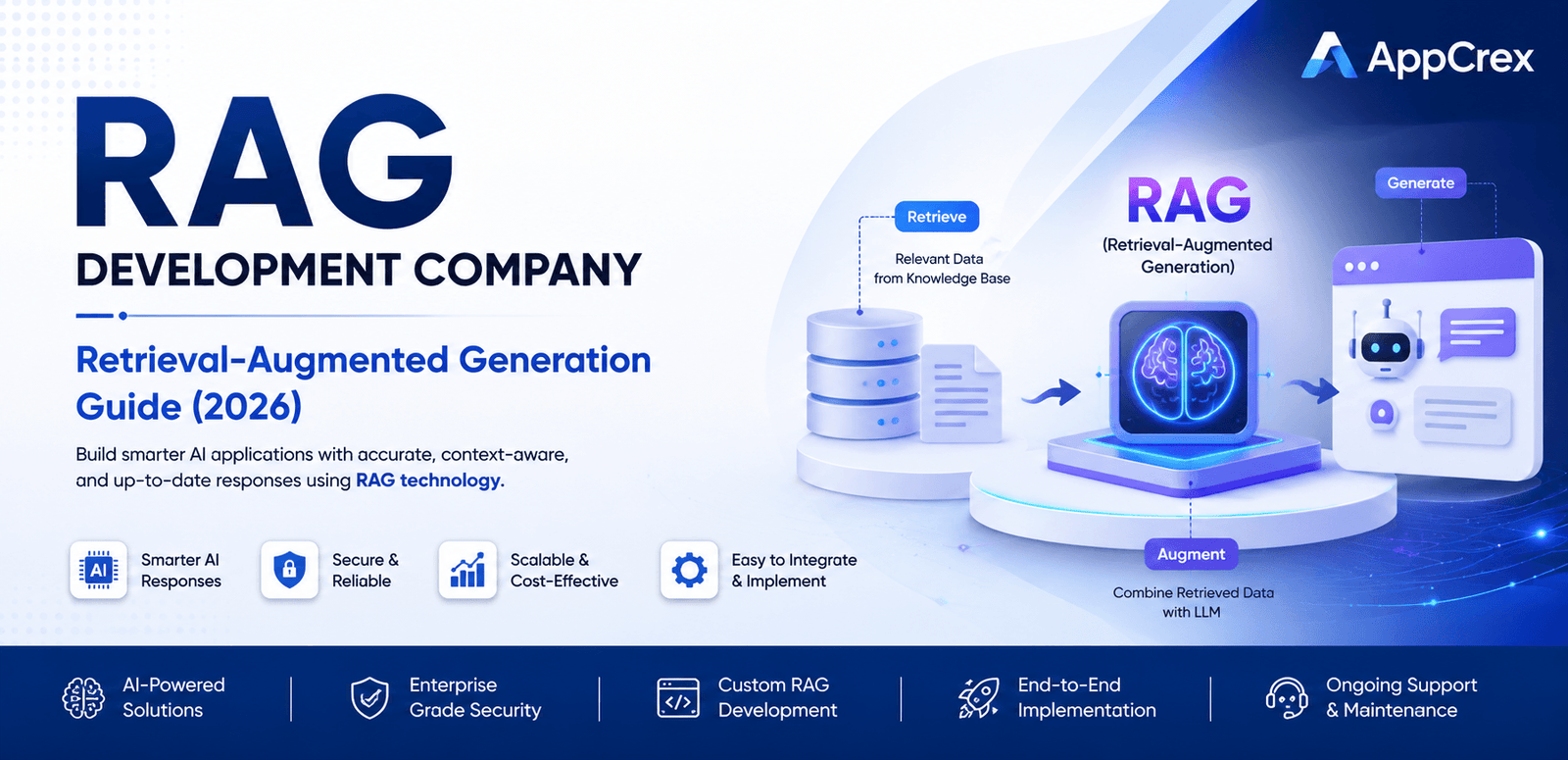
Retrieval-Augmented Generation (RAG) is an advanced AI architecture that combines information retrieval with Large Language Models (LLMs) to generate accurate, context-aware, and reliable responses.
Unlike traditional AI models that rely only on pre-trained knowledge, RAG first retrieves relevant information from trusted external sources before generating an answer.
These sources may include:
- Company knowledge bases
- Internal documentation
- Product manuals
- PDFs
- CRM systems
- Databases
- Websites
- APIs
- Research papers
- Enterprise documents
By retrieving the latest information at the time of a query, RAG enables AI systems to provide responses that are more accurate, relevant, and up to date.
This makes RAG ideal for enterprise AI applications where information changes frequently and accuracy is critical.
Why Traditional AI Models Are Not Enough?
Large Language Models are impressive, but they have several limitations when used in enterprise environments.
For example, imagine a customer asks:
“What is the latest pricing for AppCrex Enterprise AI Solutions?”
A traditional AI model may generate an answer based on outdated or incomplete information because it does not have access to your latest pricing documents.
Similarly, employees may ask:
- What is the newest HR policy?
- Which API version should I use?
- What are the latest compliance guidelines?
- Which products were launched this month?
Without access to current enterprise knowledge, AI may guess the answer or provide outdated information.
For businesses, this creates several risks:
- Incorrect customer information
- Poor customer experience
- Compliance issues
- Reduced trust in AI
- Increased support workload
RAG solves these challenges by retrieving the latest information directly from your organization’s approved knowledge sources before generating a response.
Just Read : HR Management Software Development: Complete Guide to Features, Cost, Benefits & Development Process (2026)
Why RAG is Becoming Essential in 2026?
The rapid growth of enterprise AI has increased the demand for reliable and trustworthy AI systems.
Organizations are moving beyond simple chatbots and building intelligent assistants that can understand company knowledge, search enterprise documents, and automate business processes.
Several factors are driving the adoption of RAG.
Growing Enterprise Data
Modern businesses generate enormous volumes of data every day, including emails, contracts, reports, invoices, product documentation, customer conversations, and technical manuals.
Traditional AI models cannot continuously memorize all this information.
RAG allows AI to access relevant business information in real time instead of relying only on static training data.
Need for Accurate AI Responses
In industries such as healthcare, banking, insurance, and legal services, inaccurate AI responses can have serious consequences.
RAG significantly improves response accuracy by grounding AI answers in trusted enterprise knowledge.
This reduces hallucinations and increases user confidence.
Faster Decision-Making
Employees spend a significant amount of time searching for documents, policies, reports, and technical information.
RAG-powered enterprise assistants retrieve relevant knowledge within seconds, helping teams make faster and better-informed decisions.
Better Customer Experiences
Customers expect accurate answers immediately.
Whether they are asking about pricing, subscriptions, technical issues, or product documentation, RAG enables AI assistants to provide personalized, context-aware responses without unnecessary delays.
Cost-Effective AI Implementation
Many businesses assume they need to fine-tune Large Language Models every time their information changes.
In reality, RAG allows organizations to update their knowledge base instead of retraining the entire model.
This significantly reduces maintenance costs while keeping AI responses current.
How Does RAG Work?
Retrieval-Augmented Generation follows a structured workflow that combines intelligent search with generative AI.
Step 1: User Submits a Query
A customer, employee, or business user asks a question through a chatbot, enterprise portal, mobile application, or internal AI assistant.
For example:
“What are the latest onboarding policies for new employees?”
Step 2: Query Embedding
The question is converted into mathematical vectors using an embedding model.
These vectors capture the meaning of the query rather than just matching keywords.
This allows AI to understand context and intent more effectively.
Step 3: Search in the Vector Database
The embedding is compared against a vector database containing indexed enterprise knowledge.
Instead of searching for exact words, the system retrieves documents with similar meaning.
This semantic search produces highly relevant results even if the wording is different.
Step 4: Retrieve Relevant Documents
The system retrieves the most relevant information from sources such as:
- HR documentation
- Product manuals
- Knowledge base articles
- Company policies
- Internal databases
- API documentation
- CRM records
Only the most relevant content is selected for the next step.
Step 5: Large Language Model Generates the Response
The retrieved information is passed to the Large Language Model.
Rather than relying solely on its pre-trained knowledge, the model uses the retrieved enterprise content to generate a factual, contextual, and natural-language response.
This approach greatly improves reliability and reduces hallucinations.
Step 6: Deliver the Final Answer
The user receives a clear, accurate, and context-aware response, often with references to the underlying documents or knowledge source.
This process typically takes only a few seconds, providing a seamless user experience.
RAG Workflow
User Question
      │
      ▼
Embedding Model
      │
      ▼
Vector Database Search
      │
      ▼
Relevant Documents Retrieved
      │
      ▼
Large Language Model (GPT / Gemini / Claude / Llama)
      │
      ▼
Accurate AI Response
RAG Architecture Explained
A modern RAG architecture consists of several interconnected components that work together to provide reliable AI-powered search and response generation.
The core architecture typically includes:
- User Interface (Web, Mobile, Chatbot, Voice Assistant)
- Embedding Model
- Document Processing Pipeline
- Vector Database
- Retriever
- Large Language Model
- Enterprise Knowledge Sources
- APIs and Business Systems
- Security & Access Control
- Monitoring and Analytics
Each component plays a critical role in ensuring that the AI system retrieves relevant information efficiently while maintaining security, scalability, and performance.
Components of a RAG System
A Retrieval-Augmented Generation (RAG) system consists of multiple components working together to deliver accurate, context-aware, and real-time AI responses. Understanding these components helps businesses build scalable and high-performing enterprise AI solutions.
User Interface (UI)
The user interface is where users interact with the AI application. It can be integrated into:
- Websites
- Mobile applications
- Enterprise portals
- Customer support chat
- Slack
- Microsoft Teams
- Voice assistants
A well-designed interface ensures users can ask questions naturally without needing technical expertise.
Also Read : Enterprise App Development Company: Complete Guide to Cost, Features & Process
Document Processing Pipeline
Before AI can answer questions, enterprise data must be prepared.
The document processing pipeline:
- Uploads documents
- Extracts text
- Removes duplicates
- Splits content into smaller chunks
- Adds metadata
- Creates embeddings
Supported document types include:
- DOCX
- Excel
- PowerPoint
- HTML
- Markdown
- CSV
- Emails
- Database records
This preprocessing step ensures efficient retrieval later.
Embedding Model
Embedding models convert text into numerical vectors that capture the meaning of the content rather than just keywords.
Popular embedding models include:
- OpenAI Embeddings
- Gemini Embeddings
- BAAI BGE
- E5 Embeddings
- Sentence Transformers
These embeddings allow semantic search, helping AI find relevant information even when different words or phrases are used.
Vector Database
A vector database stores embeddings instead of plain text.
When a user asks a question, the system searches for documents with similar meaning instead of matching exact keywords.
Popular vector databases include:
- Pinecone
- Weaviate
- Qdrant
- Milvus
- ChromaDB
- Elasticsearch Vector Search
Vector databases make enterprise search significantly faster and more accurate.
Retriever
The retriever is responsible for identifying the most relevant information from the vector database.
Its responsibilities include:
- Semantic search
- Ranking results
- Filtering irrelevant content
- Returning top matching documents
Only the most relevant information is forwarded to the language model.
Large Language Model (LLM)
The Large Language Model generates the final response using the retrieved information.
Popular LLMs include:
- OpenAI GPT
- Anthropic Claude
- Google Gemini
- Meta Llama
- Mistral AI
Instead of guessing, the model generates answers grounded in the retrieved enterprise knowledge.
Enterprise Data Sources
RAG systems can connect to numerous business systems, including:
- CRM platforms
- ERP software
- SharePoint
- Google Drive
- Confluence
- Notion
- Salesforce
- HubSpot
- SQL databases
- Cloud storage
- APIs
- Internal knowledge bases
This allows AI to work with live business data rather than static training information.
Security Layer
Enterprise AI must protect sensitive information.
Security measures include:
- Role-Based Access Control (RBAC)
- User authentication
- API security
- Data encryption
- Audit logs
- Compliance management
- Access permissions
These controls ensure users only access authorized information.
Benefits of RAG Development
Retrieval-Augmented Generation offers several advantages over traditional AI systems, making it one of the most valuable technologies for enterprise AI applications.
More Accurate AI Responses
The biggest advantage of RAG is accuracy.
Since AI retrieves information from trusted company documents before generating responses, answers are:
- More reliable
- More relevant
- Context-aware
- Based on real business information
This significantly reduces incorrect responses.
Reduced AI Hallucinations
Large Language Models sometimes generate information that sounds convincing but is factually incorrect.
RAG minimizes hallucinations by grounding responses in verified enterprise knowledge instead of relying solely on model memory.
Real-Time Knowledge Access
Business information changes frequently.
Examples include:
- Product pricing
- Company policies
- Inventory
- Technical documentation
- Compliance regulations
RAG allows AI to retrieve the latest information without retraining the entire model.
Lower AI Maintenance Costs
Without RAG, organizations often need to fine-tune AI models whenever business information changes.
With RAG:
- Update the documents
- Refresh the vector database
- AI immediately uses the latest knowledge
This reduces development costs while simplifying maintenance.
Better Customer Experience
Customers receive:
- Faster responses
- More accurate information
- Personalized recommendations
- Consistent support
- Reliable answers
These improvements lead to higher customer satisfaction and increased trust.
Increased Employee Productivity
Employees spend significant time searching for internal documentation.
RAG-powered enterprise assistants provide instant access to:
- HR policies
- Technical manuals
- SOPs
- Legal documents
- Product information
- Internal procedures
This saves time and improves productivity across departments.
Enterprise Security
Unlike public AI systems, enterprise RAG solutions can be deployed within secure environments.
Organizations maintain full control over:
- Documents
- Data access
- User permissions
- Compliance
- Infrastructure
This is essential for industries with strict regulatory requirements.
Easy Integration
Modern RAG solutions integrate seamlessly with existing business software.
Examples include:
- Salesforce
- SAP
- Oracle
- Microsoft Dynamics
- Zendesk
- HubSpot
- SharePoint
- Google Workspace
- Microsoft 365
This enables organizations to extend AI capabilities without replacing existing systems.
RAG vs Fine-Tuning
Many businesses assume that fine-tuning an AI model is always the best approach. In reality, RAG and fine-tuning solve different problems.
| Feature | RAG | Fine-Tuning |
|---|---|---|
| Uses latest business data | ✅ Yes | ❌ No |
| Requires model retraining | ❌ No | ✅ Yes |
| Lower maintenance cost | ✅ Yes | ❌ Higher |
| Fast knowledge updates | ✅ Yes | ❌ Slow |
| Ideal for enterprise documents | ✅ Yes | ❌ Limited |
| Improves factual accuracy | ✅ Yes | ⚠️ Depends |
| Best for dynamic information | ✅ Yes | ❌ No |
| Best for changing business data | ✅ Yes | ❌ No |
When Should You Use RAG?
Choose RAG when your AI needs access to:
- Company documentation
- Product manuals
- Internal policies
- Customer records
- Knowledge bases
- Frequently changing information
When Should You Use Fine-Tuning?
Fine-tuning is more suitable when you want the model to:
- Learn a specific writing style
- Follow a unique tone
- Perform specialized reasoning tasks
- Improve domain-specific behavior
In many enterprise AI solutions, businesses combine RAG + Fine-Tuning to achieve the best results.
RAG vs Traditional AI Chatbots
Traditional chatbots were primarily rule-based and relied on predefined conversation flows. Modern RAG-powered assistants provide a far more intelligent and flexible experience.
| Capability | Traditional Chatbot | RAG-Powered AI |
|---|---|---|
| Rule-based responses | ✅ | ❌ |
| Understands natural language | Limited | Advanced |
| Searches company documents | ❌ | ✅ |
| Uses latest enterprise knowledge | ❌ | ✅ |
| Supports semantic search | ❌ | ✅ |
| Integrates with enterprise systems | Limited | Extensive |
| Handles complex questions | Limited | Excellent |
| Personalized responses | Basic | Advanced |
RAG-powered AI assistants are ideal for organizations that need accurate, context-aware, and continuously updated responses rather than simple scripted conversations.
Enterprise Use Cases of RAG Development
Retrieval-Augmented Generation is transforming how organizations access, manage, and use enterprise knowledge. Instead of searching through multiple documents, employees and customers can ask questions in natural language and receive accurate, context-aware answers within seconds.
Below are some of the most impactful enterprise use cases for RAG.
AI Customer Support
One of the most popular applications of RAG is AI-powered customer support.
Instead of relying on static FAQs, RAG enables AI assistants to retrieve information from:
- Product documentation
- Help center articles
- Warranty policies
- Troubleshooting guides
- CRM systems
- Customer order history
Customers receive accurate answers while support teams handle fewer repetitive queries.
Enterprise Knowledge Management
Large organizations often store critical information across multiple systems, making it difficult for employees to find what they need.
A RAG-powered enterprise assistant allows employees to ask questions such as:
- What is our leave policy?
- Where is the latest sales presentation?
- How does the expense reimbursement process work?
- What are the company’s security guidelines?
Instead of manually searching documents, employees receive instant answers sourced from trusted company knowledge.
AI Sales Assistant
Sales teams spend valuable time searching for product specifications, pricing documents, proposals, and competitor information.
A RAG-powered sales assistant can instantly provide:
- Product details
- Pricing information
- Proposal templates
- Customer case studies
- Competitor comparisons
- Sales playbooks
This helps sales representatives respond to prospects more quickly and confidently.
Healthcare AI Solutions
Hospitals and healthcare providers manage large volumes of clinical and administrative data.
RAG enables AI assistants to retrieve information from:
- Clinical guidelines
- Treatment protocols
- Hospital policies
- Medical research
- Patient education materials
Healthcare professionals gain faster access to trusted information while maintaining strict data security.
Also Read : Custom Software Development Company: Complete Guide to Services, Process, Cost & Benefits (2026)
Legal Document Search
Legal teams often work with thousands of contracts, regulations, and compliance documents.
Instead of manually reviewing files, RAG-powered legal assistants can locate:
- Contract clauses
- Legal precedents
- Regulatory requirements
- Compliance policies
- Internal legal documents
This improves efficiency and reduces research time.
Financial Services
Banks and financial institutions can use RAG to provide secure access to:
- Investment policies
- Banking procedures
- Compliance documentation
- Risk management guidelines
- Internal knowledge bases
Employees receive accurate information without navigating multiple systems.
Human Resources
HR departments manage extensive documentation related to employees.
A RAG assistant can answer questions about:
- Leave policies
- Payroll procedures
- Employee benefits
- Recruitment guidelines
- Performance review processes
- Company policies
This reduces repetitive HR inquiries while improving employee experience.
Software Development
Engineering teams frequently search technical documentation.
RAG can retrieve:
- API documentation
- System architecture
- Coding standards
- Deployment procedures
- Technical specifications
- Release notes
Developers spend less time searching and more time building software.
Technology Stack for RAG Development
Building an enterprise-grade RAG solution requires selecting technologies that are scalable, secure, and capable of handling large volumes of enterprise data.
Frontend
A modern and intuitive user interface improves user adoption.
Popular frontend technologies include:
- React.js
- Next.js
- Angular
- Vue.js
These frameworks support responsive web portals, AI chat interfaces, and enterprise dashboards.
Backend
The backend manages document processing, authentication, integrations, and AI workflows.
Common backend technologies include:
- Python
- Node.js
- Java
- .NET
- Go
Python is widely preferred due to its mature AI ecosystem and extensive library support.
AI Frameworks
AI orchestration frameworks simplify the development of RAG workflows.
Popular frameworks include:
- LangChain
- LangGraph
- LlamaIndex
- CrewAI
- Microsoft Semantic Kernel
- AutoGen
These frameworks help developers build intelligent AI pipelines with minimal complexity.
Large Language Models
The LLM is responsible for generating human-like responses using the retrieved context.
Popular options include:
- OpenAI GPT
- Anthropic Claude
- Google Gemini
- Meta Llama
- Mistral AI
The right model depends on business goals, privacy requirements, and deployment preferences.
Vector Databases
Vector databases store embeddings and enable semantic search.
Common choices include:
- Pinecone
- Weaviate
- Qdrant
- Milvus
- ChromaDB
The choice depends on scalability, performance, hosting, and enterprise requirements.
Cloud Platforms
Enterprise RAG solutions are typically deployed on:
- Amazon Web Services (AWS)
- Microsoft Azure
- Google Cloud Platform (GCP)
Cloud deployment provides scalability, high availability, and enterprise-grade security.
RAG Development Process
Developing a successful RAG solution involves much more than connecting an LLM to a document repository. A structured implementation process ensures accuracy, security, and long-term scalability.
Step 1: Requirement Analysis
Understand the business objectives, target users, and use cases.
Typical questions include:
- Who will use the AI system?
- Which documents should it access?
- Which business systems need integration?
- What security requirements must be met?
Step 2: Data Collection
Gather information from trusted sources such as:
- PDFs
- Word documents
- Internal portals
- CRM systems
- ERP platforms
- APIs
- Knowledge bases
- Databases
Data quality directly impacts AI response quality.
Step 3: Data Preparation
Documents are cleaned, formatted, and divided into smaller chunks.
Metadata is added to improve retrieval accuracy and document filtering.
Step 4: Embedding Generation
The processed content is converted into vector embeddings and stored in a vector database.
This enables semantic search rather than simple keyword matching.
Step 5: AI Integration
The RAG pipeline is connected with:
- Large Language Models
- Enterprise APIs
- Authentication systems
- Business workflows
- User interfaces
At this stage, the AI can retrieve enterprise knowledge and generate intelligent responses.
Step 6: Testing & Optimization
Before deployment, the system is evaluated for:
- Retrieval accuracy
- Response quality
- Latency
- Security
- Hallucination rate
- User experience
Continuous optimization ensures the AI performs reliably in production.
Step 7: Deployment & Monitoring
After launch, organizations should monitor:
- Query success rate
- User satisfaction
- Response accuracy
- System performance
- Knowledge base freshness
- AI usage analytics
Regular updates help maintain long-term effectiveness.
How Much Does RAG Development Cost?
The cost of building a RAG solution depends on project complexity, AI capabilities, integrations, data volume, and deployment requirements.
Factors Affecting Development Cost
Several factors influence the total investment:
- Number of documents
- Data sources
- LLM selection
- Vector database
- Enterprise integrations
- Security requirements
- Cloud infrastructure
- Custom UI/UX
- Multi-language support
- Ongoing maintenance
Estimated Development Cost
| Project Type | Estimated Cost | Timeline |
|---|---|---|
| RAG MVP | $15,000–$30,000 | 6–8 Weeks |
| Business RAG Solution | $30,000–$80,000 | 2–4 Months |
| Enterprise RAG Platform | $80,000–$250,000+ | 4–8 Months |
The actual cost depends on the scope, AI model selection, infrastructure, compliance requirements, and level of customization.
Best Practices for RAG Development
Building an enterprise-grade Retrieval-Augmented Generation (RAG) solution requires more than connecting an LLM to a vector database. To achieve high accuracy, scalability, and security, organizations should follow industry best practices throughout the development lifecycle.
Organize and Maintain High-Quality Data
The quality of a RAG system depends on the quality of its knowledge base. Before indexing documents, ensure that information is accurate, well-structured, and up to date.
Best practices include:
- Remove duplicate content
- Eliminate outdated documents
- Standardize document formats
- Add metadata for better filtering
- Regularly update the knowledge base
A clean and well-maintained data repository improves retrieval accuracy and user trust.
Choose the Right Chunking Strategy
Large documents should be divided into smaller, meaningful sections before generating embeddings.
Effective chunking helps the retriever locate the most relevant information while preserving context.
Common chunking methods include:
- Fixed-size chunks
- Paragraph-based chunking
- Section-based chunking
- Semantic chunking
Selecting the appropriate strategy improves response quality and reduces irrelevant results.
Implement Role-Based Access Control (RBAC)
Enterprise AI applications often contain confidential business information.
Implement RBAC to ensure users only access documents relevant to their roles.
For example:
- HR employees access HR documents
- Finance teams access financial reports
- Developers access technical documentation
- Executives access strategic reports
This protects sensitive information and supports regulatory compliance.
Continuously Monitor AI Performance
RAG systems should be monitored after deployment to maintain quality and reliability.
Key performance indicators (KPIs) include:
- Retrieval Accuracy
- Response Accuracy
- Query Latency
- User Satisfaction
- Hallucination Rate
- Document Coverage
- Search Success Rate
Continuous monitoring helps identify improvement opportunities and maintain optimal performance.
Optimize for Scalability
As enterprise data grows, your RAG solution should scale without affecting performance.
Consider:
- Cloud-native deployment
- Load balancing
- Distributed vector databases
- Caching frequently requested queries
- Incremental indexing
Scalable architecture ensures consistent performance as users and documents increase.
Future Trends in RAG Development (2026)
Retrieval-Augmented Generation is evolving rapidly. Several emerging trends will shape the next generation of enterprise AI solutions.
Agentic RAG
Traditional RAG retrieves information once before generating a response.
Agentic RAG introduces autonomous AI agents that can:
- Plan tasks
- Perform multiple searches
- Validate information
- Use external tools
- Generate more reliable responses
This enables AI to solve complex, multi-step business problems more effectively.
Multimodal RAG
Future RAG systems will retrieve information not only from text but also from:
- Images
- Videos
- Audio recordings
- Diagrams
- PDFs
- Spreadsheets
This will enable richer AI experiences across industries such as healthcare, manufacturing, and education.
Graph RAG
Graph RAG combines knowledge graphs with Retrieval-Augmented Generation to better understand relationships between people, organizations, products, and concepts.
Benefits include:
- Better reasoning
- More connected responses
- Improved knowledge discovery
- Enhanced enterprise search
Real-Time Enterprise AI
Organizations increasingly require AI systems that access live business data.
Future RAG solutions will retrieve information directly from:
- CRM platforms
- ERP systems
- Inventory databases
- Business intelligence tools
- IoT devices
- Real-time APIs
This enables AI assistants to provide responses based on the latest available information.
Hybrid AI Architectures
Many enterprises are combining multiple AI techniques, including:
- RAG
- Fine-Tuning
- AI Agents
- Workflow Automation
- Knowledge Graphs
Hybrid architectures offer greater flexibility, higher accuracy, and improved automation across business processes.
Also Read : Multi-Agent AI Development: Complete Guide to Architecture, Benefits, Cost & Use Cases
Why Choose AppCrex as Your RAG Development Company?
Implementing Retrieval-Augmented Generation requires expertise in AI engineering, enterprise software development, cloud infrastructure, and secure data integration.
At AppCrex, we develop enterprise-grade RAG solutions that help businesses unlock the full value of their organizational knowledge.
Our solutions are designed to improve search accuracy, automate workflows, reduce operational costs, and deliver intelligent AI experiences.
Our RAG Development Services
We offer end-to-end RAG development services, including:
- Custom RAG Application Development
- Enterprise Knowledge Base Solutions
- AI Chatbot Development
- AI Search Solutions
- Vector Database Implementation
- Document Intelligence Systems
- AI Agent Development
- Multi-Agent AI Solutions
- LLM Integration
- API & Enterprise System Integration
- AI Consulting & Strategy
- Ongoing Maintenance and Optimization
Why Businesses Partner with AppCrex?
Businesses choose AppCrex because we provide:
- Experienced AI engineers
- Custom enterprise AI solutions
- Secure and scalable architecture
- Cloud-native deployments
- Modern AI frameworks and tools
- Seamless third-party integrations
- Agile development methodology
- Transparent communication
- Long-term technical support
Whether you want to build an internal AI knowledge assistant, an intelligent customer support platform, or a secure enterprise search solution, AppCrex delivers customized RAG systems tailored to your business objectives.
(FAQs)
Q. What is Retrieval-Augmented Generation (RAG)?
Retrieval-Augmented Generation (RAG) is an AI architecture that retrieves relevant information from trusted knowledge sources before generating responses, improving the accuracy and reliability of Large Language Models.
Q. Why should businesses use RAG?
RAG enables businesses to build AI applications that access up-to-date enterprise knowledge, reduce hallucinations, improve decision-making, and deliver more accurate customer and employee support.
Q. What is the difference between RAG and Fine-Tuning?
RAG retrieves information from external knowledge sources at runtime, while fine-tuning changes the model’s behavior through additional training. RAG is better for frequently changing business information, whereas fine-tuning is useful for adapting the model’s style or specialized tasks.
Q. Which industries benefit from RAG?
RAG is widely used in healthcare, banking, insurance, legal services, education, retail, manufacturing, logistics, SaaS, and enterprise knowledge management.
Q. Which Large Language Models support RAG?
Popular models include OpenAI GPT, Anthropic Claude, Google Gemini, Meta Llama, and Mistral AI.
Q. Which vector databases are commonly used?
Popular vector databases include Pinecone, Weaviate, Qdrant, Milvus, and ChromaDB.
Q. How long does it take to build a RAG solution?
A basic RAG MVP can be developed in 6–8 weeks, while enterprise-grade platforms typically require 4–8 months, depending on complexity and integrations.
Q. How much does RAG development cost?
Development costs generally range from $15,000 for an MVP to $250,000+ for large-scale enterprise RAG platforms, depending on features, infrastructure, and customization.
Q. Can RAG integrate with existing enterprise software?
Yes. RAG solutions can integrate with CRM systems, ERP platforms, cloud storage, databases, APIs, knowledge bases, and document management systems.
Q. Why choose AppCrex for RAG development?
AppCrex provides customized RAG development services backed by expertise in Generative AI, Large Language Models, vector databases, cloud infrastructure, and enterprise software integration. We build secure, scalable, and high-performance AI solutions tailored to your business needs.
Conclusion
Retrieval-Augmented Generation (RAG) is redefining how enterprises use Artificial Intelligence by combining the reasoning capabilities of Large Language Models with the reliability of real-time enterprise knowledge. Instead of relying solely on pre-trained data, RAG retrieves relevant information from trusted sources before generating responses, enabling AI systems to deliver accurate, context-aware, and up-to-date answers.
From AI-powered customer support and enterprise knowledge management to intelligent document search and workflow automation, RAG has become a foundational technology for modern AI applications. It helps organizations reduce hallucinations, improve productivity, strengthen data security, and make better business decisions without the need for constant model retraining.
As enterprise AI adoption accelerates in 2026 and beyond, investing in a well-designed RAG solution will provide a significant competitive advantage. Businesses that embrace this technology can transform how employees access information, how customers receive support, and how knowledge is shared across the organization.
If you’re looking to build a secure, scalable, and future-ready RAG solution, AppCrex is your trusted technology partner. Our AI experts design and develop enterprise-grade RAG applications tailored to your business goals, helping you unlock the full potential of your organizational knowledge and accelerate your AI transformation.