
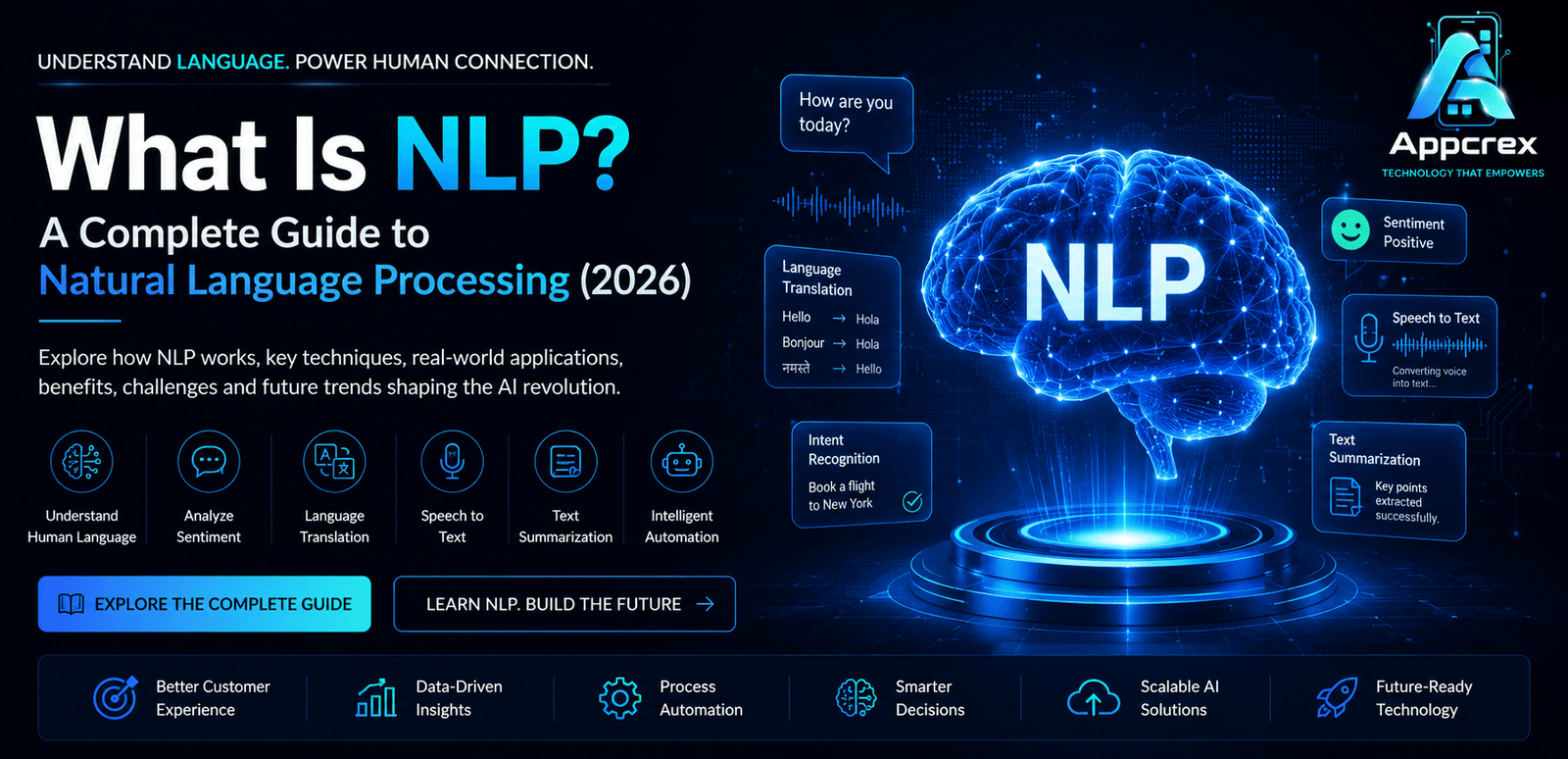
📌 Key Takeaways
- NLP helps computers understand human language.
- It powers ChatGPT, Google Search, chatbots, and voice assistants.
- NLP improves automation, search, and customer support.
- Modern NLP uses LLMs for smarter, context-aware responses.
- NLP skills are in high demand across AI and tech industries.
Introduction
Artificial Intelligence (AI) is transforming the way businesses communicate, automate processes, and deliver personalized customer experiences. One of the most powerful technologies driving this transformation is Natural Language Processing (NLP). From AI chatbots and virtual assistants to sentiment analysis and language translation, NLP enables machines to understand, interpret, and generate human language.
Whether you’re asking ChatGPT a question, using Google Search, talking to Siri, or receiving personalized product recommendations, you’re interacting with NLP-powered technology.
As businesses increasingly adopt AI, understanding what NLP is, how it works, and where it can be applied has become essential. In this guide, we’ll explore everything you need to know about Natural Language Processing, including its benefits, techniques, applications, challenges, future trends, and why it is shaping the future of intelligent software.
What Is Natural Language Processing (NLP)?
Natural Language Processing (NLP) is a branch of Artificial Intelligence (AI) and Machine Learning (ML) that enables computers to understand, analyze, interpret, and generate human language.
In simple terms, NLP bridges the gap between human communication and computer understanding. Instead of requiring users to interact through programming languages or rigid commands, NLP allows computers to process everyday language—whether it’s spoken or written.
For example, NLP powers technologies that can:
- Understand customer queries
- Translate languages
- Analyze emotions in text
- Generate human-like responses
- Summarize long documents
- Detect spam emails
- Convert speech into text
- Answer questions automatically
By combining linguistics, machine learning, and deep learning, NLP helps businesses automate communication and extract valuable insights from text and speech data.
Why Is NLP Important?
Every day, people generate massive amounts of unstructured data through emails, social media posts, customer reviews, documents, chats, and voice recordings. NLP enables organizations to process this information efficiently and gain actionable insights.
Some of the key reasons NLP is important include:
- Improves customer service through AI chatbots
- Automates repetitive communication tasks
- Enhances search engine accuracy
- Enables multilingual communication
- Analyzes customer sentiment
- Supports voice assistants
- Increases business efficiency
- Reduces operational costs
- Improves decision-making with data-driven insights
As AI adoption grows, NLP is becoming a core technology for businesses across industries.
How Does Natural Language Processing Work?
Natural Language Processing follows a series of steps to understand and interpret human language.
1. Text Input
The process begins when the system receives text or voice input from users.
Examples include:
- Customer support messages
- Emails
- Reviews
- Social media posts
- Voice commands
- Documents
2. Text Preprocessing
Before analyzing text, NLP cleans and organizes the data by:
- Removing punctuation
- Eliminating unnecessary words
- Correcting spelling
- Converting text into lowercase
- Removing duplicate characters
This improves the accuracy of language processing.
3. Tokenization
Tokenization breaks text into smaller pieces called tokens.
For example:
Input:
“Healthcare apps improve patient care.”
Output:
- Healthcare
- apps
- improve
- patient
- care
These tokens help AI understand sentence structure.
4. Part-of-Speech Tagging
The NLP model identifies the grammatical role of each word.
Example:
- Healthcare → Noun
- Improve → Verb
- Better → Adjective
This helps machines understand sentence meaning.
5. Named Entity Recognition (NER)
NLP identifies important entities such as:
- People
- Organizations
- Cities
- Countries
- Dates
- Products
- Brands
For example:
“Apple launched a new AI model in California.”
NLP identifies:
- Apple → Organization
- California → Location
6. Sentiment Analysis
The system determines whether the text expresses positive, negative, or neutral emotions.
Example:
“This healthcare app is amazing.”
Sentiment:
Positive
Businesses use this for:
- Product reviews
- Customer feedback
- Brand monitoring
- Social media analytics
7. Machine Learning Analysis
The processed text is analyzed using AI models trained on millions of examples.
Modern NLP relies heavily on deep learning models that recognize patterns, context, and relationships between words.
8. Response Generation
Finally, the AI generates a meaningful response based on the user’s query.
This powers:
- AI chatbots
- Voice assistants
- Search engines
- Recommendation systems
- Translation tools
Key NLP Techniques
Some of the most widely used NLP techniques include:
Tokenization
Breaking sentences into individual words or phrases.
Lemmatization
Reducing words to their root form.
Example:
- Running
- Runs
- Ran
Become:
Run
1. Stemming
Removing prefixes and suffixes to identify the base word.
2. Sentiment Analysis
Determining emotions within text.
3. Named Entity Recognition
Finding names of people, organizations, locations, and products.
4. Text Classification
Automatically categorizing text into predefined groups.
5. Machine Translation
Converting text from one language into another.
6. Speech Recognition
Transforming spoken language into written text.
7. Text Summarization
Generating shorter versions of lengthy documents while preserving the main ideas.
Applications of Natural Language Processing
NLP powers countless digital experiences that people use every day. Common applications include:
1. AI Chatbots
Businesses use AI chatbots to provide instant customer support, answer FAQs, and automate conversations.
2. Virtual Assistants
Voice assistants use NLP to understand spoken commands and perform tasks.
3. Search Engines
NLP helps search engines understand user intent and deliver more relevant results.
4. Language Translation
Translation tools convert text between languages while preserving meaning.
5. Email Spam Detection
Email providers identify spam messages using NLP models.
6. Healthcare
Healthcare organizations use NLP to analyze medical records, support clinical documentation, and improve patient communication.
7. Finance
Banks and financial institutions analyze customer interactions, detect fraud patterns, and automate support services.
8. E-commerce
Online retailers use NLP for product recommendations, review analysis, and intelligent search.
9. Education
Educational platforms use NLP to automate grading, language learning, and personalized tutoring.
10. Social Media Monitoring
Brands analyze customer opinions, trends, and engagement through sentiment analysis.
Benefits of Natural Language Processing
NLP offers significant advantages for businesses and users alike:
- Automates repetitive tasks
- Improves customer experiences
- Enables multilingual support
- Increases operational efficiency
- Enhances search accuracy
- Supports data-driven decision-making
- Reduces support costs
- Improves personalization
- Provides real-time insights
- Scales customer interactions efficiently
1. Industries Using NLP
Natural Language Processing is widely adopted across industries, including:
- Healthcare
- Banking and Finance
- Retail & E-commerce
- Education
- Travel & Hospitality
- Legal Services
- Insurance
- Telecommunications
- Media & Entertainment
- Human Resources
- Manufacturing
- Government
Businesses in cities like New York, San Francisco, London, Dubai, Singapore, Toronto, Sydney, and Bangalore are increasingly leveraging NLP to automate operations and enhance customer engagement.
2. Challenges of NLP
Despite its capabilities, NLP presents several challenges:
- Understanding sarcasm and humor
- Handling multiple languages and dialects
- Managing ambiguous words
- Protecting user privacy
- Reducing AI bias
- Processing domain-specific terminology
- Interpreting context accurately
Advancements in large language models and transformer-based architectures continue to address these limitations.
3. Future of NLP
The future of NLP is closely tied to advancements in generative AI and multimodal systems. Emerging trends include:
- AI copilots for businesses
- Multilingual AI assistants
- Voice-first applications
- Emotion-aware conversational AI
- Industry-specific language models
- Real-time translation
- AI-powered document automation
- Hyper-personalized customer experiences
As AI technology evolves, NLP will become even more accurate, efficient, and accessible.
Why Businesses Should Invest in NLP Solutions
Organizations that adopt NLP can streamline communication, automate workflows, and gain valuable insights from unstructured data.
Benefits include:
- Faster customer support
- Improved employee productivity
- Better business intelligence
- Increased customer satisfaction
- Competitive advantage
- Reduced operational costs
Whether you’re building an AI chatbot, a virtual assistant, a recommendation engine, or a document processing platform, NLP provides the foundation for intelligent automation.
Conclusion
Natural Language Processing is transforming how humans interact with technology. By enabling computers to understand and generate human language, NLP powers everything from chatbots and search engines to healthcare systems and financial platforms.
As businesses continue to embrace AI, investing in NLP solutions can improve efficiency, enhance customer experiences, and unlock new opportunities for innovation. Whether you’re a startup or an enterprise, understanding NLP is the first step toward building smarter, AI-driven applications.
Frequently Asked Questions (FAQs)
1. What is NLP in simple terms?
Natural Language Processing (NLP) is a branch of Artificial Intelligence that enables computers to understand, analyze, and generate human language in both text and speech.
2. What are some examples of NLP?
Examples include AI chatbots, virtual assistants, language translation, spam detection, sentiment analysis, voice recognition, and search engines.
3. What is the difference between AI and NLP?
AI is the broader field of creating intelligent systems, while NLP is a specialized branch of AI focused on understanding and processing human language.
4. Which industries use NLP?
Healthcare, finance, retail, education, legal services, telecommunications, e-commerce, media, and customer support are among the leading industries using NLP.
5. How does NLP benefit businesses?
NLP helps businesses automate customer service, analyze feedback, improve search functionality, process documents, personalize user experiences, and increase operational efficiency.
6. Is NLP the same as Machine Learning?
No. NLP is a field of AI focused on language, while Machine Learning is a technique used to train models. Modern NLP systems often rely on Machine Learning and Deep Learning to improve their performance. Visit for more…