
📌 Key Takeaways
- Push notifications boost user engagement by delivering timely, personalized, and relevant updates directly to users.
- Different notification types—promotional, transactional, reminder, and behavioral—serve different business goals.
- Personalization and timing matter for improving open rates, click-through rates, and customer retention.
- Following best practices like audience segmentation, clear CTAs, and optimal frequency leads to better results.
- A well-planned push notification strategy helps businesses increase conversions, strengthen customer relationships, and drive long-term growth.
Artificial Intelligence is rapidly becoming a core part of modern business operations. Organizations across healthcare, finance, education, retail, manufacturing, and logistics are adopting AI technologies to automate processes, improve decision-making, and deliver better customer experiences. However, technology adoption alone does not guarantee success. The real challenge lies in ensuring employees have the skills and confidence needed to work effectively with AI-powered systems.
As AI continues to transform workplaces, enterprises are investing heavily in workforce training and digital learning initiatives. Traditional learning management systems often struggle to keep pace with rapidly evolving AI technologies. This has led to the emergence of AI training applications—intelligent learning platforms designed to help employees understand, practice, and apply AI in real-world business scenarios.
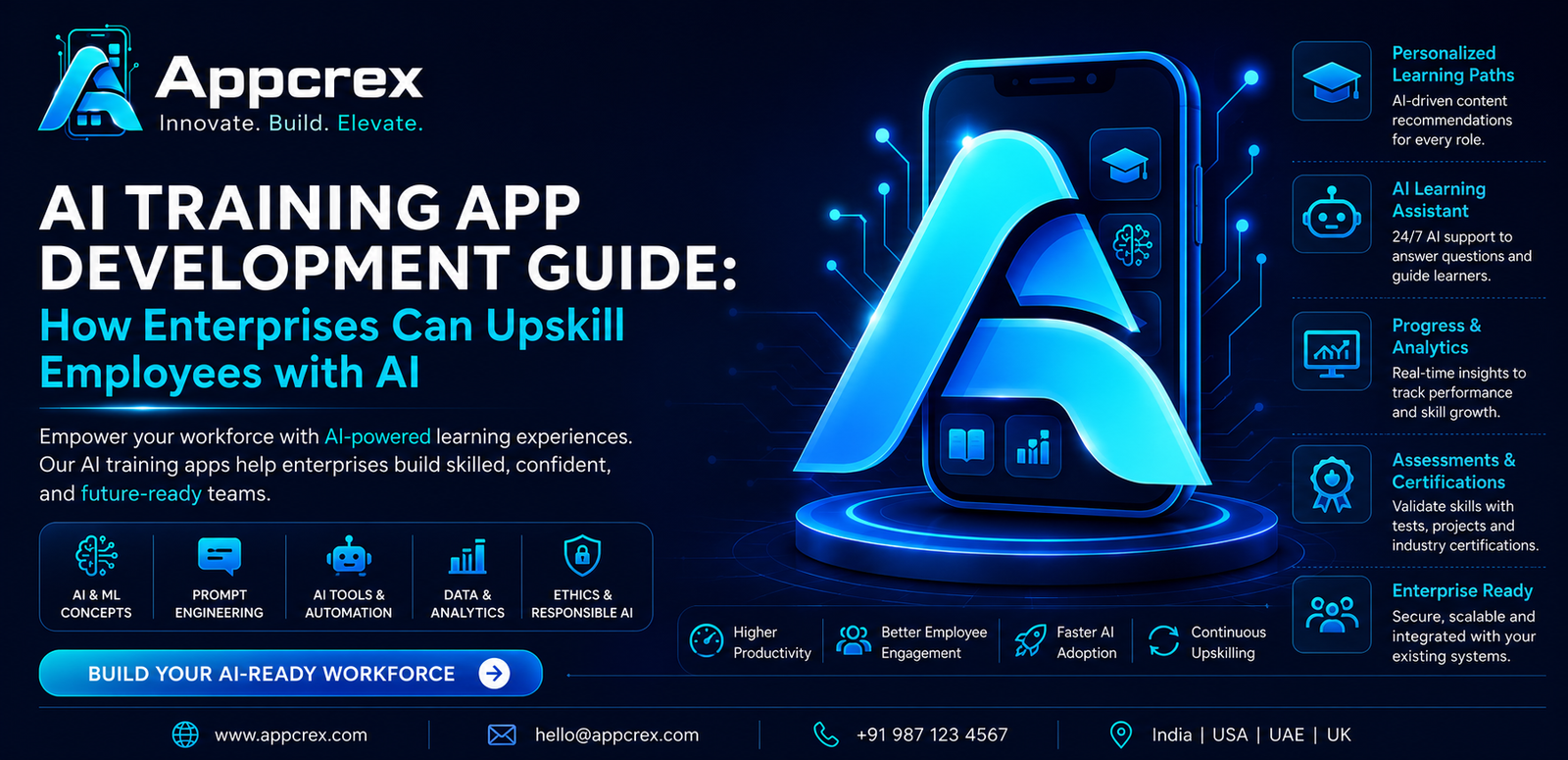
At AppCrex, we help organizations build custom Artificial Intelligence training applications that combine personalized learning experiences, AI-powered assistance, analytics, certifications, and enterprise integrations. These platforms enable businesses to create future-ready workforces while accelerating digital transformation initiatives.
This guide explores everything you need to know about enterprise AI training app development, including features, benefits, technology stack, costs, challenges, and best practices.
What Is an Enterprise AI Training App?
An enterprise AI training app is a digital learning platform specifically designed to educate employees about artificial intelligence, machine learning, automation, data analytics, prompt engineering, AI copilots, and emerging technologies.
Unlike traditional corporate training systems, AI learning applications leverage artificial intelligence to personalize learning paths, recommend educational content, assess performance, and provide interactive support throughout the learning journey.
These platforms are designed to help organizations:
- Improve AI literacy
- Reduce skill gaps
- Increase AI adoption
- Support workforce transformation
- Deliver continuous learning
- Improve productivity
- Build AI-ready teams
- Foster innovation
As businesses continue integrating AI into daily operations, employee education has become just as important as technology implementation.
Why AI Training Matters More Than Ever
Many organizations invest in AI tools expecting immediate productivity improvements. However, employees often lack the necessary training to use these technologies effectively.
Common challenges include:
Limited AI Knowledge
Many employees are unfamiliar with AI concepts, capabilities, and limitations.
Resistance to Change
Teams may hesitate to adopt new technologies due to uncertainty or fear of job disruption.
Rapid Technology Evolution
AI tools evolve quickly, making ongoing education essential.
Department-Specific Learning Needs
Different departments require different AI skills and use cases.
Inconsistent Training Programs
Traditional training methods often fail to deliver scalable and personalized learning experiences.
AI training apps solve these challenges by providing structured, accessible, and continuously updated learning environments.
Benefits of Enterprise AI Training Applications
1. Accelerated Workforce Upskilling
Employees gain practical AI knowledge faster through personalized learning experiences.
2. Increased AI Adoption
Well-trained employees are more likely to embrace AI tools and integrate them into daily workflows.
3. Enhanced Productivity
Teams learn how to automate repetitive tasks, streamline processes, and improve efficiency.
4. Better Decision-Making
AI education helps employees leverage data insights and predictive analytics more effectively.
5. Reduced Training Costs
Digital learning platforms eliminate many expenses associated with traditional classroom-based training.
6. Scalable Learning Environment
Organizations can train thousands of employees simultaneously across multiple locations.
7. Improved Employee Engagement
Interactive and personalized learning experiences increase participation and retention.
8. Future-Ready Workforce
Continuous learning ensures employees remain prepared for technological advancements.
Key Features of an AI Training Application
1. Personalized Learning Paths
Every employee learns differently. AI-powered personalization helps create customized training journeys based on:
- Job role
- Experience level
- Department
- Learning behavior
- Career goals
- Skill assessments
Personalized learning improves engagement and knowledge retention.
2. AI Learning Assistant
An AI-powered learning assistant acts as a virtual tutor available 24/7.
Capabilities include:
- Answering questions
- Explaining concepts
- Recommending courses
- Providing feedback
- Supporting practical exercises
This feature significantly improves learner engagement.
3. Interactive Learning Modules
Modern employees prefer hands-on learning experiences rather than passive content consumption.
Interactive modules may include:
- Simulations
- Real-world scenarios
- Practice environments
- AI tool demonstrations
- Guided projects
Experiential learning improves understanding and confidence.
4. Gamification Features
Gamification increases motivation and participation.
Popular gamification elements include:
- Achievement badges
- Leaderboards
- Reward systems
- Progress tracking
- Learning streaks
These features encourage consistent engagement.
5. Skill Assessments
Organizations need measurable outcomes from training programs.
Assessment features include:
- Quizzes
- Practical assignments
- Knowledge checks
- Certification exams
- Competency evaluations
Assessments help validate learning effectiveness.
6. Certification Management
Certification systems provide recognition and accountability.
Benefits include:
- Skill validation
- Employee motivation
- Career development
- Compliance tracking
- Workforce planning
7. Analytics Dashboard
Administrators require visibility into learning performance.
Analytics can track:
- Course completion rates
- User engagement
- Skill development
- Department performance
- AI adoption metrics
- Certification progress
Data-driven insights support continuous improvement.
Types of AI Training Apps
1. Corporate AI Learning Platforms
Designed for organization-wide AI education programs.
2. AI Literacy Applications
Focus on foundational AI concepts for non-technical employees.
3. Prompt Engineering Training Platforms
Teach employees how to effectively interact with AI systems.
4. AI Certification Portals
Provide structured learning paths and industry-recognized certifications.
5. Industry-Specific AI Learning Apps
Tailored for healthcare, finance, manufacturing, logistics, education, and retail.
6. Executive AI Training Platforms
Help leaders understand AI strategy, governance, and implementation.
Generative AI in Corporate Learning
Generative AI is transforming workplace education by creating dynamic, personalized, and scalable learning experiences.
Modern AI training apps can use Generative AI to:
- Generate learning content
- Create quizzes automatically
- Provide personalized explanations
- Simulate real-world scenarios
- Deliver conversational learning
- Offer instant feedback
These capabilities significantly improve training efficiency and learner engagement.
AI Copilots for Employee Training
AI copilots are becoming a core feature of enterprise learning ecosystems.
An AI copilot can help employees:
- Navigate learning paths
- Receive recommendations
- Practice prompt engineering
- Understand AI workflows
- Access organizational knowledge
At AppCrex, we develop custom AI copilots tailored to enterprise learning environments.
Industries Using AI Training Applications
1. Healthcare
Train professionals on AI-assisted diagnostics, patient analytics, and healthcare automation.
2. Finance
Educate teams on fraud detection, risk analysis, and predictive modeling.
3. Retail
Improve customer personalization, inventory forecasting, and marketing optimization.
4. Manufacturing
Support predictive maintenance and intelligent production systems.
5. Logistics
Enable workforce training on route optimization and supply chain intelligence.
6. Education
Deliver AI literacy and technology education programs.
Technology Stack for AI Training App Development
Frontend
- React
- Angular
- Vue.js
- Next.js
Mobile Development
- Flutter
- React Native
- Swift
- Kotlin
Backend
- Node.js
- Python
- .NET
AI Frameworks
- OpenAI
- Anthropic Claude
- Google Gemini
- LangChain
- LlamaIndex
Databases
- PostgreSQL
- MongoDB
- Pinecone
- Weaviate
Cloud Infrastructure
- AWS
- Microsoft Azure
- Google Cloud Platform
How Much Does AI Training App Development Cost?
The cost depends on features, complexity, AI integrations, and enterprise requirements.
| Development Level | Estimated Cost |
|---|---|
| Basic Platform | $15,000 – $35,000 |
| Mid-Level Enterprise Solution | $35,000 – $80,000 |
| Advanced AI Learning Ecosystem | $80,000 – $250,000+ |
Factors affecting cost:
- AI integrations
- Mobile app development
- Enterprise security
- Learning analytics
- Multi-language support
- Cloud infrastructure
- Third-party integrations
Common Challenges in AI Training App Development
Organizations should prepare for:
- Rapid AI technology changes
- Content maintenance
- User adoption challenges
- Data privacy concerns
- Integration complexity
- Measuring learning outcomes
- Enterprise scalability requirements
Proper planning helps overcome these obstacles successfully.
Why Choose AppCrex for AI Training App Development?
AppCrex develops intelligent enterprise learning platforms that help organizations build AI-ready workforces.
Our expertise includes:
- AI Training App Development
- Generative AI Solutions
- AI Copilot Development
- Enterprise LMS Development
- AI Agent Integration
- Prompt Engineering Platforms
- Mobile Learning Applications
- Learning Analytics Systems
- Cloud-Based Enterprise Solutions
We focus on building scalable, secure, and user-friendly platforms that deliver measurable business results.
Future of Enterprise AI Learning
The future of workplace education will be driven by:
- AI-powered personalization
- Adaptive learning systems
- Virtual AI mentors
- Generative AI content creation
- Predictive skill analytics
- Immersive learning experiences
- Continuous workforce development
Organizations that invest in AI education today will be better positioned to compete in the AI-powered economy.
Conclusion
AI adoption is no longer just a technology initiative—it is a workforce transformation strategy. Organizations must ensure employees have the skills, confidence, and practical knowledge needed to work effectively alongside AI systems.
Enterprise AI training applications provide a scalable and intelligent way to educate teams, improve productivity, and accelerate digital transformation. By combining personalized learning, AI-powered assistance, analytics, certifications, and enterprise integrations, businesses can create future-ready workforces prepared for long-term success.
At AppCrex, we help organizations design and develop custom AI training platforms that empower employees and maximize the value of AI investments. Whether you need an AI learning portal, certification platform, AI copilot, or enterprise upskilling solution, our team can help transform your vision into a powerful learning ecosystem.
