📌 Key Takeaways
- Define Your Business Goals: Clearly identify your target audience, features, and project objectives before hiring a development company.
- Choose Proven Blockchain Experts: Select a company with hands-on experience in NFT marketplaces, smart contracts, and multi-chain development.
- Check Portfolio & Client Reviews: Review previous projects, testimonials, and case studies to evaluate their expertise and reliability.
- Focus on Security & Scalability: Ensure the platform is built with strong security measures and can scale as your business grows.
- Look for End-to-End Support: Partner with a company that offers development, testing, deployment, and ongoing maintenance for long-term success.
The NFT market has evolved far beyond digital collectibles. Today, businesses across gaming, real estate, music, sports, fashion, healthcare, and the metaverse are using NFT marketplaces to tokenize assets, create new revenue streams, and engage users in innovative ways. As demand continues to grow, partnering with an experienced NFT Marketplace Development Company is essential to building a secure, scalable, and feature-rich platform.
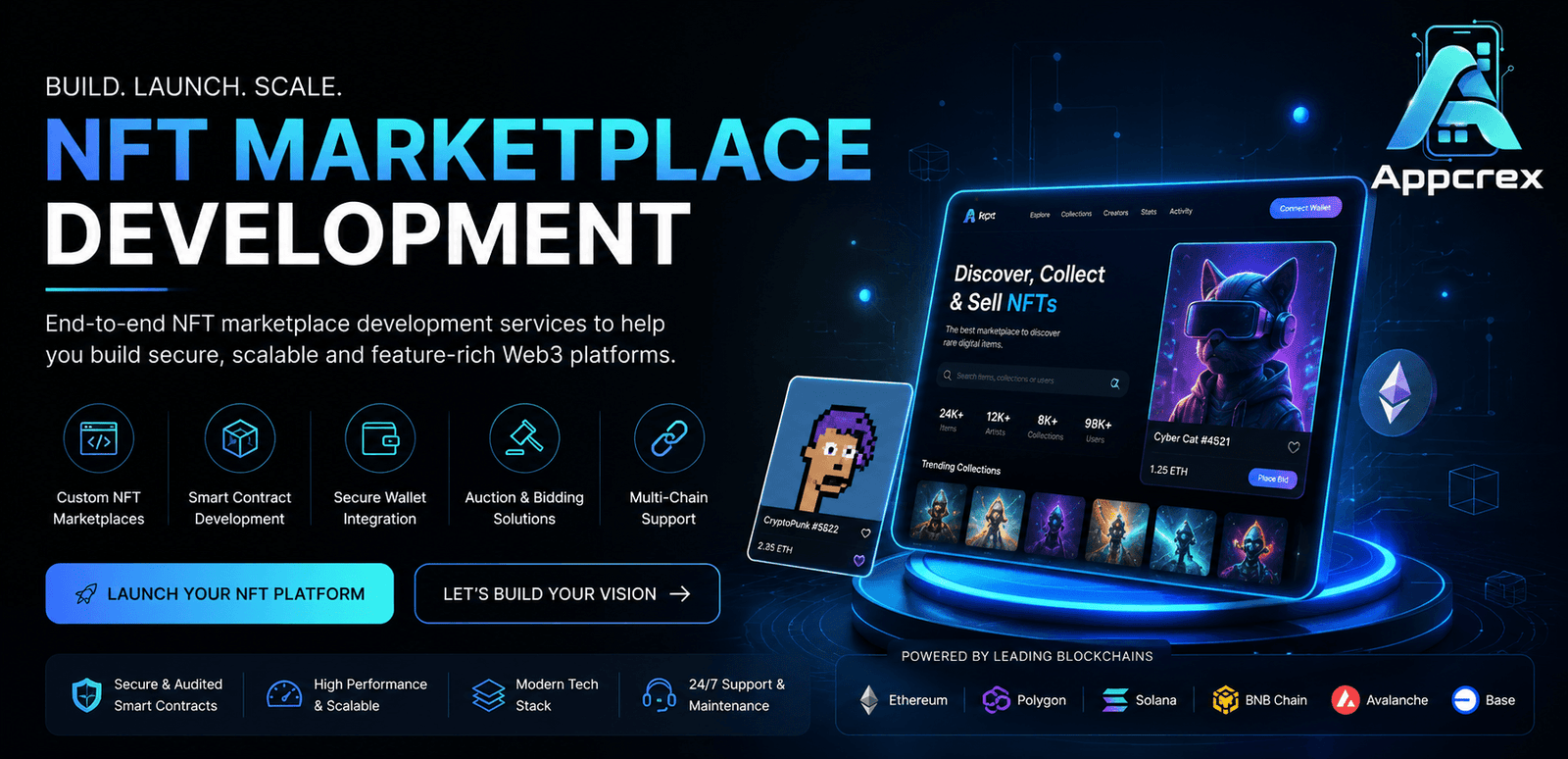
At Appcrex, we specialize in custom NFT marketplace development solutions tailored to your business goals. Whether you’re launching a niche marketplace for digital art or a multi-chain NFT platform for enterprise assets, our blockchain experts deliver end-to-end development services using the latest technologies and industry best practices.
In this guide, you’ll learn everything about NFT marketplace development, its benefits, essential features, development process, costs, technology stack, and how to choose the right development partner.
What Is NFT Marketplace Development?
NFT marketplace development is the process of designing, developing, and deploying a digital platform where users can create, buy, sell, trade, auction, and manage Non-Fungible Tokens (NFTs). These marketplaces operate on blockchain technology, ensuring transparency, security, ownership verification, and immutable transaction records.
Unlike traditional digital marketplaces, NFT platforms rely on smart contracts to automate transactions without intermediaries. Every NFT contains unique metadata that proves authenticity and ownership, making digital assets valuable and tamper-proof.
Businesses can develop NFT marketplaces for:
- Digital artwork
- Gaming assets
- Virtual real estate
- Collectibles
- Music NFTs
- Sports memorabilia
- Fashion items
- Domain names
- Event tickets
- Intellectual property
- Luxury goods
- Tokenized real-world assets (RWAs)
A professional NFT marketplace App development company ensures your platform includes secure smart contracts, seamless wallet integration, advanced search functionality, multi-chain compatibility, and a user-friendly interface.
How Does an NFT Marketplace Work?
An NFT marketplace functions through blockchain technology and smart contracts. Every transaction is verified on the blockchain, providing trust and transparency for buyers and sellers.
Here’s how a typical NFT marketplace works:
1. User Registration
Users create an account and connect a crypto wallet such as MetaMask, Trust Wallet, Coinbase Wallet, or WalletConnect-supported wallets.
2. Wallet Integration
The wallet stores cryptocurrencies and NFTs securely while enabling blockchain transactions.
3. NFT Minting
Creators upload digital assets such as images, videos, music, or documents. The platform converts these files into NFTs using blockchain smart contracts.
4. Listing NFTs
Users can list NFTs for:
- Fixed-price sales
- Timed auctions
- Dutch auctions
- Open bidding
- Bundle sales
5. Marketplace Discovery
Buyers browse collections using filters such as:
- Category
- Price
- Blockchain
- Creator
- Trending collections
- Rarity
- Recently listed
6. Purchase & Smart Contract Execution
Once a buyer purchases an NFT, the smart contract automatically:
- Transfers ownership
- Sends payment
- Updates blockchain records
- Calculates royalty payments
7. NFT Storage
Purchased NFTs remain stored in the buyer’s connected crypto wallet.
Why Businesses Are Investing in NFT Marketplace Development
NFT marketplaces have become powerful business platforms rather than temporary trends. Organizations are leveraging NFTs to monetize digital assets, strengthen customer engagement, and unlock new revenue opportunities.
Here are some key reasons businesses are investing in NFT marketplace development:
New Revenue Streams
Businesses earn revenue through:
- Marketplace commissions
- NFT minting fees
- Premium memberships
- Featured listings
- Auction fees
- Advertising
- Royalties
- API integrations
Enhanced Digital Ownership
Blockchain technology guarantees authentic ownership records, helping eliminate fraud and counterfeit digital assets.
Global Accessibility
NFT marketplaces operate 24/7, enabling users from around the world to trade digital assets without geographical limitations.
Automated Transactions
Smart contracts automate:
- Payments
- Ownership transfers
- Royalty distribution
- Escrow services
- Marketplace commissions
This minimizes manual intervention and reduces operational costs.
Increased Customer Engagement
NFTs create exclusive experiences through:
- Loyalty rewards
- Membership access
- Event tickets
- Limited-edition collectibles
- Gamification
Business Scalability
Modern NFT platforms support:
- Multi-chain infrastructure
- Thousands of daily transactions
- Enterprise-grade security
- API integrations
- Future blockchain upgrades
Types of NFT Marketplaces
Every business has unique objectives, making it important to choose the right marketplace model.
Open NFT Marketplace
Anyone can mint, list, and trade NFTs without approval.
Best for:
- Digital art
- Photography
- Collectibles
Curated NFT Marketplace
Only verified creators can publish NFTs after approval.
Ideal for:
- Premium artwork
- Luxury collectibles
- Exclusive brands
Gaming NFT Marketplace
Supports buying and selling:
- Weapons
- Characters
- Skins
- Virtual land
- In-game assets
Popular among blockchain gaming companies.
Music NFT Marketplace
Artists tokenize:
- Songs
- Albums
- Concert tickets
- Exclusive content
This allows creators to monetize directly without intermediaries.
Sports NFT Marketplace
Fans can purchase:
- Trading cards
- Match highlights
- Signed collectibles
- Fan memberships
Real Estate NFT Marketplace
Property ownership and real-world assets can be tokenized for faster, more transparent transactions.
Enterprise NFT Marketplace
Businesses use private NFT marketplaces for:
- Intellectual property
- Digital certificates
- Supply chain verification
- Employee credentials
- Luxury authentication
Essential Features of an NFT Marketplace
A successful NFT marketplace combines security, scalability, and exceptional user experience.
User-Friendly Dashboard
The platform should provide an intuitive dashboard where users can easily manage NFTs, wallets, transactions, and collections.
Secure Wallet Integration
Support popular crypto wallets including:
- MetaMask
- Coinbase Wallet
- Trust Wallet
- WalletConnect
- Phantom
NFT Minting
Allow creators to upload digital assets and mint NFTs with customizable metadata.
Advanced Search & Filters
Enable users to search NFTs based on:
- Collection
- Price
- Blockchain
- Creator
- Popularity
- Rarity
- Category
Auction Management
Support multiple auction models including:
- English auctions
- Dutch auctions
- Reserve price auctions
- Timed auctions
Multi-Chain Support
Integrate multiple blockchain networks such as:
- Ethereum
- Polygon
- Solana
- BNB Chain
- Avalanche
- Arbitrum
- Base
Smart Contract Automation
Smart contracts should automate:
- Ownership transfer
- Payments
- Royalties
- Marketplace commissions
- Escrow
- NFT burning
Royalty Management
Enable creators to receive royalties automatically whenever NFTs are resold.
Admin Panel
The admin dashboard should include:
- User management
- NFT moderation
- Transaction monitoring
- Commission management
- Analytics
- Security settings
- Content approval
Security Features
Security should include:
- Multi-factor authentication
- End-to-end encryption
- DDoS protection
- Secure APIs
- Smart contract audits
- KYC/AML integration
- Fraud detection
- Data backup
NFT Marketplace Development Services
Launching a successful NFT platform requires more than just coding. It involves blockchain expertise, intuitive UI/UX design, secure smart contracts, seamless wallet integrations, and ongoing support. At Appcrex, we offer end-to-end NFT marketplace development services that help startups, enterprises, creators, and brands build secure and scalable NFT ecosystems.
Custom NFT Marketplace Development
Every business has unique goals, and a one-size-fits-all solution rarely delivers long-term value. Our custom NFT marketplace development services focus on creating platforms tailored to your specific requirements.
We develop custom NFT marketplaces for:
- Digital art
- Gaming assets
- Music NFTs
- Sports collectibles
- Fashion and luxury goods
- Virtual real estate
- Event ticketing
- Real-world asset tokenization (RWA)
- Enterprise digital assets
From branding and user experience to blockchain architecture and smart contract logic, every aspect of the platform is customized to fit your business model.
NFT Marketplace App Development
With the growing adoption of mobile devices, businesses need NFT platforms that offer seamless experiences across Android and iOS. Our NFT marketplace app development services deliver responsive and feature-rich mobile applications that enable users to mint, buy, sell, auction, and manage NFTs from anywhere.
Key mobile app features include:
- Wallet integration
- Push notifications
- NFT collection management
- Live auction updates
- QR code support
- Secure biometric authentication
- Multi-language support
White Label NFT Marketplace Development
Businesses looking to launch quickly can benefit from our white label NFT marketplace development solutions. These ready-to-customize platforms reduce development time while offering flexibility for branding, feature enhancements, and blockchain integration.
Benefits include:
- Faster deployment
- Lower development costs
- Custom branding
- Scalable architecture
- Enterprise-grade security
- Future feature expansion
Smart Contract Development
Smart contracts form the backbone of every NFT marketplace. Our blockchain developers create secure, transparent, and audit-ready smart contracts that automate marketplace operations.
Our smart contract services include:
- NFT minting logic
- Marketplace transactions
- Royalty distribution
- Auction automation
- Escrow mechanisms
- Multi-signature functionality
- Token management
Every smart contract undergoes rigorous testing and security audits to reduce vulnerabilities.
NFT Wallet Integration
A smooth wallet experience is essential for user adoption. We integrate leading crypto wallets, allowing users to securely store digital assets and complete blockchain transactions.
Supported wallets include:
- MetaMask
- Coinbase Wallet
- Trust Wallet
- WalletConnect
- Phantom
- Rainbow Wallet
Additional wallet integrations can be added based on project requirements.
NFT Marketplace Maintenance & Support
Launching your marketplace is only the beginning. We provide ongoing maintenance and support to ensure your platform remains secure, updated, and optimized.
Our support services include:
- Performance optimization
- Security updates
- Smart contract monitoring
- Bug fixes
- Blockchain upgrades
- Feature enhancements
- Technical support
- Server maintenance
Our NFT Marketplace Development Process
At Appcrex, we follow a structured development approach that minimizes risks and ensures faster project delivery.
Step 1: Business Consultation
We begin by understanding your business objectives, target audience, marketplace model, preferred blockchain network, revenue strategy, and feature requirements.
During this phase, we define:
- Business goals
- User personas
- Marketplace type
- Blockchain selection
- Monetization model
- Compliance requirements
Step 2: UI/UX Design
Our designers create intuitive interfaces that simplify the NFT trading experience.
The design process includes:
- User journey mapping
- Wireframes
- Interactive prototypes
- Brand identity
- Responsive layouts
- Accessibility optimization
A well-designed marketplace improves user engagement and increases transaction success rates.
Step 3: Blockchain Architecture
Choosing the right blockchain impacts scalability, transaction fees, speed, and security.
Our architects evaluate factors such as:
- Network congestion
- Gas fees
- Ecosystem maturity
- Developer support
- Cross-chain compatibility
- Future scalability
Step 4: Smart Contract Development
Blockchain engineers develop secure smart contracts that automate marketplace operations.
This includes:
- NFT creation
- Ownership transfers
- Auctions
- Royalties
- Marketplace commissions
- Token standards
Step 5: Frontend & Backend Development
Our development team builds the complete marketplace infrastructure.
Frontend technologies:
- React.js
- Next.js
- Vue.js
- Flutter
- React Native
Backend technologies:
- Node.js
- NestJS
- Python
- Express.js
- GraphQL
Database solutions:
- PostgreSQL
- MongoDB
- Redis
Step 6: Wallet & Payment Integration
Users can securely connect wallets and complete transactions using cryptocurrencies or integrated fiat payment gateways, depending on the platform’s requirements.
Supported payment options include:
- Crypto payments
- Stablecoins
- Fiat payment gateways
- Credit/debit cards (where applicable)
- Multi-currency support
Step 7: Testing & Quality Assurance
Before deployment, our QA engineers conduct extensive testing to ensure a stable and secure platform.
Testing includes:
- Functional testing
- Performance testing
- Security testing
- Smart contract testing
- API testing
- Load testing
- User acceptance testing (UAT)
Step 8: Deployment
Once approved, the NFT marketplace is deployed to the production environment.
Deployment includes:
- Blockchain deployment
- Server configuration
- Domain setup
- SSL installation
- Monitoring tools
- Performance optimization
Step 9: Post-Launch Support
We continuously monitor your platform and provide regular updates to ensure optimal performance and security.
Best Blockchain Networks for NFT Marketplace Development
Selecting the right blockchain is one of the most important decisions when developing an NFT marketplace. Different networks offer varying levels of scalability, transaction speed, ecosystem maturity, and cost.
Ethereum
Ethereum remains the most widely used blockchain for NFT marketplaces due to its mature ecosystem and strong developer community.
Advantages:
- Large NFT ecosystem
- Strong security
- Extensive wallet compatibility
- High liquidity
- ERC-721 and ERC-1155 standards
Best for:
- Premium NFT marketplaces
- Enterprise platforms
- High-value collectibles
Polygon
Polygon offers lower transaction fees and faster confirmations while remaining compatible with Ethereum.
Advantages:
- Low gas fees
- High throughput
- Eco-friendly
- Ethereum compatibility
- Excellent scalability
Best for:
- Gaming
- Collectibles
- Large user communities
Solana
Solana delivers exceptional transaction speeds with minimal fees, making it ideal for high-volume marketplaces.
Advantages:
- Fast transactions
- Low costs
- High scalability
- Growing NFT ecosystem
Best for:
- Gaming NFTs
- High-frequency trading
- Large-scale marketplaces
BNB Chain
BNB Chain offers a cost-effective blockchain infrastructure with strong ecosystem support.
Benefits:
- Low transaction costs
- Fast confirmations
- Large user base
- Easy wallet integration
Avalanche
Avalanche is becoming increasingly popular for enterprise blockchain applications due to its speed and flexibility.
Benefits:
- Fast finality
- Low latency
- Energy-efficient consensus
- Enterprise scalability
Base
Base is a Layer-2 blockchain designed to provide lower fees and seamless Ethereum compatibility.
Advantages:
- Reduced gas fees
- Ethereum ecosystem support
- Faster transactions
- Growing developer adoption
NFT Token Standards
Token standards define how NFTs function on a blockchain.
ERC-721
The most widely used NFT standard, where each token is unique and indivisible. It is ideal for digital art, collectibles, and exclusive assets.
ERC-1155
Supports both fungible and non-fungible tokens within a single smart contract, making it more efficient for gaming, virtual assets, and batch transactions.
Technology Stack for NFT Marketplace Development
A reliable technology stack is critical for building a high-performance NFT marketplace.
Frontend
- React.js
- Next.js
- Vue.js
- Angular
- Flutter
- React Native
Backend
- Node.js
- Express.js
- NestJS
- Python
- Go
Blockchain
- Ethereum
- Polygon
- Solana
- BNB Chain
- Avalanche
- Base
Storage
- IPFS
- Filecoin
- AWS S3
- Cloudflare R2
Databases
- PostgreSQL
- MongoDB
- Redis
Cloud & DevOps
- AWS
- Google Cloud
- Microsoft Azure
- Docker
- Kubernetes
- GitHub Actions
NFT Marketplace Development Cost
One of the first questions businesses ask is, “How much does NFT marketplace development cost?” The answer depends on several factors, including the platform’s complexity, supported blockchain networks, feature set, security requirements, and customization level.
A basic marketplace with standard features costs significantly less than an enterprise-grade, multi-chain platform with AI-powered recommendations, advanced analytics, and custom smart contracts.
Estimated Development Cost
| Marketplace Type | Estimated Cost | Development Timeline |
|---|---|---|
| Basic NFT Marketplace | $15,000 – $30,000 | 2–3 Months |
| Medium Complexity Marketplace | $30,000 – $60,000 | 3–5 Months |
| Advanced NFT Marketplace | $60,000 – $120,000+ | 5–8 Months |
| Enterprise NFT Marketplace | Custom Pricing | 6–12 Months |
Note: These estimates vary depending on your project requirements, blockchain selection, third-party integrations, security audits, and post-launch support.
Factors Affecting NFT Marketplace Development Cost
Several technical and business considerations influence the overall investment required to build an NFT marketplace.
1. Marketplace Complexity
A simple platform with basic buying and selling functionality requires less effort than an enterprise marketplace featuring auctions, staking, governance, and multi-chain support.
2. Blockchain Network
Development costs vary based on the blockchain you choose. Factors such as smart contract complexity, network architecture, and transaction optimization can affect the overall budget.
3. UI/UX Design
Custom designs, animations, interactive dashboards, and responsive layouts require more design and development time than template-based interfaces.
4. Smart Contract Development
Developing secure smart contracts for minting, auctions, royalties, escrow, and token management requires specialized blockchain expertise and extensive testing.
5. Wallet Integration
Supporting multiple wallets and payment options increases development complexity but improves user accessibility.
6. Security Features
Investing in advanced security measures—such as multi-factor authentication, smart contract audits, encryption, and fraud detection—is essential for protecting user assets and maintaining trust.
7. Third-Party Integrations
Integrations with analytics tools, KYC providers, payment gateways, CRM systems, cloud services, and APIs add functionality but also impact development time and cost.
8. Post-Launch Maintenance
Ongoing maintenance, feature enhancements, security updates, and blockchain upgrades should be considered as part of the total project investment.
Revenue Models for NFT Marketplaces
A well-designed NFT marketplace can generate recurring revenue through multiple monetization strategies.
1. Transaction Fees
Charge a percentage on every NFT sale or purchase completed through the platform.
2. NFT Minting Fees
Collect fees when creators mint new NFTs.
3. Listing Fees
Charge sellers to list premium NFT collections or featured assets.
4. Featured Listings
Offer paid promotions that increase the visibility of NFT collections.
5. Auction Fees
Generate revenue from successful NFT auctions.
6. Subscription Plans
Provide premium memberships with exclusive features, analytics, or early access to collections.
7. Advertising
Display sponsored collections, banners, or brand partnerships within the marketplace.
8. Loyalty Sharing
Generate recurring income through royalty-sharing mechanisms, depending on your business model.
Industries Using NFT Marketplace Development
NFT technology has expanded beyond digital art and collectibles. Businesses across various industries are using NFT marketplaces to improve transparency, enhance customer engagement, and create new digital experiences.
1. Gaming
Gaming companies use NFT marketplaces to allow players to own, trade, and monetize in-game assets such as skins, characters, weapons, and virtual land.
2. Art & Collectibles
Artists and creators sell authenticated digital artwork while earning royalties from secondary sales.
3. Music
Musicians can tokenize albums, songs, backstage passes, and exclusive content to connect directly with fans.
4. Sports
Sports organizations offer digital collectibles, player cards, match highlights, and exclusive fan experiences.
5. Fashion & Luxury
Brands use NFTs to verify authenticity, launch limited-edition collections, and provide digital ownership certificates.
6. Real Estate
Property developers tokenize real estate assets, enabling fractional ownership and simplified transactions.
7. Education
Educational institutions issue blockchain-based certificates, diplomas, and digital credentials that are secure and verifiable.
8. Healthcare
Healthcare providers can use NFTs for secure management of medical credentials, certifications, and digital health records where appropriate.
9. Entertainment
Movie studios and entertainment companies create exclusive digital collectibles, event passes, and fan engagement campaigns.
Also Read : Push Notification Guide: Benefits, Types & Best Practices (2026)
Challenges in NFT Marketplace Development
Developing an NFT marketplace comes with technical and operational challenges. Choosing the right development partner helps address these issues effectively.
1. Scalability
Growing user traffic and transaction volumes require scalable architecture capable of handling increased demand without affecting performance.
2. Security
Protecting digital assets through secure coding practices, encryption, smart contract audits, and continuous monitoring is essential.
3. Regulatory Compliance
NFT businesses should comply with applicable laws related to digital assets, data privacy, taxation, and anti-money laundering requirements in their target markets.
4. User Experience
Simplifying wallet connections, NFT creation, and transaction processes helps improve adoption among both experienced and first-time users.
5. Gas Fees
High blockchain transaction fees can impact user satisfaction. Layer-2 solutions and efficient blockchain selection help reduce costs.
Future Trends in NFT Marketplace Development
The NFT ecosystem continues to evolve rapidly. Businesses that embrace emerging technologies can build more competitive and future-ready platforms.
1. AI-Powered NFT Discovery
Artificial intelligence can personalize NFT recommendations, improve search accuracy, detect fraudulent activity, and enhance user engagement.
2. Multi-Chain Ecosystems
Supporting multiple blockchain networks enables users to trade assets across ecosystems with greater flexibility and lower transaction costs.
3. Real-World Asset (RWA) Tokenization
Businesses are increasingly tokenizing physical assets such as real estate, luxury goods, artwork, and intellectual property to improve liquidity and accessibility.
4. Metaverse Integration
NFT marketplaces are becoming integral to virtual worlds, where users buy, sell, and showcase digital assets for gaming, commerce, and social interaction.
5. Fractional NFT Ownership
Fractional ownership allows multiple investors to share ownership of high-value NFTs, making premium digital assets more accessible.
6. Decentralized Identity (DID)
Integrating decentralized identity solutions can improve user verification while giving individuals greater control over their personal data.
Why Choose Appcrex as Your NFT Marketplace Development Company?
Choosing the right technology partner can significantly influence the success of your NFT marketplace. At Appcrex, we combine blockchain expertise, modern technologies, and business-focused strategies to deliver platforms built for long-term growth.
Why Businesses Trust Appcrex
- Custom NFT marketplace development tailored to your business goals
- Experienced blockchain and Web3 development team
- Secure, audit-ready smart contracts
- Multi-chain marketplace expertise
- Responsive web and mobile applications
- Intuitive UI/UX design
- Scalable cloud infrastructure
- Comprehensive testing and quality assurance
- Ongoing maintenance and technical support
- Transparent communication throughout the project lifecycle
Whether you’re a startup launching your first NFT platform or an enterprise expanding into Web3, Appcrex helps transform your vision into a secure, scalable, and user-friendly marketplace.
Ready to Build Your NFT Marketplace?
The NFT industry continues to create new opportunities for businesses across gaming, entertainment, real estate, fashion, and digital commerce. A well-designed marketplace enables secure transactions, enhances customer engagement, and opens new revenue streams.
If you’re planning to launch an NFT marketplace, partnering with an experienced development company can help reduce risks, accelerate time-to-market, and ensure your platform is built for future growth.
Contact Appcrex today to discuss your NFT marketplace development project and create a secure, scalable, and feature-rich Web3 platform tailored to your business goals.
Frequently Asked Questions (FAQs)
1. What is an NFT marketplace?
An NFT marketplace is a blockchain-powered digital platform where users can create (mint), buy, sell, auction, and trade non-fungible tokens (NFTs). These platforms verify ownership through blockchain technology, ensuring secure and transparent transactions.
2. How much does NFT marketplace development cost?
The cost of NFT marketplace development depends on the project’s complexity, features, blockchain network, integrations, and customization requirements.
Generally, development costs range from:
- Basic Marketplace: $15,000–$30,000
- Mid-Level Marketplace: $30,000–$60,000
- Advanced Marketplace: $60,000–$120,000+
- Enterprise Solution: Custom pricing based on business needs
For an accurate estimate, consult an experienced NFT marketplace development company like Appcrex.
3. Which blockchain is best for NFT marketplace development?
The ideal blockchain depends on your business goals.
Popular options include:
- Ethereum – Best for premium NFT marketplaces
- Polygon – Low transaction fees and high scalability
- Solana – Fast transactions with minimal fees
- BNB Chain – Cost-effective and efficient
- Avalanche – Enterprise-grade performance
- Base – Layer-2 solution with lower gas fees
Many businesses now prefer multi-chain NFT marketplaces to support a broader audience and improve flexibility.
4. How long does it take to develop an NFT marketplace?
The development timeline varies based on project complexity.
Typical timelines include:
- Basic marketplace: 2–3 months
- Medium-complexity platform: 3–5 months
- Advanced marketplace: 5–8 months
- Enterprise marketplace: 6–12 months
Custom features, security audits, and third-party integrations may extend the timeline.
5. What features should an NFT marketplace include?
A modern NFT marketplace should offer:
- User registration
- Secure wallet integration
- NFT minting
- Buying and selling
- Auction functionality
- Royalty management
- Smart contracts
- Advanced search and filters
- Multi-chain support
- Admin dashboard
- Analytics
- KYC/AML integration (if required)
- Responsive web and mobile design
6. Can you build a custom NFT marketplace for my business?
Yes. At Appcrex, we specialize in custom NFT marketplace development tailored to your business model, industry, branding, and scalability requirements. Whether you’re launching a marketplace for digital art, gaming, music, sports, real estate, or enterprise assets, we can build a solution designed around your goals.
7. What is a white-label NFT marketplace?
A white-label NFT marketplace is a pre-built solution that can be customized with your branding, features, and preferred blockchain. It helps businesses launch faster while reducing development time and costs compared to building a platform from scratch.
8. Which wallets can be integrated into an NFT marketplace?
We can integrate leading crypto wallets, including:
- MetaMask
- Trust Wallet
- Coinbase Wallet
- WalletConnect
- Phantom
- Rainbow Wallet
Additional wallet integrations can be added based on your project requirements.
9. Which industries can benefit from NFT marketplace development?
NFT marketplaces are transforming multiple industries, including:
- Digital Art
- Gaming
- Music
- Sports
- Fashion
- Real Estate
- Healthcare
- Education
- Entertainment
- Luxury Goods
- Event Ticketing
- Supply Chain
10. Is NFT marketplace development secure?
Yes, when developed correctly. A secure NFT marketplace should include:
- Smart contract audits
- Data encryption
- Multi-factor authentication
- Secure wallet integration
- DDoS protection
- Role-based access control
- Fraud detection
- Regular security updates
Security should be a priority throughout development and post-launch maintenance.
11. Can an NFT marketplace support multiple blockchains?
Absolutely. A multi-chain NFT marketplace allows users to mint and trade NFTs across networks such as Ethereum, Polygon, Solana, BNB Chain, Avalanche, and Base. This improves flexibility, reduces transaction costs, and expands your potential user base.
12. Why choose Appcrex for NFT marketplace development?
Appcrex provides end-to-end NFT marketplace development services, including blockchain consulting, UI/UX design, smart contract development, wallet integration, multi-chain support, quality assurance, deployment, and ongoing maintenance. Our team focuses on building secure, scalable, and future-ready Web3 solutions that align with your business objectives.
Also Read : What Is API Integration? A Complete Guide to Benefits, Types & Best Practices
Conclusion
The NFT ecosystem continues to evolve, creating exciting opportunities for businesses to innovate, engage customers, and unlock new revenue streams. Whether you’re building a marketplace for digital collectibles, gaming assets, tokenized real-world assets, or enterprise use cases, choosing the right technology partner is essential for long-term success.
At Appcrex, we combine blockchain expertise, modern development practices, and user-centric design to deliver high-performance NFT marketplace solutions. From strategy and smart contract development to deployment and ongoing support, we provide comprehensive services to help you launch a secure and scalable platform.
Ready to turn your NFT marketplace idea into reality? Partner with Appcrex to build a future-ready Web3 platform that empowers your business and delivers exceptional user experiences.