
Introduction
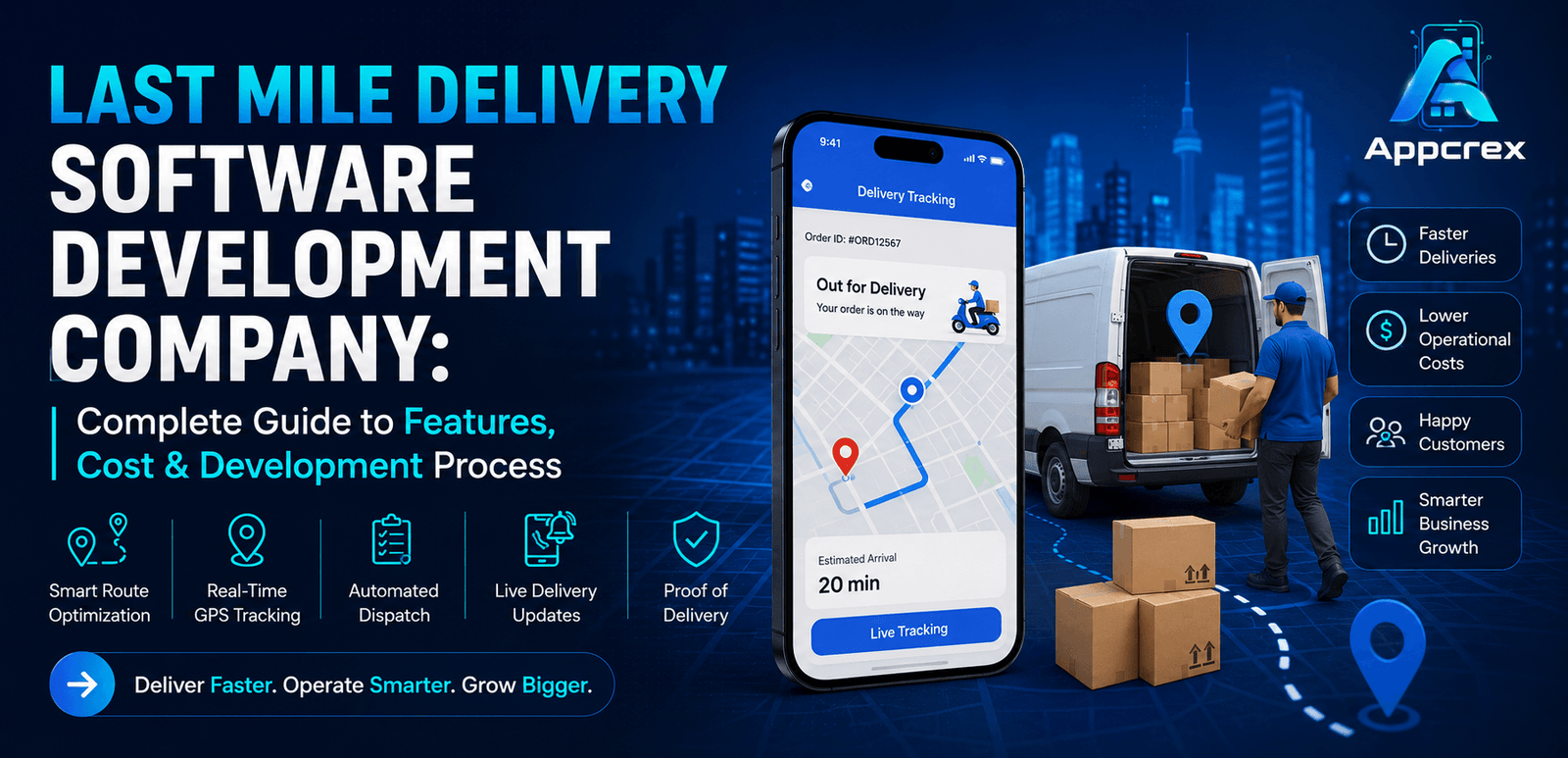
The rapid growth of eCommerce, quick commerce, grocery delivery, pharmacy delivery, food delivery, and hyperlocal logistics has made last mile delivery one of the most critical stages of the supply chain. Customers now expect faster deliveries, real-time tracking, accurate delivery updates, and seamless experiences. To meet these expectations, businesses are investing in intelligent last mile delivery software development.
Last mile delivery refers to the final stage of the delivery process, where a package is transported from a distribution center or warehouse to the customer’s doorstep. Although it is the shortest part of the supply chain, it is often the most expensive and operationally complex. Businesses face challenges such as traffic congestion, inefficient routes, delayed deliveries, high fuel costs, and limited delivery visibility.
A custom last mile delivery software solution helps businesses overcome these challenges by automating dispatching, optimizing delivery routes, tracking drivers in real time, managing orders, and providing customers with live delivery updates. Modern platforms also leverage Artificial Intelligence (AI), GPS technology, cloud computing, and predictive analytics to improve operational efficiency and reduce delivery costs.
The demand for last mile delivery software development continues to rise across the USA, UAE, Saudi Arabia, Qatar, and India, where online shopping, same-day delivery, and digital logistics are experiencing significant growth.
Whether you operate an eCommerce business, logistics company, courier service, grocery delivery platform, or pharmacy delivery network, partnering with an experienced Last Mile Delivery Software Development Company enables you to build a scalable, secure, and feature-rich solution tailored to your business needs.
In this comprehensive guide, you’ll learn everything about last mile delivery software development, including its features, business benefits, development process, technology stack, AI capabilities, development cost, and key trends shaping the logistics industry in 2026.
What is Last Mile Delivery Software?
Last Mile Delivery Software is a digital platform designed to manage and optimize the final stage of the delivery process. It enables businesses to efficiently assign deliveries, monitor drivers, optimize routes, track shipments in real time, and ensure packages reach customers quickly and accurately.
Instead of relying on manual dispatching and paper-based processes, businesses can automate delivery operations while improving customer satisfaction and reducing operational costs.
A complete last mile delivery solution generally consists of four major components:
Customer App
Customers can:
- Place delivery requests
- Track deliveries in real time
- Receive delivery notifications
- View estimated arrival times (ETA)
- Rate completed deliveries
- Access delivery history
Driver App
Delivery drivers can:
- Receive delivery assignments
- Navigate using GPS
- View optimized routes
- Update delivery status
- Capture proof of delivery
- Communicate with dispatchers
Dispatcher Dashboard
Dispatch managers can:
- Assign orders automatically
- Monitor drivers in real time
- Optimize delivery routes
- Track delivery progress
- Manage delivery schedules
- Analyze delivery performance
Admin Panel
Administrators can:
- Manage users
- Configure delivery zones
- Monitor business performance
- Generate reports
- Manage pricing and notifications
- Control system settings
A professionally developed last mile delivery software solution helps businesses automate logistics operations, improve delivery efficiency, and deliver exceptional customer experiences.
How Last Mile Delivery Software Works?
A modern last mile delivery platform follows a streamlined workflow to ensure fast and efficient deliveries.
The typical process includes:
- A customer places a delivery order.
- The system identifies the nearest available driver.
- AI-powered dispatching automatically assigns the order.
- GPS navigation calculates the fastest delivery route.
- Customers receive live tracking and delivery updates.
- Drivers complete the delivery and collect digital proof of delivery.
- The system generates reports and analytics for business optimization.
By combining AI, GPS tracking, route optimization, and cloud technology, businesses can reduce delivery delays, improve fleet utilization, and increase customer satisfaction.
Why Businesses Need Last Mile Delivery Software
As delivery expectations continue to rise, businesses require intelligent software solutions to manage high delivery volumes efficiently.
Improve Delivery Speed
Automated dispatching and route optimization help businesses complete deliveries faster while reducing travel time.
Reduce Operational Costs
Efficient route planning minimizes fuel consumption, vehicle wear, and unnecessary travel expenses.
Real-Time Delivery Tracking
Customers and dispatchers can monitor deliveries in real time, improving transparency and communication.
Enhance Customer Experience
Live tracking, accurate ETAs, and instant delivery notifications improve customer satisfaction and build trust.
Increase Driver Productivity
Drivers can manage more deliveries with optimized routes, digital navigation, and automated task management.
Support Business Growth
Cloud-based last mile delivery software scales easily as businesses expand into new cities, regions, and countries.
Last Mile Delivery Software Market Opportunities in USA, UAE, Saudi Arabia, Qatar & India
The demand for last mile delivery software development is increasing rapidly as businesses strive to deliver orders faster, reduce operational costs, and improve customer satisfaction. The rise of eCommerce, quick commerce (Q-commerce), hyperlocal delivery, and digital logistics has made last mile delivery software a strategic investment across multiple industries.
Businesses in the USA, UAE, Saudi Arabia, Qatar, and India are adopting AI-powered delivery management platforms to optimize routes, automate dispatching, monitor drivers, and provide customers with real-time order tracking.
USA
The United States has one of the world’s largest eCommerce and logistics markets. Consumers increasingly expect same-day and next-day deliveries, prompting logistics companies, retailers, and courier services to invest in intelligent last mile delivery solutions.
Businesses use delivery software to automate dispatching, optimize delivery routes, reduce fuel costs, and provide live shipment tracking.
Also Read : AI-Powered Healthcare Platforms (2026): Features, Benefits & Development Guide
UAE (Dubai & Abu Dhabi)
The UAE is experiencing rapid growth in online shopping, grocery delivery, food delivery, and retail logistics. Smart city initiatives and digital transformation have accelerated the adoption of AI-powered delivery management systems.
Businesses use last mile delivery software to improve delivery efficiency, reduce travel time, and provide real-time tracking for customers.
Saudi Arabia
Saudi Arabia’s Vision 2030 is driving significant investments in logistics, transportation, and eCommerce infrastructure. Companies are implementing intelligent delivery software to manage increasing order volumes, optimize fleet operations, and improve customer experiences.
Qatar
Qatar’s growing retail and logistics sectors continue to create demand for smart delivery management platforms. Businesses use route optimization, GPS tracking, and automated dispatching to improve delivery performance and reduce operational expenses.
India
India’s rapidly expanding eCommerce, grocery delivery, pharmacy delivery, and hyperlocal commerce sectors have made last mile delivery software an essential business solution. Companies rely on AI-powered delivery platforms to manage high delivery volumes, optimize routes, and improve customer satisfaction.
Industries Using Last Mile Delivery Software
Last mile delivery software is widely adopted across industries that depend on fast, accurate, and reliable deliveries.
eCommerce
Online retailers use delivery management software to automate order dispatching, optimize delivery routes, and provide customers with real-time order tracking.
Grocery Delivery
Supermarkets and grocery platforms use last mile delivery software to manage same-day and scheduled deliveries while ensuring timely fulfillment.
Milk Delivery
Subscription-based milk delivery businesses use automated route planning, recurring deliveries, and customer management features to streamline daily operations.
Also Read : Milk Delivery App Development Company: Complete Guide to Features, Cost & Development Process
Pharmacy Delivery
Healthcare providers and pharmacies use intelligent delivery software to ensure secure and timely delivery of medicines and healthcare products.
Food Delivery
Restaurants and food delivery platforms use GPS navigation, route optimization, and live tracking to improve delivery speed and customer satisfaction.
Courier & Parcel Services
Courier companies manage pickups, deliveries, proof of delivery, and shipment tracking using centralized delivery management systems.
Retail & Hyperlocal Commerce
Retail businesses deliver electronics, fashion, home essentials, and local products through optimized last mile logistics platforms.
B2B Distribution
Manufacturers and wholesalers use delivery software to manage scheduled deliveries between warehouses, distributors, and retail stores.
Types of Last Mile Delivery Software Solutions
Businesses require different delivery management solutions based on their operational needs and delivery models.
| Software Type | Best For |
|---|---|
| Courier Delivery Software | Courier & parcel companies |
| Grocery Delivery Software | Supermarkets & grocery chains |
| Food Delivery Software | Restaurants & cloud kitchens |
| Pharmacy Delivery Software | Pharmacies & healthcare providers |
| eCommerce Delivery Software | Online retailers & marketplaces |
| Fleet-Based Delivery Software | Logistics & transportation companies |
Choosing the right solution depends on your business model, delivery volume, customer expectations, and future scalability.
Benefits of Last Mile Delivery Software
Implementing a modern last mile delivery platform provides measurable benefits for both businesses and customers.
Faster Deliveries
AI-powered route optimization and automated dispatching reduce delivery times and improve on-time performance.
Lower Delivery Costs
Optimized routes reduce fuel consumption, travel distance, and vehicle operating expenses.
Real-Time Order Visibility
Customers and dispatchers can monitor deliveries through live GPS tracking and receive instant status updates.
Improved Driver Productivity
Drivers receive optimized delivery schedules, navigation assistance, and automated task management, enabling them to complete more deliveries each day.
Better Customer Experience
Features such as live tracking, estimated arrival times (ETAs), digital notifications, and proof of delivery increase customer trust and satisfaction.
Business Scalability
Cloud-based delivery software allows businesses to manage thousands of daily deliveries while expanding into new cities and regions without major infrastructure changes.
Essential Features of Last Mile Delivery Software
A successful Last Mile Delivery Software Development solution should streamline delivery operations, improve driver productivity, optimize routes, and provide customers with complete visibility throughout the delivery journey.
A modern last mile delivery platform generally includes four major components:
- Customer App
- Driver App
- Dispatcher Dashboard
- Admin Panel
Together, these modules help businesses automate deliveries, reduce operational costs, and improve customer satisfaction.
Customer App Features
The customer application enables users to place orders, monitor deliveries, and communicate with delivery personnel in real time.
1. User Registration & Profile Management
Customers can sign up using:
- Mobile Number
- Email Address
- Google Login
- Apple Login
They can manage addresses, delivery preferences, payment methods, and order history.
2. Order Placement
Customers can easily:
- Schedule deliveries
- Select delivery addresses
- Choose delivery time slots
- Add delivery instructions
- Confirm orders
3. Real-Time Order Tracking
Customers can track their delivery from dispatch to doorstep using live GPS tracking with real-time status updates.
4. Estimated Delivery Time (ETA)
The software provides accurate delivery estimates based on traffic conditions, route optimization, and driver location.
5. Push Notifications
Customers receive instant notifications for:
- Order confirmation
- Driver assignment
- Delivery status
- Driver arrival
- Successful delivery
6. Digital Proof of Delivery
Customers can verify completed deliveries through:
- OTP Verification
- Digital Signature
- Delivery Photos
This improves delivery security and reduces disputes.
7. Ratings & Reviews
Customers can rate drivers, provide feedback, and review their delivery experience to help businesses improve service quality.
Driver App Features
The driver application helps delivery personnel complete deliveries efficiently with optimized routes and real-time communication.
1. Secure Driver Login
Drivers can securely access their assigned deliveries and daily schedules.
2. Delivery Assignment
The app automatically displays assigned deliveries with customer details, addresses, delivery instructions, and priority levels.
Integrated GPS navigation provides:
- Turn-by-turn directions
- Live traffic updates
- Alternate routes
- Distance calculations
Helping drivers complete deliveries faster.
4. Route Optimization
The software automatically recommends the fastest delivery sequence based on:
- Traffic
- Distance
- Delivery priority
- Vehicle location
5. Delivery Status Updates
Drivers can instantly update delivery progress, including:
- Accepted
- Picked Up
- En Route
- Arrived
- Delivered
6. Proof of Delivery
Drivers can upload:
- Customer Signature
- Delivery Photos
- OTP Confirmation
This ensures secure and verified deliveries.
7. In-App Communication
Drivers can communicate with dispatchers and customers using built-in chat or calling features when assistance is required.
Dispatcher Dashboard Features
The dispatcher dashboard provides centralized control over daily delivery operations.
1. Live Driver Tracking
Monitor the real-time location of all delivery drivers from a single dashboard.
2. Smart Order Assignment
Automatically assign orders to the nearest available driver based on location, workload, and delivery priority.
3. Route Management
Create, modify, and optimize delivery routes to improve efficiency and reduce delivery times.
4. Delivery Monitoring
Track every order throughout its lifecycle, ensuring deliveries stay on schedule and customers receive timely updates.
5. Reports & Analytics
Generate reports on:
- Delivery performance
- Driver productivity
- On-time delivery rates
- Failed deliveries
- Operational efficiency
These insights help optimize logistics operations and improve business performance.
Admin Panel Features
The admin panel enables businesses to manage the entire delivery ecosystem from one centralized platform.
1. User & Driver Management
Manage customers, drivers, dispatchers, and administrators with role-based permissions.
2. Delivery Zone Management
Configure delivery areas, service zones, pricing rules, and coverage regions to support efficient operations.
3. Fleet Management
Monitor delivery vehicles, maintenance schedules, fuel usage, and driver assignments to maximize fleet utilization.
4. Payment & Billing Management
Manage payment methods, invoices, refunds, COD (Cash on Delivery), and transaction history securely.
5. Business Reports & Analytics
Access dashboards showing:
- Revenue
- Order volume
- Delivery success rate
- Customer satisfaction
- Driver performance
- Operational costs
AI-Powered Features in Last Mile Delivery Software
Artificial Intelligence is helping businesses automate logistics operations while reducing delivery costs and improving efficiency.
AI Route Optimization
AI analyzes traffic, weather, road closures, and delivery priorities to recommend the fastest and most efficient delivery routes.
Intelligent Dispatching
Automatically assigns deliveries to the most suitable driver based on proximity, vehicle availability, workload, and estimated delivery time.
Predictive Delivery ETA
Machine learning continuously updates estimated delivery times using live traffic patterns and historical delivery data.
Driver Performance Analysis
AI monitors driver behavior, including speeding, harsh braking, idle time, and delivery efficiency, helping businesses improve safety and productivity.
Demand Forecasting
AI predicts delivery demand during peak hours, weekends, and seasonal events, allowing businesses to allocate drivers and vehicles more effectively.
Customer Behavior Analytics
Analyze customer ordering patterns, preferred delivery windows, and purchasing behavior to improve customer retention and optimize delivery planning.
Also Read : AI Software Development Company: Custom AI Solutions, Cost & Development Process
Technology Stack for Last Mile Delivery Software Development
Selecting the right technology stack ensures your delivery platform is secure, scalable, and capable of handling high delivery volumes.
| Component | Recommended Technologies |
|---|---|
| Mobile App Development | Flutter, React Native, Swift, Kotlin |
| Frontend Development | React.js, Next.js |
| Backend Development | Node.js, Python, Java, .NET |
| Database | PostgreSQL, MongoDB, MySQL |
| Cloud Hosting | AWS, Google Cloud, Microsoft Azure |
| Maps & Navigation | Google Maps API, Mapbox |
| Notifications | Firebase Cloud Messaging |
| Payment Gateway | Stripe, PayPal, Razorpay |
| Analytics | Google Analytics, Power BI |
Last Mile Delivery Software Development Process
Building a reliable last mile delivery software requires a structured development approach that focuses on speed, scalability, and user experience. From planning and design to deployment and maintenance, every stage contributes to creating a high-performance delivery management platform.
Step 1: Business Analysis & Requirement Gathering
The project starts with understanding your business model, delivery workflow, target audience, and operational challenges.
This phase includes:
- Business requirement analysis
- Competitor research
- Feature planning
- Technology selection
- Development roadmap
Step 2: UI/UX Design
An intuitive interface improves productivity for customers, drivers, dispatchers, and administrators.
The design process includes:
- Wireframes
- Interactive prototypes
- User journey mapping
- Dashboard design
- Mobile-first UI
Step 3: Last Mile Delivery Software Development
Developers build the core modules of the platform, including:
- Customer App
- Driver App
- Dispatcher Dashboard
- Admin Panel
- Order Management
- Route Optimization
- GPS Tracking
- Delivery Notifications
- Proof of Delivery
Using Flutter or React Native enables businesses to launch Android and iOS apps faster while reducing development costs.
Step 4: Third-Party Integrations
To improve functionality, developers integrate essential services such as:
- Google Maps API
- Mapbox
- Payment Gateways
- SMS & Email Services
- Firebase Notifications
- Cloud Storage
- ERP & CRM Systems
Step 5: Testing & Quality Assurance
Before launch, the software undergoes extensive testing to ensure stability, security, and performance.
Testing includes:
- Functional Testing
- Performance Testing
- Security Testing
- API Testing
- Device Compatibility Testing
- User Acceptance Testing (UAT)
Step 6: Deployment & Maintenance
After successful testing, the software is deployed to production servers and app stores.
Post-launch services include:
- Bug fixes
- Security updates
- Performance monitoring
- Feature enhancements
- Technical support
- Scalability improvements
How Much Does Last Mile Delivery Software Development Cost?
The cost of Last Mile Delivery Software Development depends on the project’s complexity, required features, third-party integrations, AI capabilities, and deployment requirements.
| Software Type | Estimated Cost |
|---|---|
| Basic Delivery Software | $30,000–$50,000 |
| Advanced Delivery Platform | $50,000–$100,000 |
| Enterprise AI-Powered Solution | $100,000–$250,000+ |
The final cost depends on customization, cloud infrastructure, integrations, and long-term scalability.
Factors Affecting Development Cost
Several factors influence the overall software development budget.
Software Complexity
Advanced capabilities such as AI-powered dispatching, predictive analytics, multi-warehouse management, and enterprise dashboards require more development effort.
Platform Selection
Businesses can build:
- Android App
- iOS App
- Web Dashboard
- Cross-Platform Solution
Supporting multiple platforms increases development time and cost.
Third-Party Integrations
Additional integrations may include:
- Google Maps API
- Payment Gateways
- ERP & CRM Systems
- SMS & Email Services
- Analytics Platforms
AI & Automation
Features like route optimization, demand forecasting, smart dispatching, and predictive ETAs require advanced AI development.
Security & Compliance
Protecting customer and business data requires secure authentication, data encryption, role-based access control, and compliance with industry standards.
Ongoing Maintenance
Regular updates, cloud hosting, API upgrades, security patches, and new feature development should be included in the long-term budget.
Monetization Models
If you’re building a commercial delivery platform, these revenue models can generate recurring income.
SaaS Subscription
Offer monthly or annual subscription plans based on delivery volume, users, or features.
Enterprise Licensing
Provide customized solutions for logistics companies, courier services, retailers, and enterprise businesses through licensing agreements.
White-Label Software
Allow businesses to rebrand your delivery software and launch it under their own company name.
Premium Features
Offer paid features such as:
- AI Route Optimization
- Advanced Analytics
- Multi-Warehouse Support
- Custom Reports
- API Integrations
Integration & Support Services
Generate additional revenue by offering implementation, integration, customization, and ongoing maintenance services.
Why Choose AppCrex for Last Mile Delivery Software Development?
At AppCrex, we develop intelligent and scalable Last Mile Delivery Software tailored to the needs of logistics providers, courier companies, eCommerce businesses, grocery platforms, pharmacy delivery services, and retail brands.
Our experienced team builds secure, cloud-based delivery solutions with advanced features such as AI-powered dispatching, GPS tracking, route optimization, proof of delivery, real-time analytics, and enterprise dashboards.
From strategy and UI/UX design to development, deployment, and long-term support, we deliver end-to-end software solutions that help businesses improve delivery efficiency, reduce operational costs, and accelerate digital transformation across the USA, UAE, Saudi Arabia, Qatar, and India.
(FAQs)
1. What is last mile delivery software?
Last mile delivery software helps businesses manage the final stage of the delivery process through order management, route optimization, driver tracking, and real-time delivery updates.
2. How much does last mile delivery software development cost?
Development typically costs between $30,000 and $250,000+, depending on features, AI capabilities, integrations, and business requirements.
3. How long does it take to develop last mile delivery software?
A standard solution generally takes 4–8 months, while enterprise-grade platforms may require 8–12 months.
4. Can AI improve last mile delivery operations?
Yes. AI enhances route optimization, intelligent dispatching, delivery ETA prediction, demand forecasting, and driver performance analysis.
5. Which industries use last mile delivery software?
Industries including eCommerce, grocery delivery, milk delivery, pharmacy delivery, courier services, logistics, retail, and food delivery rely on last mile delivery software to streamline operations.
Conclusion
As customer expectations for same-day, next-day, and on-demand delivery continue to rise, investing in Last Mile Delivery Software Development has become essential for businesses looking to improve efficiency and remain competitive. A modern platform equipped with AI, GPS tracking, route optimization, real-time analytics, and automated dispatching helps reduce operational costs, improve delivery accuracy, and enhance the customer experience.
Whether you operate in eCommerce, logistics, grocery, pharmacy, courier, or retail, a custom-built solution can streamline your delivery operations and support long-term business growth.
Partnering with an experienced Last Mile Delivery Software Development Company like AppCrex ensures you receive a secure, scalable, and future-ready platform tailored to your operational needs across the USA, UAE, Saudi Arabia, Qatar, and India.