📌 Key Takeaways
- AI-powered healthcare platforms improve diagnostics, patient engagement, and operational efficiency.
- Technologies such as machine learning, NLP, computer vision, and generative AI are transforming healthcare.
- AI helps healthcare organizations reduce costs while improving patient outcomes.
- Security, compliance, and interoperability are critical for healthcare platform success.
- Partnering with an experienced healthcare app development company like AppCrex ensures scalability and long-term growth.
Introduction
Artificial Intelligence (AI) is revolutionizing the healthcare industry by improving patient care, streamlining operations, and enabling data-driven decision-making. Healthcare organizations worldwide are adopting AI-powered healthcare platforms to address challenges such as rising costs, workforce shortages, increasing patient expectations, and growing volumes of medical data.
From virtual health assistants and predictive analytics to intelligent diagnostics and remote patient monitoring, AI is transforming how healthcare services are delivered. Modern healthcare providers are leveraging machine learning, natural language processing (NLP), computer vision, and generative AI to improve clinical outcomes while reducing operational burdens.
As healthcare continues to embrace digital transformation, AI-powered healthcare platforms are becoming essential for hospitals, clinics, telemedicine providers, healthcare startups, and insurance companies. These platforms not only improve efficiency but also create personalized healthcare experiences for patients.
In this comprehensive guide, we’ll explore AI-powered healthcare platforms, their benefits, key features, use cases, development process, costs, challenges, and future trends.
What Are AI-Powered Healthcare Platforms?
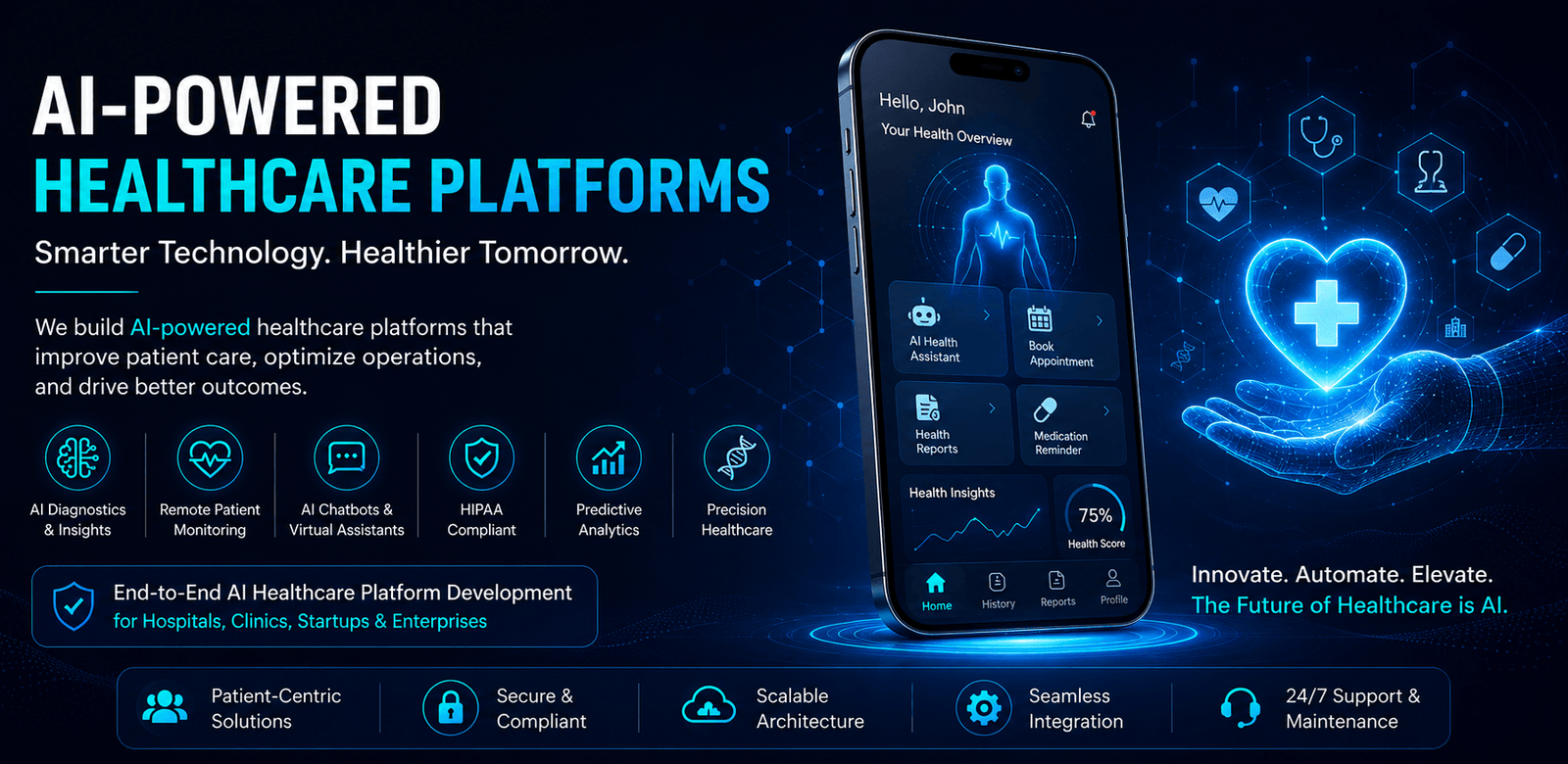
AI-powered healthcare platforms are digital systems that use artificial intelligence technologies to automate healthcare processes, analyze medical data, support clinical decisions, and enhance patient experiences.
Unlike traditional healthcare software, AI-driven platforms continuously learn from data and improve their performance over time.
These platforms help healthcare organizations:
- Improve diagnostics
- Automate workflows
- Monitor patients remotely
- Enhance patient engagement
- Reduce operational costs
- Support personalized treatment plans
AI-powered healthcare platforms can be used by:
- Hospitals
- Clinics
- Telemedicine Providers
- Insurance Companies
- Healthcare Startups
- Pharmaceutical Companies
Why AI Is Transforming Healthcare
The healthcare industry generates massive amounts of data every day. This includes:
- Electronic Health Records (EHRs)
- Medical Imaging
- Laboratory Reports
- Patient Histories
- Wearable Device Data
- Insurance Claims
Traditional healthcare systems often struggle to process this information effectively.
AI technologies help healthcare organizations analyze large datasets quickly and identify patterns that support better decision-making.
Key Drivers of AI Adoption
Increasing Demand for Personalized Care
Patients expect tailored healthcare experiences based on their individual needs and medical histories.
Growing Healthcare Costs
Healthcare organizations need innovative ways to reduce operational expenses.
Workforce Shortages
AI helps automate repetitive administrative tasks, allowing healthcare professionals to focus on patient care.
Expansion of Telemedicine
Virtual healthcare requires intelligent systems capable of supporting remote consultations and patient management.
Benefits of AI-Powered Healthcare Platforms
Improved Diagnostic Accuracy
AI algorithms can analyze medical images and patient records to identify diseases more accurately and efficiently.
Benefits include:
- Faster Diagnoses
- Reduced Human Error
- Early Disease Detection
Enhanced Patient Engagement
AI-powered platforms improve communication through:
- Virtual Assistants
- Chatbots
- Personalized Recommendations
- Automated Follow-Ups
Predictive Healthcare
Predictive analytics helps identify health risks before symptoms become severe.
Applications include:
- Chronic Disease Management
- Readmission Prevention
- Preventive Care
Operational Efficiency
AI automates routine administrative processes such as:
- Scheduling
- Billing
- Documentation
- Claims Processing
Reduced Healthcare Costs
Automation and intelligent workflows help healthcare providers lower operational expenses.
Why Healthcare Organizations Are Investing in AI in 2026
Healthcare organizations are increasingly investing in AI because it enables better patient outcomes while improving operational performance.
Key reasons include:
- Growing patient expectations
- Increasing healthcare data
- Demand for personalized care
- Rising healthcare costs
- Need for operational efficiency
Healthcare providers that adopt AI gain a significant competitive advantage by delivering smarter and more efficient services.
Essential Features of AI-Powered Healthcare Platforms
AI Chatbots & Virtual Assistants
AI assistants help patients with:
- Appointment Scheduling
- Symptom Assessment
- Medication Reminders
- General Healthcare Questions
Electronic Health Records (EHR) Integration
Healthcare professionals require seamless access to patient information.
Features include:
- Medical Histories
- Lab Reports
- Prescriptions
- Treatment Plans
Predictive Analytics
AI identifies patterns and predicts future health risks.
Applications include:
- Disease Prediction
- Risk Assessment
- Population Health Management
Remote Patient Monitoring
Healthcare providers can monitor patients remotely using wearable devices.
Examples:
- Heart Rate Monitoring
- Blood Pressure Tracking
- Oxygen Level Monitoring
Telemedicine Support
Features include:
- Video Consultations
- Secure Messaging
- Digital Prescriptions
- Follow-Up Care
Medical Imaging Analysis
AI assists healthcare professionals by analyzing:
- X-Rays
- CT Scans
- MRIs
- Mammograms
Clinical Decision Support
AI provides evidence-based recommendations to healthcare professionals.
Traditional Healthcare Systems vs AI-Powered Healthcare Platforms
| Feature | Traditional Systems | AI-Powered Platforms |
|---|---|---|
| Data Processing | Manual | Automated |
| Diagnostics | Human Dependent | AI-Assisted |
| Patient Monitoring | Periodic | Real-Time |
| Scheduling | Manual | Automated |
| Analytics | Basic | Advanced |
| Personalization | Limited | High |
| Operational Efficiency | Moderate | High |
| Scalability | Moderate | Excellent |
AI-powered platforms clearly provide superior efficiency and scalability.
Use Cases of AI-Powered Healthcare Platforms
AI in Diagnostics
AI helps identify diseases through:
- Medical Image Analysis
- Pattern Recognition
- Risk Assessment
AI in Telemedicine
AI improves virtual care through:
- Smart Triage
- Automated Follow-Ups
- Virtual Assistants
AI in Hospital Management
Applications include:
- Resource Allocation
- Staff Scheduling
- Inventory Management
AI in Mental Healthcare
Mental health applications use AI for:
- Mood Tracking
- Emotional Analysis
- Virtual Therapy Support
AI in Chronic Disease Management
AI supports ongoing management of:
- Diabetes
- Hypertension
- Asthma
- Heart Disease
Industries Benefiting from AI-Powered Healthcare Platforms
Hospitals
Hospitals use AI to improve operational efficiency and patient outcomes.
Clinics
Clinics benefit from AI-powered scheduling, diagnostics, and patient engagement.
Telemedicine Providers
AI enhances virtual healthcare experiences and improves patient satisfaction.
Insurance Companies
Insurance providers use AI for:
- Fraud Detection
- Claims Processing
- Risk Analysis
Pharmaceutical Companies
Applications include:
- Drug Discovery
- Clinical Research
- Trial Optimization
AI Technologies Used in Healthcare Platforms
Machine Learning (ML)
ML enables systems to learn from healthcare data and improve predictions.
Natural Language Processing (NLP)
NLP helps platforms understand and process human language.
Applications include:
- Medical Documentation
- Voice Assistants
- Clinical Notes Analysis
Computer Vision
Computer vision supports:
- Medical Imaging
- Disease Detection
- Surgical Assistance
Predictive Analytics
Predictive models help healthcare organizations forecast future outcomes.
Generative AI in Healthcare
Generative AI is becoming one of the most transformative technologies in healthcare.
Clinical Documentation
AI can automatically generate:
- Consultation Summaries
- Medical Reports
- Patient Notes
Healthcare Chatbots
Generative AI-powered assistants provide:
- Instant Responses
- Patient Support
- Healthcare Guidance
Personalized Treatment Recommendations
AI analyzes patient data and recommends customized treatment plans.
Medical Research
Researchers use generative AI to accelerate discoveries and analyze large datasets.
AI Healthcare Platform Development Process
Step 1: Requirement Analysis
Define:
- Business Goals
- User Needs
- Compliance Requirements
Step 2: UI/UX Design
Create intuitive and accessible healthcare experiences.
Step 3: AI Model Development
Develop and train AI models using healthcare datasets.
Step 4: Platform Development
Build scalable applications using:
- React Native
- Flutter
- Node.js
- Python
Step 5: Integration
Integrate:
- EHR Systems
- Telemedicine APIs
- AI Services
- Payment Gateways
Step 6: Testing
Perform:
- Functional Testing
- Security Testing
- Performance Testing
Step 7: Deployment
Launch the platform across target devices and environments.
Technology Stack for AI Healthcare Platforms
Frontend
- React Native
- Flutter
- React.js
Backend
- Node.js
- Python
- Java
AI Frameworks
- TensorFlow
- PyTorch
- OpenAI
- Azure AI
Cloud Platforms
- AWS
- Microsoft Azure
- Google Cloud
Databases
- PostgreSQL
- MongoDB
- Firebase
Why React Native Is Ideal for AI Healthcare Platforms
Many healthcare organizations choose React Native because it allows developers to create Android and iOS applications using a single codebase.
Benefits include:
- Faster Development
- Lower Costs
- Better Scalability
- Easier Maintenance
- Strong AI Integration Support
For healthcare startups and enterprises alike, React Native provides a cost-effective approach to mobile healthcare development.
HIPAA Compliance & Security Requirements
Healthcare applications manage sensitive patient information and must follow strict security standards.
Essential requirements include:
- HIPAA Compliance
- GDPR Compliance
- Data Encryption
- Audit Logs
- Role-Based Access Control
- Multi-Factor Authentication
Security should be integrated into every stage of development.
How Much Does AI Healthcare Platform Development Cost?
| Platform Type | Estimated Cost |
|---|---|
| Basic Platform | $25,000 – $50,000 |
| Mid-Level Platform | $50,000 – $120,000 |
| Enterprise Platform | $120,000 – $300,000+ |
Cost Factors
- AI Complexity
- Platform Features
- Compliance Requirements
- Integrations
- Development Team Location
AI Healthcare Platform Monetization Models
Subscription Model
Users pay recurring monthly or annual fees.
Pay-Per-Consultation
Patients pay for each consultation session.
SaaS Model
Healthcare organizations subscribe to cloud-based healthcare software.
Enterprise Licensing
Hospitals and clinics purchase enterprise licenses.
Freemium Model
Basic features are free, while advanced functionality requires payment.
Challenges in AI Healthcare Platform Development
Data Privacy
Protecting sensitive patient data remains a top priority.
Compliance Complexity
Healthcare regulations vary across different regions.
Data Quality
AI systems require accurate and reliable healthcare datasets.
User Adoption
Healthcare professionals must trust and understand AI-powered solutions.
Future Trends in AI Healthcare Platforms
AI-Powered Virtual Assistants
Healthcare assistants will become increasingly intelligent and personalized.
Predictive Healthcare
AI will help identify diseases before symptoms appear.
Personalized Medicine
Treatment plans will become more tailored to individual patients.
Smart Hospitals
Hospitals will increasingly use AI for automation and operational efficiency.
Wearable Health Technology
AI-powered wearables will provide continuous health monitoring and real-time insights.
Why Choose AppCrex for AI Healthcare Platform Development?
AppCrex specializes in developing secure, scalable, and innovative healthcare solutions.
Our Services
- AI Healthcare Platform Development
- Healthcare App Development
- Telemedicine App Development
- AI Chatbot Development
- Healthcare Software Development
- React Native Development
- Flutter Development
- EHR Integration
- Generative AI Integration
Why Clients Choose AppCrex
- Healthcare Industry Expertise
- Experienced AI Developers
- HIPAA-Compliant Development
- Agile Methodology
- Transparent Communication
- End-to-End Support
We help healthcare providers, startups, and enterprises build future-ready AI healthcare platforms that drive digital transformation and improve patient outcomes.
Frequently Asked Questions (FAQs)
1. What is an AI-powered healthcare platform?
An AI-powered healthcare platform uses artificial intelligence technologies to automate healthcare processes and improve patient care.
2. How much does AI healthcare platform development cost?
Costs typically range from $25,000 to $300,000+ depending on complexity and features.
3. What are the main benefits of AI in healthcare?
Improved diagnostics, operational efficiency, predictive analytics, and personalized patient care.
4. Is AI secure for healthcare applications?
Yes, when developed with HIPAA compliance, encryption, and strong access controls.
5. What technologies are used in AI healthcare platforms?
React Native, Flutter, Python, TensorFlow, OpenAI, AWS, Azure, and Google Cloud.
6. Can AI replace healthcare professionals?
No. AI supports healthcare professionals by improving decision-making and automating repetitive tasks.
7. How long does it take to build an AI healthcare platform?
Most projects take between 3 and 12 months.
8. What is Generative AI in healthcare?
Generative AI helps create clinical documentation, patient summaries, and intelligent healthcare assistants.
9. Can AI healthcare platforms integrate with EHR systems?
Yes, modern platforms commonly integrate with EHR and EMR systems.
10. Why choose React Native for healthcare app development?
React Native offers faster development, lower costs, and cross-platform compatibility.
Final Thoughts
AI-powered healthcare platforms are transforming healthcare delivery by enabling smarter diagnostics, personalized treatment plans, predictive analytics, and improved operational efficiency. As healthcare organizations continue investing in digital transformation, AI will play an increasingly important role in shaping the future of patient care. Businesses that adopt AI healthcare solutions today will be better positioned to improve outcomes, enhance patient experiences, and remain competitive in the evolving healthcare landscape. By partnering with a trusted healthcare app development company like AppCrex, organizations can build secure, scalable, and future-ready AI-powered healthcare platforms that drive long-term success.