
📌 Key Takeaways
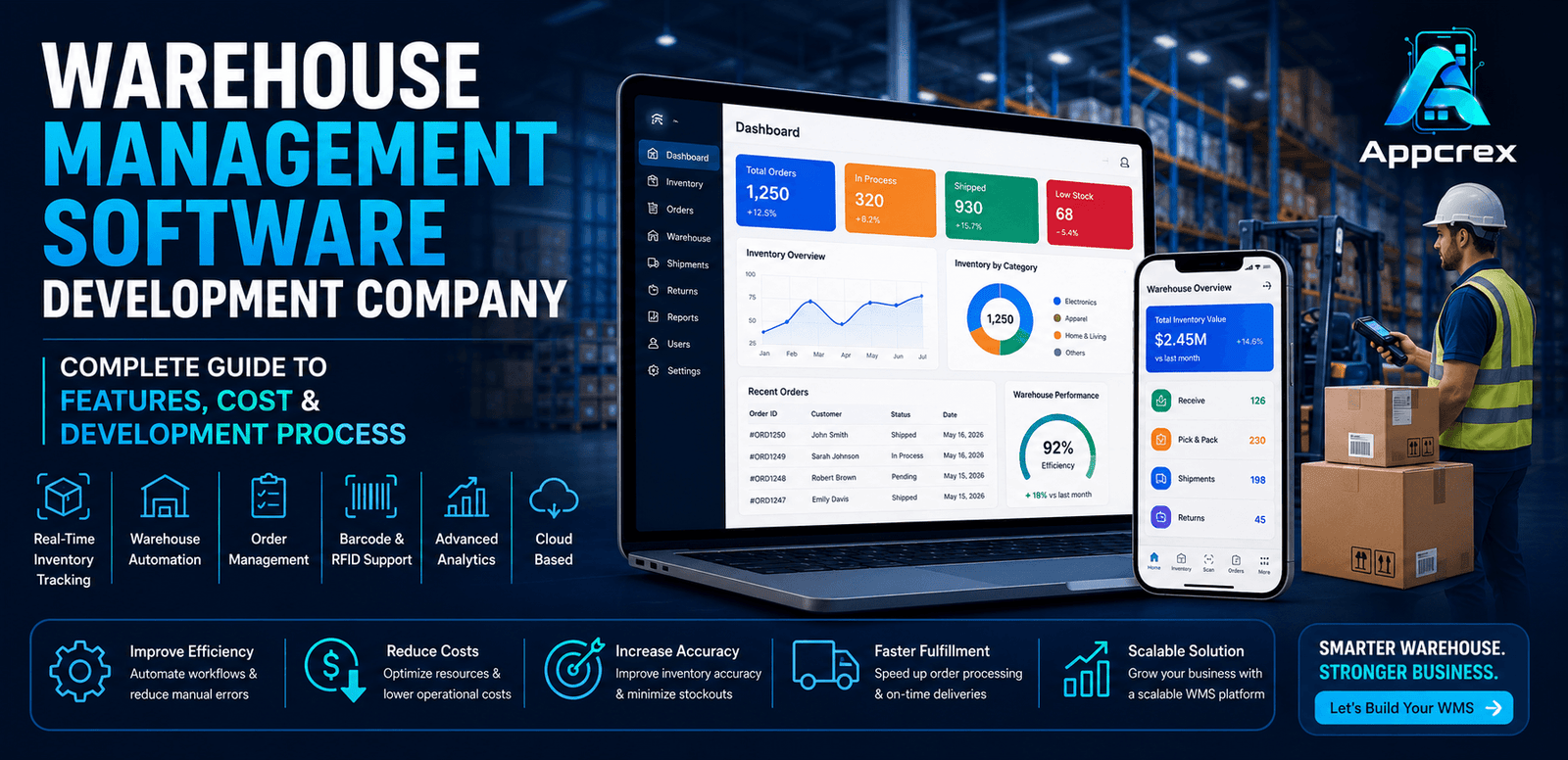
- Warehouse Management Software automates inventory, storage, order fulfillment, and warehouse operations.
- AI-powered features improve inventory forecasting, warehouse optimization, and operational efficiency.
- Barcode, RFID, ERP, and cloud integrations enable real-time inventory visibility and accurate stock management.
- WMS development typically costs $30,000 to $300,000+, depending on features, integrations, and customization.
- A custom WMS helps eCommerce, retail, manufacturing, logistics, healthcare, and 3PL businesses improve productivity and scale efficiently.
Introduction
As global supply chains become more complex and customer expectations continue to rise, businesses need smarter ways to manage inventory, warehouse operations, and order fulfillment. Manual warehouse processes often lead to inventory inaccuracies, delayed shipments, increased operational costs, and reduced productivity. This is why businesses are increasingly investing in Warehouse Management Software (WMS) to automate and optimize warehouse operations.
Warehouse Management Software helps organizations efficiently manage inventory, receiving, storage, picking, packing, shipping, and returns from a centralized platform. By integrating technologies such as Artificial Intelligence (AI), barcode scanning, RFID, IoT, cloud computing, and real-time analytics, a modern WMS improves inventory visibility, streamlines workflows, and enhances overall supply chain performance.
The demand for Warehouse Management Software Development is growing rapidly across industries such as eCommerce, retail, manufacturing, logistics, healthcare, wholesale distribution, FMCG, and third-party logistics (3PL). Businesses are adopting intelligent warehouse solutions to reduce operational costs, improve inventory accuracy, accelerate order fulfillment, and support business growth.
Countries such as the USA, Germany, UK, UAE, and India are witnessing significant investments in warehouse automation as organizations modernize their supply chain infrastructure to meet increasing customer demand.
Whether you’re managing a single warehouse or a multi-location distribution network, partnering with an experienced Warehouse Management Software Development Company helps you build a secure, scalable, and feature-rich solution tailored to your business requirements.
In this complete guide, we’ll explore everything you need to know about Warehouse Management Software Development, including its features, benefits, development process, technology stack, AI capabilities, development cost, and the latest trends shaping warehouse operations in 2026.
Just Read : Custom Software Development Company: Complete Guide to Services, Process, Cost & Benefits (2026)
What is Warehouse Management Software?
Warehouse Management Software (WMS) is a digital solution that helps businesses manage and optimize day-to-day warehouse operations. It provides complete visibility into inventory movement, warehouse activities, and order fulfillment while improving operational efficiency.
Instead of relying on spreadsheets or manual processes, businesses can automate warehouse workflows, minimize errors, and make data-driven decisions using a centralized software platform.
A complete Warehouse Management System typically includes four major modules:
Inventory Management
Track inventory levels in real time, monitor stock movement, manage warehouse locations, and reduce stock discrepancies.
Warehouse Operations
Automate receiving, put-away, storage, picking, packing, shipping, and returns to improve operational efficiency.
Manager Dashboard
Warehouse managers can monitor inventory performance, employee productivity, order status, warehouse capacity, and operational KPIs from a centralized dashboard.
Admin Panel
Administrators can manage users, warehouses, inventory rules, system settings, reports, integrations, and business analytics.
A professionally developed Warehouse Management Software enables businesses to improve inventory accuracy, optimize warehouse space, accelerate order processing, and reduce operational costs.
How Warehouse Management Software Works?
A modern Warehouse Management System automates warehouse activities from the moment inventory arrives until products are shipped to customers.
The typical workflow includes:
- Inventory is received at the warehouse.
- Products are scanned using barcodes or RFID.
- Items are assigned to optimized storage locations.
- Customer orders are received and processed.
- Warehouse staff receive picking and packing instructions.
- Orders are packed, labeled, and prepared for shipment.
- Inventory levels are updated automatically in real time.
- Managers access reports and analytics to optimize warehouse performance.
By integrating AI, barcode scanning, RFID, cloud computing, and analytics, businesses can improve inventory control and streamline warehouse operations.
Why Businesses Need Warehouse Management Software?
As order volumes increase and supply chains become more complex, businesses need intelligent warehouse solutions to remain competitive.
Improve Inventory Accuracy
Real-time inventory tracking minimizes stock discrepancies, reduces human error, and ensures accurate stock availability.
Faster Order Fulfillment
Automated picking, packing, and shipping processes help businesses process customer orders more quickly and accurately.
Reduce Operational Costs
Warehouse automation minimizes manual work, reduces inventory losses, and optimizes labor utilization.
Better Warehouse Visibility
Managers gain complete visibility into inventory, warehouse activities, employee performance, and operational metrics through centralized dashboards.
Optimize Warehouse Space
Smart storage allocation and inventory management improve warehouse capacity utilization and reduce unnecessary storage costs.
Support Business Growth
Cloud-based Warehouse Management Software scales with your business, allowing you to manage multiple warehouses, distribution centers, and fulfillment locations efficiently.
Warehouse Management Software Market Opportunities in USA, Germany, UK, UAE & India
The demand for Warehouse Management Software (WMS) is growing rapidly as businesses modernize their supply chain operations and invest in warehouse automation. Rising eCommerce sales, global trade, and customer expectations for faster deliveries have encouraged organizations to adopt intelligent warehouse management solutions.
Businesses across the USA, Germany, UK, UAE, and India are implementing Warehouse Management Software to improve inventory accuracy, streamline warehouse operations, automate order fulfillment, and reduce operational costs.
USA
The United States has one of the world’s largest logistics and eCommerce industries. Retailers, manufacturers, and third-party logistics (3PL) providers are adopting AI-powered Warehouse Management Software to manage high inventory volumes, improve warehouse efficiency, and support same-day and next-day delivery operations.
Germany
Germany is a global manufacturing and logistics hub with highly advanced supply chain networks. Businesses are investing in smart warehouse automation, robotics, and Warehouse Management Systems to improve productivity, optimize inventory, and enhance operational efficiency.
United Kingdom
The UK’s growing retail and eCommerce sectors continue to drive demand for Warehouse Management Software. Businesses use WMS solutions to manage inventory across multiple warehouses, improve order accuracy, and streamline fulfillment operations.
UAE
The UAE has become a major logistics and distribution center in the Middle East. As online shopping and international trade continue to expand, businesses are investing in Warehouse Management Software to improve warehouse visibility, automate operations, and support digital transformation.
India
India’s fast-growing eCommerce, retail, pharmaceutical, and manufacturing industries have significantly increased the demand for Warehouse Management Software. Companies use WMS platforms to improve inventory management, optimize warehouse space, and accelerate order processing.
Industries Using Warehouse Management Software
Warehouse Management Software is used across industries that require efficient inventory control, order fulfillment, and warehouse automation.
eCommerce
Online retailers use Warehouse Management Software to manage inventory, process customer orders, and ensure fast, accurate deliveries.
Retail
Retail businesses manage stock across stores and warehouses while improving replenishment and inventory visibility.
Manufacturing
Manufacturers use WMS to track raw materials, manage production inventory, and improve warehouse efficiency.
Third-Party Logistics (3PL)
3PL providers use Warehouse Management Software to manage multiple clients, optimize storage, and improve shipment accuracy.
Healthcare & Pharmaceuticals
Hospitals, distributors, and pharmaceutical companies use WMS to manage medical inventory, maintain stock accuracy, and ensure regulatory compliance.
FMCG
Fast-moving consumer goods companies rely on Warehouse Management Software to handle large inventory volumes and accelerate order fulfillment.
Wholesale Distribution
Wholesalers use WMS to streamline inventory movement, improve warehouse productivity, and fulfill bulk orders efficiently.
Automotive
Automotive businesses use Warehouse Management Software to track spare parts, manage inventory, and improve supply chain operations.
Types of Warehouse Management Software
Different businesses require different warehouse solutions depending on their size, industry, and operational requirements.
| Software Type | Best For |
|---|---|
| Inventory Management Software | Small & medium businesses |
| Standalone Warehouse Management System | Single warehouse operations |
| Cloud-Based WMS | Growing businesses & enterprises |
| Enterprise Warehouse Management Software | Large organizations |
| 3PL Warehouse Management Software | Logistics service providers |
| Automated Warehouse Management System | Smart warehouses & distribution centers |
Selecting the right Warehouse Management Software depends on inventory volume, warehouse size, operational complexity, and future business growth.
Benefits of Warehouse Management Software
Implementing a modern Warehouse Management System offers significant operational and financial advantages.
Improve Inventory Accuracy
Real-time inventory tracking minimizes stock errors, prevents overstocking or stockouts, and ensures accurate inventory records.
Faster Order Fulfillment
Automated picking, packing, and shipping processes reduce processing time and improve order accuracy.
Lower Operational Costs
Warehouse automation reduces manual work, minimizes inventory losses, and improves labor productivity.
Better Warehouse Visibility
Managers gain complete visibility into inventory movement, warehouse performance, employee productivity, and operational KPIs.
Optimized Warehouse Space
Intelligent storage allocation helps businesses maximize warehouse capacity and improve inventory organization.
Business Scalability
Cloud-based Warehouse Management Software enables businesses to manage multiple warehouses, distribution centers, and fulfillment locations while supporting future growth.
Essential Features of Warehouse Management Software
A modern Warehouse Management Software (WMS) should help businesses automate warehouse operations, improve inventory accuracy, streamline order fulfillment, and provide complete visibility across the supply chain.
A complete WMS generally consists of four major modules:
- Warehouse Staff App
- Manager Dashboard
- Admin Panel
- Customer & Supplier Portal (Optional)
Together, these modules improve operational efficiency, reduce errors, and enhance warehouse productivity.
Also Read : GPS Navigation App Development Guide: Features, Cost & Development Process
Warehouse Staff App Features
The warehouse staff application helps employees manage daily warehouse tasks quickly and accurately.
1. Secure Login & Role Management
Employees can securely log in using role-based permissions, ensuring access only to authorized warehouse functions.
2. Barcode & QR Code Scanning
Warehouse staff can scan products using barcode or QR code technology to:
- Receive inventory
- Verify stock
- Pick products
- Update inventory
- Process shipments
This minimizes manual errors and speeds up warehouse operations.
3. Inventory Tracking
Employees can check real-time inventory levels, product locations, stock availability, and movement history directly from the mobile app.
4. Receiving & Put-Away Management
The app guides warehouse staff through receiving incoming goods and assigning products to the correct storage locations for better warehouse organization.
5. Picking & Packing
Warehouse employees receive optimized picking lists, allowing them to collect, pack, and prepare orders accurately and efficiently.
6. Shipping Management
Staff can generate shipping labels, verify packages, and update shipment status before dispatch.
7. Returns Management
Warehouse teams can process returned products, inspect item conditions, update inventory, and restock eligible products efficiently.
Manager Dashboard Features
The manager dashboard provides complete visibility into warehouse operations and business performance.
1. Real-Time Inventory Dashboard
Managers can monitor:
- Stock availability
- Inventory movement
- Low-stock alerts
- Overstock situations
- Warehouse utilization
2. Order Management
Track customer orders from receiving through picking, packing, shipping, and delivery.
3. Warehouse Performance Monitoring
Monitor important KPIs such as:
- Order fulfillment rate
- Inventory accuracy
- Picking efficiency
- Warehouse productivity
- Employee performance
4. Multi-Warehouse Management
Businesses operating multiple warehouses can monitor inventory, stock transfers, and warehouse performance from a single dashboard.
5. Reports & Analytics
Generate reports on:
- Inventory turnover
- Warehouse utilization
- Order accuracy
- Shipment performance
- Employee productivity
These insights help businesses optimize warehouse operations and improve decision-making.
Also Read : Last Mile Delivery Software Development Company: Complete Guide to Features, Cost & Development Process
Admin Panel Features
The admin panel enables complete control over the Warehouse Management System.
1. User & Role Management
Manage warehouse staff, managers, suppliers, and administrators with role-based access control.
2. Inventory Configuration
Configure inventory rules, product categories, storage locations, warehouses, and stock thresholds.
3. Supplier Management
Manage supplier information, purchase orders, deliveries, and vendor performance from a centralized dashboard.
4. Warehouse Configuration
Create and manage multiple warehouses, storage zones, racks, shelves, and bin locations.
5. Business Reports & Analytics
Access dashboards showing:
- Revenue
- Inventory value
- Warehouse efficiency
- Order processing speed
- Operational costs
- Business growth
AI-Powered Features in Warehouse Management Software
Artificial Intelligence is transforming warehouse operations by improving automation, forecasting, and operational efficiency.
AI Inventory Forecasting
AI predicts future inventory requirements based on historical sales, seasonal demand, and purchasing trends, helping businesses avoid stock shortages and excess inventory.
Smart Inventory Optimization
AI recommends optimal stock levels, storage allocation, and replenishment schedules to maximize warehouse efficiency.
Intelligent Picking Routes
AI calculates the most efficient picking routes inside the warehouse, reducing travel time and improving employee productivity.
Automated Demand Forecasting
Machine learning analyzes customer demand patterns and forecasts inventory requirements, helping businesses improve procurement planning.
Warehouse Space Optimization
AI identifies the best storage locations based on product demand, size, and movement frequency to maximize warehouse capacity.
Predictive Analytics
Advanced analytics help businesses identify inventory risks, forecast warehouse performance, and support better operational planning.
Also read : Fleet Management Software Development: Complete Guide to Features, Cost & Development Process
Technology Stack for Warehouse Management Software Development
Choosing the right technology stack ensures the Warehouse Management System is secure, scalable, and capable of supporting growing business operations.
| Component | Recommended Technologies |
|---|---|
| Mobile App Development | Flutter, React Native, Swift, Kotlin |
| Frontend Development | React.js, Angular, Next.js |
| Backend Development | Node.js, Java, Python, .NET |
| Database | PostgreSQL, MySQL, MongoDB |
| Cloud Hosting | AWS, Microsoft Azure, Google Cloud |
| Barcode & RFID | Zebra SDK, RFID APIs |
| Notifications | Firebase Cloud Messaging |
| Analytics | Power BI, Google Analytics |
| ERP Integration | SAP, Oracle ERP, Microsoft Dynamics |
Warehouse Management Software Development Process
Developing a robust Warehouse Management Software (WMS) requires a strategic approach that combines business analysis, modern technologies, and industry best practices. A well-planned development process ensures your software is scalable, secure, and capable of handling complex warehouse operations.
Step 1: Business Analysis & Requirement Gathering
The project begins by understanding your warehouse operations, inventory workflow, and business objectives.
This phase includes:
- Business requirement analysis
- Warehouse workflow assessment
- Competitor research
- Feature planning
- Technology selection
- Development roadmap
Step 2: UI/UX Design
An intuitive and user-friendly interface helps warehouse staff and managers perform tasks efficiently.
The design phase includes:
- Wireframes
- Interactive prototypes
- User journey mapping
- Mobile-first design
- Dashboard design
Step 3: Warehouse Management Software Development
Developers build the core modules of the platform, including:
- Inventory Management
- Warehouse Operations
- Order Management
- Barcode & RFID Integration
- Warehouse Staff App
- Manager Dashboard
- Admin Panel
- Reports & Analytics
Using modern technologies such as Flutter, React, and Node.js ensures a scalable and high-performance solution.
Step 4: Third-Party Integrations
To enhance functionality, developers integrate essential business systems, including:
- ERP Systems
- Accounting Software
- Barcode & RFID Solutions
- Shipping & Logistics APIs
- Payment Gateways
- Cloud Storage
- Email & SMS Services
Step 5: Testing & Quality Assurance
Before deployment, the software undergoes comprehensive testing to ensure reliability, security, and performance.
Testing includes:
- Functional Testing
- Performance Testing
- Security Testing
- API Testing
- Device Compatibility Testing
- User Acceptance Testing (UAT)
Step 6: Deployment & Ongoing Maintenance
After successful testing, the software is deployed to production servers.
Ongoing support includes:
- Bug fixes
- Performance optimization
- Security updates
- Feature enhancements
- Cloud monitoring
- Technical support
How Much Does Warehouse Management Software Development Cost?
The cost of Warehouse Management Software Development depends on the project’s complexity, required features, integrations, AI capabilities, and deployment model.
| Software Type | Estimated Cost |
|---|---|
| Basic Warehouse Management Software | $30,000–$60,000 |
| Advanced Warehouse Management System | $60,000–$120,000 |
| Enterprise AI-Powered WMS | $120,000–$300,000+ |
The final investment depends on customization, warehouse size, number of users, integrations, and long-term scalability.
Factors Affecting Development Cost
Several factors influence the total development budget.
Software Complexity
Advanced features such as AI forecasting, RFID integration, warehouse automation, and multi-location inventory management increase development effort.
Warehouse Size & Locations
Supporting multiple warehouses, distribution centers, and fulfillment hubs requires additional configuration and scalability.
Third-Party Integrations
The cost may increase when integrating:
- ERP Systems
- CRM Platforms
- Shipping APIs
- Barcode & RFID Solutions
- Accounting Software
AI & Automation
Features like demand forecasting, smart inventory optimization, warehouse analytics, and predictive reporting require advanced AI development.
Security & Compliance
Enterprise-grade authentication, data encryption, role-based access control, and audit logs improve system security and compliance.
Ongoing Maintenance
Regular software updates, cloud hosting, performance optimization, and technical support should be included in the long-term budget.
Monetization Models
If you’re building a commercial Warehouse Management platform, these revenue models can generate recurring income.
SaaS Subscription
Offer monthly or yearly subscription plans based on users, warehouses, or inventory volume.
Enterprise Licensing
Provide customized WMS solutions for manufacturers, retailers, logistics companies, and distributors.
White-Label Software
Allow businesses to rebrand your Warehouse Management Software and launch it under their own company name.
Premium Modules
Offer paid add-ons such as:
- AI Forecasting
- Advanced Analytics
- RFID Integration
- Multi-Warehouse Management
- Custom Reporting
Implementation & Support Services
Generate additional revenue through software implementation, customization, training, and ongoing maintenance.
Why Choose AppCrex for Warehouse Management Software Development?
At AppCrex, we develop secure, scalable, and AI-powered Warehouse Management Software that helps businesses automate inventory control, streamline warehouse operations, and improve order fulfillment.
Our experienced developers build customized WMS solutions for retail, eCommerce, manufacturing, logistics, healthcare, wholesale distribution, and 3PL providers. From business analysis and UI/UX design to development, deployment, and long-term support, we deliver end-to-end software solutions tailored to your operational requirements.
Whether you manage a single warehouse or multiple distribution centers, AppCrex provides future-ready Warehouse Management Software designed to improve efficiency, reduce operational costs, and support business growth.
(FAQs)
1. What is Warehouse Management Software (WMS)?
Warehouse Management Software is a digital solution that helps businesses manage inventory, warehouse operations, order fulfillment, storage, shipping, and returns from a centralized platform.
2. How much does Warehouse Management Software development cost?
Development typically costs between $30,000 and $300,000+, depending on features, integrations, AI capabilities, and project complexity.
3. How long does it take to build a Warehouse Management System?
A standard Warehouse Management System usually takes 4–8 months, while an enterprise-grade solution with advanced automation may require 8–12 months.
4. Can AI be integrated into Warehouse Management Software?
Yes. AI can automate inventory forecasting, warehouse optimization, demand prediction, picking routes, and business analytics to improve operational efficiency.
5. Which industries use Warehouse Management Software?
Warehouse Management Software is widely used by eCommerce, retail, manufacturing, logistics, healthcare, wholesale distribution, FMCG, automotive, and 3PL companies.
Conclusion
Warehouse Management Software has become an essential tool for businesses aiming to improve inventory accuracy, automate warehouse operations, and optimize supply chain performance. By integrating AI, barcode scanning, RFID, cloud computing, and real-time analytics, organizations can reduce operational costs, accelerate order fulfillment, and make better business decisions.
As warehouse automation continues to grow worldwide, investing in Warehouse Management Software Development provides businesses with a scalable and future-ready solution that supports long-term growth and operational excellence.
Partnering with an experienced Warehouse Management Software Development Company like AppCrex ensures you receive a secure, scalable, and customized WMS solution designed to meet your business needs and drive digital transformation.