📌 Key Takeaways
- Manufacturing apps can digitize production, inventory, maintenance, and workforce operations.
- IoT integration enables real-time machine and equipment monitoring.
- AI and machine learning can support predictive maintenance, quality inspection, and production optimization.
- ERP and enterprise integrations connect manufacturing apps with existing business systems.
- MVP development allows manufacturers to digitize one workflow first and expand gradually.
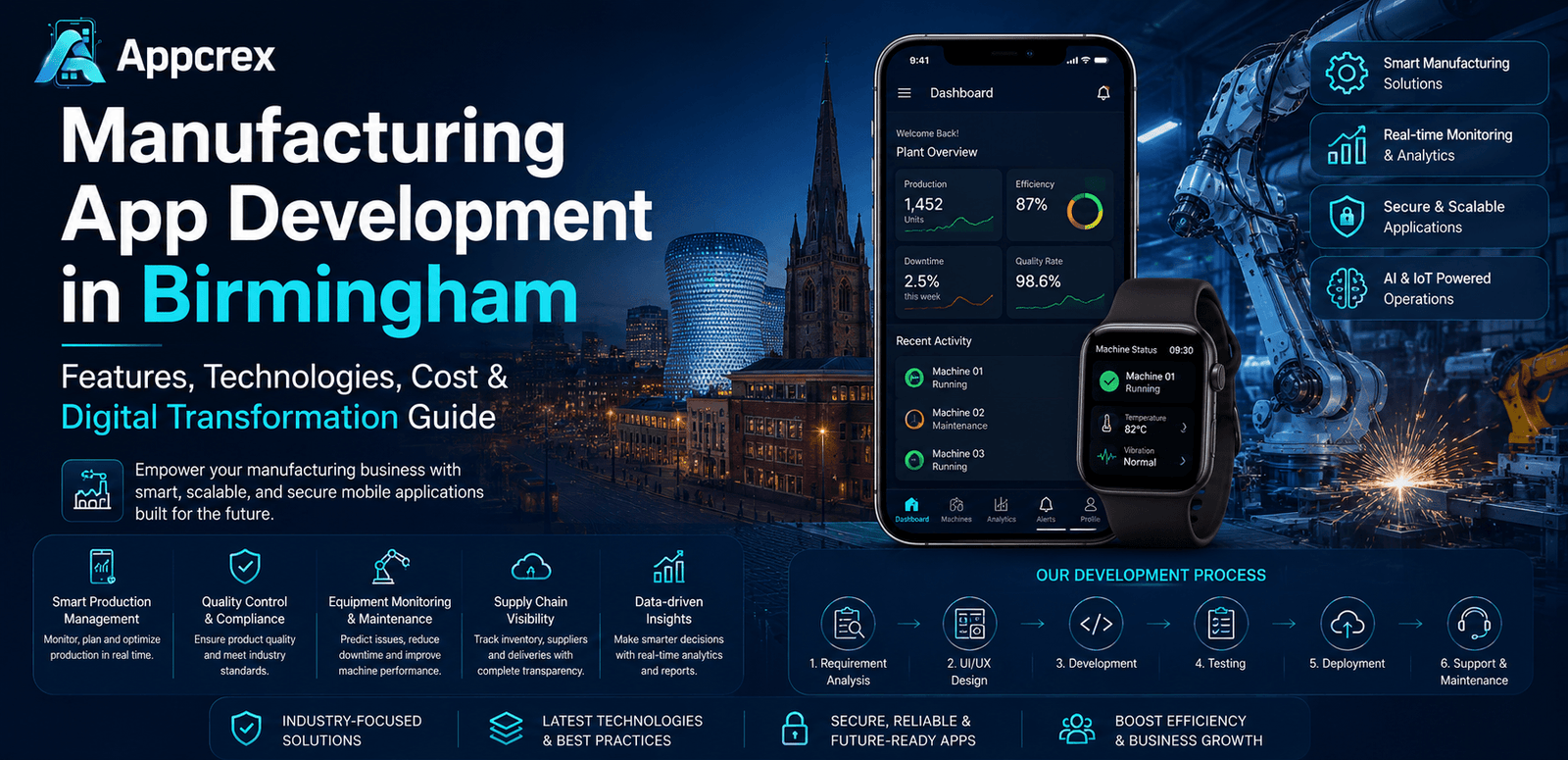
Birmingham has long been associated with manufacturing, engineering, automotive, logistics, and industrial businesses. As these sectors become increasingly connected, manufacturers are adopting digital platforms to monitor production, manage inventory, coordinate workers, track equipment, and improve operational efficiency.
A modern manufacturing app development company in Birmingham can help businesses transform traditional processes into connected digital workflows. These solutions can combine mobile apps, cloud platforms, IoT devices, artificial intelligence, machine learning, analytics, and enterprise software integrations.
Manufacturing applications are no longer limited to simple inventory management. Businesses can now build platforms that provide real-time production visibility, predictive maintenance, automated reporting, supply-chain tracking, workforce coordination, and machine monitoring.
This guide explains manufacturing app development in Birmingham, including important features, technologies, development costs, timelines, IoT and AI opportunities, development processes, and factors businesses should consider before starting a project.
Why Birmingham Is an Important Market for Manufacturing Technology?
Birmingham and the wider West Midlands have a strong industrial and engineering background.
The region provides opportunities across areas such as:
- Advanced manufacturing
- Automotive
- Engineering
- Industrial production
- Supply chain
- Logistics
- Warehousing
- Industrial automation
- Technology
- Professional services
As manufacturing businesses become more dependent on data and connected systems, mobile and web applications can become an important part of their digital infrastructure.
Instead of relying on spreadsheets, paper-based workflows, disconnected systems, and manual reporting, businesses can use centralized software to bring operational information together.
What Is Manufacturing App Development?
Manufacturing app development involves building mobile, web, or enterprise software solutions designed specifically for manufacturing operations.
Depending on the business, the application could help manage:
- Production
- Inventory
- Equipment
- Employees
- Orders
- Suppliers
- Warehouses
- Quality control
- Maintenance
- Deliveries
- Production analytics
A manufacturing platform may be used by factory managers, production supervisors, warehouse teams, engineers, drivers, maintenance teams, and senior management.
For example, a production manager could use a mobile dashboard to monitor production status without being physically present beside every machine.
Also Read : Inventory Management Software Development Company: Complete Guide
Types of Manufacturing Apps Businesses Can Build
There isn’t one standard manufacturing application. Different businesses require different digital solutions.
1. Production Management Apps
Production management software can help companies monitor manufacturing activities in real time.
Possible functionality includes:
- Production schedules
- Work orders
- Production status
- Machine utilization
- Employee assignments
- Output tracking
- Production targets
- Performance reports
Managers can use dashboards to identify delays and production bottlenecks.
2. Inventory Management Apps
Inventory applications help businesses maintain visibility into raw materials, components, finished products, and warehouse stock.
Features can include:
- Stock tracking
- Barcode scanning
- QR code scanning
- Stock alerts
- Purchase orders
- Warehouse management
- Product categorization
- Supplier information
Mobile barcode scanning can reduce the need for manual data entry.
3. Equipment Monitoring Apps
Industrial equipment can generate large amounts of operational data.
An equipment monitoring application can display:
- Machine status
- Operating hours
- Temperature
- Performance
- Error alerts
- Maintenance schedules
- Downtime
- Utilization
When combined with IoT devices, this information can be collected automatically.
4. Maintenance Management Apps
Maintenance applications help engineering teams manage equipment servicing.
A platform can provide:
- Maintenance schedules
- Work orders
- Technician assignments
- Equipment history
- Maintenance reminders
- Spare-parts information
- Breakdown reporting
- Service records
This can help businesses move from reactive maintenance toward more planned maintenance operations.
IoT and Manufacturing App Development
One of the biggest opportunities in industrial software is connecting physical equipment with digital platforms.
Internet of Things (IoT) technology allows machines and sensors to collect operational information.
A simplified architecture can look like:
Machine → Sensor → IoT Gateway → Cloud Platform → Manufacturing Dashboard
The mobile application can then display relevant information to authorized users.
For example, a manager could receive an alert when:
- A machine stops unexpectedly
- Temperature exceeds a threshold
- Production falls below target
- Maintenance becomes due
- Equipment performance changes
This creates a more connected manufacturing environment.
AI in Manufacturing Applications
Artificial intelligence can add another layer of intelligence to manufacturing systems.
Instead of simply collecting information, an AI-enabled platform can analyze it and identify patterns.
Predictive Maintenance
Machine learning models can analyze historical equipment data to identify patterns associated with potential failures.
Demand Forecasting
AI can analyze historical orders, seasonal patterns, and other business information to support demand planning.
Quality Analysis
Computer vision systems can potentially identify defects in products or components.
Production Optimization
AI can analyze production information and identify potential inefficiencies.
Intelligent Reporting
Generative AI can help convert operational data into easier-to-understand summaries and reports.
AI should complement operational teams rather than being treated as an automatic replacement for engineering or quality decisions.
Computer Vision for Manufacturing
Computer vision is particularly interesting for manufacturing businesses.
A camera-based system can inspect products during production.
Potential applications include:
- Defect detection
- Product classification
- Dimension inspection
- Packaging verification
- Label recognition
- Safety monitoring
For example, a production line could use cameras to identify products that don’t meet predefined quality criteria.
The computer vision system could then send the result to the manufacturing platform.
Manufacturing ERP Integration
Many manufacturing businesses already use ERP or other enterprise systems.
A new manufacturing app does not necessarily need to replace those systems.
Instead, the mobile application can connect with existing software through APIs.
Possible integrations include:
- ERP
- CRM
- Accounting systems
- Warehouse management systems
- Inventory platforms
- HR systems
- Procurement systems
- Payment systems
- Logistics platforms
For example:
ERP → API → Manufacturing Platform → Mobile App
This allows employees to access relevant information without logging into multiple systems.
Essential Features of a Manufacturing App
The feature set should reflect the factory’s actual workflow.
Production Dashboard
- Production status
- Daily output
- Targets
- Downtime
- Machine utilization
Inventory
- Stock levels
- Barcode scanning
- Material tracking
- Stock alerts
- Warehouse locations
Work Orders
- Create work orders
- Assign employees
- Track progress
- Update status
- Add notes
Equipment
- Machine profiles
- Operating status
- Maintenance history
- Performance metrics
Notifications
- Equipment alerts
- Maintenance reminders
- Production issues
- Inventory alerts
Reporting
- Production reports
- Inventory reports
- Maintenance reports
- Employee performance
- Operational analytics
Admin Panel
- User management
- Permissions
- Reports
- System configuration
- Integration management
Mobile App Features for Factory Workers
A manufacturing application shouldn’t be designed only for management.
Workers may need a simpler mobile interface.
They could use the application to:
- View assigned tasks
- Scan products
- Update work status
- Report equipment problems
- Submit quality issues
- Request maintenance
- View instructions
- Receive notifications
A simple interface is particularly important in industrial environments where employees may have limited time to interact with software.
How Much Does Manufacturing App Development Cost in Birmingham?
The cost depends on whether you’re developing a basic management application or a complete connected manufacturing platform.
| Manufacturing Solution | Estimated Cost | Development Timeline |
|---|---|---|
| Basic Manufacturing App | $25,000–$40,000 | 3–4 months |
| Production Management App | $35,000–$60,000 | 4–6 months |
| Inventory & Warehouse Platform | $35,000–$65,000 | 4–7 months |
| IoT Manufacturing Platform | $60,000–$100,000+ | 6–9 months |
| AI-Powered Manufacturing Platform | $70,000–$130,000+ | 7–12 months |
| Enterprise Manufacturing Ecosystem | $100,000–$180,000+ | 9–15+ months |
These figures are general estimates for planning purposes, not fixed Birmingham development prices.
The actual investment depends on:
- Number of platforms
- Number of users
- App complexity
- IoT devices
- AI requirements
- ERP integrations
- Backend architecture
- Security
- Cloud infrastructure
- Admin functionality
- Analytics
- Testing requirements
What Affects Manufacturing App Development Costs?
Several factors can change the overall budget.
Number of Platforms
Building Android, iOS, web, and desktop interfaces increases the development scope.
IoT Integration
Connecting physical machines and sensors requires additional hardware and software integration.
AI Development
Custom predictive models, computer vision, or machine learning require additional development and testing.
Enterprise Integrations
Connecting ERP, CRM, warehouse, accounting, or other systems can require significant backend work.
Real-Time Data
Live machine monitoring requires reliable data pipelines and scalable infrastructure.
Security
Manufacturing systems can contain sensitive operational and business information, requiring appropriate access controls and monitoring.
Cloud Technology for Manufacturing Apps
Cloud infrastructure allows manufacturing applications to store and process operational information centrally.
Platforms such as:
- AWS
- Microsoft Azure
- Google Cloud
can support:
- Data storage
- APIs
- IoT infrastructure
- Analytics
- Machine learning
- Authentication
- Notifications
- Application scaling
A cloud architecture can also make it easier to connect multiple facilities.
For example:
Factory A + Factory B + Warehouse → Cloud Platform → Management Dashboard
This gives businesses centralized operational visibility.
Also Read : Cloud Application Development Company: Complete Guide to Services, Cost & Development Process
Real-Time Manufacturing Analytics
A modern manufacturing platform can transform raw operational information into dashboards.
Managers may track:
- Production output
- Downtime
- Machine utilization
- Defect rates
- Inventory
- Maintenance
- Order status
- Workforce productivity
Dashboards can be customized according to the user’s role.
A factory manager might see production performance, while a maintenance engineer may see machine health and service schedules.
Manufacturing App Development Process
A successful manufacturing project should begin with understanding the factory’s existing workflow.
1. Process Discovery
Development teams identify how production, inventory, maintenance, and reporting currently work.
2. Digital Workflow Planning
Manual processes are mapped into digital workflows.
3. UX/UI Design
Interfaces are created for managers, workers, engineers, and administrators.
4. Architecture Design
The team decides how mobile apps, APIs, databases, cloud infrastructure, IoT devices, and existing enterprise systems will communicate.
5. Application Development
Developers build the mobile and backend components.
6. Integration
The application is connected to ERP, IoT, inventory, warehouse, or other required systems.
7. Testing
Testing covers:
- Functionality
- Performance
- Security
- API integrations
- Device compatibility
- Data accuracy
8. Deployment
The application is released to the appropriate users and infrastructure.
9. Monitoring & Optimization
After launch, analytics and user feedback help identify opportunities for improvement.
Why Build an MVP for Manufacturing?
Manufacturing companies don’t necessarily need to digitize every process at once.
An MVP could focus on one operational problem.
For example:
Phase 1: Production tracking
Phase 2: Inventory integration
Phase 3: Equipment monitoring
Phase 4: Predictive maintenance
Phase 5: AI analytics
This phased approach can reduce initial investment and allow businesses to measure the value of each stage.
How AI and IoT Can Work Together?
AI becomes more useful when it has access to reliable operational data.
A connected manufacturing architecture could look like:
Machines → IoT Sensors → Data Platform → AI/ML Models → Manufacturing App
The system could analyze equipment data and provide insights through a mobile dashboard.
For example:
Machine 14 is showing an unusual vibration pattern.
The platform could flag the issue for the maintenance team before the machine experiences a major failure.
Such systems require appropriate validation, data quality, monitoring, and human decision-making.
Manufacturing App Development for Automotive Businesses
The automotive sector is another area where manufacturing technology can be valuable.
Applications can support:
- Production tracking
- Component inventory
- Supplier management
- Quality control
- Machine monitoring
- Workforce coordination
- Logistics
Businesses in Birmingham and the wider West Midlands automotive ecosystem can use connected software to improve visibility across production and supply-chain workflows.
How to Choose a Manufacturing App Development Company in Birmingham?
A manufacturing software partner should understand more than mobile development.
Look for experience in:
- Manufacturing software
- IoT
- Cloud architecture
- Enterprise APIs
- ERP integration
- Data analytics
- AI/ML
- Mobile development
- Cybersecurity
- Industrial workflows
Before selecting a partner, ask:
Can you integrate our existing ERP?
Can the system process real-time machine data?
Can the platform support multiple factories?
Can AI or predictive analytics be added later?
How will operational data be protected?
What support is available after launch?
Why AppCrex for Manufacturing App Development?
AppCrex helps businesses build custom mobile and software solutions around their operational requirements.
Our capabilities include:
- Manufacturing app development
- Custom software development
- Mobile app development
- IoT application development
- AI and machine learning
- Predictive analytics
- ERP integration
- API integration
- Inventory management solutions
- Warehouse management software
- Flutter development
- React Native development
- Android and iOS development
- Cloud solutions
- UI/UX design
- Application maintenance
For businesses in Birmingham, Manchester, London, Sheffield, Leicester, Leeds, or other UK locations, solutions can be designed around manufacturing workflows, operational requirements, technology infrastructure, and future growth.
FAQs
Q. How much does it cost to develop a manufacturing app in Birmingham?
A manufacturing application can cost around $25,000 to $180,000+, depending on its features, integrations, IoT requirements, AI capabilities, and enterprise complexity.
Q. How long does manufacturing app development take?
A basic manufacturing application may take around 3–4 months, while an IoT or AI-powered enterprise platform can require 6–15+ months.
Q. Can a manufacturing app connect with ERP software?
Yes. APIs can be used to connect manufacturing applications with ERP, CRM, accounting, inventory, warehouse, and other enterprise systems.
Q. Can AI be used in manufacturing apps?
Yes. AI can support predictive maintenance, demand forecasting, quality inspection, production optimization, and intelligent reporting.
Q. What is IoT’s role in manufacturing applications?
IoT allows machines and sensors to send operational information to a digital platform, where it can be monitored, analyzed, and presented to authorized users.
Q. Can manufacturing apps support multiple factories?
Yes. A cloud-based architecture can support multiple facilities, warehouses, teams, and operational locations from a centralized platform.
Final Thoughts
Manufacturing businesses in Birmingham are operating in an environment where physical production and digital technology are becoming increasingly connected.
A modern manufacturing application can bring together production management, inventory, equipment monitoring, workforce coordination, IoT, analytics, AI, and enterprise integrations within a single digital ecosystem.
The best approach is not to digitize everything simultaneously. Businesses can start with one operational challenge, build an MVP, measure the results, and gradually introduce more advanced capabilities.
For companies looking to modernize manufacturing operations, technologies such as IoT, cloud computing, machine learning, computer vision, predictive analytics, and mobile applications can create a foundation for long-term digital transformation.
Build Your Manufacturing App With AppCrex
Planning to digitize your manufacturing operations in Birmingham or across the UK?
AppCrex can help you transform manufacturing workflows into scalable digital products—from strategy and UI/UX design to mobile development, backend engineering, IoT integration, ERP connectivity, AI/ML implementation, testing, deployment, and ongoing support.
Whether you need production management software, an inventory solution, equipment monitoring platform, IoT manufacturing system, or AI-powered industrial application, we can build the technology around your operational requirements.
Talk to AppCrex about your manufacturing app development project today.