📌 Key Takeaways
- AI ERP integration connects AI, LLMs, machine learning, and automation with existing ERP systems.
- AI can improve finance, inventory, procurement, sales, HR, supply chain, and business reporting.
- LLM-powered ERP assistants allow employees to interact with business data using natural-language queries.
- AI-powered ERP solutions can support forecasting, workflow automation, anomaly detection, inventory optimization, and intelligent reporting.
- AI ERP integration costs depend on the ERP platform, number of modules, AI features, integrations, data requirements, security, and project complexity.
Enterprise resource planning (ERP) systems help businesses manage finance, inventory, procurement, human resources, sales, supply chains, and other core operations from a centralized platform. However, traditional ERP systems often depend on predefined rules and manual workflows.
With artificial intelligence, businesses can make ERP systems more intelligent, automated, and data-driven.
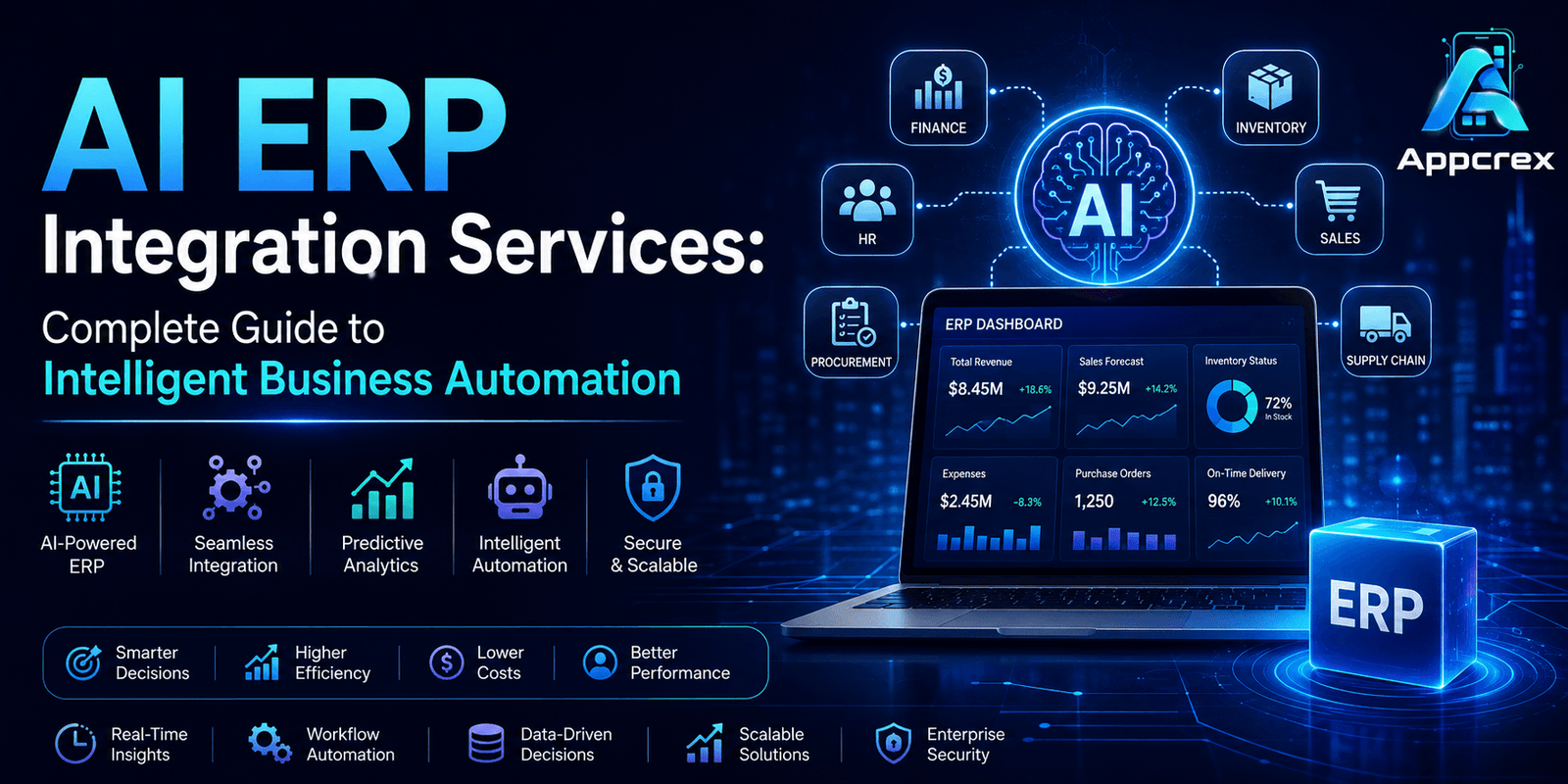
AI ERP Integration Services connect AI technologies such as machine learning, generative AI, large language models (LLMs), predictive analytics, and intelligent automation with existing ERP platforms. This allows organizations to automate repetitive tasks, analyze business data, improve forecasting, and provide employees with AI-powered assistance.
AppCrex provides custom AI ERP Integration Services for startups, SMEs, enterprises, manufacturers, retailers, logistics companies, healthcare organizations, financial businesses, and other industries looking to modernize their ERP ecosystem.
What Is AI ERP Integration?
AI ERP integration is the process of connecting artificial intelligence capabilities with an existing ERP system to improve business processes and decision-making.
A traditional ERP primarily records and manages business data. An AI-integrated ERP can additionally analyze that data, identify patterns, generate insights, predict outcomes, and automate selected workflows.
A simplified architecture looks like:
ERP Data → AI Integration Layer → AI Models → Insights/Recommendations → Business Action
For example, an AI-powered ERP could analyze historical inventory data and recommend when a business should reorder products.
AI ERP integration can include:
- Machine learning
- Generative AI
- Large Language Models
- Predictive analytics
- Natural language processing
- AI chatbots
- Intelligent workflow automation
- Recommendation engines
- Computer vision
- Business intelligence
Why Businesses Need AI ERP Integration?
ERP platforms contain valuable information about almost every part of a business. The challenge is turning that information into useful decisions without requiring employees to manually analyze large amounts of data.
AI can add an intelligence layer to the existing ERP environment.
Businesses can use AI to:
- Automate repetitive ERP tasks
- Analyze financial information
- Forecast demand
- Predict inventory requirements
- Improve procurement
- Identify unusual transactions
- Optimize supply chains
- Assist employees
- Generate reports
- Improve customer service
- Support business forecasting
Instead of replacing the ERP, AI can make the existing system more intelligent and easier to use.
AI ERP Integration Services
AI-Powered ERP Integration
AppCrex can integrate AI capabilities with existing ERP platforms or custom enterprise systems.
Depending on the business requirements, the integration can support finance, inventory, procurement, sales, HR, supply chain, customer service, and reporting workflows.
Generative AI ERP Integration
Generative AI can provide natural-language assistance inside ERP environments.
Employees may be able to ask questions such as:
- “Show this month’s highest expenses.”
- “Summarize our current inventory position.”
- “Which products are running low?”
- “Generate a sales performance summary.”
- “Summarize outstanding invoices.”
The AI layer can retrieve permitted ERP information and generate a structured response.
Generative AI can also assist with:
- Report generation
- Document creation
- Email drafting
- Data summarization
- Business recommendations
- ERP search
- Meeting and workflow summaries
Just Read : Large Language Model (LLM) Integration Services: Complete Guide to Benefits, Process, Cost & Use Cases
LLM Integration With ERP Systems
Large Language Models can make ERP systems easier to interact with by allowing users to communicate with business data using natural language.
Instead of navigating multiple ERP dashboards, an employee could ask:
“Which suppliers had the highest delivery delays this quarter?”
The system can interpret the request, retrieve authorized information, and present the result.
LLM-powered ERP assistants can support:
- Natural-language search
- Business data summaries
- Report generation
- Employee assistance
- Document analysis
- Sales support
- Procurement assistance
- Customer service
Access controls should be implemented so that users can only retrieve information they are authorized to access.
AI ERP Integration by Business Function
AI for Finance & Accounting
AI can help finance teams analyze ERP data and automate selected workflows.
Potential use cases include:
- Invoice processing
- Expense categorization
- Financial reporting
- Cash-flow forecasting
- Payment reminders
- Anomaly detection
- Revenue analysis
- Budget forecasting
AI for Inventory Management
AI can analyze historical sales, inventory movement, and other business signals to support inventory decisions.
Possible applications include:
- Demand forecasting
- Stock-level prediction
- Reorder recommendations
- Slow-moving inventory detection
- Inventory optimization
- Stockout prediction
Just Read : Inventory Management Software Development Company: Complete Guide
AI for Procurement
AI can help procurement teams analyze suppliers and purchasing patterns.
Potential capabilities include:
- Supplier analysis
- Purchase recommendations
- Price trend analysis
- Procurement forecasting
- Purchase order assistance
- Supplier performance analysis
AI for Supply Chain Management
Supply chain operations generate large amounts of data, making them suitable for predictive and analytical AI applications.
AI ERP integration can support:
- Demand forecasting
- Delivery prediction
- Route-related insights
- Supplier analysis
- Supply disruption monitoring
- Warehouse optimization
AI for Human Resources
AI can also be integrated with ERP HR modules.
Potential applications include:
- Employee data analysis
- Workforce analytics
- HR reporting
- Employee support assistants
- Recruitment workflow assistance
- Leave and attendance analysis
Sensitive employee information should be handled according to applicable privacy and employment requirements.
Also Read : HR Management Software Development: Complete Guide to Features, Cost, Benefits & Development Process (2026)
AI for Sales & Customer Management
AI can analyze sales information stored in ERP and CRM systems to provide useful insights.
Potential use cases include:
- Sales forecasting
- Customer segmentation
- Opportunity analysis
- Product recommendations
- Revenue prediction
- Customer support automation
Key Features of AI ERP Integration
A customized AI ERP solution can include:
- AI ERP assistant
- Generative AI integration
- LLM integration
- Predictive analytics
- Demand forecasting
- Inventory forecasting
- Financial analytics
- AI-powered reporting
- Intelligent document processing
- Invoice automation
- Procurement automation
- Supplier analytics
- Sales forecasting
- Anomaly detection
- Natural-language ERP search
- Workflow automation
- AI chatbot
- Business intelligence dashboards
- Data visualization
- API integration
- Role-based access
- Audit logging
The final feature set depends on the ERP platform, business processes, available data, and AI objectives.
Benefits of AI ERP Integration
1. Business Process Automation
AI can automate repetitive tasks and reduce the amount of manual work required from employees.
2. Better Decision-Making
AI can analyze large datasets and provide insights that help management make more informed decisions.
3. Improved Forecasting
Predictive models can help businesses forecast sales, demand, inventory, cash flow, and other business metrics.
4. Increased Employee Productivity
AI assistants can help employees find information, summarize reports, prepare documents, and complete repetitive workflows faster.
5. Reduced Operational Errors
Automation can reduce certain manual data-entry and processing errors.
6. Better Resource Management
AI can help businesses optimize inventory, procurement, workforce, and supply chain operations.
7. Real-Time Business Insights
AI-powered dashboards can combine ERP information with analytics to provide more actionable business visibility.
AI ERP Integration Use Cases
AI ERP integration can be applied across different industries.
Manufacturing
- Production forecasting
- Inventory optimization
- Predictive maintenance
- Supplier analysis
- Quality monitoring
Retail
- Demand forecasting
- Inventory prediction
- Customer analysis
- Sales forecasting
- Automated reporting
Logistics
- Shipment analysis
- Demand prediction
- Warehouse optimization
- Supplier monitoring
- Operational forecasting
Healthcare
- Resource management
- Inventory tracking
- Administrative automation
- Reporting
- Workflow optimization
Financial Services
- Financial analytics
- Anomaly detection
- Reporting
- Customer insights
- Process automation
E-commerce
- Sales forecasting
- Inventory management
- Customer analytics
- Order processing
- Personalized recommendations
AI ERP Integration With Popular ERP Platforms
AI capabilities can be connected to existing ERP platforms through APIs, middleware, webhooks, custom backend services, and supported integration frameworks.
Businesses may integrate AI with platforms such as:
- SAP
- Oracle ERP
- Microsoft Dynamics 365
- NetSuite
- Odoo
- Sage
- Custom ERP systems
The integration approach depends on the ERP’s APIs, modules, permissions, architecture, subscription plan, and business requirements.
AI ERP Integration Development Process
Step 1: ERP & Business Analysis
The first step is understanding the existing ERP, business workflows, data sources, departments, and operational challenges.
Step 2: Identify AI Use Cases
The most valuable AI opportunities are identified.
For example:
- Demand forecasting
- Financial analysis
- AI assistant
- Document processing
- Inventory optimization
- Procurement automation
Step 3: Integration Architecture
The technical architecture is planned around ERP APIs, AI services, databases, authentication, data processing, and workflows.
Step 4: Data Preparation
Relevant ERP data is evaluated, structured, cleaned, and prepared for AI processing.
Step 5: API & AI Integration
Developers connect the ERP with the required AI models, services, databases, and enterprise applications.
Step 6: AI Model Implementation
Depending on the use case, the solution may use LLMs, machine learning models, predictive analytics, RAG, or other AI technologies.
Step 7: Testing
Testing covers:
- ERP functionality
- API communication
- AI responses
- Data accuracy
- Security
- Permissions
- Performance
- Workflow automation
- Error handling
Step 8: Deployment
The solution is deployed within the required cloud or enterprise environment.
Step 9: Monitoring & Optimization
AI performance, ERP integrations, API reliability, and business outcomes should be monitored after deployment.
Technology Stack for AI ERP Integration
The technology stack depends on the ERP and AI requirements.
AI & Machine Learning
- Python
- TensorFlow
- PyTorch
- Scikit-learn
- Machine learning models
Generative AI
- LLM APIs
- RAG
- Embedding models
- Vector databases
- AI orchestration frameworks
Backend
- Node.js
- Python
- Java
- .NET
- PHP
Databases
- PostgreSQL
- MySQL
- MongoDB
- Redis
- Vector databases
Cloud
- AWS
- Microsoft Azure
- Google Cloud
Integration
- REST APIs
- GraphQL
- Webhooks
- OAuth
- API gateways
The technology stack should be selected based on the ERP environment, data volume, security requirements, AI workload, and scalability goals.
AI ERP Data Security
ERP systems can contain highly sensitive business information, including financial records, employee information, supplier data, customer records, and operational information.
An AI ERP integration should therefore include appropriate security measures such as:
- Authentication
- Authorization
- Role-based access
- Encryption
- Secure API communication
- Token management
- Audit logging
- Data access controls
- Monitoring
- Data retention policies
AI models should only receive the information required for their intended tasks, and organizations should evaluate how third-party AI providers handle business data.
How Much Does AI ERP Integration Cost?
The cost of AI ERP integration depends on the ERP platform, number of modules, AI functionality, integrations, data volume, and security requirements.
| AI ERP Project | Estimated Cost |
|---|---|
| Basic AI ERP Integration | $8,000 – $15,000 |
| AI ERP Assistant | $10,000 – $25,000 |
| AI Automation & Analytics | $15,000 – $35,000 |
| Advanced AI ERP Solution | $30,000 – $60,000+ |
| Enterprise AI ERP Ecosystem | $50,000 – $120,000+ |
These are indicative development estimates. Actual project pricing depends on the scope and technical requirements.
Factors Affecting AI ERP Integration Cost
- ERP platform
- Number of ERP modules
- Number of integrations
- AI functionality
- LLM usage
- Custom AI models
- Data volume
- RAG implementation
- Dashboard requirements
- Security requirements
- User count
- Cloud infrastructure
- Third-party services
- Ongoing maintenance
AI ERP Integration Company for Global Markets
Businesses across different regions are adopting AI to improve enterprise operations.
USA
AI ERP integration for manufacturing, SaaS, retail, logistics, finance, healthcare, and enterprise businesses.
UK
AI-powered ERP solutions for business automation, analytics, finance, supply chain, and operational intelligence.
Canada
Custom AI ERP integrations for startups, SMEs, and enterprises seeking automation and predictive business insights.
Dubai & UAE
AI ERP integration for trading, logistics, real estate, retail, finance, and enterprise businesses.
Saudi Arabia
AI ERP solutions for businesses in Riyadh and across Saudi Arabia, including intelligent automation, analytics, inventory, finance, and supply chain management.
India
AI ERP integration for manufacturers, retailers, logistics businesses, SaaS companies, and enterprises.
Singapore
AI ERP solutions for finance, logistics, manufacturing, eCommerce, and enterprise operations.
Australia
AI-powered ERP integration for supply chain, finance, retail, manufacturing, and business automation.
These are target service markets and do not imply a physical AppCrex office in every listed location.
AI ERP Integration vs Traditional ERP
| Feature | Traditional ERP | AI-Integrated ERP |
|---|---|---|
| Data Management | Stores business data | Stores + analyzes data |
| Reporting | Standard reports | AI-assisted insights |
| Forecasting | Manual/rule-based | Predictive analytics |
| Search | Traditional navigation | Natural-language search |
| Automation | Predefined workflows | Intelligent automation |
| Recommendations | Limited | AI-assisted recommendations |
| Decision Support | Historical data | Historical + predictive insights |
AI does not necessarily replace an existing ERP. In many cases, it works as an intelligence layer that extends the capabilities of the existing platform.
Common Challenges in AI ERP Integration
1. Data Quality
Poor-quality or inconsistent ERP data can reduce the effectiveness of AI models.
2. Legacy ERP Systems
Older ERP platforms may have limited APIs or integration capabilities.
3. Data Security
Business and employee information must be appropriately protected when connecting ERP systems with AI services.
4. Integration Complexity
ERP systems often contain multiple modules and interconnected workflows, making integration more complex.
5. AI Accuracy
AI-generated recommendations should be evaluated before being used for important business decisions.
6. Change Management
Employees may need training to effectively use new AI-powered ERP features.
Why Choose AppCrex for AI ERP Integration Services?
1. AI & LLM Expertise
AppCrex can integrate AI, machine learning, generative AI, and LLM capabilities with enterprise systems.
2. Custom ERP Integration
We design AI integrations around your existing ERP, business workflows, and operational requirements.
3. Enterprise-Focused Architecture
Solutions can be designed for scalability, security, performance, and integration with existing business infrastructure.
4. Multiple ERP Integrations
AI capabilities can be connected with SAP, Oracle, Microsoft Dynamics, NetSuite, Odoo, Sage, and custom ERP environments where supported.
5. Secure Development
Appropriate authentication, authorization, API security, data controls, and monitoring can be incorporated into the integration architecture.
Flexible Engagement Models
Businesses can work with:
- AI developers
- ERP developers
- AI integration developers
- LLM developers
- Enterprise software developers
- Dedicated development teams
- AI consultants
FAQs
Q. What is AI ERP integration?
AI ERP integration connects artificial intelligence technologies with an ERP system to improve automation, forecasting, analytics, reporting, and business decision-making.
Q. Can AI be integrated with an existing ERP?
Yes. AI can be integrated with existing ERP platforms using APIs, middleware, webhooks, custom backend services, and supported integration tools.
Q. What ERP systems can be integrated with AI?
Depending on their APIs and technical capabilities, AI can be integrated with platforms such as SAP, Oracle ERP, Microsoft Dynamics 365, NetSuite, Odoo, Sage, and custom ERP systems.
Q. How much does AI ERP integration cost?
Basic AI ERP integrations may start around $8,000–$15,000, while advanced enterprise implementations can cost significantly more depending on the modules, AI functionality, integrations, and security requirements.
Q. Can LLMs be integrated into an ERP?
Yes. LLMs can provide natural-language ERP search, report summaries, AI assistants, document processing, and other intelligent capabilities.
Q. Can AI improve inventory management?
Yes. AI can analyze historical and current business data to support demand forecasting, reorder recommendations, stockout prediction, and inventory optimization.
Q. How long does AI ERP integration take?
The timeline depends on the ERP platform, number of modules, AI features, integrations, data requirements, and testing scope. A project-specific timeline can be estimated after requirements analysis.
Conclusion
AI ERP integration is helping businesses move from traditional enterprise resource planning toward more intelligent and automated operations. By combining ERP data with AI, machine learning, generative AI, LLMs, predictive analytics, and intelligent automation, organizations can improve forecasting, streamline workflows, and provide employees with better decision-support tools.
From finance and inventory to procurement, HR, sales, manufacturing, and supply chain management, AI can add intelligence across multiple ERP functions.
However, successful implementation requires more than connecting an AI model to an ERP. Businesses need a carefully planned integration architecture, high-quality data, appropriate security controls, reliable APIs, suitable AI models, and continuous monitoring.
Build an Intelligent ERP With AppCrex
AppCrex provides AI ERP Integration Services for startups, SMEs, and enterprises looking to modernize their business operations.
Whether you need LLM-powered ERP assistants, AI automation, predictive analytics, inventory forecasting, financial intelligence, document processing, or a complete AI-powered ERP ecosystem, AppCrex can help you plan and develop a solution around your business requirements.
Ready to Make Your ERP Smarter?
Talk to AppCrex about building a secure, scalable, and intelligent AI-integrated ERP solution.