📌 Key Takeaways
- Edinburgh is a strong AI & data hub, making it suitable for intelligent digital products.
- AI, machine learning and analytics can improve forecasting, automation, and decision-making.
- Generative AI and AI agents can create smarter business workflows and user experiences.
- Data integration is essential for connecting CRM, ERP, APIs, and other business systems.
- Start with an MVP and gradually add advanced AI, analytics, and automation features.
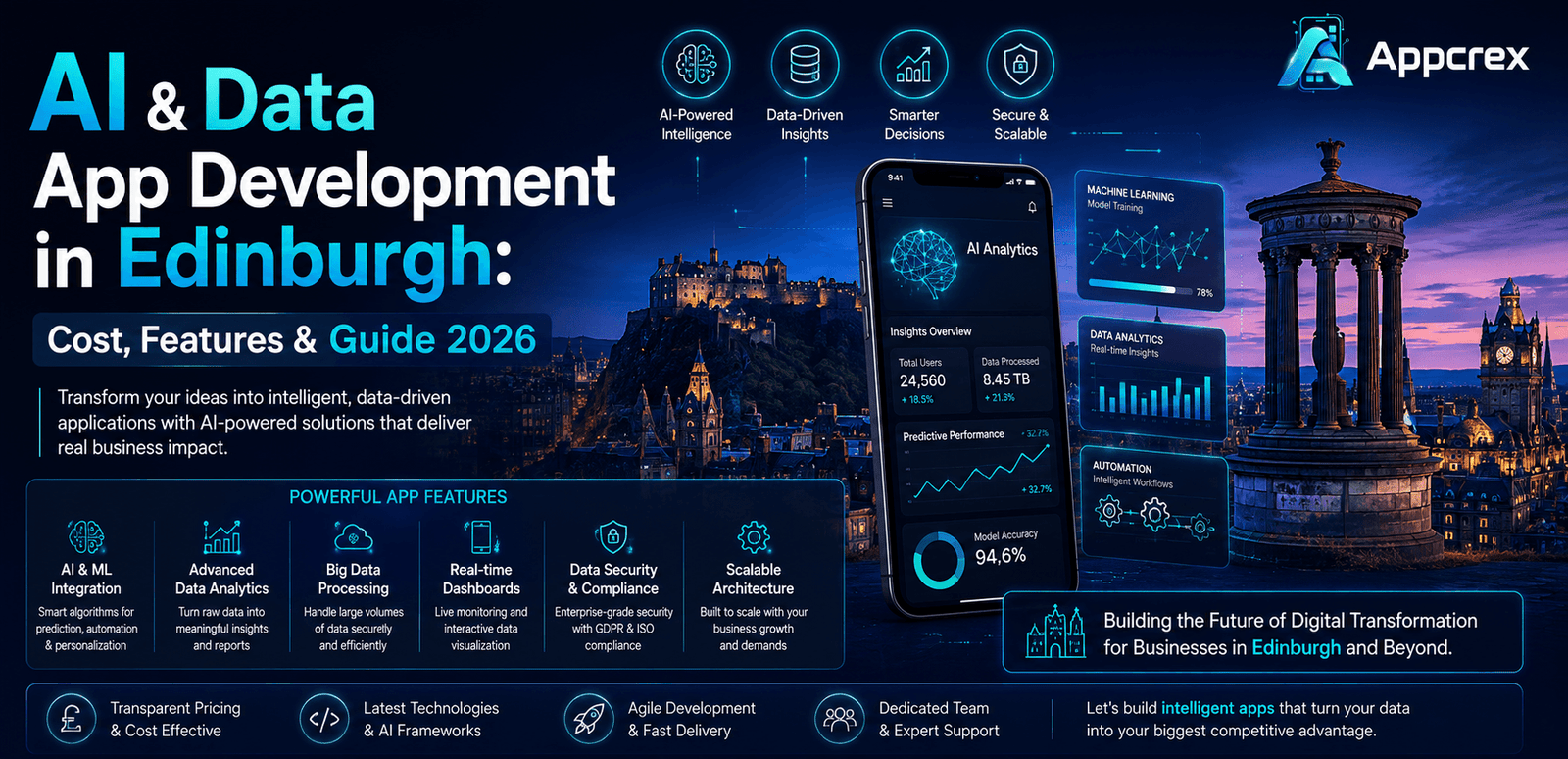
Edinburgh has become an important technology and innovation hub in the UK, with strong capabilities across artificial intelligence, data science, financial services, software, cybersecurity, and research. This combination makes the city an attractive location for businesses looking to develop intelligent digital products.
For businesses considering an AI app development company in Edinburgh, the opportunity is not limited to building a chatbot. Modern AI applications can combine machine learning, predictive analytics, natural language processing, Generative AI, data visualization, automation, and cloud technologies.
A well-designed AI and data application can help businesses turn large amounts of information into useful insights, automate repetitive processes, improve customer experiences, and support faster decision-making.
This guide explores AI and data app development in Edinburgh, including popular use cases, essential features, development costs, technologies, AI capabilities, development timelines, and how businesses can approach an AI project.
Why Edinburgh Is Becoming an AI & Data Technology Hub?
Edinburgh has a strong combination of technology companies, research institutions, financial services organizations, startups, and highly skilled technology professionals.
The city’s ecosystem creates opportunities in areas such as:
- Artificial intelligence
- Machine learning
- Data science
- Financial technology
- Cybersecurity
- Healthcare technology
- Enterprise software
- Automation
- Analytics
- Cloud computing
This makes Edinburgh particularly suitable for businesses developing applications where data and intelligent decision-making are central to the product.
Rather than creating a traditional application with static information, companies can build platforms that continuously analyze data and provide personalized insights.
What Is AI & Data App Development?
AI and data app development combines traditional software development with technologies that collect, process, analyze, and learn from data.
A typical platform may include:
Data Sources → APIs/Database → Data Processing → AI/ML Models → Application → User Insights
Depending on the business model, the application could:
- Analyze customer behavior
- Predict future trends
- Detect unusual activity
- Automate decisions
- Generate reports
- Recommend products
- Process documents
- Answer user questions
- Monitor business performance
This makes AI and data applications useful across multiple industries.
Also Read : AI & ML Development Company: Complete Guide to Services, Cost & Development Process
Types of AI & Data Apps Businesses Can Build
AI Business Intelligence Apps
These platforms can turn business data into dashboards and actionable insights.
Features may include:
- Performance dashboards
- Automated reports
- Data visualization
- KPI monitoring
- Trend analysis
- Forecasting
- Custom alerts
Executives can use these applications to understand business performance without manually reviewing multiple spreadsheets or systems.
Predictive Analytics Applications
Predictive applications use historical data to identify possible future outcomes.
Potential use cases include:
- Sales forecasting
- Demand prediction
- Customer churn prediction
- Risk analysis
- Inventory forecasting
- Equipment failure prediction
The quality of predictions depends heavily on the quality, quantity, and relevance of available data.
AI Customer Service Apps
Businesses can build intelligent customer support platforms using:
- AI chatbots
- Natural language processing
- Knowledge bases
- Automated ticket classification
- Conversation analytics
- Generative AI
Customers can receive instant responses to common questions while more complex requests can be routed to human teams.
Data Analytics Apps
A data analytics application can collect information from different business systems and display it in a single interface.
For example:
CRM + ERP + Sales + Marketing + Customer Data → Analytics Platform
This can provide businesses with a centralized view of their operations.
Generative AI in Edinburgh Applications
Generative AI has expanded the possibilities for business applications.
Instead of requiring users to navigate complex dashboards, businesses can provide conversational interfaces.
For example:
“Show me our sales performance for the last quarter.”
The AI system can interpret the request, retrieve authorized data, and provide an understandable response.
Generative AI can also support:
- Document summarization
- Report generation
- AI assistants
- Knowledge search
- Content generation
- Customer support
- Internal business assistants
For enterprise applications, AI responses should be grounded in trusted business data and governed by appropriate access controls.
AI Agents for Business Applications
AI agents can take AI applications beyond simple question-and-answer systems.
An AI agent can potentially:
- Understand a user’s request
- Access approved systems
- Retrieve relevant information
- Perform predefined actions
- Return the result
For example, an employee could request:
“Prepare this week’s sales performance summary.”
An AI-enabled workflow could collect authorized sales information, analyze it, generate a summary, and make it available to the employee.
More advanced agents can work across multiple business systems, but permissions, monitoring, validation, and auditability become increasingly important.
Machine Learning in Data Applications
Machine learning allows software to identify patterns from historical data.
Common ML applications include:
Recommendation Systems
Suggest products, content, services, or actions based on user behavior.
Fraud Detection
Identify unusual transaction or account activity.
Customer Churn Prediction
Identify customers who may be likely to stop using a service.
Classification
Automatically categorize documents, customers, transactions, or support requests.
Forecasting
Estimate future demand, sales, inventory requirements, or other measurable outcomes.
Machine learning models should be evaluated continuously because data patterns can change over time.
Also Read : Machine Learning Development Company: Complete Guide to ML Solutions, Cost & Development Process
Essential Features of an AI & Data Application
A successful AI platform needs more than an AI model.
User Authentication
- Registration
- Login
- Multi-factor authentication
- Password management
Data Dashboard
- Charts
- KPIs
- Reports
- Filters
- Data visualization
AI Interface
- AI assistant
- Natural-language search
- Recommendations
- Automated insights
Data Management
- Data import
- API connections
- Data processing
- Data validation
Notifications
- Performance alerts
- Anomaly alerts
- AI-generated insights
- System notifications
Admin Panel
- User management
- Permissions
- Data management
- Model configuration
- Usage analytics
Data Integration Is a Critical Component
AI is only as useful as the information it receives.
Businesses may need to connect applications with:
- CRM systems
- ERP software
- Payment platforms
- Databases
- Marketing platforms
- Customer support systems
- IoT devices
- Financial APIs
- Internal business systems
APIs can connect these different sources to a centralized data platform.
For example:
CRM + ERP + Website + Mobile App → Data Platform → AI Engine → Dashboard
This creates a unified information environment.
AI Dashboard Development
Traditional dashboards show users what has already happened.
AI-powered dashboards can go further by helping explain why something happened and what could happen next.
For example:
Traditional dashboard:
Sales decreased by 12%.
AI-powered dashboard:
Sales decreased by 12%, primarily due to lower repeat purchases in one customer segment.
The second approach can make data more actionable.
Real-Time Analytics
Some applications require information to be processed almost immediately.
Examples include:
- Financial monitoring
- Fraud detection
- Logistics tracking
- IoT monitoring
- Customer activity
- Security systems
Real-time data pipelines can feed updated information into dashboards and AI models.
The infrastructure required depends on the application’s volume, latency requirements, and business importance.
How Much Does AI App Development Cost in Edinburgh?
AI and data application costs vary significantly depending on the complexity of the platform.
| Project Type | Estimated Cost | Typical Timeline |
|---|---|---|
| Basic AI-Powered App | $25,000–$40,000 | 3–4 months |
| Data Analytics Application | $30,000–$55,000 | 4–6 months |
| AI Assistant Platform | $35,000–$65,000 | 4–7 months |
| Predictive Analytics Platform | $50,000–$90,000+ | 5–8 months |
| Custom Machine Learning Platform | $60,000–$110,000+ | 6–10 months |
| Enterprise AI & Data Platform | $90,000–$160,000+ | 8–14+ months |
These are general planning estimates, not fixed Edinburgh development prices.
The actual cost depends on:
- AI model complexity
- Data volume
- Number of integrations
- Mobile platforms
- Backend architecture
- Cloud infrastructure
- Security requirements
- AI API usage
- Custom ML development
- Dashboard complexity
- Testing requirements
What Makes AI App Development More Expensive?
Custom AI Models
Using an existing AI API can be faster than developing and training a custom model.
Large Data Requirements
Processing and storing large datasets increases infrastructure requirements.
Real-Time Processing
Real-time analytics can require more sophisticated backend architecture.
Enterprise Integrations
Connecting multiple internal systems can significantly increase development work.
Advanced AI Agents
AI agents that interact with multiple systems require additional orchestration, security, and testing.
Also Read : AI Agent Integration Services: Complete Guide to AI-Powered Business Integration
Technology Stack for AI & Data App Development
A modern AI platform can use multiple layers.
Mobile
- Flutter
- React Native
- Kotlin
- Swift
Backend
- Python
- Node.js
- Java
- .NET
Data
- PostgreSQL
- MySQL
- MongoDB
- Data warehouses
AI/ML
- Machine learning
- NLP
- Generative AI
- Predictive analytics
- Recommendation engines
Cloud
- AWS
- Microsoft Azure
- Google Cloud
The correct technology stack depends on the application’s data requirements, performance expectations, integrations, and long-term scalability.
AI App Development Process
AI projects require a slightly different approach from traditional mobile applications.
1. Identify the Business Problem
Start with the business problem rather than the AI technology.
For example:
Problem: Customer support takes too long.
Potential solution: AI-powered support assistant.
2. Identify Available Data
Determine:
- What data exists?
- Where is it stored?
- Is it accurate?
- Can it legally be used?
- How frequently is it updated?
3. Select the AI Approach
Depending on the use case, the project may use:
- Generative AI
- Machine learning
- NLP
- Computer vision
- Predictive analytics
- Recommendation systems
4. Design the Application
The AI experience should be integrated into a useful product rather than added simply because AI is popular.
5. Develop the Backend
The backend handles:
- APIs
- Data
- Authentication
- Business logic
- AI services
- Integrations
6. Integrate AI
AI models or APIs are connected with the application and business data.
7. Test the System
Testing should cover:
- Functional performance
- AI response quality
- Data accuracy
- Security
- API integrations
- Mobile compatibility
- Load performance
8. Launch & Monitor
AI systems need ongoing monitoring because model performance and data patterns can change over time.
AI Applications Across Edinburgh Industries
The city’s technology ecosystem creates opportunities across several industries.
Financial Services
AI can support:
- Fraud detection
- Customer analytics
- Risk analysis
- Financial assistants
- Document processing
Healthcare
Potential applications include:
- Patient engagement
- Healthcare analytics
- Appointment management
- Medical workflow automation
AI used for clinical purposes requires additional validation and appropriate regulatory considerations.
Enterprise
Businesses can use AI for:
- Internal assistants
- Business intelligence
- Document processing
- Workflow automation
Retail
AI can help with:
- Recommendations
- Customer segmentation
- Demand forecasting
- Inventory analytics
How to Reduce AI App Development Costs?
AI development doesn’t always require building everything from scratch.
Start With an MVP
Focus on one high-value AI use case.
Use Existing AI APIs
For some use cases, existing models can reduce development time.
Connect Existing Data
Use existing business systems where possible rather than creating duplicate databases.
Develop in Phases
For example:
Phase 1: Data dashboard
Phase 2: AI insights
Phase 3: Predictive analytics
Phase 4: AI agent automation
Monitor AI Usage
For Generative AI applications, API usage and infrastructure costs should be monitored as user activity increases.
AI App vs Traditional App
The difference isn’t simply the presence of an AI chatbot.
A traditional application generally follows predefined rules.
An AI-powered application can:
- Learn from patterns
- Generate responses
- Make predictions
- Recommend actions
- Analyze large datasets
- Understand natural language
The right approach depends on the problem.
Not every business application needs AI.
How to Choose an AI App Development Company in Edinburgh?
Before hiring a development partner, evaluate their experience with both software engineering and AI.
Important questions include:
- Have they developed AI-powered applications?
- Can they integrate Generative AI?
- Do they understand machine learning?
- Can they build scalable APIs?
- Can they work with large datasets?
- Can they integrate enterprise systems?
- How do they handle AI security?
- How will AI performance be monitored?
- What support is available after launch?
A development partner should understand the business problem, not simply recommend AI for every project.
Why AppCrex for AI & Data App Development?
AppCrex helps businesses create custom mobile and software products that combine modern application development with emerging technologies.
Our capabilities include:
- AI app development
- Machine learning development
- Generative AI integration
- AI agent development
- Data analytics solutions
- Predictive analytics
- Mobile app development
- Custom software development
- API integration
- Cloud development
- Flutter development
- React Native development
- Android development
- iOS development
- UI/UX design
- Enterprise software integration
- App maintenance
For businesses targeting Edinburgh, London, Manchester, Glasgow, Cambridge, Oxford, or the wider UK market, solutions can be designed around the industry’s data requirements and long-term business objectives.
FAQs
Q. How much does it cost to build an AI app in Edinburgh?
AI app development can cost approximately $25,000 to $160,000+, depending on the AI capabilities, data requirements, integrations, platforms, and overall complexity.
Q. How long does AI app development take?
A basic AI application may take around 3–4 months, while an enterprise AI and data platform can take 8–14+ months.
Q. Can Generative AI be integrated into an existing application?
Yes. Generative AI can be added to existing applications for customer support, document processing, natural-language search, reporting, and other workflows.
Q. What is the difference between AI and machine learning?
Machine learning is a branch of AI that allows systems to identify patterns and make predictions from data. AI is a broader field that also includes technologies such as Generative AI, NLP, computer vision, and intelligent automation.
Q. Can an AI app use company data?
Yes, provided the data is collected, processed, stored, and used in accordance with applicable legal, privacy, security, and organizational requirements.
Q. Is AI suitable for every mobile application?
No. AI should be introduced when it solves a genuine business or user problem. Some applications can work better with traditional software logic.
Final Thoughts
Edinburgh’s combination of AI, data science, software development, research, financial services, and technology expertise creates strong opportunities for businesses developing intelligent digital products.
The most successful AI applications are not simply traditional apps with a chatbot added to them. They use data, automation, predictive intelligence, or Generative AI to solve a specific problem more effectively.
Businesses can start with a focused MVP and gradually introduce advanced capabilities such as machine learning, predictive analytics, AI agents, and real-time data processing.
For companies targeting Edinburgh and the wider UK market, the combination of mobile technology + data + AI + cloud infrastructure can provide a strong foundation for building scalable digital products.
Build Your AI & Data App With AppCrex
Planning an AI-powered application for Edinburgh or the wider UK market?
AppCrex can help transform your idea into a complete digital product—from AI strategy and UI/UX design to mobile development, backend engineering, data integration, Generative AI, machine learning, cloud deployment, testing, and ongoing support.
Whether you need an AI assistant, predictive analytics platform, intelligent dashboard, machine learning solution, or data-driven mobile app, the technology can be tailored around your specific business requirements.
Talk to AppCrex about your AI and data app development project.