📌 Key Takeaways
- HealthTech + IoT can connect patients, healthcare teams, devices, and data.
- Remote patient monitoring can support more connected healthcare workflows.
- AI and analytics can improve healthcare insights, automation, and decision support.
- Security and data protection are essential for healthcare applications.
- MVP-first development lets businesses launch core features and add IoT and AI capabilities gradually.
Glasgow is developing a strong digital and technology ecosystem, with opportunities across healthcare, life sciences, IoT, data, engineering, and digital services. This creates an interesting market for businesses looking to develop healthcare platforms that connect patients, professionals, devices, and data.
Healthcare is also becoming increasingly connected. Wearable devices, remote monitoring systems, connected medical equipment, cloud platforms, and mobile apps can work together to provide more convenient digital healthcare experiences.
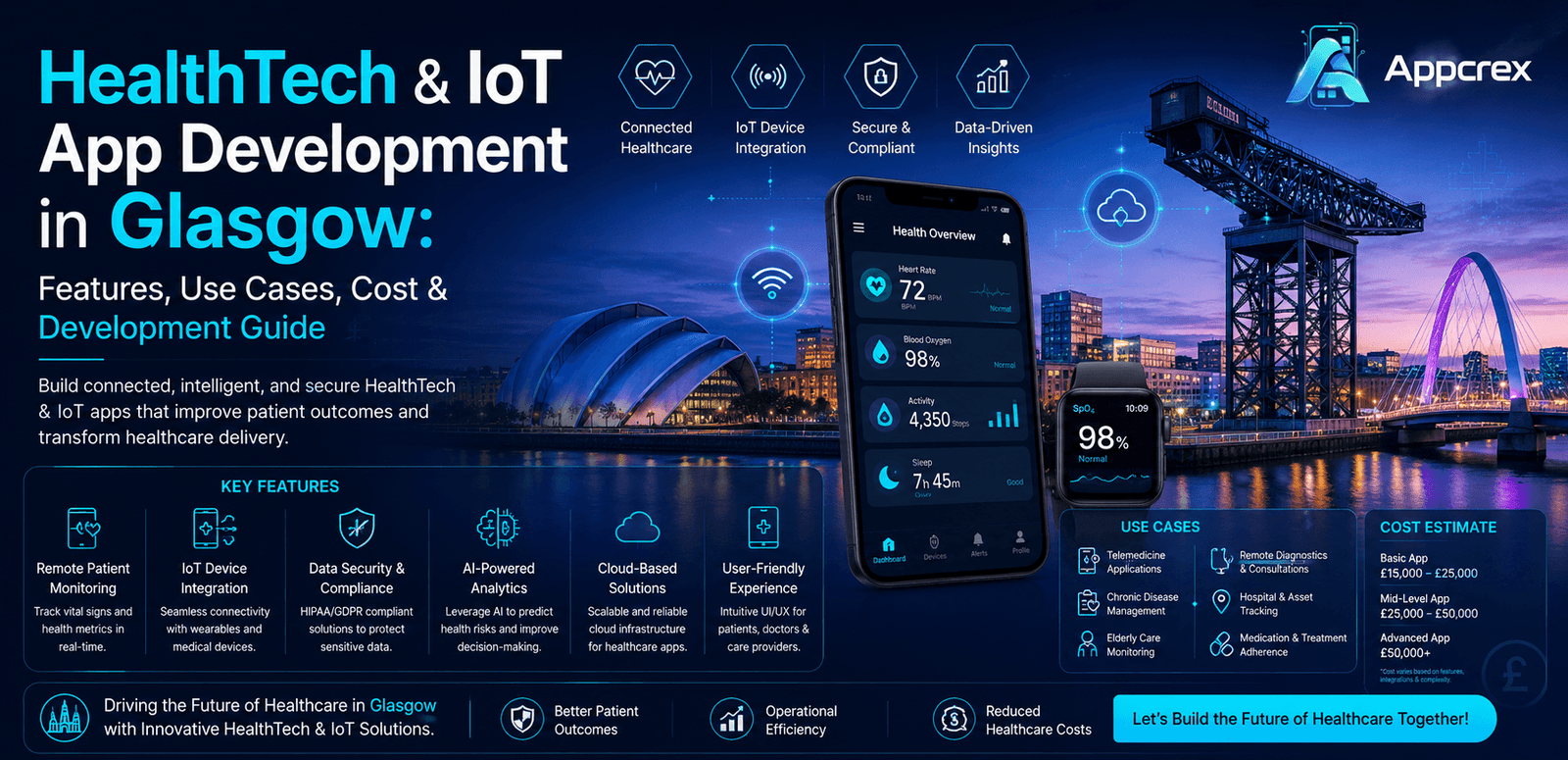
For businesses considering a HealthTech app development company in Glasgow, the opportunity goes beyond building a basic appointment or telemedicine app. Modern HealthTech solutions can combine IoT, AI, analytics, cloud computing, remote monitoring, wearable integrations, and secure healthcare data management.
This guide covers the major aspects of HealthTech and IoT app development company in Glasgow, including use cases, features, development costs, technology choices, development timelines, and practical considerations.
Why Glasgow Is an Emerging HealthTech & IoT Market?
Glasgow has a diverse technology environment supported by healthcare, research, engineering, digital technology, and innovation.
This creates opportunities for solutions involving:
- Digital healthcare
- Remote patient monitoring
- Connected medical devices
- Wearable technology
- Healthcare analytics
- IoT platforms
- AI-powered healthcare
- Hospital management
- Patient engagement
- Healthcare automation
The combination of healthcare and connected technology can help businesses create digital platforms that provide information to patients and healthcare teams in a more accessible way.
What Is HealthTech App Development?
HealthTech app development involves creating digital products that improve healthcare-related services, workflows, communication, monitoring, or data management.
Depending on the use case, a HealthTech app can support:
- Patients
- Doctors
- Nurses
- Clinics
- Hospitals
- Laboratories
- Care providers
- Healthcare administrators
Examples include:
- Telemedicine platforms
- Patient monitoring apps
- Appointment platforms
- Medication management apps
- Fitness and wellness apps
- Healthcare portals
- Medical reporting platforms
- Remote care applications
When IoT is added, the application can also receive information from connected devices.
What Is IoT in Healthcare?
The Internet of Things allows physical devices to communicate with software platforms.
A simplified healthcare architecture can look like:
Wearable/Medical Device → IoT Connectivity → Cloud Platform → Healthcare App → Dashboard
Depending on the device and use case, the system may collect information such as:
- Heart rate
- Temperature
- Blood pressure
- Oxygen levels
- Activity
- Sleep information
- Device status
The application can then display relevant information to authorized users.
For healthcare products, the exact data collected and how it is used must be designed around the applicable medical, privacy, security, and regulatory requirements.
HealthTech App Ideas for Glasgow Businesses
1. Remote Patient Monitoring App
Remote monitoring platforms can allow patients to share selected health information with healthcare teams without visiting a facility for every interaction.
Possible features include:
- Patient profiles
- Device connectivity
- Health data collection
- Alerts
- Doctor dashboards
- Patient notifications
- Reports
- Appointment management
This model can be particularly useful for long-term care and monitoring workflows.
2. Telemedicine App
A telemedicine platform can connect patients with healthcare professionals remotely.
Core features may include:
- Doctor profiles
- Appointment booking
- Video consultations
- Secure messaging
- Digital prescriptions
- Medical records
- Notifications
- Payment integration
For a more advanced platform, connected devices can be integrated to provide additional information during remote care.
3. Wearable Health App
Wearable devices can collect health and activity information and synchronize selected data with a mobile platform.
Applications can support:
- Activity tracking
- Heart-rate monitoring
- Sleep tracking
- Fitness goals
- Health reports
- Notifications
The specific capabilities depend on the wearable platform and available device APIs.
4. Hospital IoT Platform
Hospitals and larger healthcare organizations can use connected systems to monitor equipment and operational workflows.
Potential applications include:
- Equipment tracking
- Device monitoring
- Room monitoring
- Asset management
- Inventory tracking
- Environmental monitoring
- Maintenance alerts
This type of solution can combine IoT devices with centralized dashboards.
Essential Features of a HealthTech App
A healthcare application should be designed around the needs of its users.
Patient Features
- Registration
- Profile management
- Appointment booking
- Health information
- Notifications
- Secure messaging
- Reports
Healthcare Professional Features
- Patient dashboard
- Appointment management
- Health records
- Monitoring information
- Alerts
- Reports
- Communication
IoT Features
- Device pairing
- Data synchronization
- Device monitoring
- Sensor information
- Real-time or scheduled updates
- Alerts
Admin Features
- User management
- Provider management
- Device management
- Reports
- Permissions
- Analytics
AI Opportunities in HealthTech
AI can make healthcare applications more intelligent, but it should be implemented carefully.
Potential applications include:
Healthcare Data Analysis
AI can analyze large datasets to identify patterns and trends.
Patient Engagement
AI assistants can help users navigate healthcare information and platform features.
Predictive Analytics
Machine learning can potentially help identify patterns associated with certain outcomes.
Medical Document Processing
AI can help summarize or classify documents and information where appropriate.
Intelligent Alerts
AI-powered systems can analyze incoming information and prioritize alerts according to predefined criteria.
Any AI functionality used for clinical decision-making may require additional validation, regulatory review, and human oversight.
Generative AI in Healthcare Applications
Generative AI can provide conversational interfaces for healthcare platforms.
For example, a patient could ask:
“Show me my upcoming appointments.”
Or an authorized healthcare worker could ask:
“Summarize this patient’s recent records.”
The system could retrieve information from approved sources and present it in a simpler format.
Other potential uses include:
- Healthcare knowledge assistants
- Medical document summarization
- Administrative automation
- Patient support
- Natural-language search
- Report generation
Generative AI should not be treated as an unrestricted source of medical advice. Healthcare applications need appropriate safeguards, data controls, and human oversight.
IoT + AI: A More Intelligent HealthTech Platform
The combination of IoT and AI can create a more advanced healthcare ecosystem.
For example:
Connected Device → Data Collection → Cloud → AI Analysis → Healthcare Dashboard
The platform could analyze incoming information and highlight unusual patterns for authorized healthcare professionals.
This can be particularly useful for remote monitoring and operational healthcare applications.
However, automated insights should be appropriately validated before being used in important clinical decisions.
Healthcare Data Security
HealthTech applications handle sensitive information, so security should be considered from the beginning.
Important technical measures can include:
- Encryption
- Secure authentication
- Multi-factor authentication
- Role-based access
- Secure APIs
- Audit logs
- Data backups
- Access monitoring
- Secure cloud infrastructure
The exact legal and regulatory requirements depend on the application, data involved, organization, and jurisdictions in which the product operates.
For UK healthcare projects, businesses should consider applicable requirements such as UK GDPR, the Data Protection Act 2018, NHS-related standards where relevant, and medical-device regulations where applicable.
How Much Does HealthTech App Development Cost in Glasgow?
The development budget depends on the scope of the healthcare platform.
| HealthTech Solution | Estimated Cost | Typical Timeline |
|---|---|---|
| Basic Healthcare App | $25,000–$40,000 | 3–4 months |
| Telemedicine Platform | $35,000–$65,000 | 4–6 months |
| Patient Monitoring App | $45,000–$80,000 | 5–7 months |
| IoT Healthcare Platform | $60,000–$100,000+ | 6–9 months |
| AI-Powered HealthTech Platform | $70,000–$130,000+ | 7–12 months |
| Enterprise Healthcare Ecosystem | $100,000–$180,000+ | 9–15+ months |
These are general planning estimates rather than fixed Glasgow development prices.
The final cost can change based on:
- Number of platforms
- IoT devices
- AI requirements
- Healthcare integrations
- Cloud architecture
- Security requirements
- Admin functionality
- Real-time data processing
- Third-party APIs
- Testing
- Compliance requirements
What Makes an IoT HealthTech App More Expensive?
IoT healthcare applications usually require more than standard mobile development.
Device Integration
Every device may have its own communication protocols and APIs.
Real-Time Data
Continuous or near-real-time monitoring requires additional backend infrastructure.
Cloud Processing
Large amounts of device-generated data need secure storage and processing.
AI Analytics
Machine learning adds data engineering, model development, testing, and monitoring requirements.
Security
Connected healthcare devices create additional security considerations.
Technology Stack for HealthTech & IoT Apps
A typical solution may combine several technologies.
Mobile Development
- Flutter
- React Native
- Kotlin
- Swift
Backend
- Python
- Node.js
- Java
- .NET
Database
- PostgreSQL
- MySQL
- MongoDB
Cloud
- AWS
- Microsoft Azure
- Google Cloud
IoT
- IoT gateways
- Device APIs
- MQTT or other suitable protocols
- Cloud IoT infrastructure
AI
- Machine learning
- Predictive analytics
- Natural language processing
- Generative AI
- Computer vision
The final stack should be selected based on the devices, data requirements, security model, scalability, and intended use of the healthcare application.
HealthTech App Development Process
1. Identify the Healthcare Problem
Start by defining what the product is trying to improve.
For example:
- Remote monitoring
- Patient engagement
- Appointment management
- Equipment tracking
- Healthcare administration
2. Define Users
Identify whether the product is designed for:
- Patients
- Doctors
- Hospitals
- Clinics
- Care teams
- Administrators
3. Map the Data Flow
Determine where healthcare and device data originates and where it needs to go.
4. Design the Experience
Create separate workflows for patients, healthcare professionals, and administrators where necessary.
5. Build the Core Platform
Develop the mobile application, backend, database, authentication, and APIs.
6. Connect Devices
Integrate supported wearables, sensors, or medical equipment.
7. Add AI or Analytics
Introduce intelligence only where it provides measurable value.
8. Security & Testing
Test the application for:
- Security
- Performance
- Device compatibility
- API reliability
- Data accuracy
- Usability
9. Launch & Monitor
After deployment, monitor application performance, device connectivity, security events, and user feedback.
Building an MVP for HealthTech
Healthcare businesses don’t necessarily need to launch a complex platform immediately.
A practical MVP could begin with:
Phase 1: Patient mobile app
Phase 2: Healthcare professional dashboard
Phase 3: Device integration
Phase 4: Data analytics
Phase 5: AI-powered insights
This phased approach allows businesses to validate the product before investing heavily in advanced IoT and AI infrastructure.
Also Read : What Is an MVP in App Development? A Complete Guide
HealthTech App Integrations
A healthcare application may need to communicate with different systems.
Possible integrations include:
- Wearables
- Medical devices
- Hospital systems
- Electronic health record systems
- Appointment platforms
- Payment gateways
- Video consultation services
- Notification platforms
- Identity verification services
APIs provide the communication layer between these systems.
Benefits of IoT-Enabled HealthTech Apps
When appropriately designed, connected healthcare applications can offer several operational advantages.
Better Visibility
Healthcare teams can access relevant information through centralized dashboards.
Remote Monitoring
Selected patient information can be monitored outside traditional healthcare facilities.
Faster Alerts
Connected systems can notify authorized users when predefined conditions occur.
Better Asset Tracking
Healthcare organizations can track equipment and other connected assets.
Data-Driven Decisions
Analytics can help organizations understand trends and operational patterns.
How to Reduce HealthTech Development Costs?
Start With One Core Use Case
Don’t build an entire healthcare ecosystem immediately.
Use Existing APIs
Where appropriate, integrate established services instead of rebuilding infrastructure.
Choose Devices Carefully
Supporting fewer devices initially can simplify development.
Build Cross-Platform
Flutter or React Native may reduce duplicated mobile development effort for suitable projects.
Add AI in Stages
Start with analytics or one focused AI capability before developing advanced AI agents.
How to Choose a HealthTech App Development Company in Glasgow?
Healthcare development requires experience beyond standard mobile development.
Look for a development partner with knowledge of:
- Healthcare software
- Mobile applications
- IoT
- Cloud architecture
- Data security
- API integration
- AI/ML
- Healthcare workflows
- Enterprise systems
Before hiring a company, ask:
Can you integrate healthcare devices?
How will sensitive health data be protected?
Can the platform scale to more users and devices?
Can AI capabilities be introduced later?
How will the application be tested?
What post-launch support is included?
Why AppCrex for HealthTech & IoT App Development?
AppCrex provides custom mobile and software development services for businesses building technology-driven digital products.
Our capabilities include:
- HealthTech app development
- Healthcare mobile app development
- Telemedicine development
- IoT app development
- AI and machine learning
- Generative AI integration
- Remote monitoring solutions
- API integration
- Cloud development
- Flutter development
- React Native development
- Android and iOS development
- UI/UX design
- Custom software development
- App maintenance
For businesses targeting Glasgow, Edinburgh, London, Manchester, Birmingham, or the wider UK market, solutions can be designed around the healthcare workflow, device ecosystem, security requirements, and long-term product strategy.
Also Read : AI App Development in the UK: Use Cases, Cost, Features & Development Guide
FAQs
Q. How much does it cost to build a HealthTech app in Glasgow?
A HealthTech application can cost approximately $25,000 to $180,000+, depending on features, integrations, IoT devices, AI capabilities, security, and overall complexity.
Q. How long does HealthTech app development take?
A basic healthcare app may take around 3–4 months, while an IoT or AI-powered healthcare platform can require 6–15+ months.
Q. Can IoT devices be connected to a healthcare app?
Yes. Compatible wearables, sensors, and connected medical devices can be integrated through APIs or suitable IoT communication systems.
Q. Can AI be added to a healthcare application?
Yes. AI can support analytics, document processing, patient engagement, predictive models, and administrative automation. Clinical applications require appropriate validation and oversight.
Q. Can a HealthTech app integrate with existing healthcare systems?
Yes. APIs can connect applications with supported healthcare, scheduling, EHR, payment, communication, and other systems.
Q. Is a healthcare app required to follow UK data protection requirements?
Healthcare products handling personal or health information need to consider applicable UK data protection and healthcare requirements. The exact obligations depend on the product and how it is used.
Final Thoughts
The combination of HealthTech, IoT, AI, cloud computing, and mobile technology is creating new possibilities for healthcare businesses in Glasgow and across the UK.
A connected healthcare application can bring together patients, healthcare professionals, devices, and data within one digital ecosystem.
However, successful HealthTech development requires more than adding sensors or an AI chatbot. The product needs a clear healthcare use case, secure architecture, reliable integrations, appropriate data governance, and a user experience that works for both patients and professionals.
Starting with an MVP and gradually introducing IoT connectivity, analytics, AI, and automation can provide a practical path toward a larger healthcare technology platform.
Build Your HealthTech App With AppCrex
Planning a HealthTech or IoT application in Glasgow?
AppCrex can help with the complete development lifecycle—from product strategy and UI/UX design to mobile development, backend engineering, IoT integration, AI/ML implementation, API connectivity, testing, deployment, and ongoing support.
Whether you’re planning a remote patient monitoring platform, connected healthcare application, telemedicine product, medical device integration, or AI-powered HealthTech solution, the platform can be designed around your specific business and technology requirements.
Talk to AppCrex about your HealthTech app development project today.