📌 Key Takeaways
- Cambridge’s DeepTech ecosystem creates opportunities for AI, machine learning, life sciences, and advanced software products.
- Computer vision and machine learning can solve complex industrial, healthcare, and research problems.
- Generative AI and AI agents can make advanced data and research platforms easier to use.
- A proof of concept can validate technical feasibility before full-scale development.
- Phased development from PoC to MVP helps control cost while gradually adding advanced capabilities.
Introduction
Cambridge is widely recognized for its concentration of research, technology, artificial intelligence, life sciences, engineering, and deep-tech innovation. Its ecosystem creates opportunities for businesses developing advanced digital products that combine software with AI, data, automation, and specialized technologies.
For companies exploring an AI app development company in Cambridge, the opportunity goes beyond standard mobile applications. Businesses can build intelligent platforms using machine learning, computer vision, Generative AI, predictive analytics, automation, and data-driven decision systems.
This guide explores DeepTech and AI app development in Cambridge, including major use cases, technologies, features, development costs, timelines, development processes, and practical considerations for businesses.
Why Cambridge Is Important for DeepTech & AI?
Cambridge has a strong technology and research-oriented ecosystem. The city is particularly relevant to businesses working with:
- Artificial intelligence
- Machine learning
- Deep technology
- Life sciences
- Biotechnology
- Data science
- Computer vision
- Robotics
- Engineering
- Scientific computing
This creates opportunities for software products that require advanced data processing and intelligent automation.
Unlike conventional software, DeepTech products often involve technology that addresses complex scientific, engineering, or industrial problems.
What Is DeepTech App Development?
DeepTech app development involves building software products around advanced technologies that may originate from scientific research or sophisticated engineering.
Examples can include applications using:
- AI
- Machine learning
- Computer vision
- Robotics
- Advanced analytics
- IoT
- Digital twins
- Scientific data processing
- Automation
A DeepTech application may be developed for businesses, researchers, healthcare organizations, industrial companies, or technology startups.
AI vs DeepTech: What’s the Difference?
AI is one component of the broader DeepTech ecosystem.
For example:
AI App
→ Customer support assistant
→ Recommendation engine
→ AI productivity tool
DeepTech Application
→ Computer vision inspection platform
→ Scientific data analysis system
→ AI-powered industrial simulation
→ Intelligent robotics platform
The boundaries can overlap, but DeepTech generally involves a deeper technology or research component.
DeepTech App Ideas for Cambridge Businesses
1. AI Research & Data Platform
Businesses and research teams can build platforms that organize and analyze large datasets.
Potential features include:
- Data ingestion
- Data visualization
- AI analysis
- Search
- Automated reports
- Research dashboards
- Collaboration tools
Such platforms can help users work with complex datasets through a more accessible interface.
2. Computer Vision Application
Computer vision allows software to interpret images and video.
Potential applications include:
- Quality inspection
- Object detection
- Medical image analysis
- Product recognition
- Security monitoring
- Document processing
- Industrial inspection
A mobile or web interface can display results generated by the computer vision system.
3. AI-Powered Life Sciences Platform
Cambridge’s life sciences ecosystem creates opportunities for technology products that support research and healthcare workflows.
Possible applications include:
- Research data management
- Laboratory workflow management
- Scientific analytics
- Document processing
- Data visualization
- Research collaboration
Applications involving clinical decision-making or regulated medical use require appropriate validation and compliance planning.
Machine Learning Development for DeepTech
Machine learning can help DeepTech applications identify patterns within complex datasets.
Common applications include:
Classification
Categorizing images, documents, samples, or other datasets.
Prediction
Estimating future outcomes based on historical information.
Anomaly Detection
Identifying unusual behavior within large datasets.
Recommendation
Providing intelligent suggestions based on user or system data.
Forecasting
Predicting demand, trends, equipment behavior, or other measurable outcomes.
The development approach depends heavily on the available data and the specific business problem.
Generative AI for DeepTech Applications
Generative AI can provide a more accessible interface to complex systems.
For example, instead of manually searching through large datasets, an authorized user could ask:
“Summarize the key changes in this dataset.”
The AI system could analyze the relevant information and produce a structured summary.
Other applications include:
- Research assistants
- Technical document summarization
- Knowledge management
- Natural-language data search
- Report generation
- Internal AI copilots
- Workflow automation
For specialist or scientific applications, AI-generated information should be appropriately reviewed before being relied upon for important decisions.
AI Agents for Advanced Applications
AI agents can connect reasoning capabilities with approved tools and business systems.
A DeepTech business could potentially use an AI agent to:
- Receive a research or business request
- Search authorized information
- Analyze selected datasets
- Perform predefined calculations
- Generate a report
- Present the findings to the user
Agents become more complex when they are allowed to interact with multiple systems, so access controls, logging, validation, and monitoring are important.
Also Read : AI Agent Development Company: Complete Guide to Features, Benefits, Cost & Development Process (2026)
Essential Features of a DeepTech & AI App
The features depend on the product, but advanced applications commonly include:
Intelligent Search
Users can search large amounts of information using natural-language queries.
Data Visualization
- Charts
- Graphs
- Dashboards
- Interactive reports
AI Assistant
Users can interact with the platform through natural language.
Analytics
- Trend analysis
- Forecasting
- Anomaly detection
- Performance monitoring
Collaboration
- User accounts
- Teams
- Comments
- Sharing
- Permissions
Admin Panel
- User management
- Access controls
- Data management
- System monitoring
- Usage analytics
Computer Vision and DeepTech
Computer vision is particularly valuable for technology businesses dealing with physical objects, images, or video.
A typical workflow could be:
Camera → Image Processing → AI Model → Detection/Classification → Dashboard
For example, a manufacturing system could analyze product images and flag potential defects.
A research platform could process large numbers of images and categorize them automatically.
The model must be trained and evaluated against representative data to ensure useful performance.
Data Infrastructure for AI Applications
AI applications often depend on multiple data sources.
A typical architecture can look like:
Data Sources → APIs → Data Processing → Database/Data Warehouse → AI Models → Application
Data sources may include:
- Business systems
- Databases
- IoT devices
- Research datasets
- Mobile applications
- Third-party APIs
The architecture should be designed around the volume, sensitivity, frequency, and quality of the data.
Cloud Technology for DeepTech Applications
Cloud infrastructure can provide the computing resources required by advanced applications.
Common cloud platforms include:
- AWS
- Microsoft Azure
- Google Cloud
Cloud infrastructure can support:
- Data storage
- APIs
- AI model hosting
- Machine learning
- Analytics
- User authentication
- Application deployment
- Monitoring
Some DeepTech workloads may also require specialized computing infrastructure, depending on model size and processing requirements.
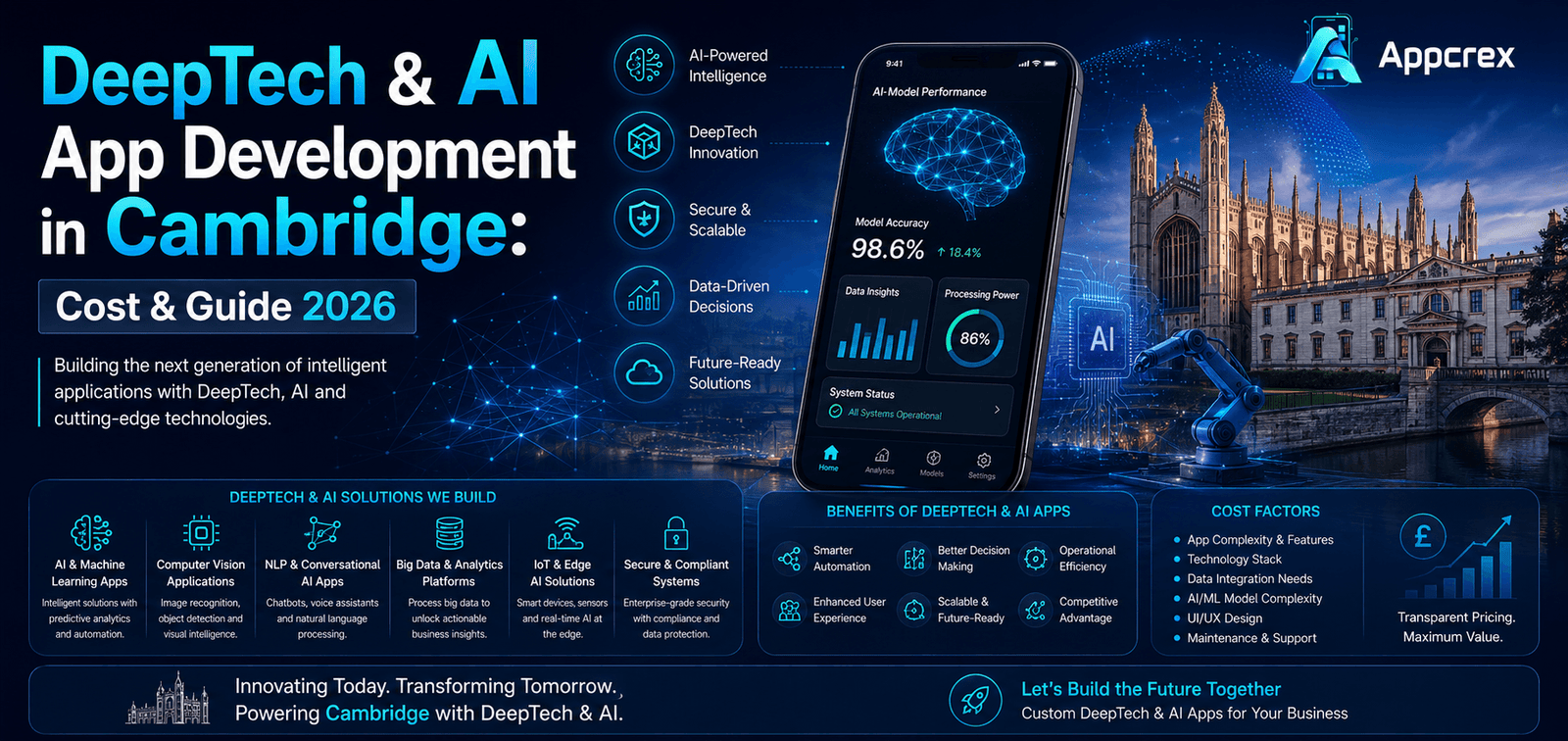
How Much Does DeepTech & AI App Development Cost in Cambridge?
DeepTech projects can have a wide cost range because their complexity varies significantly.
| Project Type | Estimated Cost | Typical Timeline |
|---|---|---|
| AI-Powered Business App | $25,000–$45,000 | 3–5 months |
| AI Analytics Platform | $35,000–$65,000 | 4–7 months |
| Computer Vision App | $45,000–$85,000+ | 5–8 months |
| Custom ML Platform | $55,000–$100,000+ | 6–10 months |
| DeepTech Research Platform | $70,000–$130,000+ | 7–12 months |
| Enterprise DeepTech Platform | $100,000–$180,000+ | 9–15+ months |
These are general planning estimates, not fixed Cambridge development rates.
The final investment depends on:
- AI complexity
- Dataset size
- Custom model development
- Computing requirements
- Number of integrations
- Application platforms
- Security
- Data infrastructure
- Research requirements
- Testing
What Makes DeepTech Development More Expensive?
Research & Development
Some DeepTech products require experimentation before the final technology approach is established.
Data Preparation
AI models often require large amounts of properly prepared data.
Custom Models
Developing and training custom models can require more resources than integrating an existing AI service.
Specialized Infrastructure
Certain AI and scientific workloads may require high-performance computing resources.
Advanced Testing
DeepTech products may require extensive model evaluation and domain-specific testing.
Technology Stack for DeepTech Applications
A possible technology stack can include:
Mobile
- Flutter
- React Native
- Kotlin
- Swift
Backend
- Python
- Node.js
- Java
- .NET
AI/ML
- Machine learning
- Deep learning
- Computer vision
- NLP
- Generative AI
- Predictive analytics
Databases
- PostgreSQL
- MySQL
- MongoDB
Cloud
- AWS
- Azure
- Google Cloud
The final technology choices should be made after evaluating the product’s data, AI, performance, security, and scalability requirements.
Also Read : AI & ML Development Company: Complete Guide to Services, Cost & Development Process
DeepTech App Development Process
DeepTech projects benefit from a staged approach.
1. Define the Problem
Start by identifying the specific technical or business problem.
2. Feasibility Assessment
Determine whether the proposed AI or DeepTech approach is technically practical.
3. Data Assessment
Evaluate available data, its quality, format, volume, and accessibility.
4. Prototype
Build a proof of concept to test the core technology.
5. MVP Development
Turn the validated concept into a usable product.
6. AI/ML Integration
Integrate and evaluate the required models.
7. Application Development
Build the mobile, web, backend, and administrative components.
8. Testing
Test:
- Functionality
- AI performance
- Security
- Scalability
- Data accuracy
- User experience
9. Deployment
Launch the platform on suitable cloud or infrastructure.
10. Continuous Improvement
Monitor real-world performance and improve models and features as additional data becomes available.
Why a Proof of Concept Can Be Important?
Traditional applications can often move directly into MVP development.
DeepTech products may benefit from a proof of concept (PoC) first.
For example, before building a full computer vision platform, a business could test whether its available image data is sufficient for the desired detection task.
A PoC can help answer:
- Is the technology feasible?
- Is the data sufficient?
- Can the model achieve useful performance?
- What infrastructure will be required?
- What will the eventual product look like?
This can reduce the risk of investing heavily before the core technology is validated.
DeepTech Applications Across Industries
Life Sciences
- Research platforms
- Data analytics
- Laboratory software
- Scientific workflow management
Manufacturing
- Computer vision
- Predictive maintenance
- Industrial analytics
- Automation
Healthcare
- Healthcare analytics
- Remote monitoring
- Medical imaging
- Digital health platforms
Financial Services
- Fraud detection
- Risk analytics
- Automated analysis
- Intelligent financial tools
Logistics
- Route optimization
- Demand forecasting
- Fleet analytics
- Predictive maintenance
How to Reduce DeepTech Development Costs?
Start With a PoC
Validate the most technically uncertain component first.
Use Existing AI Models Where Suitable
Not every project requires training a model from scratch.
Build an MVP
Launch the smallest useful product before developing the complete ecosystem.
Prioritize Data
Poor-quality data can create unnecessary development and model-training costs.
Develop in Stages
A possible roadmap:
Stage 1: PoC
Stage 2: MVP
Stage 3: AI/ML enhancement
Stage 4: Advanced automation
Stage 5: Enterprise scaling
Also Read : AI App Development in the UK: Use Cases, Cost, Features & Development Guide
How to Choose a DeepTech App Development Company in Cambridge?
DeepTech development requires a combination of software engineering and emerging technology expertise.
Look for experience in:
- AI
- Machine learning
- Data engineering
- Cloud architecture
- Computer vision
- API integration
- Mobile development
- Enterprise software
- Analytics
- Cybersecurity
Ask potential development partners:
Can you validate the AI concept before full development?
How will you evaluate model performance?
Can you work with large datasets?
Can the architecture scale as data increases?
Can existing AI models be integrated where appropriate?
How will data security be handled?
Also Read : Multi-Agent AI Development: Complete Guide to Architecture, Benefits, Cost & Use Cases
Why AppCrex for DeepTech & AI App Development?
AppCrex provides custom software and mobile development services for businesses exploring AI-powered and data-driven digital products.
Our capabilities include:
- AI app development
- Machine learning development
- DeepTech software development
- Generative AI integration
- AI agent development
- Computer vision solutions
- Data analytics
- Predictive analytics
- API integration
- Cloud development
- Flutter development
- React Native development
- Android and iOS development
- UI/UX design
- Custom software development
- Application maintenance
For businesses targeting Cambridge, London, Oxford, Edinburgh, Glasgow, Manchester, Birmingham, or the wider UK market, solutions can be developed around specific technical requirements and business objectives.
FAQs
Q. How much does it cost to develop an AI app in Cambridge?
An AI application can cost approximately $25,000 to $180,000+, depending on the technology, AI complexity, data infrastructure, integrations, and application scope.
Q. How much does DeepTech software development cost?
DeepTech projects can range from around $50,000 to $180,000+, particularly when custom AI models, research, computer vision, or specialized infrastructure are involved.
Q. How long does DeepTech app development take?
A basic AI product may take 3–5 months, while an advanced DeepTech platform can require 9–15+ months.
Q. Should I build a PoC before an AI application?
For technically complex projects, a proof of concept can help validate the technology and data before significant resources are invested in full-scale development.
Q. Can Generative AI be integrated into a DeepTech application?
Yes. Generative AI can support research assistants, document analysis, knowledge search, report generation, and natural-language interfaces.
Q. Can DeepTech apps use existing AI models?
Yes. Depending on the use case, existing models and AI APIs can reduce development time compared with developing a completely custom model.
Final Thoughts
Cambridge’s combination of AI, research, life sciences, engineering, data science, and technology innovation makes it an attractive environment for developing advanced digital products.
DeepTech applications can solve problems that go beyond conventional software by combining AI, machine learning, computer vision, data analytics, automation, and specialized technologies.
However, advanced technology should always begin with a clear problem. A proof of concept can validate technical feasibility, while an MVP can establish whether the product delivers practical value.
For businesses planning an advanced digital product in Cambridge, a phased approach—from PoC to MVP and eventually an enterprise platform—can provide a more controlled path toward development and scaling.
Build Your DeepTech & AI App With AppCrex
Planning a DeepTech or AI-powered product in Cambridge?
AppCrex can help with the complete development journey—from technical discovery and PoC development to UI/UX design, mobile app development, backend engineering, AI/ML integration, data architecture, cloud deployment, testing, and ongoing support.
Whether you are building an AI analytics platform, computer vision solution, research application, intelligent business tool, or advanced DeepTech product, the technology can be designed around your specific requirements.