📌 Key Takeaways
- IoT integration connects devices, applications, cloud platforms, and business systems into a unified ecosystem.
- Businesses use IoT solutions to improve automation, reduce costs, and make data-driven decisions.
- AI, edge computing, and 5G are shaping the future of IoT development.
- Custom IoT integration provides better scalability, security, and flexibility for growing businesses.
- AppCrex delivers end-to-end IoT integration services to help companies build intelligent and future-ready connected solutions.
Introduction
The Internet of Things (IoT) has become one of the most powerful technologies driving digital transformation across industries. From smart homes and connected vehicles to intelligent factories and healthcare monitoring systems, IoT is helping businesses automate operations, improve efficiency, and make data-driven decisions.
However, the real power of IoT comes when different devices, software platforms, applications, and business systems work together seamlessly. This connection between multiple technologies is known as IoT Integration.
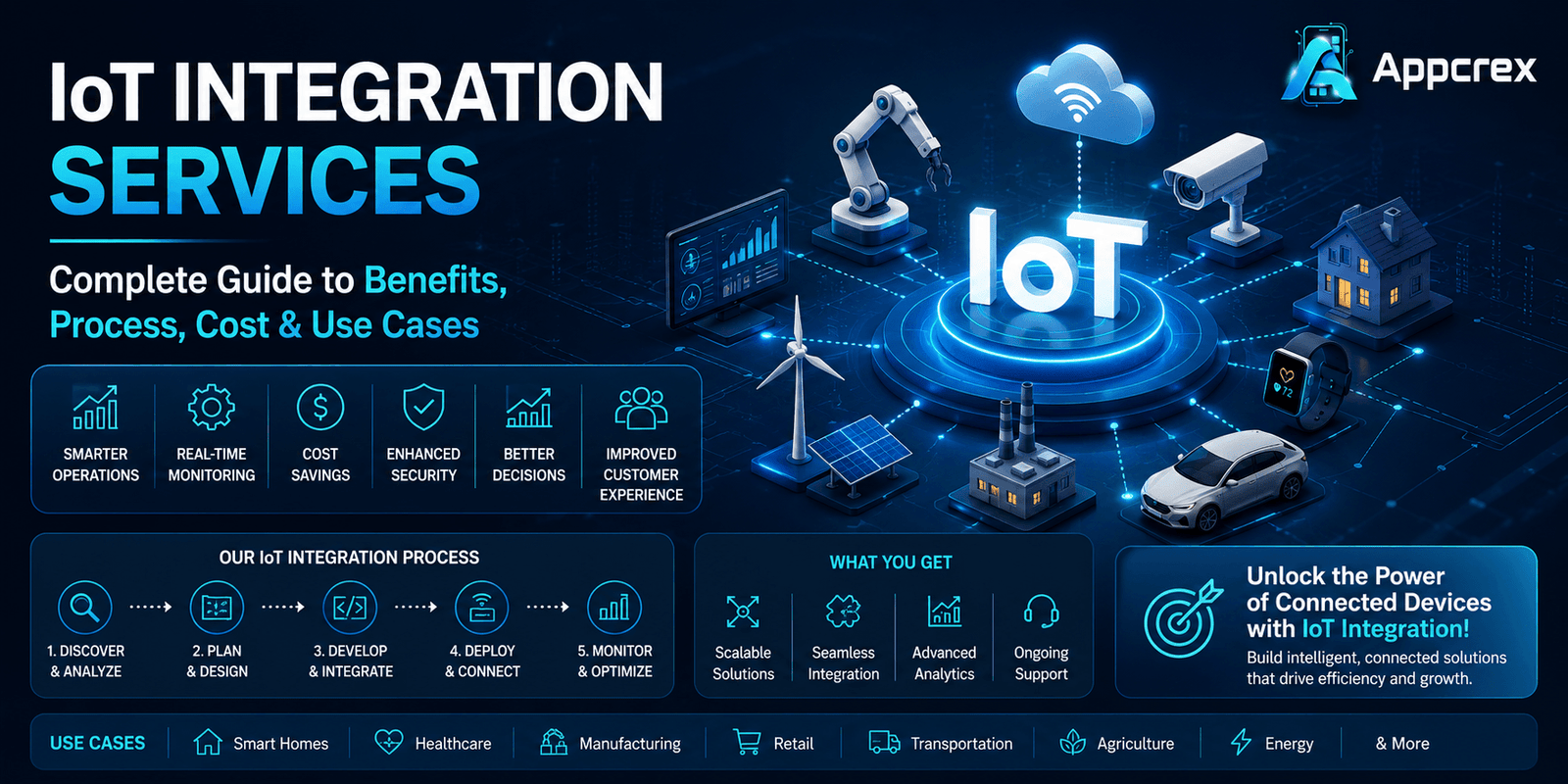
IoT Integration Services help businesses connect smart devices, sensors, cloud platforms, mobile applications, enterprise software, and AI systems into a unified ecosystem. This enables real-time data exchange, automation, remote monitoring, predictive analytics, and improved operational control.
Today, companies across industries such as healthcare, manufacturing, agriculture, logistics, automotive, retail, and energy are investing in custom IoT solutions to improve productivity and create smarter business processes.
A professional IoT Integration Company helps organizations build scalable IoT ecosystems by combining hardware integration, cloud computing, APIs, data analytics, cybersecurity, and artificial intelligence.
At AppCrex, we provide end-to-end IoT integration services to help startups and enterprises develop secure, intelligent, and scalable connected solutions that improve business performance.
This complete guide covers everything you need to know about IoT integration, including its benefits, development process, technologies, cost, use cases, and future trends.
What is IoT Integration?
IoT Integration is the process of connecting Internet of Things devices, sensors, software applications, cloud platforms, and enterprise systems to enable seamless communication and data sharing.
An IoT ecosystem usually includes:
- Smart Devices
- Sensors
- IoT Gateways
- Cloud Platforms
- Mobile Applications
- Web Dashboards
- APIs
- AI Analytics Systems
Through IoT integration, businesses can collect real-time information from connected devices and use that data to automate processes, monitor performance, and make intelligent decisions.
For example, a manufacturing company can integrate IoT sensors with production machines to monitor equipment performance, identify potential failures, and automatically schedule maintenance.
Similarly, a healthcare organization can connect wearable devices with healthcare platforms to monitor patient health conditions in real time.
How Does IoT Integration Work?
IoT integration works by connecting different layers of technology to create a complete connected ecosystem.
1. Device Layer
The device layer includes physical hardware components that collect information from the environment.
Examples include:
- Temperature Sensors
- Smart Cameras
- Wearable Devices
- Industrial Machines
- GPS Devices
- Smart Appliances
- Medical Equipment
These devices collect data and send it to connected platforms for processing.
2. Connectivity Layer
The connectivity layer enables communication between IoT devices and software systems.
Common connectivity technologies include:
- Wi-Fi
- Bluetooth
- 5G
- Zigbee
- LoRaWAN
- MQTT
The right communication technology depends on factors such as device location, data requirements, and business objectives.
3. Data Processing Layer
After collecting data, IoT systems process and analyze information using cloud computing, edge computing, and AI technologies.
This layer helps businesses:
- Analyze Device Data
- Identify Patterns
- Detect Problems
- Generate Insights
- Automate Actions
4. Application Layer
The application layer provides user access through:
- Mobile Apps
- Web Applications
- Admin Dashboards
- Enterprise Platforms
Users can monitor devices, control operations, and view analytics through these applications.
Why Businesses Need IoT Integration Services?
Businesses are adopting IoT integration because it helps them improve efficiency, automate processes, reduce costs, and create better customer experiences.
Real-Time Monitoring
IoT integration enables businesses to monitor connected devices and operations in real time.
Organizations can track:
- Equipment Performance
- Vehicle Locations
- Energy Usage
- Production Activities
- Environmental Conditions
Real-time monitoring helps companies identify issues quickly and improve operational control.
Business Process Automation
IoT integration allows organizations to automate repetitive tasks and reduce manual intervention.
Examples include:
- Automatic Equipment Control
- Smart Inventory Management
- Automated Energy Management
- Remote Device Management
Automation improves productivity and reduces operational errors.
Predictive Maintenance
One of the biggest advantages of IoT integration is predictive maintenance.
Traditional maintenance relies on fixed schedules, but IoT systems analyze real-time equipment data to predict possible failures.
Benefits include:
- Reduced Equipment Downtime
- Lower Repair Costs
- Longer Asset Life
- Improved Productivity
Better Decision Making
IoT devices generate large amounts of valuable data. With analytics and AI integration, businesses can convert this data into actionable insights.
Companies can understand:
- Performance Trends
- Customer Behavior
- Resource Usage
- Operational Challenges
This helps management make faster and smarter decisions.
Improved Customer Experience
IoT technology enables businesses to provide personalized and connected experiences.
Examples:
- Smart Home Solutions
- Connected Vehicles
- Wearable Healthcare Devices
- Smart Retail Experiences
Connected solutions help businesses improve customer satisfaction and loyalty.
Cost Reduction
IoT integration helps reduce operational expenses by optimizing resources and improving efficiency.
Businesses can save costs through:
- Energy Optimization
- Automated Processes
- Predictive Maintenance
- Better Asset Management
Enhanced Security & Monitoring
IoT integration improves security through connected monitoring systems.
Businesses can implement:
- Smart Surveillance
- Access Control Systems
- Real-Time Alerts
- Remote Monitoring
This is especially useful for industries such as healthcare, logistics, manufacturing, and smart buildings.
Types of IoT Integration Solutions
IoT integration is not limited to connecting devices with software. A complete IoT ecosystem requires seamless communication between hardware, applications, cloud platforms, enterprise systems, and analytics tools.
Businesses choose different IoT integration solutions based on their industry requirements, operational goals, and the type of devices they want to connect.
1. Device Integration
Device integration connects physical IoT devices and sensors with software platforms to collect and exchange data.
It allows businesses to manage and monitor connected devices from a centralized system.
Examples of devices:
- Industrial Equipment
- Smart Sensors
- Wearable Devices
- Medical Devices
- GPS Trackers
- Smart Appliances
- Connected Vehicles
Business Applications:
- Remote Equipment Monitoring
- Asset Tracking
- Smart Automation
- Performance Management
Device integration is the foundation of any IoT solution because it enables communication between physical assets and digital platforms.
2. Cloud IoT Integration
Cloud integration connects IoT devices with cloud platforms for storing, processing, and analyzing large volumes of data.
Cloud-based IoT solutions provide businesses with flexible infrastructure that can scale according to growing device networks.
Popular cloud platforms include:
- AWS IoT
- Microsoft Azure IoT
- Google Cloud IoT Solutions
Cloud IoT Integration Enables:
- Real-Time Data Processing
- Remote Device Management
- Data Storage
- Analytics
- AI Model Integration
- Global Device Access
Cloud integration is especially important for businesses managing thousands of connected devices across multiple locations.
3. API Integration
API integration allows IoT platforms to communicate with other software systems and business applications.
Through APIs, businesses can connect IoT data with existing digital infrastructure.
Common integrations include:
- CRM Systems
- ERP Platforms
- Mobile Applications
- Payment Systems
- Analytics Platforms
- Enterprise Software
For example, a logistics company can integrate IoT vehicle tracking data with its fleet management software to improve delivery planning and route optimization.
Also Read : What Is API Integration? A Complete Guide to Benefits, Types & Best Practices (2026)
4. Mobile App Integration
Mobile app integration allows users to monitor and control IoT devices remotely through smartphones and tablets.
IoT mobile applications provide:
- Device Monitoring
- Remote Control
- Real-Time Notifications
- Data Visualization
- User Management
Examples:
- Smart Home Applications
- Healthcare Monitoring Apps
- Vehicle Tracking Apps
- Industrial Monitoring Apps
Mobile integration improves accessibility and allows businesses to manage connected systems from anywhere.
5. Enterprise IoT Integration
Large organizations often require IoT systems to work with their existing enterprise software.
Enterprise IoT integration connects IoT platforms with business management systems such as:
- ERP Software
- CRM Solutions
- Warehouse Management Systems
- Manufacturing Systems
- Business Intelligence Platforms
This creates a unified ecosystem where operational data and business processes work together.
6. AI & Machine Learning Integration
AI integration transforms traditional IoT systems into intelligent platforms capable of analyzing data and making automated decisions.
AI-powered IoT solutions can:
- Predict Equipment Failures
- Detect Unusual Patterns
- Optimize Operations
- Automate Decisions
- Generate Business Insights
This combination is commonly known as AIoT (Artificial Intelligence of Things).
Key Features of IoT Integration Solutions
A successful IoT platform should include advanced features that help businesses monitor, manage, and optimize connected operations.
1. Real-Time Data Monitoring
Real-time monitoring allows businesses to view live information from connected devices.
Users can monitor:
- Device Status
- Performance Data
- Location Information
- Environmental Conditions
- Energy Consumption
This helps organizations maintain better visibility over their operations.
2. Remote Device Management
IoT platforms allow businesses to control and manage devices remotely without physical access.
Capabilities include:
- Device Configuration
- Software Updates
- Remote Troubleshooting
- Device Activation
- Performance Monitoring
Remote management reduces maintenance effort and improves operational efficiency.
3. Data Analytics & Visualization
IoT systems collect large amounts of data that need proper analysis.
Advanced analytics dashboards help businesses understand:
- Performance Trends
- Usage Patterns
- Operational Issues
- Resource Consumption
Data visualization makes complex information easier to understand and act upon.
4. Automated Alerts & Notifications
IoT applications can automatically send alerts when specific conditions occur.
Examples:
- Equipment Failure Alerts
- Temperature Warnings
- Security Notifications
- Low Battery Alerts
- Maintenance Reminders
Automated alerts help businesses respond quickly to critical situations.
5. Predictive Maintenance
Predictive maintenance uses IoT data to identify potential equipment problems before failures happen.
The system analyzes:
- Machine Performance
- Sensor Data
- Usage Patterns
- Historical Records
Benefits:
- Reduced Downtime
- Lower Maintenance Costs
- Improved Equipment Reliability
6. Security Management
Security is one of the most important features of an IoT solution because connected devices handle sensitive information.
IoT security features include:
- Device Authentication
- Data Encryption
- Secure APIs
- Access Control
- User Permissions
- Activity Monitoring
Strong security ensures safe communication between devices and platforms.
7. Scalability & Device Management
A professional IoT platform should support future business growth.
Scalable IoT solutions allow organizations to:
- Add New Devices
- Manage Multiple Locations
- Handle More Users
- Process Larger Data Volumes
This ensures the platform remains effective as business requirements expand.
8. Custom Dashboards & Reporting
IoT dashboards provide a centralized view of connected operations.
Dashboard capabilities include:
- Live Data Reports
- Device Analytics
- Performance Monitoring
- Custom Reports
- Business Insights
Custom dashboards help managers make informed decisions quickly.
IoT Integration Process
Building a successful IoT solution requires a structured development approach. A professional IoT Integration Development Company follows a systematic process to ensure reliability, security, and scalability.
Step 1: Requirement Analysis
The process begins by understanding business objectives, device requirements, and expected outcomes.
This stage includes:
- Business Goal Analysis
- Device Identification
- Feature Planning
- Integration Requirements
- Security Planning
Step 2: IoT Architecture Design
Developers design the complete IoT ecosystem, including:
- Devices
- Connectivity
- Cloud Infrastructure
- Database
- Applications
- Security Layers
A strong architecture ensures better performance and future scalability.
Step 3: Hardware & Device Integration
IoT devices and sensors are connected with software platforms using suitable communication technologies.
This includes:
- Sensor Configuration
- Device Connectivity
- Data Transmission Setup
- Hardware Testing
Step 4: Software Development
Custom IoT applications are developed based on business requirements.
Solutions may include:
- Mobile Applications
- Web Dashboards
- Admin Panels
- Enterprise Platforms
Also Read : Custom Software Development Company: Complete Guide to Services, Process, Cost & Benefits (2026)
Step 5: Cloud & API Integration
Cloud services and APIs are integrated to enable:
- Data Storage
- Real-Time Synchronization
- Third-Party Connectivity
- Analytics Processing
Step 6: Testing & Deployment
Before launch, the IoT solution is tested for:
- Performance
- Security
- Device Compatibility
- Data Accuracy
- Network Reliability
After successful testing, the platform is deployed for business use.
Technologies Used in IoT Integration
A successful IoT solution requires a combination of hardware, connectivity technologies, cloud platforms, databases, and software frameworks. The right technology stack ensures reliable communication between devices, secure data transfer, and efficient processing of real-time information.
1. IoT Communication Technologies
Communication technologies allow IoT devices to exchange data with applications and cloud platforms.
MQTT
MQTT is a lightweight messaging protocol widely used in IoT systems because it provides fast and reliable communication with low bandwidth usage.
Common use cases:
- Industrial Monitoring
- Smart Devices
- Remote Sensors
- Connected Equipment
HTTP/HTTPS
HTTP-based communication is commonly used for connecting IoT platforms with web applications and APIs.
Used for:
- Cloud Communication
- Mobile Applications
- Data Exchange
- Third-Party Integrations
Bluetooth Low Energy (BLE)
BLE is designed for low-power IoT devices that require short-range communication.
Examples:
- Fitness Trackers
- Wearable Devices
- Healthcare Sensors
5G Connectivity
5G enables faster communication and lower latency for advanced IoT applications.
Benefits:
- Faster Data Transfer
- Real-Time Communication
- Support for Large Device Networks
Used in:
- Smart Cities
- Autonomous Vehicles
- Industrial Automation
LoRaWAN
LoRaWAN supports long-range communication with low power consumption.
Common applications:
- Smart Agriculture
- Environmental Monitoring
- Smart Metering
2. Cloud Platforms for IoT
Cloud platforms provide the infrastructure needed to store, process, and analyze IoT data.
AWS IoT
Amazon Web Services provides scalable IoT solutions for device management, analytics, and secure communication.
Features:
- Device Connectivity
- Data Processing
- Cloud Storage
- Machine Learning Integration
Microsoft Azure IoT
Azure IoT provides enterprise-level solutions for organizations managing large IoT networks.
Capabilities include:
- Device Management
- Digital Twin Solutions
- Data Analytics
- Security Management
Google Cloud IoT Solutions
Google Cloud enables businesses to process IoT data using advanced analytics and AI technologies.
Used for:
- Data Processing
- Predictive Analytics
- Machine Learning Models
3. Database Technologies
IoT systems generate massive amounts of data that require efficient storage and management.
Popular database technologies include:
- MongoDB
- PostgreSQL
- MySQL
- Firebase
- InfluxDB
These databases help manage:
- Device Information
- Sensor Data
- User Data
- Historical Analytics
4. Application Development Technologies
IoT solutions require user-friendly applications for monitoring and controlling connected devices.
Mobile App Development
Technologies:
- Flutter
- React Native
- Kotlin
- Swift
Used for building:
- IoT Control Apps
- Monitoring Applications
- Smart Device Apps
Web Application Development
Technologies:
- React.js
- Angular
- Next.js
Used for:
- IoT Dashboards
- Admin Panels
- Analytics Platforms
Backend Development
Technologies:
- Node.js
- Python
- Java
- .NET
Used for:
- API Development
- Data Processing
- Device Communication
IoT + AI Integration (AIoT): The Future of Smart Automation
The combination of Artificial Intelligence and IoT is creating a new generation of intelligent connected systems.
IoT collects real-time data from devices, while AI analyzes that information and enables automated decision-making.
This combination is known as AIoT (Artificial Intelligence of Things).
How AI Improves IoT Solutions?
Predictive Analytics
AI analyzes IoT data to identify patterns and predict future outcomes.
Examples:
- Machine Failure Prediction
- Energy Demand Forecasting
- Customer Behavior Analysis
Businesses can take preventive actions instead of reacting to problems.
Intelligent Automation
AI enables IoT systems to automatically respond based on collected information.
Examples:
- Smart Buildings Adjusting Energy Usage
- Machines Automatically Optimizing Performance
- Smart Irrigation Managing Water Supply
Computer Vision Integration
AI-powered cameras connected with IoT systems can analyze visual information.
Applications:
- Quality Inspection
- Security Monitoring
- Traffic Management
- Healthcare Imaging
Anomaly Detection
AI algorithms detect unusual activities in IoT data.
Examples:
- Equipment Problems
- Security Threats
- Abnormal Energy Usage
- System Errors
This helps businesses prevent operational failures.
Industries Using IoT Integration
IoT integration is transforming multiple industries by improving automation, monitoring, and decision-making.
1. Healthcare IoT
Healthcare organizations use IoT solutions to provide better patient care and improve medical operations.
Use cases:
- Remote Patient Monitoring
- Wearable Health Devices
- Smart Medical Equipment
- Hospital Asset Tracking
Benefits:
- Real-Time Patient Data
- Faster Medical Response
- Improved Healthcare Management
2. Manufacturing IoT (Industrial IoT)
Manufacturing companies use IoT integration to create smart factories.
Applications:
- Machine Monitoring
- Predictive Maintenance
- Production Tracking
- Quality Control
Benefits:
- Reduced Downtime
- Improved Productivity
- Automated Operations
3. Agriculture IoT
IoT technology is helping farmers improve productivity through smart farming solutions.
Use cases:
- Soil Monitoring
- Smart Irrigation
- Weather Tracking
- Crop Monitoring
Benefits:
- Better Crop Management
- Reduced Resource Usage
- Higher Efficiency
4. Automotive IoT
Connected vehicles and fleet systems rely on IoT integration.
Applications:
- Vehicle Tracking
- Fleet Management
- Driver Monitoring
- Vehicle Diagnostics
Benefits:
- Improved Safety
- Better Fleet Performance
- Reduced Maintenance Costs
5. Logistics & Supply Chain IoT
IoT helps logistics companies improve visibility and operational efficiency.
Use cases:
- GPS Tracking
- Warehouse Monitoring
- Smart Inventory Management
- Temperature Monitoring
Benefits:
- Real-Time Shipment Tracking
- Improved Delivery Management
- Reduced Losses
Also Read : Logistics App Development: Complete Guide to Features, Cost & Development Process
6. Smart Home IoT
Smart home solutions connect everyday devices to create automated living environments.
Examples:
- Smart Lights
- Smart Locks
- Smart Cameras
- Smart Appliances
Benefits:
- Convenience
- Energy Savings
- Better Security
7. Energy & Utility IoT
Energy companies use IoT integration to monitor and optimize resource consumption.
Applications:
- Smart Meters
- Solar Monitoring
- Energy Management Systems
- Grid Monitoring
Benefits:
- Reduced Energy Waste
- Better Resource Management
- Improved Sustainability
8. Retail IoT
Retail businesses use IoT to improve customer experience and inventory management.
Applications:
- Smart Shelves
- Customer Analytics
- Automated Checkout
- Inventory Tracking
Benefits:
- Better Customer Experience
- Improved Sales Insights
- Efficient Operations
IoT Integration Use Cases
IoT integration is being adopted across industries to improve automation, operational visibility, and decision-making. By connecting devices, sensors, software platforms, and analytics systems, businesses can create smarter solutions that solve real-world challenges.
Below are some of the most common IoT integration use cases.
1. Smart Manufacturing & Industrial Automation
Manufacturing companies are using IoT integration to build smart factories where machines, sensors, and software systems work together.
Use Cases:
- Machine Performance Monitoring
- Equipment Health Tracking
- Automated Production Control
- Quality Inspection
- Predictive Maintenance
For example, IoT sensors installed on manufacturing equipment can monitor temperature, vibration, and performance data. The system can identify early signs of failure and schedule maintenance before production stops.
Business Benefits:
- Reduced Downtime
- Increased Production Efficiency
- Lower Maintenance Costs
- Better Quality Control
2. Healthcare IoT Solutions
IoT integration is transforming healthcare by enabling connected medical devices and remote patient monitoring.
Use Cases:
- Wearable Health Devices
- Remote Patient Monitoring
- Smart Medical Equipment
- Hospital Asset Tracking
- Medication Monitoring Systems
Healthcare providers can collect real-time patient information and provide faster medical responses.
Also Read : Healthcare App Development Guide: Features, Cost & Process (2026)
Business Benefits:
- Improved Patient Care
- Faster Diagnosis
- Better Healthcare Management
- Reduced Hospital Costs
3. Smart Agriculture Solutions
IoT integration helps farmers use technology to monitor crops, soil, and environmental conditions.
Use Cases:
- Smart Irrigation Systems
- Soil Moisture Monitoring
- Weather Monitoring
- Crop Health Tracking
- Livestock Monitoring
IoT sensors collect agricultural data and help farmers make better decisions about irrigation, fertilizers, and crop management.
Business Benefits:
- Higher Crop Productivity
- Reduced Water Usage
- Better Resource Management
- Improved Farming Efficiency
4. Connected Vehicle & Fleet Management
Automotive companies and logistics businesses use IoT integration to manage vehicles and improve transportation operations.
Use Cases:
- GPS Vehicle Tracking
- Fleet Monitoring
- Driver Behavior Analysis
- Fuel Monitoring
- Vehicle Diagnostics
IoT systems provide real-time vehicle information and help companies optimize fleet performance.
Business Benefits:
- Better Route Planning
- Reduced Fuel Costs
- Improved Driver Safety
- Efficient Fleet Operations
5. Smart Home Automation
Smart home IoT solutions connect household devices to provide automation and remote control.
Use Cases:
- Smart Lighting
- Smart Security Cameras
- Smart Locks
- Smart Thermostats
- Voice-Controlled Devices
Users can control home devices through mobile applications or voice assistants.
Business Benefits:
- Improved Convenience
- Energy Savings
- Enhanced Security
- Better User Experience
6. Smart Retail Solutions
Retail businesses use IoT integration to improve customer experience and optimize inventory management.
Use Cases:
- Smart Shelves
- Customer Behavior Tracking
- Automated Checkout Systems
- Inventory Monitoring
- Personalized Shopping Experiences
IoT helps retailers understand customer preferences and manage stock efficiently.
Business Benefits:
- Improved Sales
- Better Inventory Control
- Enhanced Customer Experience
- Reduced Operational Costs
7. Energy Management Systems
IoT integration helps energy companies monitor and optimize energy consumption.
Use Cases:
- Smart Meters
- Solar Energy Monitoring
- Smart Grid Management
- Energy Usage Tracking
Businesses can analyze energy patterns and automatically optimize consumption.
Business Benefits:
- Reduced Energy Costs
- Better Sustainability
- Improved Resource Management
8. Smart Logistics & Warehouse Management
IoT technology improves supply chain visibility and warehouse operations.
Use Cases:
- Asset Tracking
- Inventory Monitoring
- Temperature Monitoring
- Automated Warehouse Systems
- Shipment Tracking
IoT sensors provide real-time information about goods, locations, and storage conditions.
Business Benefits:
- Faster Operations
- Reduced Product Loss
- Better Supply Chain Management
How Much Does IoT Integration Cost?
The cost of IoT integration depends on several factors, including hardware requirements, software complexity, number of connected devices, cloud infrastructure, security requirements, and AI capabilities.
A simple IoT monitoring solution will cost less compared to an enterprise IoT platform managing thousands of devices.
Estimated IoT Integration Development Cost
| IoT Solution Type | Estimated Cost | Development Timeline |
|---|---|---|
| Basic IoT Solution | $15,000 – $40,000 | 2–4 Months |
| IoT Mobile App + Dashboard | $40,000 – $80,000 | 4–6 Months |
| Industrial IoT Platform | $80,000 – $150,000 | 6–10 Months |
| Enterprise IoT Ecosystem | $150,000 – $300,000+ | 10–18 Months |
Note: Actual pricing depends on project requirements, technology stack, device complexity, and customization needs.
Factors Affecting IoT Integration Cost
1. Number of Connected Devices
The number of devices directly impacts development complexity.
A solution connecting 100 devices requires fewer resources compared to a platform managing thousands of devices across different locations.
More devices require:
- Advanced Device Management
- Strong Infrastructure
- Higher Data Processing Capacity
2. Hardware Requirements
Hardware selection affects the overall development budget.
Cost depends on:
- Sensors
- IoT Modules
- Device Customization
- Connectivity Hardware
- Embedded Software
3. Software Platform Development
A custom IoT platform may include:
- Mobile Applications
- Web Dashboards
- Admin Panels
- APIs
- Analytics Systems
More advanced features increase development time and cost.
4. Cloud Infrastructure
Cloud requirements depend on:
- Data Volume
- Storage Needs
- Number of Users
- Real-Time Processing Requirements
Enterprise IoT platforms usually require powerful cloud architecture.
5. AI & Analytics Features
AI-powered IoT solutions require additional investment for:
- Machine Learning Models
- Data Training
- Predictive Analytics
- Automation Features
However, AI integration provides higher efficiency and long-term value.
6. Security Requirements
Security implementation impacts cost but is essential for protecting IoT systems.
Important security features include:
- Data Encryption
- Device Authentication
- Secure APIs
- Access Control
7. Third-Party Integrations
Integration with existing systems such as ERP, CRM, payment platforms, and enterprise software can increase development effort.
Benefits of IoT Integration for Businesses
IoT integration helps businesses move from traditional operations to smart, automated, and data-driven ecosystems. By connecting devices, software platforms, and analytics systems, organizations can improve efficiency, reduce costs, and create new business opportunities.
1. Improved Operational Efficiency
IoT integration automates business processes and helps organizations manage operations more effectively.
Businesses can:
- Monitor equipment performance
- Automate repetitive tasks
- Optimize workflows
- Reduce manual intervention
For example, manufacturing companies can automatically track production activities and identify operational issues before they affect productivity.
2. Real-Time Business Insights
IoT devices continuously generate valuable data that helps businesses understand their operations.
Companies can analyze:
- Device Performance
- Customer Behavior
- Resource Usage
- Operational Trends
Real-time insights allow businesses to make faster and more accurate decisions.
3. Reduced Operational Costs
IoT integration helps companies reduce expenses by improving resource utilization and preventing unnecessary downtime.
Cost-saving opportunities include:
- Predictive Maintenance
- Energy Optimization
- Automated Processes
- Better Asset Management
Businesses can achieve higher efficiency while lowering operational expenses.
4. Enhanced Customer Experience
Connected technologies allow businesses to provide personalized and convenient experiences.
Examples:
- Smart Home Services
- Connected Vehicles
- Healthcare Monitoring
- Smart Retail Solutions
IoT helps businesses understand customer needs and deliver better services.
5. Better Asset Management
IoT solutions provide complete visibility into valuable business assets.
Companies can track:
- Equipment Location
- Asset Performance
- Usage History
- Maintenance Requirements
This improves asset utilization and extends equipment lifespan.
6. Increased Security & Safety
IoT integration improves monitoring and security through connected systems.
Businesses can implement:
- Smart Surveillance
- Access Control
- Real-Time Alerts
- Remote Monitoring
This helps organizations protect assets, employees, and customers.
7. Scalability for Future Growth
A well-designed IoT platform can grow with business requirements.
Organizations can:
- Add New Devices
- Expand Locations
- Integrate New Technologies
- Support More Users
Scalable architecture ensures long-term business growth without rebuilding the entire system.
Challenges in IoT Integration
Although IoT provides significant business advantages, organizations must address several challenges during implementation.
1. Data Security & Privacy
IoT devices collect and exchange large amounts of data, making security a major concern.
Businesses need:
- Data Encryption
- Secure Communication
- Device Authentication
- Regular Security Updates
A strong security framework protects sensitive business information.
2. Device Compatibility
Different IoT devices may use different communication standards and technologies.
Businesses need proper integration strategies to ensure:
- Device Compatibility
- Reliable Communication
- Smooth Data Exchange
3. Data Management Complexity
IoT ecosystems generate massive amounts of real-time data.
Organizations need efficient systems for:
- Data Storage
- Data Processing
- Data Analysis
- Data Management
Without proper infrastructure, handling IoT data can become challenging.
4. High Initial Investment
IoT implementation requires investment in:
- Hardware
- Software Development
- Cloud Infrastructure
- Security Solutions
However, the long-term benefits often provide strong ROI through automation and efficiency improvements.
5. Scalability Issues
A solution designed for a small number of devices may not perform well when expanded.
Businesses need scalable IoT architecture to support future growth.
Future Trends of IoT Integration (2026–2030)
IoT technology will continue evolving with advancements in AI, automation, connectivity, and cloud computing.
1. AI-Powered IoT (AIoT)
AI and IoT integration will create smarter systems capable of analyzing data and making automated decisions.
Future applications include:
- Predictive Maintenance
- Smart Automation
- Intelligent Monitoring
- Automated Decision Making
2. Edge Computing Adoption
Edge computing will allow IoT devices to process data closer to the source instead of depending completely on cloud servers.
Benefits:
- Faster Response Time
- Reduced Network Load
- Improved Privacy
- Real-Time Processing
3. 5G-Enabled IoT Solutions
5G connectivity will improve IoT performance by providing:
- Faster Data Transfer
- Lower Latency
- Better Device Connectivity
This will support advanced solutions like smart cities, autonomous vehicles, and industrial automation.
4. Digital Twin Technology
Digital twins create virtual models of physical assets using IoT data.
Businesses can use digital twins for:
- Equipment Simulation
- Performance Analysis
- Predictive Maintenance
- Operational Planning
5. Smart Cities & Connected Infrastructure
Cities will increasingly adopt IoT solutions for:
- Smart Traffic Management
- Smart Parking
- Waste Management
- Public Safety
- Energy Optimization
IoT will help create more sustainable and efficient urban environments.
Why Choose AppCrex for IoT Integration Services?
Choosing the right technology partner is essential for building a secure and scalable IoT ecosystem.
At AppCrex, we help businesses develop custom IoT solutions that connect devices, software platforms, and enterprise systems to improve automation and operational efficiency.
End-to-End IoT Development Services
Our IoT integration services include:
- IoT Strategy Consulting
- Device Integration
- Cloud IoT Development
- Mobile App Development
- Web Dashboard Development
- API Integration
- AI & Machine Learning Integration
- IoT Security Implementation
Custom IoT Solutions for Multiple Industries
We develop IoT solutions for:
- Healthcare
- Manufacturing
- Agriculture
- Automotive
- Logistics
- Retail
- Energy
- Smart Homes
Advanced Technology Expertise
Our team works with modern technologies including:
- Artificial Intelligence
- Cloud Computing
- Edge Computing
- IoT Sensors
- Data Analytics
- Mobile Applications
- Enterprise Software Integration
Secure & Scalable Architecture
We build IoT platforms with:
- Secure Data Communication
- Scalable Cloud Infrastructure
- Real-Time Monitoring
- Reliable APIs
- Enterprise-Level Security
This ensures your IoT solution remains efficient as your business grows.
(FAQs)
1. What are IoT integration services?
IoT integration services connect smart devices, sensors, applications, cloud platforms, and enterprise systems to create a connected digital ecosystem.
2. How much does IoT integration cost?
IoT integration development cost usually ranges from $15,000 to $300,000+ depending on device requirements, software complexity, AI features, cloud infrastructure, and customization needs.
3. How long does it take to develop an IoT solution?
A basic IoT solution may take around 2–4 months, while complex enterprise IoT platforms can require 10–18 months.
4. Which industries use IoT integration?
IoT solutions are widely used in:
- Healthcare
- Manufacturing
- Agriculture
- Automotive
- Logistics
- Retail
- Energy
- Smart Cities
5. Can IoT be integrated with AI?
Yes. AI integration helps IoT systems perform predictive analytics, automation, anomaly detection, and intelligent decision-making.
6. Why should businesses choose custom IoT integration?
Custom IoT solutions provide better flexibility, scalability, security, and integration capabilities compared to generic solutions.
Conclusion
IoT integration is becoming a key technology for businesses looking to improve automation, efficiency, and decision-making. By connecting devices, applications, cloud platforms, and AI systems, organizations can create intelligent ecosystems that deliver real-time insights and operational improvements.
From smart manufacturing and healthcare monitoring to connected vehicles and smart cities, IoT solutions are transforming industries worldwide.
Investing in professional IoT Integration Services helps businesses build secure, scalable, and future-ready solutions that support long-term growth.
Build Your Custom IoT Solution with AppCrex
Looking for a reliable IoT Integration Development Company to build your connected solution?
AppCrex helps businesses develop custom IoT platforms with device integration, cloud connectivity, AI-powered analytics, mobile applications, and enterprise software integration.
Our experts help transform ideas into scalable IoT solutions designed to improve automation, efficiency, and business growth.
Contact AppCrex today to discuss your IoT integration project and build a smarter connected future.