Businesses today need digital solutions that are fast, secure, cost-effective, and accessible across multiple devices. While native mobile applications continue to offer excellent performance, many companies are now choosing Progressive Web Apps (PWAs) to deliver app-like experiences without requiring users to download an application from an app store.
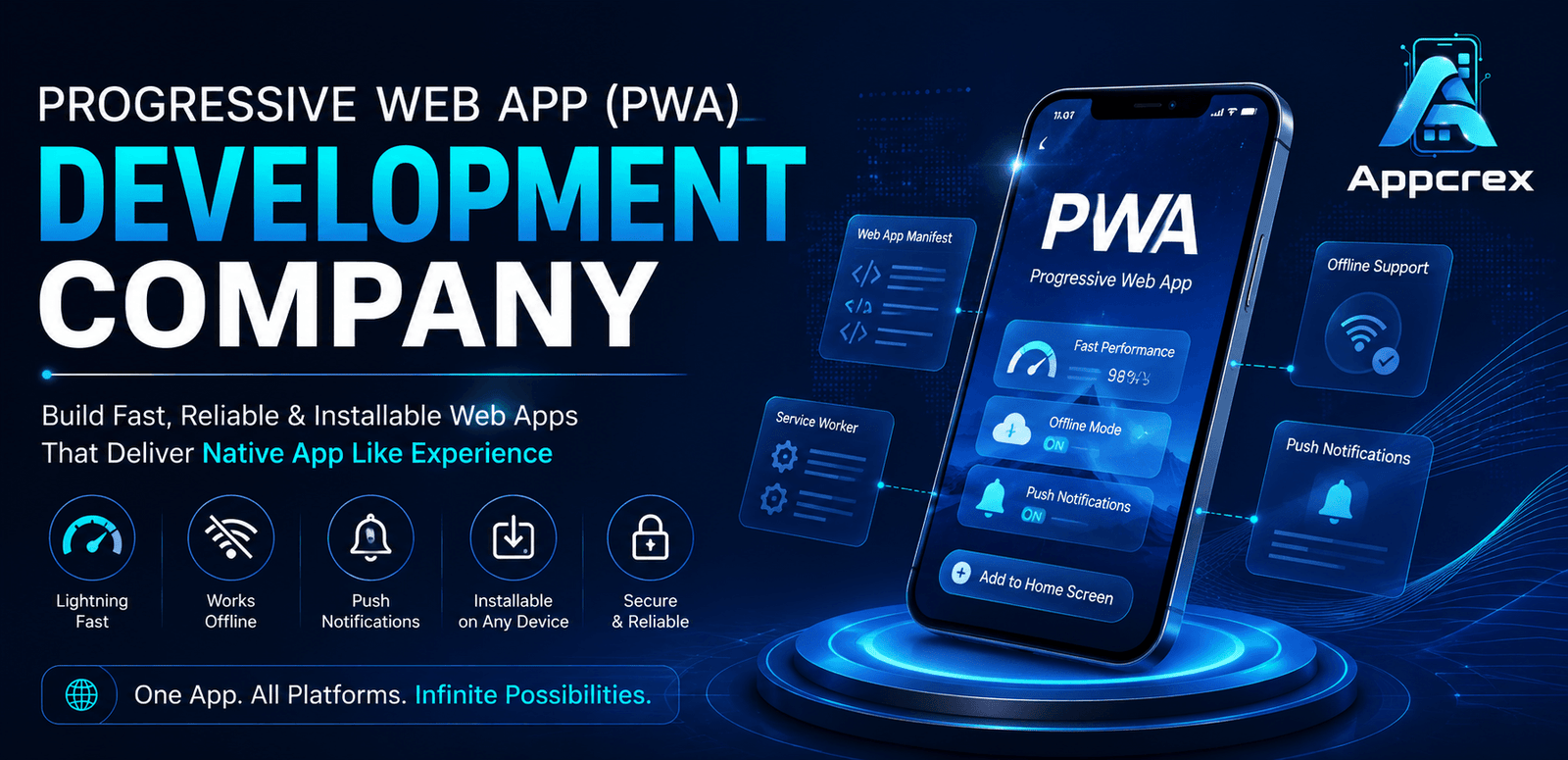
PWAs combine the best features of websites and mobile applications. They load quickly, work offline, send push notifications, and can be installed directly from a browser. This makes them an excellent choice for startups, SMEs, and enterprises looking to improve customer engagement while reducing development costs.
As a leading Progressive Web App (PWA) development company, AppCrex builds secure, scalable, and high-performance PWAs that help businesses increase conversions, improve user retention, and deliver seamless digital experiences across Android, iOS, tablets, and desktops.
In this guide, you’ll learn everything about PWA development, including its features, business benefits, technologies, development process, costs, and why investing in a Progressive Web App can be a smart decision in 2026.
What is Progressive Web App (PWA) Development?
Progressive Web App (PWA) development is the process of building web applications that deliver a native mobile app-like experience directly through a web browser.
Unlike traditional websites, PWAs can:
- Be installed on a user’s device
- Work even with limited or no internet connection
- Send push notifications
- Load almost instantly
- Automatically update
- Use device features like camera, GPS, and storage (supported by browsers)
A PWA is essentially a website enhanced with modern web technologies such as:
- Service Workers
- Web App Manifest
- HTTPS
- Responsive UI
- Browser Caching
The result is an application that feels like a native mobile app while remaining accessible through a simple URL.
Just Read : How Much Does It Cost to Develop an App in 2026? Complete Pricing Guide
Why Businesses Are Investing in Progressive Web Apps?
Today’s users expect speed and convenience. Studies consistently show that slow websites lead to higher bounce rates and lower conversions.
Progressive Web Apps solve these problems by delivering:
- Faster page loading
- Better mobile performance
- Improved SEO
- Lower development costs
- Higher customer engagement
- Offline functionality
- Cross-platform compatibility
Instead of maintaining separate Android, iOS, and web applications, businesses can often serve users through a single PWA.
Key Features of Progressive Web Apps
1. Offline Functionality
PWAs continue working even when users lose internet connectivity.
Using Service Workers, important resources are cached locally, allowing users to browse previously loaded content without interruption.
This is particularly useful for:
- News platforms
- eCommerce stores
- Educational portals
- Healthcare platforms
- Travel websites
2. Installable Without App Stores
Unlike native applications, PWAs don’t require users to visit Google Play or the Apple App Store.
Users simply tap:
“Add to Home Screen”
The application is installed instantly.
Benefits include:
- No lengthy downloads
- No app store approvals
- Faster user acquisition
- Higher installation rates
3. Lightning-Fast Performance
Speed directly impacts revenue.
PWAs use intelligent caching techniques that significantly reduce loading times.
Benefits include:
- Better Core Web Vitals
- Improved user satisfaction
- Lower bounce rates
- Higher conversions
4. Push Notifications
PWAs can send personalized push notifications to re-engage users.
Businesses commonly use notifications for:
- Order updates
- Promotions
- Appointment reminders
- News alerts
- Cart abandonment reminders
- New product launches
Also Read : Push Notification Guide: Benefits, Types & Best Practices (2026)
5. Responsive Design
A Progressive Web App automatically adapts to:
- Smartphones
- Tablets
- Laptops
- Desktop computers
Users enjoy a consistent experience regardless of screen size.
6. Secure Browsing
PWAs operate over HTTPS, ensuring secure communication between users and servers.
This protects:
- Customer information
- Payment details
- Login credentials
- Personal data
7. Automatic Updates
Users always access the latest version of the application without downloading updates manually.
This reduces maintenance issues and improves user satisfaction.
8. App-Like User Experience
Modern PWAs provide:
- Smooth animations
- Full-screen interfaces
- Fast navigation
- Gesture support
- Native-like interactions
Many users cannot distinguish a well-built PWA from a traditional mobile application.
Benefits of Progressive Web App Development
Lower Development Costs
Building separate Android, iOS, and web applications can be expensive.
A single PWA significantly reduces:
- Development cost
- Testing cost
- Maintenance expenses
- Future upgrade costs
This makes PWAs ideal for startups and growing businesses.
Faster Time-to-Market
Launching one application is much faster than building multiple native apps.
Businesses can release products sooner and start acquiring users earlier.
Improved SEO
Unlike native applications, PWAs are indexed by search engines.
This means customers can discover your application through Google search results, increasing organic traffic and reducing customer acquisition costs.
Better User Engagement
Features like push notifications, fast loading, and offline support encourage users to spend more time using the application.
Higher engagement often leads to:
- More purchases
- Increased session duration
- Better customer retention
Increased Conversion Rates
A faster experience usually means more completed purchases.
Businesses frequently observe improvements in:
- Sales
- Lead generation
- Booking completion
- User registrations
after adopting a Progressive Web App.
Easier Maintenance
Managing one codebase instead of multiple applications reduces complexity and simplifies updates, bug fixes, and feature releases.
Cross-Platform Compatibility
PWAs work across:
- Android
- iPhone
- Windows
- macOS
- ChromeOS
- Linux
without requiring separate versions.
Also Read : Cross-Platform App Development Cost: Complete Pricing Guide (2026)
Why Choose PWA Over a Responsive Website?
Isme comparison table ho:
| Feature | Responsive Website | Progressive Web App |
|---|---|---|
| Offline Support | ❌ | ✅ |
| Push Notifications | ❌ | ✅ |
| Installable | ❌ | ✅ |
| App-like Experience | Limited | Excellent |
| Performance | Good | Excellent |
| Engagement | Medium | High |
Progressive Web App vs Native App
| Feature | Progressive Web App | Native Mobile App |
|---|---|---|
| Installation | Browser | App Store |
| Development Cost | Lower | Higher |
| SEO | Yes | No |
| Offline Access | Yes | Yes |
| Push Notifications | Yes | Yes |
| Cross Platform | Yes | Separate Apps Required |
| Updates | Automatic | User Download Required |
| App Store Approval | Not Required | Required |
| Development Time | Faster | Longer |
While native apps remain the best choice for graphics-intensive games or apps requiring deep hardware integration, PWAs are an excellent option for most business applications.
Industries That Benefit Most from PWA Development
Progressive Web Apps are suitable for a wide range of industries, including:
- eCommerce & Retail – Faster shopping experiences, improved conversions, and offline product browsing.
- Healthcare – Appointment booking, patient portals, and health record access.
- Education – Online learning platforms, quizzes, and course management.
- Food Delivery – Menu browsing, ordering, and order tracking.
- Travel & Hospitality – Hotel booking, itinerary management, and travel updates.
- Real Estate – Property listings, virtual tours, and lead generation.
- Finance & Banking – Secure account access, payment tracking, and financial dashboards.
- Logistics – Shipment tracking, delivery updates, and fleet management.
Real-World Examples of Successful PWAs
- Starbucks
- Uber
- Spotify
- Trivago
- Alibaba
- Twitter Lite
Progressive Web App (PWA) Development Process
Building a successful Progressive Web App involves more than simply converting an existing website into a mobile-friendly version. A well-planned PWA focuses on user experience, performance, security, scalability, and long-term business goals.
At AppCrex, we follow a structured development process to ensure every PWA delivers speed, reliability, and measurable business results.
1. Business Discovery & Requirement Analysis
The first step is understanding your business objectives, target audience, competitors, and technical requirements. During this phase, we identify:
- Business goals
- Target users
- Required features
- User journeys
- Platform requirements
- Third-party integrations
- Security and compliance needs
This helps create a clear roadmap before development begins.
2. UI/UX Design
A Progressive Web App should feel as intuitive as a native mobile application. Our design team creates responsive interfaces optimized for smartphones, tablets, and desktops.
Key design activities include:
- Wireframing
- User flow mapping
- Interactive prototypes
- Responsive layouts
- Accessibility optimization
- Brand-focused visual design
The goal is to provide a seamless user experience across all devices.
3. Frontend Development
The frontend is built using modern JavaScript frameworks to ensure high performance and responsiveness.
Common technologies include:
- React.js
- Angular
- Vue.js
- Next.js
- Nuxt.js
Developers implement responsive components, smooth navigation, and fast-loading interfaces.
4. Backend Development
The backend powers business logic, authentication, databases, and APIs.
Depending on project requirements, developers may use:
- Node.js
- Laravel
- Django
- ASP.NET
- Spring Boot
The backend ensures secure data handling and smooth communication between users and servers.
5. PWA Feature Integration
This stage transforms a standard web application into a Progressive Web App by implementing:
- Service Workers
- Web App Manifest
- Offline caching
- Push notifications
- Background synchronization
- Secure HTTPS configuration
- Installable application functionality
These technologies create the app-like experience users expect.
6. Quality Assurance & Testing
Before launch, the application undergoes comprehensive testing to ensure stability and performance.
Testing includes:
- Cross-browser compatibility
- Device testing
- Performance optimization
- Security testing
- Offline functionality
- Load testing
- API testing
- User acceptance testing (UAT)
7. Deployment & Launch
After successful testing, the PWA is deployed to a secure production server.
Deployment includes:
- HTTPS configuration
- CDN setup
- Performance optimization
- Analytics integration
- Search engine indexing
- Monitoring tools
The application is then ready for public access.
8. Ongoing Maintenance & Support
A successful PWA requires continuous monitoring and improvements.
Our maintenance services include:
- Security updates
- Performance optimization
- Feature enhancements
- Bug fixes
- Browser compatibility updates
- Analytics monitoring
Technologies Used for Progressive Web App Development
Choosing the right technology stack is essential for building scalable and high-performing PWAs.
| Category | Technologies |
|---|---|
| Frontend | React.js, Angular, Vue.js, Next.js |
| Backend | Node.js, Laravel, Django, ASP.NET |
| Database | MySQL, PostgreSQL, MongoDB, Firebase |
| Cloud | AWS, Google Cloud, Microsoft Azure |
| Authentication | OAuth, JWT, Firebase Auth |
| Payment | Stripe, PayPal, Razorpay, Apple Pay |
| Notifications | Firebase Cloud Messaging (FCM) |
| Analytics | Google Analytics, Mixpanel, Firebase Analytics |
| DevOps | Docker, Kubernetes, GitHub Actions |
Advanced Features to Include in a Progressive Web App
To stand out in a competitive market, modern PWAs often include advanced capabilities beyond the core features.
Some popular enhancements include:
User Authentication
- Social login
- OTP login
- Biometric authentication (browser support permitting)
- Multi-factor authentication
AI-Powered Personalization
- Smart product recommendations
- Personalized dashboards
- AI chatbots
- Content recommendations
Payment Integration
Support for secure payment gateways such as:
- Stripe
- PayPal
- Razorpay
- Apple Pay
- Google Pay
Also Read : Why Does Your Business Need Payment Gateway Integration Services?
Real-Time Updates
Useful for:
- Order tracking
- Live chat
- Delivery status
- Inventory updates
- Notifications
Location Services
Businesses can leverage:
- GPS tracking
- Nearby store locator
- Delivery tracking
- Geo-fencing
Multi-Language Support
Expand globally with:
- Multiple languages
- Regional currencies
- Localization
- RTL language support
How Much Does Progressive Web App Development Cost?
The cost of developing a Progressive Web App depends on several factors, including complexity, features, integrations, design requirements, and development time.
| Project Type | Estimated Cost |
|---|---|
| Basic PWA | $5,000 – $12,000 |
| Medium Complexity PWA | $12,000 – $30,000 |
| Enterprise PWA | $30,000 – $80,000+ |
Note: These are estimated ranges. The final cost depends on your project scope, technology stack, custom features, and integration requirements.
Factors Affecting PWA Development Cost
- UI/UX complexity
- Number of features
- Backend architecture
- Third-party integrations
- Offline functionality
- Push notification setup
- Security requirements
- API development
- Testing and QA
- Ongoing maintenance
How Long Does It Take to Build a PWA?
Development timelines vary based on project complexity.
| Project Size | Estimated Timeline |
|---|---|
| Basic PWA | 4–8 Weeks |
| Medium PWA | 8–16 Weeks |
| Enterprise PWA | 4–8 Months |
A structured development process helps reduce delays and ensures a successful launch.
Why Choose AppCrex as Your Progressive Web App (PWA) Development Company?
Selecting the right app development partner is just as important as choosing the right technology.
At AppCrex, we specialize in building custom Progressive Web Apps that are secure, scalable, and designed to support long-term business growth.
What Sets AppCrex Apart?
- Experienced PWA developers
- Custom, business-focused solutions
- Modern technology stack
- SEO-friendly architecture
- Responsive UI/UX design
- Secure and scalable development
- Agile development methodology
- Transparent communication
- Dedicated post-launch support
- On-time project delivery
Whether you’re a startup building your first digital product or an enterprise modernizing existing systems, our team delivers PWAs that combine the reach of the web with the experience of native apps.
(FAQs)
1. What is a Progressive Web App (PWA)?
A Progressive Web App (PWA) is a web application that combines the best features of websites and native mobile apps. It runs in a browser but offers app-like functionality, including offline access, push notifications, fast loading, and installation on a user’s device without requiring an app store.
2. What is the difference between a PWA and a native mobile app?
A PWA works through a web browser and can be installed directly from a website, while a native app is downloaded from app stores like Google Play or the Apple App Store. PWAs are generally more cost-effective to build and maintain because they use a single codebase across multiple platforms.
3. Which businesses should choose PWA development?
PWAs are an excellent choice for:
- eCommerce stores
- Healthcare providers
- Educational platforms
- Food delivery businesses
- Travel agencies
- Real estate companies
- Logistics and transportation
- SaaS businesses
- Financial service providers
- News and media platforms
4. Can a Progressive Web App work offline?
Yes. PWAs use Service Workers to cache important resources, allowing users to continue accessing previously loaded content even when they have limited or no internet connectivity.
5. Can a PWA send push notifications?
Yes. Progressive Web Apps support push notifications on most modern browsers, enabling businesses to send promotions, reminders, order updates, and personalized messages to users.
6. Is a Progressive Web App SEO-friendly?
Absolutely. Unlike native mobile apps, PWAs are indexed by search engines, making it easier for potential customers to discover your business through organic search results.
7. How much does it cost to develop a Progressive Web App?
The development cost depends on the project’s complexity, required features, integrations, and design requirements. Basic PWAs typically start around $5,000, while enterprise-grade solutions can exceed $80,000.
8. How long does it take to build a PWA?
Development timelines generally range from 4–8 weeks for basic projects to 4–8 months for complex enterprise solutions.
9. Which technologies are commonly used for PWA development?
Popular technologies include:
- React.js
- Angular
- Vue.js
- Next.js
- Node.js
- Laravel
- Django
- Firebase
- MongoDB
- AWS
- Google Cloud
The right technology stack depends on your business goals and scalability requirements.
10. Why choose AppCrex for Progressive Web App development?
AppCrex delivers custom Progressive Web Apps tailored to your business needs. Our team focuses on performance, security, scalability, intuitive user experiences, and long-term support, helping businesses launch fast, reliable, and future-ready digital products.
Conclusion
Progressive Web Apps have transformed the way businesses deliver digital experiences. By combining the accessibility of the web with the functionality of native mobile applications, PWAs provide an efficient and cost-effective solution for organizations looking to engage customers across multiple devices.
From offline functionality and push notifications to improved performance and SEO benefits, PWAs help businesses increase user engagement, reduce development costs, and accelerate time-to-market. Whether you’re launching a new product, modernizing an existing website, or expanding your digital presence, investing in a Progressive Web App can deliver long-term value and a competitive advantage.
As customer expectations continue to evolve, adopting PWA technology ensures your business remains fast, accessible, and ready for the future.
Ready to Build a High-Performance Progressive Web App?
Looking for a trusted Progressive Web App development company to turn your idea into a fast, secure, and scalable digital solution?
At AppCrex, we specialize in building custom PWAs that combine the best of web and mobile technologies. From strategy and UI/UX design to development, testing, deployment, and ongoing support, our experienced team delivers solutions tailored to your business goals.
Whether you need a PWA for eCommerce, healthcare, education, logistics, fintech, SaaS, or enterprise applications, AppCrex can help you create a future-ready platform that drives engagement, improves performance, and supports business growth.
Get in touch with AppCrex today to discuss your project and discover how a custom Progressive Web App can help your business reach more users while reducing development and maintenance costs.