📌 Key Takeaways
- A Talabat-like MVP can start from around $40,000.
- Customer, restaurant, driver and admin systems are essential.
- GPS, payments and real-time tracking are core technologies.
- AI can improve food discovery and delivery optimization.
- Start with an MVP and expand into a larger delivery ecosystem.
Introduction
The food delivery market in Dubai and across the UAE has become highly competitive, with customers expecting fast delivery, accurate tracking, convenient payments, personalized recommendations, and a smooth ordering experience.
For entrepreneurs, this creates an opportunity to build a food delivery platform like Talabat that connects customers, restaurants, delivery partners, and businesses through one scalable digital ecosystem.
Talabat is more than a simple food ordering app. A modern platform combines restaurant discovery, online ordering, payment processing, delivery management, GPS tracking, promotions, customer support, analytics, and increasingly AI-powered personalization.
So, if you are planning to build a similar platform, one of the first questions is:
How much does it cost to build an app like Talabat?
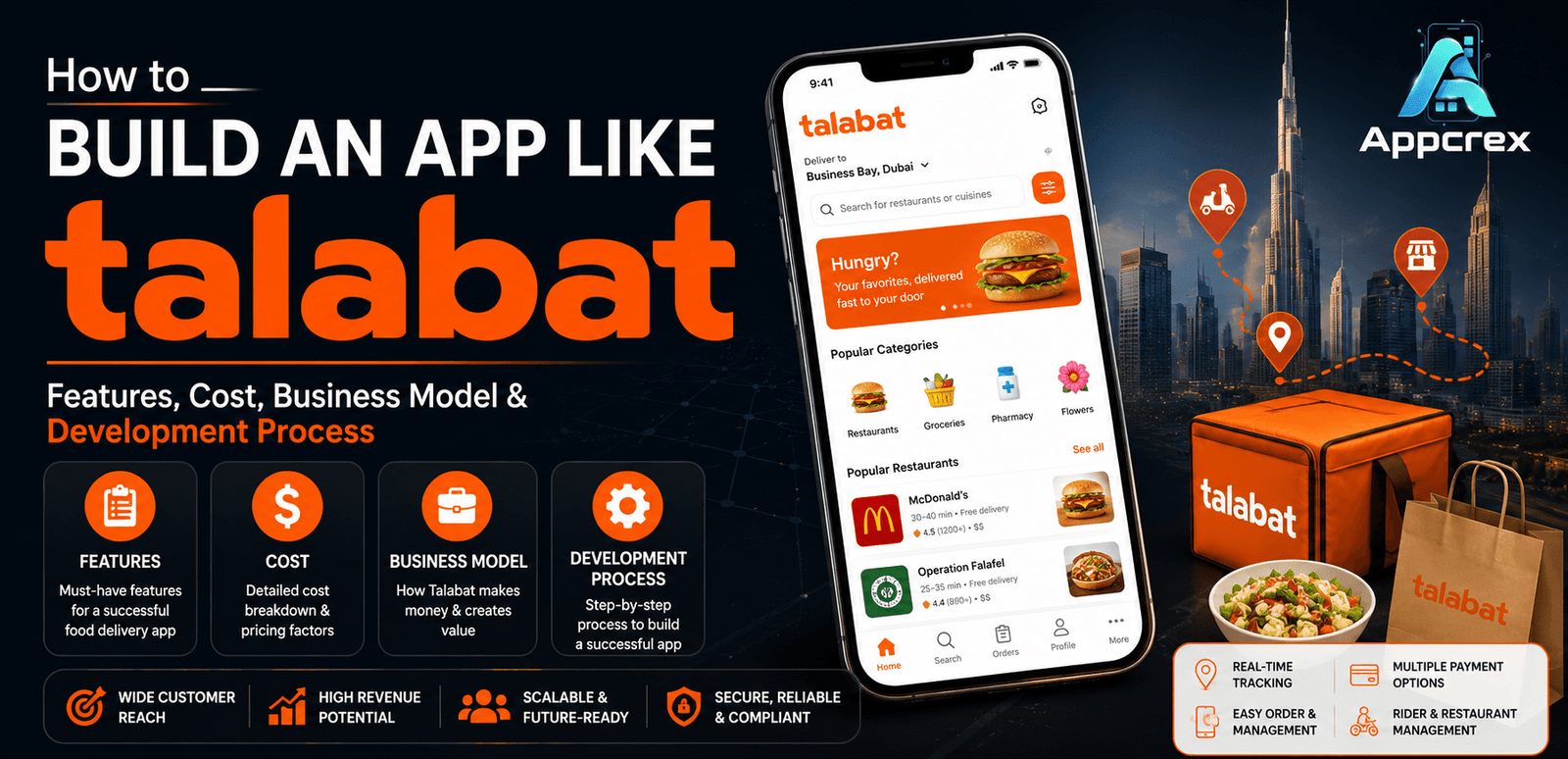
A basic food delivery MVP may cost around $40,000–$70,000, while a feature-rich platform with customer, restaurant, delivery, admin, AI, real-time tracking, and advanced integrations can cost $100,000–$200,000+.
This guide explains the major features, development cost, technology stack, business model, development process, timeline, and AI opportunities involved in building an app like Talabat.
Just Read : How Much Does It Cost to Build an AI-Powered App in Dubai? Complete Pricing Guide (2026)
How Much Does It Cost to Build an App Like Talabat?
The cost depends on the number of features, platforms, integrations, and user roles.
| Development Scope | Estimated Cost |
|---|---|
| Basic Food Delivery MVP | $40,000–$70,000 |
| Standard Food Delivery Platform | $70,000–$120,000 |
| Advanced Talabat-Like App | $120,000–$200,000+ |
| Large Multi-Service Platform | $200,000–$350,000+ |
A food delivery platform normally requires several products rather than a single mobile app:
- Customer app
- Restaurant app/portal
- Delivery partner app
- Admin dashboard
- Backend system
This multi-sided architecture is one of the major reasons the development cost is higher than a basic restaurant-ordering application.
What Is a Talabat-Like App?
A Talabat-style platform connects customers with restaurants and delivery partners through a centralized marketplace.
A typical workflow looks like:
Customer → Restaurant → Order → Delivery Partner → Customer
The platform manages the entire process, including:
- Restaurant discovery
- Menu browsing
- Cart management
- Online ordering
- Payment
- Restaurant confirmation
- Delivery assignment
- GPS tracking
- Order completion
- Reviews and ratings
A more advanced version can expand beyond food into grocery, pharmacy, retail, and other on-demand delivery services.
Why Build an App Like Talabat?
Food delivery is a strong use case for mobile technology because customers frequently order from smartphones.
A well-designed platform can provide:
- Convenient restaurant discovery
- Faster ordering
- Digital payments
- Real-time delivery tracking
- Personalized recommendations
- Loyalty rewards
- Restaurant promotions
For entrepreneurs, the marketplace model also creates multiple potential revenue streams.
Key Features of a Talabat-Like Food Delivery App
1. Customer Registration & Login
Customers should be able to create accounts using:
- Mobile number
- OTP
- Apple
- Social login
A simple onboarding process can reduce abandonment.
2. Personalized Home Screen
The home page can display:
- Nearby restaurants
- Popular restaurants
- Recommended dishes
- Offers
- Recently ordered food
- Cuisine categories
- Fast delivery options
Personalization can become more powerful as the platform collects user behavior data.
3. Restaurant Search
Users should be able to search for:
- Restaurants
- Dishes
- Cuisine
- Locations
- Brands
Filters can include:
- Rating
- Delivery time
- Price
- Distance
- Offers
- Cuisine
- Vegetarian options
4. Restaurant Profiles
Each restaurant should have a dedicated profile containing:
- Restaurant name
- Logo
- Images
- Rating
- Delivery time
- Delivery fee
- Menu
- Opening hours
- Reviews
- Offers
This gives customers the information they need before placing an order.
5. Digital Menu
Restaurant menus should support:
- Categories
- Food images
- Prices
- Descriptions
- Add-ons
- Variations
- Availability
- Customizations
For example, a customer can select:
Pizza → Large → Extra Cheese → Add Chicken
6. Smart Cart
The cart should show:
- Selected items
- Quantity
- Add-ons
- Subtotal
- Delivery fee
- Taxes
- Discounts
- Final amount
Users should be able to edit items before checkout.
7. Online Food Ordering
The core ordering system should allow customers to:
- Select restaurant
- Choose food
- Customize items
- Add to cart
- Select delivery address
- Apply coupon
- Make payment
- Confirm order
The restaurant receives the order immediately after confirmation.
Also Read : How to Build a Vacation Rental App in Dubai: Features, Cost & Development Process
8. Multiple Payment Methods
A modern food delivery app can support:
- Credit cards
- Debit cards
- Digital wallets
- Apple Pay
- Google Pay
- Cash on delivery
For Dubai and UAE markets, payment options should be selected according to the target audience and available payment providers.
9. Order Tracking
Customers should be able to track the order through stages such as:
Order Placed → Restaurant Confirmed → Preparing → Picked Up → On the Way → Delivered
This gives users visibility throughout the delivery process.
10. Real-Time GPS Tracking
GPS tracking allows customers to see the delivery partner’s location on a map.
The system can display:
- Driver location
- Restaurant location
- Customer location
- Route
- Estimated arrival time
Real-time tracking requires reliable location services and backend infrastructure.
11. Delivery Partner App
A Talabat-like platform needs a dedicated application for delivery partners.
Drivers can:
- Register
- Upload documents
- Go online/offline
- Receive delivery requests
- Accept or reject orders
- Navigate to restaurants
- Pick up orders
- Navigate to customers
- Complete deliveries
- Track earnings
The delivery app can integrate mapping and navigation services.
Drivers can get:
- Turn-by-turn directions
- Restaurant location
- Customer location
- Estimated travel time
- Alternative routes
This can reduce delivery delays.
13. Restaurant App or Dashboard
Restaurants need their own interface to manage orders.
Restaurant features can include:
- New order alerts
- Accept/reject order
- Menu management
- Pricing
- Item availability
- Preparation time
- Order history
- Sales reports
A tablet-friendly restaurant dashboard can be particularly useful for busy kitchens.
Also Read : Restaurant Management Software Development Company: Complete Guide to Features, Cost & Development Process
14. Restaurant Onboarding
Restaurant owners should be able to submit:
- Business information
- License details
- Menu
- Bank information
- Location
- Contact details
- Restaurant images
The admin team can review and approve the restaurant before it becomes active.
15. Promotions & Coupons
Restaurants and platform administrators can create:
- Percentage discounts
- Fixed discounts
- First-order offers
- Free delivery
- Buy-one-get-one offers
- Time-limited promotions
Promotions can help attract new users and increase order frequency.
16. Loyalty Program
A loyalty system can reward users with:
- Points
- Discounts
- Free delivery
- Cashback
- Restaurant rewards
For example:
Spend $100 → Earn 100 points
These points can later be exchanged for discounts or other rewards.
17. Ratings & Reviews
Customers can rate:
- Restaurant
- Food
- Delivery experience
They can also leave written reviews.
Restaurants can use feedback to improve service quality.
18. Push Notifications
Notifications can inform customers about:
- Order confirmation
- Restaurant acceptance
- Food preparation
- Driver assignment
- Delivery status
- Promotions
- New restaurants
Restaurants and drivers can receive separate operational notifications.
19. Customer Support
Support features can include:
- FAQs
- Chat
- Ticket system
- Order-related support
- Refund requests
- Missing item complaints
- Delivery issues
An AI chatbot can handle common questions before transferring complicated cases to human support.
20. Multiple Addresses
Customers should be able to save:
- Home
- Office
- Family address
- Other locations
Users can select the required address during checkout.
AI Features for a Talabat-Like App
AI can differentiate a new food delivery platform from traditional competitors.
AI Food Recommendations
The system can analyze:
- Previous orders
- Favorite cuisines
- Order frequency
- Time of day
- Spending patterns
It can then recommend relevant restaurants or dishes.
For example:
“You usually order Indian food on Friday evening. Here are three popular options near you.”
AI-Powered Search
Instead of searching only by restaurant name, customers could type:
“Find me a healthy dinner under AED 50 near Marina.”
AI can understand the intent and return relevant restaurants.
AI Voice Ordering
A future-ready platform can allow customers to say:
“Order my usual chicken biryani.”
The system can confirm the restaurant, items, delivery address, and payment before placing the order.
AI Customer Support
An AI assistant can answer questions about:
- Order status
- Delivery time
- Restaurant availability
- Refunds
- Coupons
- Payments
This can reduce customer-support workload.
AI Delivery Optimization
AI can analyze:
- Driver locations
- Traffic
- Restaurant preparation time
- Delivery distance
- Order volume
It can help assign orders to suitable delivery partners.
Predictive Demand Analytics
AI can forecast demand based on:
- Day
- Time
- Weather
- Location
- Historical orders
- Events
Restaurants can use these insights to prepare inventory and staffing.
Also Read : Automotive App Development Company Dubai: Complete Guide to Features, Cost & Development Process
Technology Stack for a Talabat-Like App
Mobile App Development
A business can use:
- Flutter
- React Native
- Kotlin
- Swift
For a startup launching on both Android and iOS, cross-platform development can reduce initial development time and cost.
A specialized mobile app development company Dubai can help determine whether native or cross-platform development is more appropriate for the product.
Backend Development
Possible technologies include:
- Node.js
- Python
- Java
- Go
The backend needs to handle:
- Orders
- Users
- Restaurants
- Drivers
- Payments
- Notifications
- GPS
- Promotions
- Analytics
Database
Potential technologies include:
- PostgreSQL
- MySQL
- MongoDB
- Redis
A combination of databases can be used depending on the application’s requirements.
Maps & GPS
Mapping technology is required for:
- Restaurant discovery
- Address selection
- Driver navigation
- Distance calculation
- Delivery tracking
- ETA calculation
Cloud Infrastructure
The platform can use cloud services for:
- Application hosting
- Databases
- File storage
- Notifications
- Analytics
- Auto-scaling
Cloud infrastructure becomes particularly important during lunch and dinner peaks when order volumes can increase significantly.
How Does a Talabat-Like App Work?
The complete ecosystem can be represented as:
Customer App → Backend → Restaurant → Order Management → Delivery Partner → Customer
For payments:
Customer → Payment Gateway → Transaction System → Restaurant/Platform
For tracking:
Driver GPS → Real-Time Server → Customer App
For AI recommendations:
User Data → AI/ML Engine → Recommendation System → Customer App
This architecture allows each part of the marketplace to communicate with the central platform.
Development Process for a Talabat-Like App
Step 1: Define Your Business Model
First decide whether you want to build:
- Food delivery marketplace
- Restaurant ordering platform
- Hyperlocal delivery app
- Multi-service delivery platform
This decision affects the entire product architecture.
Step 2: Market Research
Research:
- Target customers
- Restaurants
- Delivery partners
- Competitors
- Pricing
- Delivery fees
- Local regulations
For a Dubai-focused product, research the UAE food delivery market and target customer segments before development.
Step 3: Define MVP Features
Start with essential functionality:
- Customer registration
- Restaurant discovery
- Menu
- Cart
- Checkout
- Payment
- Restaurant dashboard
- Driver app
- GPS tracking
- Admin panel
Avoid building every advanced feature at launch.
Step 4: UI/UX Design
Create intuitive designs for:
- Customer app
- Restaurant interface
- Driver app
- Admin dashboard
The customer checkout flow should require as few steps as possible.
Step 5: Backend Development
Build the core systems:
- Authentication
- Restaurant management
- Order management
- Delivery management
- Payment processing
- Notifications
- Reviews
- Promotions
Step 6: API Integrations
Integrate:
- Payment gateways
- Maps
- GPS
- SMS
- Push notifications
- Analytics
- AI services
Step 7: Security
Implement:
- Encryption
- Secure authentication
- API security
- Payment security
- Role-based access
- Fraud detection
- Audit logs
Step 8: Testing
Test:
- Ordering
- Payments
- Driver assignment
- GPS
- Restaurant workflows
- Notifications
- Refunds
- Performance
- Security
Load testing is particularly important because food delivery platforms experience traffic spikes during peak meal hours.
Step 9: Launch MVP
Launch in a limited geographical area first.
For example, a Dubai startup could initially target selected neighborhoods rather than the entire UAE.
This makes it easier to manage:
- Restaurant onboarding
- Driver availability
- Delivery times
- Customer support
Step 10: Scale
Once the product has stable demand, expand into:
- More restaurants
- More locations
- Grocery
- Pharmacy
- Retail
- AI features
- Corporate ordering
This can eventually turn the platform into a broader on-demand delivery super app.
Also Read : Super App Development Company: Complete Guide to Features, Cost & Development Process
How Long Does It Take to Build an App Like Talabat?
| Project Type | Estimated Timeline |
|---|---|
| Basic Food Delivery MVP | 4–6 months |
| Standard Platform | 6–9 months |
| Advanced Talabat-Like App | 9–14 months |
| Multi-Service Delivery Super App | 14–20+ months |
The timeline depends on the number of platforms, integrations, AI functionality, and complexity of the delivery system.
Talabat App Development Cost Breakdown
| Development Component | Estimated Cost |
|---|---|
| UI/UX Design | $7,000–$15,000 |
| Customer App | $20,000–$40,000 |
| Driver App | $15,000–$30,000 |
| Restaurant App/Portal | $12,000–$25,000 |
| Backend Development | $25,000–$50,000 |
| Admin Dashboard | $10,000–$20,000 |
| GPS & Maps | $7,000–$15,000 |
| Payment Integration | $7,000–$15,000 |
| AI Features | $10,000–$30,000 |
| Testing & Security | $10,000–$20,000 |
The actual development cost can vary according to the required technology, integrations, location, development team, and feature scope.
What Factors Affect the Cost?
Number of Platforms
Building only a customer application is cheaper than developing:
- Customer app
- Driver app
- Restaurant portal
- Admin dashboard
Number of Restaurants
A marketplace supporting thousands of restaurants requires scalable infrastructure.
Real-Time Tracking
GPS tracking and live delivery updates require additional backend infrastructure.
Payment Systems
Multiple payment methods increase development and testing complexity.
AI Development
AI recommendations, AI customer support, voice ordering, and delivery optimization add additional development costs.
Multi-City Expansion
Different cities can have different delivery zones, fees, taxes, restaurants, and operational rules.
Business Model of a Talabat-Like App
A food delivery platform can generate revenue through several channels.
Restaurant Commission
The platform can charge restaurants a percentage of each completed order.
For example:
Restaurant Order = $50
The platform charges an agreed commission based on the partnership terms.
Delivery Charges
Customers can pay delivery fees based on:
- Distance
- Restaurant
- Location
- Order size
- Delivery speed
Advertising
Restaurants can pay to promote their:
- Restaurant
- Menu
- Offers
- New dishes
Sponsored listings can become a significant revenue channel.
Subscription
A premium membership can offer:
- Free delivery
- Exclusive discounts
- Priority support
- Special offers
Corporate Accounts
Businesses can use the platform for employee meals and corporate food ordering.
This creates a separate B2B revenue opportunity.
How to Make a Talabat-Like App Different?
Simply copying an established food delivery platform is unlikely to provide a strong competitive advantage.
Instead, focus on a specific niche.
AI-First Food Delivery
Build the entire discovery experience around AI-powered recommendations and natural-language search.
Healthy Food Delivery
Focus on:
- Calorie information
- Nutrition
- Healthy restaurants
- Personalized meal recommendations
Premium Restaurant Delivery
Target premium customers with:
- High-end restaurants
- Priority delivery
- Premium memberships
Local Restaurant Marketplace
Focus on independent restaurants that need better digital visibility.
Multi-Service Delivery
Expand from food into:
- Grocery
- Pharmacy
- Flowers
- Retail
- Convenience products
How to Reduce Food Delivery App Development Cost?
The best approach is to build an MVP rather than developing a complete Talabat-like ecosystem from day one.
Phase 1
Build:
- Customer app
- Restaurant portal
- Driver app
- Admin dashboard
- Ordering
- Payments
- GPS tracking
Phase 2
Add:
- Loyalty
- Coupons
- Subscription
- Advanced analytics
- Restaurant advertising
Phase 3
Introduce:
- AI recommendations
- AI chatbot
- Voice ordering
- Predictive analytics
- Smart delivery optimization
- Grocery and pharmacy delivery
This phased approach lets you validate the business before investing heavily in advanced functionality.
Why Choose AppCrex for Food Delivery App Development?
AppCrex can help businesses build custom food delivery, restaurant marketplace, and on-demand delivery platforms for Dubai, UAE, and international markets.
Development services can include:
- Food Delivery App Development
- Restaurant App Development
- Delivery Driver App Development
- On-Demand Delivery App Development
- Grocery Delivery App Development
- Taxi & Delivery App Development
- AI App Development
- AI Integration Services
- GPS Tracking
- Payment Gateway Integration
- Real-Time Order Tracking
- iOS App Development
- Android App Development
- Cross-Platform App Development
- Admin Dashboard Development
- Cloud Backend Development
- API Integration
Businesses can also hire mobile app developers from AppCrex for dedicated development projects, whether they need a complete food delivery marketplace or specific functionality such as AI, payments, GPS, or backend development.
Build a Food Delivery App Like Talabat With AppCrex
The cost to build an app like Talabat can start at approximately $40,000–$70,000 for a basic MVP and reach $120,000–$200,000+ for an advanced platform.
The final cost depends on the number of applications, restaurants, delivery partners, integrations, payment methods, real-time tracking requirements, and AI functionality.
A successful food delivery platform needs much more than an attractive customer app. It requires a reliable restaurant management system, driver application, order management engine, payment infrastructure, GPS tracking, notifications, analytics, and scalable backend.
AI can further differentiate the platform through personalized food recommendations, intelligent search, AI customer support, demand forecasting, and delivery optimization.
If you are planning to launch a food delivery business in Dubai or another market, starting with a focused MVP is usually the most practical approach. Once the platform achieves product-market fit, additional restaurants, cities, services, and AI capabilities can be introduced.
Have an idea for a food delivery platform? AppCrex can help you plan the features, technology architecture, development process, timeline, and estimated budget for your app.
FAQs
Q. How much does it cost to build an app like Talabat?
A basic MVP can cost around $40,000–$70,000, while an advanced Talabat-like platform can cost $120,000–$200,000+.
Q. How long does it take to develop a food delivery app?
A basic MVP can take around 4–6 months, while a large multi-service platform can take 9–14 months or longer.
Q. What features should a Talabat-like app have?
Core features include restaurant discovery, menus, cart, ordering, payments, delivery tracking, GPS, driver management, restaurant management, notifications, reviews, and an admin dashboard.
Q. Can AI be integrated into a food delivery app?
Yes. AI can support food recommendations, natural-language search, customer support, demand forecasting, voice ordering, and delivery optimization.
Q. Can I hire mobile app developers for a food delivery app?
Yes. You can hire mobile app developers with experience in food delivery, GPS tracking, payment integration, real-time systems, AI, and marketplace platforms.
Q. Can a Talabat-like app operate in Dubai?
Yes, but the business should consider applicable UAE regulations, payment requirements, food business requirements, delivery operations, and other local compliance obligations.
Yes. A restaurant dashboard can allow restaurant owners to manage menus, prices, availability, offers, orders, and business information.
Q. Can the platform expand beyond food delivery?
Yes. The same architecture can be expanded into grocery, pharmacy, retail, flowers, convenience delivery, and other on-demand services.
Q. Can AppCrex build a Talabat-like app?
Yes. AppCrex can develop customer, restaurant, driver, admin, backend, AI, payment, GPS, and other components required for a complete food delivery platform.