Introduction
The automotive industry is rapidly transforming with the adoption of mobile technology, artificial intelligence, IoT, and connected vehicle solutions. Modern customers no longer want traditional automotive services; they expect digital experiences that allow them to manage vehicles, book services, track cars, and access smart mobility solutions through their smartphones.
Dubai, being one of the world’s leading automotive and smart city hubs, is experiencing increasing demand for advanced automotive applications. From luxury car services and vehicle tracking to EV charging and fleet management, businesses are investing in innovative automotive solutions to improve customer experience and operational efficiency.
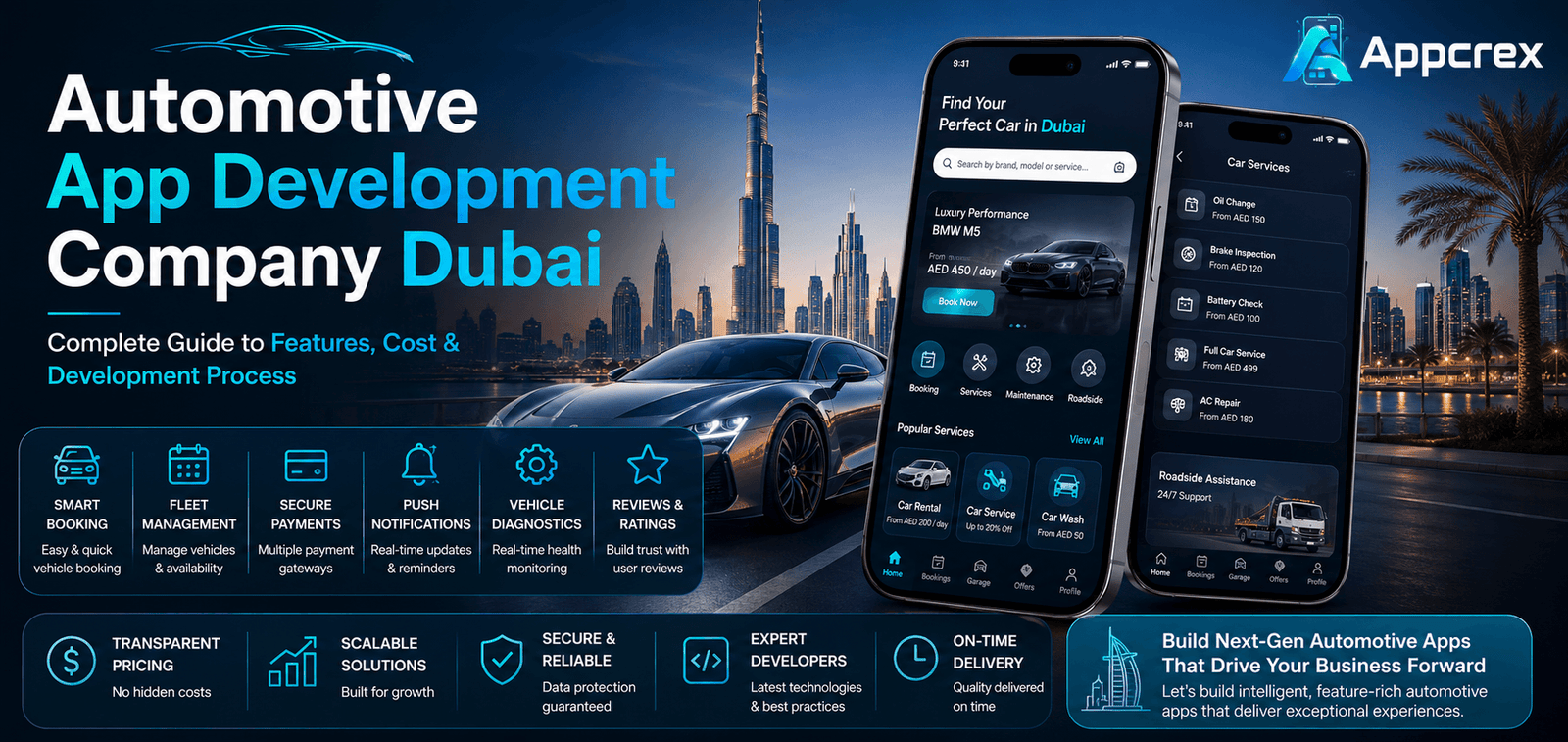
A professional automotive app development company in Dubai helps businesses create customized mobile solutions that connect vehicles, customers, and automotive service providers through powerful digital platforms.
Whether you are a car manufacturer, dealership, rental company, fleet operator, or automotive service provider, a custom automotive app can help you build stronger customer relationships and create new revenue opportunities.
In this guide, we will explore how to build an automotive app in Dubai, including features, technologies, development process, cost, and business benefits.
What Is Automotive App Development?
Automotive app development is the process of creating mobile applications and digital platforms designed specifically for the automotive industry.
These applications help users and businesses manage different automotive operations, including:
- Vehicle monitoring
- Car maintenance
- Vehicle tracking
- Digital car services
- Car rentals
- EV charging
- Fleet management
- Connected vehicle solutions
Automotive apps connect users with vehicles through technologies such as:
- Internet of Things (IoT)
- GPS
- Artificial Intelligence (AI)
- Cloud computing
- Machine Learning
- Bluetooth connectivity
A well-developed automotive application improves convenience, safety, and efficiency for both customers and businesses.
Why Businesses Need Automotive Apps?
The automotive industry is becoming increasingly digital. Customers now expect instant access to vehicle-related services through mobile devices.
1. Better Customer Experience
Automotive apps allow users to:
- Access vehicle information
- Schedule services
- Track vehicles
- Make payments
- Receive maintenance alerts
This creates a smoother and more personalized customer journey.
2. Increased Business Efficiency
Businesses can automate many manual processes through automotive applications.
Benefits include:
- Digital bookings
- Automated notifications
- Real-time tracking
- Customer management
- Data-driven decisions
3. Growing Connected Vehicle Demand
Connected cars are becoming more popular worldwide.
Modern users want features like:
- Remote vehicle monitoring
- Smart navigation
- Vehicle health reports
- Digital keys
- Safety alerts
Automotive apps make these connected experiences possible.
4. New Revenue Opportunities
Automotive apps help businesses create additional revenue streams through:
- Subscription services
- Premium features
- Service packages
- Digital marketplaces
- Partner integrations
Why Automotive App Development Is Growing in Dubai?
Dubai has become one of the world’s most advanced automotive and smart mobility markets. The city’s focus on digital transformation, luxury vehicles, electric mobility, and smart transportation solutions is creating new opportunities for businesses to invest in automotive applications.
A custom automotive app development solution in Dubai helps companies provide faster services, improve vehicle management, and deliver connected experiences to customers.
1. Growing Luxury Car Market
Dubai is globally recognized for its luxury automotive ecosystem.
The demand is increasing for:
- Premium vehicle services
- Luxury car rentals
- Supercar booking platforms
- Personalized automotive experiences
- Vehicle management solutions
Automotive apps help businesses connect luxury car owners and customers through digital platforms.
2. Smart City & Mobility Transformation
Dubai continues to invest in smart transportation and digital mobility solutions.
Automotive applications support:
- Connected vehicles
- Smart parking solutions
- Digital transportation services
- Real-time vehicle monitoring
- Automated mobility experiences
Businesses can leverage these technologies to build future-ready automotive solutions.
3. Growth of Electric Vehicles (EVs)
Electric vehicle adoption is increasing worldwide, including in Dubai.
This creates demand for:
- EV charging apps
- Charging station locators
- Battery monitoring systems
- EV maintenance platforms
- Energy management solutions
4. Increasing Demand for Fleet Management Solutions
Dubai has many businesses operating vehicle fleets, including:
- Logistics companies
- Delivery businesses
- Transportation services
- Rental companies
- Corporate fleets
Automotive apps help companies manage vehicles efficiently through tracking, analytics, and automation.
Types of Automotive Apps
The automotive industry requires different types of applications depending on business needs.
1. Connected Car Apps
Connected car applications allow users to interact with their vehicles digitally.
Features include:
- Remote vehicle control
- Vehicle status monitoring
- Fuel level tracking
- Maintenance alerts
- Digital keys
- Safety notifications
These apps improve convenience and create a smart driving experience.
2. Car Rental Apps
Car rental applications allow customers to find and book vehicles instantly.
Features include:
- Vehicle search
- Online booking
- Digital payments
- GPS tracking
- Rental history
- Reviews and ratings
These solutions are highly popular in Dubai due to tourism and business travel.
3. Vehicle Tracking Apps
Vehicle tracking applications use GPS technology to monitor vehicle locations.
Businesses use these apps for:
- Fleet monitoring
- Route optimization
- Driver management
- Theft prevention
- Real-time tracking
4. Fleet Management Apps
Fleet management applications help companies control and optimize large vehicle operations.
Features include:
- Vehicle tracking
- Fuel monitoring
- Driver performance reports
- Maintenance scheduling
- Fleet analytics
These apps are valuable for logistics, transportation, and delivery companies.
5. EV Charging Apps
EV charging applications help electric vehicle users find and access charging stations.
Features include:
- Charging station locator
- Availability status
- Online payments
- Charging history
- Battery monitoring
6. Car Service & Maintenance Apps
These applications connect vehicle owners with automotive service providers.
Users can:
- Book service appointments
- Schedule maintenance
- Find nearby workshops
- Order spare parts
- Track repair status
7. Automotive Marketplace Apps
Automotive marketplaces allow users to buy, sell, or compare vehicles.
Features include:
- Vehicle listings
- Price comparison
- Dealer profiles
- Financing options
- Inspection services
Key Features of Automotive Apps
A successful automotive app should provide a seamless experience for customers, businesses, and administrators.
Customer App Features
1. User Registration & Profile Management
Users should be able to create accounts using:
- Phone number
- Social login
- OTP verification
Profiles can store:
- Vehicle details
- Service history
- Preferences
- Payment information
2. Vehicle Information Dashboard
Users can access important vehicle information such as:
- Vehicle health status
- Fuel level
- Mileage
- Service reminders
- Driving information
GPS integration enables:
- Real-time location tracking
- Route assistance
- Vehicle monitoring
- Location sharing
4. Service Booking
Users can schedule:
- Vehicle maintenance
- Repairs
- Inspections
- Car washing
- Emergency services
5. Digital Payments
Secure payment integration allows users to pay for:
- Services
- Rentals
- Charging
- Maintenance packages
6. Push Notifications
Notifications help users receive:
- Service reminders
- Payment updates
- Safety alerts
- Booking confirmations
- Maintenance warnings
Business & Admin Panel Features for Automotive Apps
A powerful admin panel helps automotive businesses manage customers, vehicles, services, payments, and operations from a single dashboard.
1. Vehicle Management System
Businesses can manage their complete vehicle database.
Features include:
- Add and update vehicle information
- Monitor vehicle status
- Track vehicle history
- Manage vehicle categories
- Maintain service records
This is especially useful for rental companies, dealerships, and fleet operators.
2. Customer Management
The admin dashboard allows businesses to manage customer relationships.
Features include:
- Customer profiles
- Booking history
- Service records
- Payment details
- Customer feedback
This helps businesses deliver personalized automotive services.
3. Fleet Management Dashboard
Fleet operators can monitor and optimize their vehicle operations.
Features include:
- Real-time vehicle tracking
- Driver monitoring
- Route management
- Fuel consumption tracking
- Maintenance alerts
Fleet management apps help reduce operational costs and improve productivity.
4. Service & Maintenance Management
Automotive businesses can automate vehicle maintenance operations.
Features include:
- Service scheduling
- Maintenance reminders
- Repair tracking
- Workshop management
- Spare parts tracking
5. Analytics & Reporting
Advanced analytics help businesses make better decisions.
Reports can include:
- Vehicle performance
- Customer behavior
- Revenue analysis
- Booking trends
- Service performance
Advanced Technologies Used in Automotive Apps
Modern automotive applications use advanced technologies to deliver smart and connected experiences.
1. Artificial Intelligence (AI)
AI improves automotive apps through intelligent automation.
AI applications include:
- Predictive maintenance
- Smart recommendations
- Driver behavior analysis
- AI chatbots
- Automated customer support
For example, AI can predict when a vehicle requires maintenance by analyzing usage patterns.
2. Internet of Things (IoT)
IoT enables communication between vehicles and mobile applications.
IoT features include:
- Vehicle sensors
- Real-time monitoring
- Remote vehicle control
- Performance tracking
- Smart alerts
Connected vehicle technology is becoming a major trend in the automotive industry.
3. Machine Learning
Machine learning helps businesses analyze large amounts of automotive data.
Uses include:
- Demand prediction
- Smart pricing
- Route optimization
- Customer personalization
- Vehicle performance analysis
4. Blockchain Technology
Blockchain can improve security and transparency in automotive platforms.
Applications include:
- Secure vehicle records
- Digital ownership verification
- Transparent transactions
- Data protection
5. Voice Assistant Integration
Voice technology improves driving safety and convenience.
Users can:
- Control vehicle features
- Get navigation assistance
- Schedule services
- Check vehicle status
without using their hands.
Also Read : Voice AI Integration: Complete Guide to Benefits, Use Cases, Cost & Implementation (2026)
6. Augmented Reality (AR)
AR technology can enhance automotive experiences.
Examples:
- Virtual vehicle demonstrations
- AR navigation
- Vehicle inspection assistance
- Interactive car showcases
Technology Stack for Automotive App Development
Choosing the right technology stack ensures scalability, performance, and security.
| Category | Technologies |
|---|---|
| Mobile App Development | Flutter, React Native, Swift, Kotlin |
| Frontend Development | React.js, Angular, Vue.js |
| Backend Development | Node.js, Laravel, Django, Java |
| Database | MySQL, PostgreSQL, MongoDB |
| Cloud Platforms | AWS, Google Cloud, Microsoft Azure |
| IoT Integration | MQTT, IoT Platforms, Sensor APIs |
| Maps & Location | Google Maps API, Mapbox |
| AI Integration | Machine Learning APIs, AI Models |
| Notifications | Firebase Cloud Messaging |
Automotive App Development Process
Building a successful automotive application requires a structured development approach.
Step 1: Business Analysis & Planning
The first stage focuses on understanding:
- Business goals
- Target users
- Automotive requirements
- Competitor analysis
- Required features
A detailed roadmap ensures smooth development.
Step 2: UI/UX Design
Design teams create intuitive interfaces focused on usability.
The process includes:
- User journey planning
- Wireframes
- Prototypes
- Interface design
- Usability testing
Step 3: Frontend & Backend Development
Developers build:
- Mobile applications
- Web dashboards
- Backend systems
- APIs
- Database architecture
The development approach depends on business requirements and scalability needs.
Step 4: IoT & API Integration
Automotive apps often require integrations with:
- Vehicle sensors
- GPS systems
- Payment gateways
- CRM systems
- Third-party automotive platforms
Step 5: Testing & Quality Assurance
Testing ensures the application performs reliably.
Testing includes:
- Functional testing
- Security testing
- Device compatibility testing
- Performance testing
- Real-time tracking testing
Step 6: Deployment & Maintenance
After launch, continuous support ensures long-term success.
Maintenance includes:
- Bug fixes
- Security updates
- Performance optimization
- New feature development
Cost to Develop an Automotive App in Dubai
The cost of developing an automotive app in Dubai depends on various factors, including app complexity, features, technology requirements, platform selection, integrations, and customization level.
An automotive app with basic features like vehicle information, service booking, and customer management requires a lower investment. However, advanced solutions with IoT connectivity, AI features, GPS tracking, fleet management, and connected car capabilities require a higher development budget.
Estimated Automotive App Development Cost
| App Type | Estimated Cost |
|---|---|
| Basic Automotive App | $15,000 – $35,000 |
| Medium-Level Automotive Solution | $35,000 – $75,000 |
| Advanced Connected Car Platform | $75,000 – $200,000+ |
Note: The final cost depends on business requirements, number of features, technology stack, and development partner.
Factors Affecting Automotive App Development Cost
1. App Features & Complexity
The number and complexity of features directly impact the overall development cost.
Basic features:
- User registration
- Vehicle information
- Service booking
- Notifications
- Payment integration
Advanced features:
- IoT connectivity
- AI-powered recommendations
- Remote vehicle control
- GPS tracking
- Predictive maintenance
- Real-time analytics
More advanced functionality requires additional development time and expertise.
2. Platform Selection
Businesses can choose between different development approaches.
Native App Development
Separate applications are developed for:
- Android
- iOS
Advantages:
- High performance
- Better hardware integration
- Premium user experience
Cross-Platform Development
Technologies like Flutter and React Native allow businesses to create apps for multiple platforms using a single codebase.
Benefits:
- Reduced development cost
- Faster launch
- Easier maintenance
3. IoT & Hardware Integration
Connected automotive apps often require integration with:
- Vehicle sensors
- GPS devices
- Smart systems
- Diagnostic tools
These integrations increase development complexity and cost.
4. UI/UX Design Requirements
A modern automotive app needs an attractive and user-friendly interface.
Design costs depend on:
- Number of screens
- Custom graphics
- Animations
- User experience research
- Interactive dashboards
5. Backend Infrastructure
Automotive applications require a powerful backend to manage:
- Vehicle data
- User accounts
- Service records
- Payments
- Analytics
- Real-time updates
A scalable backend ensures smooth performance as users grow.
Monetization Models for Automotive Apps
A strong revenue strategy helps businesses generate long-term income.
1. Subscription-Based Model
Businesses can offer premium subscription plans.
Examples:
- Advanced vehicle monitoring
- Premium maintenance packages
- Fleet analytics
- Connected car features
2. Service Commission Model
Automotive platforms can earn commissions from:
- Vehicle servicing
- Repairs
- Insurance services
- Spare parts sales
3. Fleet Management Services
Businesses can provide fleet management solutions to companies through monthly subscriptions.
Target customers:
- Logistics companies
- Delivery businesses
- Transportation providers
- Rental companies
4. Marketplace Revenue
Automotive marketplaces can generate revenue through:
- Vehicle listings
- Featured advertisements
- Dealer subscriptions
- Lead generation
5. Advertising & Partnerships
Apps can partner with:
- Insurance companies
- Car dealerships
- Auto service providers
- Charging networks
and generate advertising revenue.
Challenges in Automotive App Development & Solutions
1. Data Security & Privacy
Challenge:
Automotive apps handle sensitive information such as vehicle data and customer details.
Solution:
Implement:
- Data encryption
- Secure authentication
- Access controls
- Regular security testing
2. Complex Vehicle Integration
Challenge:
Connecting applications with different vehicle systems can be complicated.
Solution:
Use:
- Standard APIs
- IoT platforms
- Automotive communication protocols
- Cloud-based solutions
3. Real-Time Data Management
Challenge:
Handling live vehicle data requires reliable infrastructure.
Solution:
Use:
- Cloud servers
- Real-time databases
- Scalable backend architecture
- Optimized APIs
4. User Adoption
Challenge:
Customers need simple and valuable digital experiences.
Solution:
Focus on:
- Easy navigation
- Fast performance
- Useful features
- Personalized experiences
Why Choose an Automotive App Development Company in Dubai?
Dubai has become a global hub for automotive innovation, smart transportation, and digital mobility solutions. With the rapid growth of luxury vehicles, electric vehicles, fleet operations, and connected car technologies, businesses need advanced digital platforms to meet changing customer expectations.
Partnering with an experienced automotive app development company in Dubai helps businesses create customized solutions that improve vehicle management, enhance customer experiences, and support future mobility requirements.
1. Understanding of Dubai’s Automotive Market
A local-focused automotive app development approach helps businesses understand Dubai’s unique market requirements, including:
- Luxury car rental demand
- Premium automotive services
- Fleet management needs
- EV adoption
- Smart transportation solutions
This market understanding helps create applications that match customer expectations.
2. Development of Customized Automotive Solutions
Every automotive business has different requirements. A professional development company can create customized solutions for:
- Car rental businesses
- Vehicle dealerships
- Fleet operators
- EV charging providers
- Auto service centers
- Transportation companies
Custom development ensures the app includes the right features for specific business goals.
3. Integration of Advanced Automotive Technologies
Modern automotive applications require advanced technologies to deliver smart experiences.
An experienced development partner can integrate:
- Artificial Intelligence (AI)
- Internet of Things (IoT)
- GPS tracking
- Cloud computing
- Machine Learning
- Real-time analytics
These technologies help businesses improve efficiency and provide better services.
4. Scalable & Secure Application Development
Automotive platforms handle important data such as:
- Vehicle information
- Customer details
- Payment transactions
- Location data
A reliable automotive app development company focuses on:
- Data security
- High performance
- Scalable architecture
- Secure integrations
This ensures the application can support future business growth.
5. Better User Experience & Modern Design
Customer expectations are changing rapidly. Users want fast, simple, and convenient automotive services.
Professional developers create apps with:
- Easy navigation
- Modern UI/UX design
- Smooth booking experience
- Personalized features
- Quick access to vehicle services
A better user experience increases customer satisfaction and retention.
6. Complete End-to-End Development Support
A trusted automotive app development partner provides complete support from idea to launch, including:
- Business consultation
- UI/UX design
- App development
- API integration
- Testing
- Deployment
- Maintenance
This allows businesses to focus on growth while technology experts manage the development process.
Why Choose AppCrex for Automotive App Development in Dubai?
Building a successful automotive solution requires expertise in mobile technology, connected systems, and modern automotive trends.
AppCrex helps businesses develop customized automotive applications designed for the evolving mobility industry.
Our Automotive App Development Services Include:
- Custom automotive mobile app development
- Connected car app development
- Vehicle tracking solutions
- Fleet management applications
- EV charging app development
- Car service booking platforms
- AI-powered automotive solutions
- IoT-based automotive applications
- Cloud-based automotive platforms
Why Businesses Choose AppCrex?
- Experienced mobile app developers
- Industry-focused solutions
- Scalable and secure architecture
- Modern technology implementation
- User-friendly UI/UX design
- End-to-end development support
- Post-launch maintenance
Whether you want to build a connected car platform, smart mobility solution, fleet management system, or automotive marketplace, AppCrex provides complete development solutions.
(FAQs)
1. How much does it cost to develop an automotive app?
The cost generally ranges from $15,000 to $200,000+ depending on features, complexity, integrations, and customization requirements.
2. How long does it take to build an automotive app?
A basic automotive app may take around 3–5 months, while advanced connected car platforms can take 6–12 months or more.
3. What type of automotive apps can be developed?
Businesses can build:
- Connected car apps
- Vehicle tracking apps
- Fleet management apps
- EV charging apps
- Car service apps
- Automotive marketplace apps
4. Can automotive apps integrate with vehicles?
Yes. Automotive apps can integrate with vehicles using:
- IoT technology
- APIs
- GPS systems
- Vehicle sensors
- Cloud platforms
5. Why build an automotive app in Dubai?
Dubai’s luxury automotive market, smart city initiatives, EV growth, and digital transformation make it an ideal location for automotive technology solutions.
6. Which technologies are used for automotive app development?
Common technologies include:
- Flutter
- React Native
- Node.js
- IoT platforms
- AI solutions
- Cloud computing
- GPS APIs
Conclusion
The automotive industry is moving toward a smarter, connected, and digital future. Businesses that invest in automotive applications can improve customer experiences, optimize operations, and create new revenue opportunities.
From connected car solutions and fleet management platforms to EV charging applications and automotive marketplaces, mobile technology is transforming how people interact with vehicles.
To build a successful automotive solution, businesses need an experienced automotive app development company in Dubai that understands advanced technologies, user expectations, and industry requirements.
With the right features, secure infrastructure, and scalable technology, an automotive app can help businesses stay competitive in the rapidly evolving mobility ecosystem.
Build Your Automotive App with AppCrex
Looking for a reliable automotive app development company in Dubai?
AppCrex specializes in creating innovative automotive and smart mobility solutions for businesses worldwide. Our team helps companies build feature-rich applications with AI, IoT, GPS tracking, cloud technology, and modern user experiences.
From initial planning and design to development, testing, launch, and ongoing support, we provide complete automotive app development services.
Contact AppCrex today and transform your automotive business idea into a future-ready digital solution.