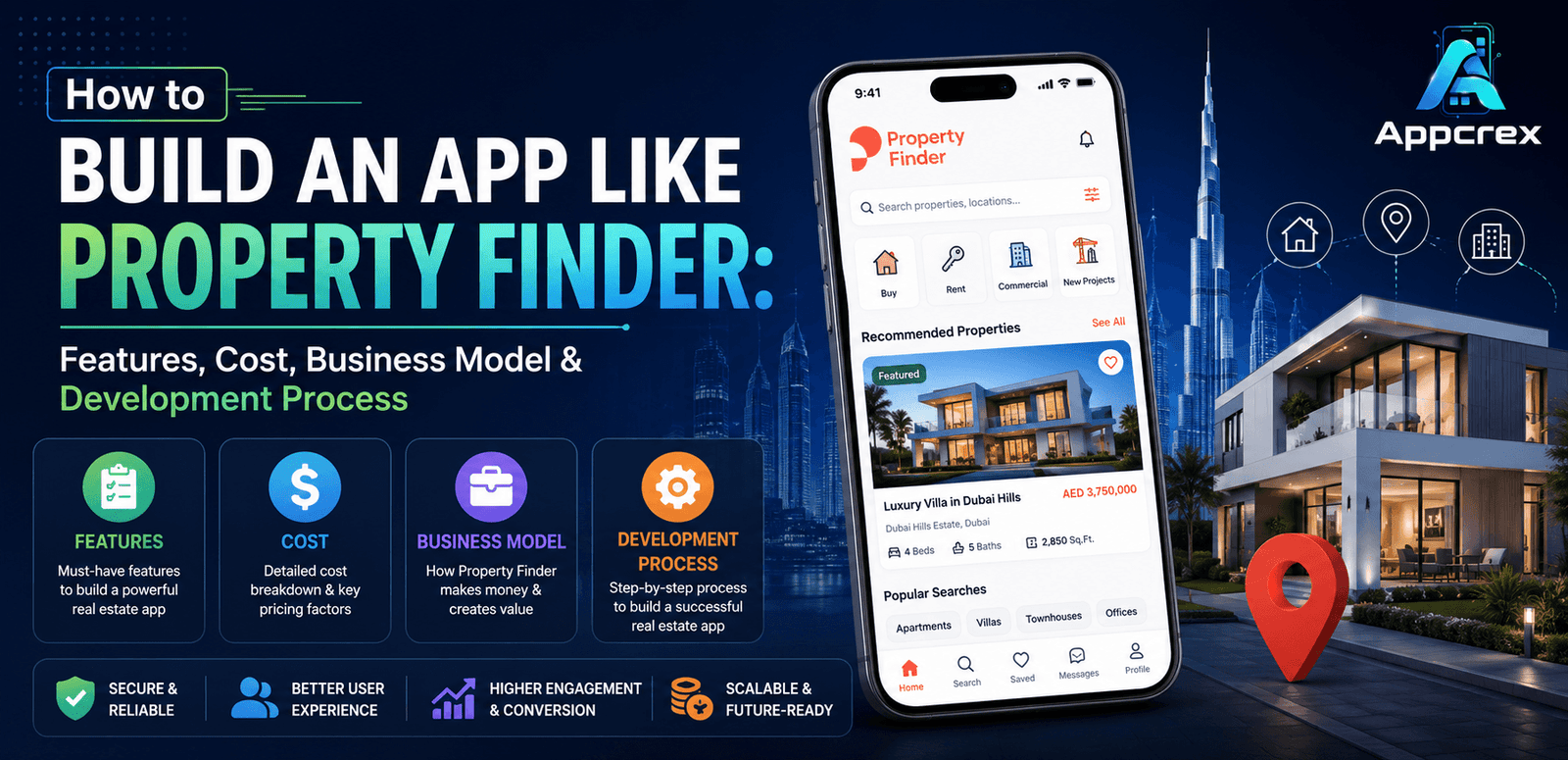
📌 Key Takeaways
- A real estate MVP can start from around $40,000.
- Search, filters, maps and listings are core features.
- Agent tools are essential for marketplace growth.
- AI can improve property search and recommendations.
- MVP-first development helps control the initial budget.
Introduction
Dubai’s real estate market has become increasingly digital, with buyers, renters, investors, landlords, and property agents relying on mobile platforms to discover and manage properties. A real estate marketplace like Property Finder brings these users together through property listings, advanced search, location-based discovery, agent communication, mortgage information, and other digital services.
For entrepreneurs planning to enter this market, building a real estate app like Property Finder can be an attractive opportunity. However, developing a successful property marketplace requires much more than creating a listing application. It involves search technology, maps, property management, lead generation, communication, payments, analytics, and potentially AI-powered recommendations.
So, how much does it cost to build an app like Property Finder?
A basic real estate app MVP can cost approximately $40,000–$70,000, while a feature-rich platform with advanced search, agent dashboards, maps, AI, analytics, and multiple integrations can cost $100,000–$200,000+.
This guide explains the major features, development cost, business model, technology stack, AI opportunities, development timeline, and complete process for building a Property Finder-like platform.
How Much Does It Cost to Build an App Like Property Finder?
The cost depends on the platform’s functionality, number of user roles, integrations, technology choices, and level of customization.
| App Type | Estimated Development Cost | Approx. Timeline |
|---|---|---|
| Basic Real Estate MVP | $40,000–$70,000 | 4–6 months |
| Standard Property Marketplace | $70,000–$120,000 | 6–9 months |
| Advanced Property Finder-Like App | $120,000–$200,000+ | 9–14 months |
| Large Real Estate Platform | $200,000–$300,000+ | 14–18+ months |
A simple property listing app can be developed with fewer features, while a large marketplace may require separate interfaces for customers, agents, property owners, administrators, and potentially mortgage or service partners.
What Is a Property Finder-Like App?
A Property Finder-style platform is essentially a real estate marketplace app where users can search, compare, save, and inquire about residential or commercial properties.
A typical platform can connect:
Buyer/Renter → Property Listing → Agent/Owner → Inquiry → Viewing → Deal
Depending on the business model, the platform can support:
- Property buying
- Property renting
- Property selling
- Property listing
- Agent discovery
- Property valuation
- Mortgage information
- New developments
- Commercial properties
- Property management
This makes the platform much more valuable than a basic property directory.
Why Build a Real Estate App Like Property Finder?
The biggest advantage of a digital real estate marketplace is convenience.
Users can search properties based on:
- Location
- Price
- Property type
- Bedrooms
- Bathrooms
- Area
- Amenities
- Furnishing
- Availability
Agents and property owners can use the platform to reach potential buyers and tenants without relying entirely on traditional marketing.
For businesses, the marketplace can generate revenue from listings, subscriptions, advertising, premium placement, and qualified leads.
Key Features of a Property Finder-Like App
1. User Registration and Login
Users should be able to register using:
- Mobile number
- OTP
- Apple
- Social login
The platform can create separate experiences for buyers, renters, property owners, and agents.
2. Property Search
Search is one of the most important components of a real estate app.
Users should be able to search by:
- Location
- Community
- Building
- Property name
- Developer
- Property type
A powerful search engine helps users find relevant properties quickly.
3. Advanced Filters
Filters can include:
- Minimum price
- Maximum price
- Bedrooms
- Bathrooms
- Property size
- Furnished/unfurnished
- Ready/off-plan
- Amenities
- Parking
- Swimming pool
- Balcony
- Pet-friendly
- Availability
Advanced filtering is particularly important when a platform contains thousands of listings.
4. Map-Based Property Search
A map interface allows users to discover properties geographically.
Users can:
- Explore properties around a location
- Search near schools
- Search near offices
- Find properties near metro stations
- Compare neighborhoods
- View nearby amenities
GPS and map integration can therefore become an important part of the platform.
5. Property Listing Pages
Every property should have a detailed listing page containing:
- Property photos
- Videos
- Price
- Location
- Property size
- Bedrooms
- Bathrooms
- Amenities
- Description
- Agent information
- Availability
- Contact options
A well-designed listing page can significantly improve lead generation.
6. High-Quality Property Images and Videos
Real estate decisions are highly visual.
The platform should support:
- Multiple images
- Video tours
- Floor plans
- 360-degree tours
- Property documents
For premium properties, virtual tours can provide a more immersive experience.
7. Save and Favorite Properties
Users should be able to save properties for later.
They can create a personal list of:
- Favorite properties
- Shortlisted homes
- Investment opportunities
- Properties they want to compare
This also gives the platform valuable behavioral data for personalization.
8. Property Comparison
A comparison feature can allow users to compare several properties side by side.
For example:
| Feature | Property A | Property B | Property C |
|---|---|---|---|
| Price | AED 1.2M | AED 1.35M | AED 1.1M |
| Bedrooms | 2 | 2 | 3 |
| Area | 1,150 sq. ft. | 1,300 sq. ft. | 1,250 sq. ft. |
| Parking | Yes | Yes | Yes |
| Pool | Yes | Yes | No |
This makes the decision-making process easier.
9. Agent Profiles
Real estate agents can have dedicated profiles containing:
- Name
- Photo
- Company
- Experience
- Languages
- Contact details
- Active listings
- Ratings
- Reviews
Users can then contact agents directly.
10. Agent Dashboard
Agents need a separate dashboard to manage their business.
They can:
- Add properties
- Edit listings
- Upload images
- Manage inquiries
- Track leads
- Update availability
- View performance
- Promote listings
A good agent dashboard can become one of the platform’s strongest monetization tools.
11. Property Owner Portal
Property owners can manage:
- Property listings
- Rental availability
- Leads
- Viewing requests
- Documents
- Tenant inquiries
For a larger platform, owner and agent accounts can have different permissions.
12. Contact Agent
Users should have multiple ways to contact an agent:
- In-app chat
- Phone
- WhatsApp integration
- Inquiry form
Lead routing should automatically connect inquiries with the appropriate agent.
13. Schedule Property Viewings
Users can request a property viewing directly from the application.
They can select:
- Date
- Time
- Property
- Preferred contact method
Agents receive the request and can confirm or reschedule it.
14. Push Notifications
Notifications can alert users about:
- New properties
- Price changes
- Saved-search matches
- Viewing confirmations
- Agent messages
- Listing updates
- Special offers
Personalized notifications can improve user engagement.
15. Saved Searches
Users can save a search such as:
2-bedroom apartment in Dubai Marina under AED 1.5 million
Whenever a matching property is listed, the user can receive a notification.
This is especially useful for active buyers and renters.
16. Mortgage and Affordability Calculator
A real estate app can include financial tools such as:
- Mortgage calculator
- Monthly payment calculator
- Down-payment calculator
- Affordability estimator
- Rental yield calculator
- ROI calculator
These tools can increase engagement and create additional opportunities for financial-service partnerships.
17. Property Investment Calculator
Investors can estimate:
- Purchase price
- Rental income
- Annual expenses
- Expected yield
- Appreciation
- ROI
This makes the platform more useful for property investors rather than only buyers and renters.
18. Reviews and Ratings
Users can review:
- Agents
- Property management companies
- Developers
- Service providers
Reviews can improve transparency and trust.
19. Admin Dashboard
The administrator needs centralized control over the marketplace.
The dashboard can manage:
- Users
- Agents
- Property owners
- Listings
- Categories
- Leads
- Payments
- Advertisements
- Reviews
- Reports
- Notifications
The admin can also moderate listings and remove duplicate or misleading properties.
Also Read : AI Training App Development Guide: How Enterprises Can Upskill Employees with AI
AI Features for a Property Finder-Like App
AI can make a real estate marketplace considerably more intelligent.
AI Property Recommendations
Instead of showing users generic listings, AI can analyze:
- Search history
- Favorite properties
- Budget
- Preferred locations
- Property type
- Previous interactions
It can then recommend properties that are more relevant to each user.
AI-Powered Property Search
Users could search using natural language.
For example:
“Find a 2-bedroom apartment near Dubai Marina under AED 1.5 million with a pool and parking.”
AI can interpret the request and automatically apply the appropriate filters.
This can create a much better search experience than traditional filter-based systems.
AI Real Estate Chatbot
An AI assistant can answer questions such as:
- What is the average property price in this area?
- Which properties match my budget?
- What documents do I need?
- What is the estimated mortgage payment?
- Which properties are near a metro station?
Complex queries can be transferred to a human agent.
AI Property Valuation
Machine learning models can potentially estimate property values using factors such as:
- Location
- Property size
- Bedrooms
- Building
- Historical prices
- Amenities
- Market trends
The result should be presented as an estimate rather than a guaranteed market valuation.
AI Lead Scoring
AI can help agents identify high-intent leads.
For example:
High Intent: User requested a viewing
Medium Intent: User contacted an agent
Low Intent: User only viewed the listing
Agents can prioritize leads based on these signals.
AI Property Description Generation
AI can help agents create listing descriptions based on structured property information.
This can save time while maintaining consistent listing quality.
Also Read : AI Sales Agent Development Company in UAE: Complete Guide to Features, Cost, Benefits & Business Use Cases
Technology Stack for a Property Finder-Like App
| Technology Area | Possible Technologies |
|---|---|
| Mobile Development | Flutter, React Native, Swift, Kotlin |
| Backend | Node.js, Python, Java |
| Database | PostgreSQL, MySQL, MongoDB |
| Search | Elasticsearch, OpenSearch |
| Maps | Google Maps or suitable mapping APIs |
| Cloud | AWS, Google Cloud, Azure |
| Real-Time Chat | WebSockets, Firebase |
| AI/ML | Python, OpenAI APIs, ML frameworks |
| Notifications | Firebase Cloud Messaging, APNs |
The final technology stack should be selected according to scalability, budget, expected traffic, and required integrations.
Working with an experienced mobile app development company in Dubai can help determine which technologies are appropriate for the project rather than selecting tools purely based on popularity.
How Does a Real Estate Marketplace Work?
The basic architecture can look like:
User App → API → Backend → Property Database → Search Engine → Results
For inquiries:
User → Property → Agent → Lead Management → Communication
For AI recommendations:
User Behavior → AI Engine → Recommendation Model → Personalized Listings
For maps:
User Location → Maps API → Property Coordinates → Nearby Listings
This architecture allows the platform to scale as the number of properties and users increases.
Development Process for a Property Finder-Like App
Step 1: Define the Target Market
First decide whether the application targets:
- Buyers
- Renters
- Investors
- Property owners
- Agents
- Developers
A focused audience makes it easier to define the MVP.
Step 2: Market and Competitor Research
Analyze:
- Competitors
- Property categories
- User expectations
- Pricing models
- Agent requirements
- Local regulations
- Monetization opportunities
For Dubai, the platform should be designed around the local real estate ecosystem and applicable requirements.
Step 3: Create the MVP
The first version can include:
- Registration
- Property listings
- Search
- Filters
- Maps
- Favorites
- Agent profiles
- Contact agent
- Notifications
- Admin dashboard
Advanced AI and financial features can be added later.
Also Read : What Is an MVP in App Development? A Complete Guide
Step 4: UI/UX Design
Design separate experiences for:
- Buyers/renters
- Agents
- Owners
- Administrators
The search and property discovery experience should remain simple even when thousands of listings are available.
Step 5: Backend Development
Develop:
- User management
- Listing management
- Search
- Lead management
- Agent management
- Notifications
- Analytics
- Admin controls
Step 6: API Integration
Depending on the project, integrations may include:
- Maps
- Payment gateways
- Property data
- Mortgage services
- Communication
- Analytics
- AI services
Third-party and government-related integrations should only be implemented through authorized access.
Step 7: Testing
Test:
- Search accuracy
- Filters
- Maps
- Property uploads
- Chat
- Notifications
- Lead routing
- Security
- Performance
Search performance is particularly important because users expect results to appear quickly.
Step 8: Launch and Scale
Start with a defined geographical market or property category.
After validating demand, expand into:
- More locations
- Commercial properties
- New developments
- Mortgage services
- Property management
- AI-powered tools
How Long Does It Take to Build an App Like Property Finder?
A basic MVP may take around 4–6 months.
A standard marketplace can require 6–9 months, while a large platform with AI, advanced search, financial tools, agent systems, and extensive integrations can take 9–14 months or more.
The timeline depends heavily on the number of platforms and integrations.
Also Read : Property Listing App Development Company: Complete Guide to Features, Cost & Development Process
Property Finder App Development Cost Breakdown
| Development Component | Estimated Cost |
|---|---|
| UI/UX Design | $7,000–$15,000 |
| Customer Mobile App | $20,000–$40,000 |
| Agent/Owner Portal | $15,000–$30,000 |
| Backend Development | $25,000–$50,000 |
| Search & Filters | $8,000–$18,000 |
| Maps & Location | $7,000–$15,000 |
| Admin Dashboard | $10,000–$20,000 |
| Chat & Notifications | $5,000–$12,000 |
| AI Features | $10,000–$30,000 |
| Testing & Security | $10,000–$20,000 |
These are approximate ranges. The final estimate should be based on the actual feature list and technical requirements.
Business Model of a Property Finder-Like App
A real estate marketplace can generate revenue through multiple channels.
Featured Listings
Agents and property owners can pay to place their properties higher in search results.
Premium Agent Subscriptions
Agents can purchase monthly plans offering:
- More listings
- More leads
- Analytics
- Featured placement
- Enhanced profiles
Advertising
Developers, banks, mortgage providers, furniture companies, and other relevant businesses can advertise on the platform.
Lead Generation
The platform can charge businesses for qualified property leads depending on the business model.
Developer Packages
Real estate developers can purchase packages to promote new projects and developments.
Also Read : Property Management System Development Company: Complete Guide to Features, Cost & Development Process
How to Make a Property Finder-Like App Different?
Competition in real estate is strong, so simply creating another listing marketplace may not be enough.
AI-First Property Search
Allow users to describe what they want naturally instead of forcing them through dozens of filters.
Investment-Focused Platform
Focus on:
- ROI
- Rental yield
- Property appreciation
- Investment scoring
- Market analytics
Rental-Focused Platform
Build tools for:
- Renters
- Landlords
- Lease management
- Rental payments
- Maintenance requests
New Property Marketplace
Focus specifically on:
- Off-plan properties
- New developments
- Developer projects
- Investment opportunities
A clear niche can help a new platform differentiate itself from established marketplaces.
How to Reduce Real Estate App Development Cost?
You don’t need to launch every feature at once.
Phase 1 — MVP
- User registration
- Property listings
- Search
- Filters
- Maps
- Favorites
- Agent profiles
- Inquiry
- Admin panel
Phase 2 — Marketplace Growth
- Agent subscriptions
- Featured listings
- Reviews
- Chat
- Property comparison
- Saved searches
- Analytics
Phase 3 — AI & Advanced Services
- AI property recommendations
- AI search
- AI chatbot
- Property valuation
- Lead scoring
- Investment analytics
- Mortgage tools
This approach lets businesses validate the marketplace before investing heavily in advanced technology.
Why Choose AppCrex for Real Estate App Development?
AppCrex can help businesses develop customized real estate platforms for Dubai, UAE, and international markets.
Services can include:
- Real Estate App Development
- Property Listing App Development
- Real Estate Marketplace Development
- Property Management App Development
- AI Real Estate App Development
- AI Integration Services
- Property Search Development
- GPS & Map Integration
- Chat & Communication
- Payment Gateway Integration
- iOS App Development
- Android App Development
- Cross-Platform App Development
- Admin Dashboard Development
- API Integration
- Cloud Backend Development
Businesses can also hire mobile app developers from AppCrex for dedicated real estate development projects, whether they need an MVP, complete marketplace, AI functionality, or ongoing technical support.
Build a Real Estate App Like Property Finder With AppCrex
The cost to build an app like Property Finder can start from approximately $40,000–$70,000 for an MVP and exceed $200,000 for an advanced real estate marketplace.
The final cost depends on the number of user roles, property listings, search capabilities, maps, integrations, AI features, financial tools, and backend complexity.
A successful real estate platform should focus on three things: easy property discovery, high-quality leads, and a smooth experience for agents and property owners.
AI can provide another competitive advantage through intelligent property recommendations, natural-language search, property valuation, lead scoring, and AI-powered customer assistance.
If you are planning to launch a real estate marketplace in Dubai or another market, starting with a focused MVP can help validate demand before expanding into advanced services.
Have a real estate app idea? AppCrex can help you define the features, technology stack, development timeline, and estimated budget for your platform.
FAQs
Q. How much does it cost to build an app like Property Finder?
A basic MVP can cost approximately $40,000–$70,000, while an advanced real estate marketplace can cost $120,000–$200,000+.
Q. How long does it take to build a Property Finder-like app?
A basic MVP can take around 4–6 months, while a feature-rich platform may require 9–14 months or longer.
Q. What are the main features of a real estate app?
Property listings, advanced search, filters, maps, favorites, agent profiles, inquiries, property comparison, notifications, chat, and an admin dashboard are some of the most important features.
Q. Can AI be added to a real estate app?
Yes. AI can support property recommendations, natural-language search, valuation estimates, lead scoring, AI chatbots, and personalized property discovery.
Q. Can I hire mobile app developers to build a real estate platform?
Yes. You can hire mobile app developers experienced in real estate marketplaces, maps, search technology, AI, APIs, and scalable backend development.
Q. How does a real estate app make money?
Common revenue models include featured listings, agent subscriptions, advertising, lead generation, developer packages, and premium services.
Q. Can the app support both buyers and renters?
Yes. The platform can provide separate search options and workflows for property buyers and renters.
Q. Can a Property Finder-like app be launched in Dubai?
Yes. However, the business should understand applicable UAE and Dubai real estate, advertising, data, payment, and platform requirements before launch.
Q. Can AppCrex build a Property Finder-like app?
Yes. AppCrex can develop property listing platforms, real estate marketplaces, AI-powered property search solutions, agent portals, admin dashboards, and supporting backend systems.