📌 Key Takeaways
- Start with an MVP containing property, tenant, lease, rent, and maintenance management.
- AI can automate operations through chatbots, predictive maintenance, document processing, and analytics.
- SaaS is a strong business model for property management software with subscription-based pricing.
- Security and role-based access are essential because the platform handles financial and tenant information.
- Build for scalability if you plan to manage multiple property companies or expand globally.
Introduction
Property management is becoming increasingly digital as property owners, landlords, real estate companies, and property managers handle larger portfolios and more complex day-to-day operations.
Managing properties through spreadsheets, emails, phone calls, and disconnected tools can make it difficult to track tenants, rent payments, maintenance requests, leases, documents, and property performance.
A property management system (PMS) brings these activities together into a centralized digital platform.
A modern property management system can help businesses manage residential, commercial, rental, and multi-property portfolios from a single dashboard. It can also integrate automation, analytics, mobile access, online payments, tenant communication, and AI-powered tools to reduce manual work.
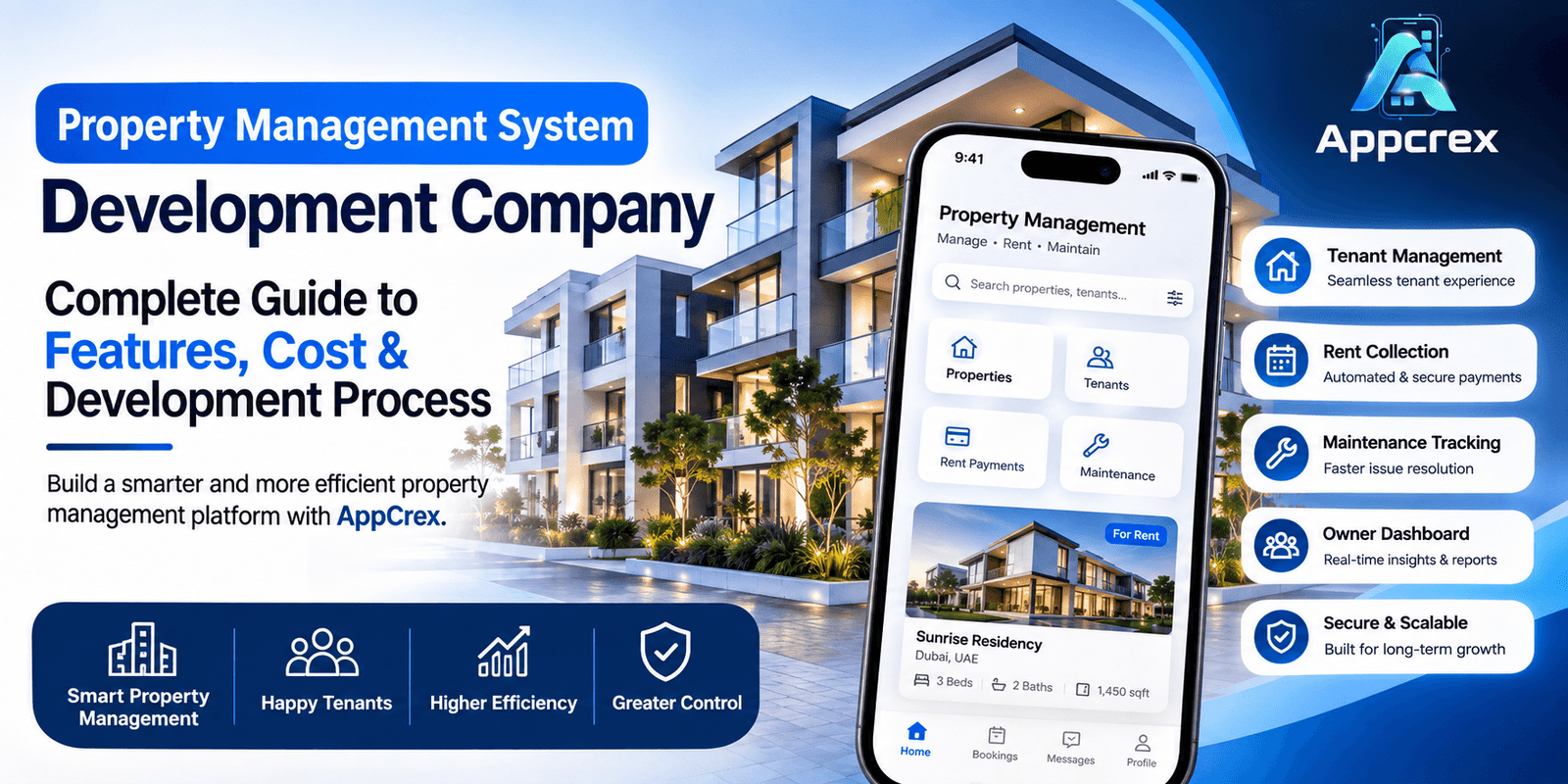
For businesses planning to build their own platform, working with a property management system development company can help transform operational requirements into a scalable web or mobile solution.
This guide explains how to build a property management system, essential features, AI capabilities, technology stack, development process, development cost, timeline, and future trends.
Just Read : Real Estate App Development Company: Complete Guide to Features, Cost & Development Process
What Is a Property Management System?
A property management system is a software platform designed to help property owners and managers manage properties, tenants, finances, maintenance, documents, and daily operations from one centralized system.
Depending on the business model, a PMS can manage:
- Residential properties
- Commercial properties
- Apartments
- Villas
- Rental properties
- Office buildings
- Retail spaces
- Multi-property portfolios
A typical system connects multiple users, including:
Property Owner → Property Manager → Tenant → Admin
Instead of managing information through separate spreadsheets and communication channels, users can access relevant information through dedicated dashboards.
Why Invest in Property Management Software Development?
1. Centralized Property Management
Property managers can manage multiple properties from a single platform instead of maintaining separate records.
2. Automated Rent Management
The system can track:
- Rent due dates
- Payments
- Outstanding balances
- Payment history
- Late payments
- Receipts
Automation can reduce repetitive administrative work.
3. Better Tenant Communication
Property managers can communicate with tenants through:
- In-app messaging
- SMS
- Push notifications
This creates a centralized communication history.
4. Faster Maintenance Management
Tenants can submit maintenance requests through the platform.
Property managers can then assign requests to maintenance teams, track progress, and update tenants.
5. Improved Financial Visibility
Property owners can monitor:
- Rental income
- Expenses
- Maintenance costs
- Outstanding payments
- Property profitability
6. Manage Multiple Properties
A scalable PMS allows businesses to manage portfolios containing dozens, hundreds, or potentially thousands of properties from one platform.
7. Reduce Manual Work
Automation can handle repetitive tasks such as:
- Payment reminders
- Lease expiry notifications
- Maintenance updates
- Tenant notifications
- Reports
This makes property management more efficient.
Also Read : Property Listing App Development Company: Complete Guide to Features, Cost & Development Process
Types of Property Management Systems
Residential Property Management System
Designed for apartments, houses, villas, and other residential properties.
Common features include:
- Tenant management
- Rent collection
- Lease management
- Maintenance requests
- Notifications
Commercial Property Management System
Designed for offices, retail spaces, warehouses, and commercial buildings.
It may include:
- Commercial leases
- Occupancy management
- Tenant billing
- Facility management
- Financial reporting
Rental Property Management Software
Focused primarily on landlords and rental businesses managing multiple rental units.
Apartment Management System
Designed specifically for apartment communities and residential buildings.
It can support:
- Tenant communication
- Maintenance
- Rent
- Visitor management
- Notices
- Community services
Hotel & Hospitality Property Management System
A hospitality-focused PMS can manage:
- Reservations
- Rooms
- Guests
- Payments
- Housekeeping
- Check-in/check-out
This is a different specialization from traditional long-term property management, but it can use similar underlying management concepts.
How to Build a Property Management System?
Building a property management system requires a clear understanding of the property owner’s, manager’s, and tenant’s workflows. The objective should be to bring property operations, rent management, maintenance, communication, and reporting into one centralized platform.
Step 1: Define Your Business Requirements
First, determine what type of properties the system will manage:
- Residential properties
- Apartments
- Villas
- Commercial properties
- Rental portfolios
- Mixed-use properties
The business model will determine which features and dashboards are required.
Step 2: Define User Roles
A typical property management system includes:
- Property Owner
- Property Manager
- Tenant
- Maintenance Staff
- Accountant
- Admin
Each role should have appropriate permissions and access to relevant information.
Step 3: Plan the MVP
Start with the core features instead of building every advanced function at once.
A property management MVP can include:
- Property management
- Unit management
- Tenant management
- Lease management
- Rent tracking
- Maintenance requests
- Notifications
- Basic reporting
- Admin dashboard
Advanced AI, automation, analytics, and integrations can be added later.
Also Read : What Is an MVP in App Development? A Complete Guide
Step 4: Design the UI/UX
The interface should make common tasks easy to complete.
Important screens can include:
- Dashboard
- Properties
- Units
- Tenants
- Payments
- Leases
- Maintenance
- Messages
- Reports
- Settings
A responsive web dashboard can be combined with mobile applications for property managers and tenants.
Step 5: Develop the Backend & Applications
The development team builds the:
- Web application
- Mobile application
- Backend
- Database
- APIs
- Admin panel
- User dashboards
The backend should be designed with scalability and security in mind, particularly for systems managing sensitive financial and tenant information.
Step 6: Integrate Third-Party Services
Depending on requirements, integrations can include:
- Payment gateways
- Banking APIs
- SMS
- Push notifications
- Accounting software
- Maps
- E-signature services
- Cloud storage
- AI services
Step 7: Test the System
Testing should cover:
- User permissions
- Rent calculations
- Payments
- Notifications
- Maintenance workflows
- API integrations
- Security
- Performance
- Mobile responsiveness
Step 8: Launch & Improve
After launch, monitor user activity and collect feedback. New automation and features can then be introduced based on actual business requirements.
Also Read : Progressive Web App Development Company: Complete Guide to Features, Benefits, Cost & Development Process
Essential Features of a Property Management System
1. Property & Unit Management
Property managers should be able to create and organize property records.
Information can include:
- Property name
- Property type
- Address
- Number of units
- Unit number
- Property size
- Amenities
- Occupancy status
- Property images
- Documents
For large portfolios, properties can be organized by buildings, floors, units, or locations.
2. Tenant Management
A centralized tenant management module can store relevant tenant information such as:
- Tenant profile
- Contact information
- Lease details
- Rental amount
- Payment history
- Documents
- Maintenance requests
- Communication history
This gives property managers a single place to manage tenant relationships.
3. Lease Management
The system can help property managers track:
- Lease start date
- Lease end date
- Rent amount
- Security deposit
- Renewal date
- Lease documents
- Renewal status
Automated reminders can notify managers and tenants before a lease expires.
4. Rent & Payment Management
Rent management is one of the most important features of a property management platform.
The system can support:
- Rent schedules
- Online payments
- Payment history
- Outstanding balances
- Late payment tracking
- Automated reminders
- Digital receipts
A payment dashboard can help property owners quickly understand their rental income and outstanding payments.
5. Maintenance Management
Tenants can submit maintenance requests directly through the platform.
A typical workflow can be:
Tenant submits request → Manager reviews → Technician assigned → Work completed → Tenant notified
The system can track:
- Issue description
- Photos/videos
- Priority
- Assigned technician
- Status
- Cost
- Completion date
This creates a transparent maintenance process.
6. Tenant Portal
A tenant portal can allow residents to:
- View lease information
- Pay rent
- Submit maintenance requests
- Download documents
- Receive announcements
- Communicate with management
- View payment history
This reduces the need for repetitive phone calls and emails.
7. Property Owner Dashboard
Property owners can view portfolio performance through a dedicated dashboard.
Important information can include:
- Total properties
- Occupied units
- Vacant units
- Rental income
- Outstanding payments
- Maintenance expenses
- Property performance
This gives owners better visibility without requiring them to manage day-to-day operations.
8. Maintenance Staff Dashboard
Maintenance teams can receive assigned work orders through their own dashboard.
They can:
- View assigned requests
- Accept jobs
- Update status
- Upload photos
- Add notes
- Record expenses
- Mark work as completed
9. Notifications & Alerts
The system can automatically send notifications for:
- Rent due dates
- Payment confirmations
- Late payments
- Lease expiration
- Maintenance updates
- New announcements
- Scheduled inspections
Notifications can be delivered through push notifications, email, or SMS.
Also Read : Push Notification Guide: Benefits, Types & Best Practices (2026)
10. Reports & Analytics
Property managers and owners can access reports related to:
- Rental income
- Expenses
- Occupancy
- Vacancies
- Maintenance
- Tenant payments
- Property performance
Advanced analytics can help owners understand which properties are performing well and where costs are increasing.
11. Document Management
A property management system can provide centralized document storage for:
- Lease agreements
- Tenant documents
- Property documents
- Maintenance invoices
- Receipts
- Inspection reports
Role-based permissions can control who can access specific documents.
12. Admin Panel
The admin panel manages the entire system.
Core functions include:
- User management
- Property management
- Tenant management
- Agent/manager management
- Payment management
- Subscription management
- Reports
- Notifications
- Content management
- System settings
- Access permissions
For a multi-tenant SaaS property management platform, the admin can also manage different organizations or property management companies from one central system.
Property Management System User Flow
A simplified workflow can look like:
Property Owner
↓
Adds Property
↓
Property Manager
↓
Adds Units & Tenants
↓
Tenant
↓
Pays Rent / Raises Maintenance Request
↓
Property Manager
↓
Processes Payment / Assigns Maintenance
↓
Owner Dashboard
↓
Views Property Performance & Reports
This type of connected workflow is one of the biggest advantages of a centralized property management system.
AI & ML Features for Property Management Systems
Artificial intelligence can make a property management system more efficient by automating repetitive tasks, analyzing property data, and helping managers make faster decisions.
AI-Powered Tenant Support
An AI chatbot can answer common tenant questions about:
- Rent payments
- Lease terms
- Maintenance requests
- Property rules
- Amenities
- Payment status
- Service requests
This can provide 24/7 assistance while reducing repetitive workload for property managers.
Predictive Maintenance
AI can analyze maintenance history and property data to identify potential issues before they become major problems.
For example, the system could identify recurring equipment problems and recommend preventive maintenance.
Also Read : AI Chatbot Development Company: Complete Guide to Features, Benefits, Cost & Trends (2026)
AI Rent & Property Insights
Machine learning can analyze available property and rental data to identify trends related to:
- Rental prices
- Occupancy
- Vacancy
- Expenses
- Property performance
These insights can help owners make more informed decisions.
Automated Document Processing
AI-powered document processing can extract relevant information from leases, invoices, inspection reports, and other documents.
For example, it can identify:
- Lease dates
- Rent amounts
- Renewal dates
- Deposit information
- Important clauses
AI Lead & Tenant Communication
AI can help categorize and prioritize incoming requests based on urgency and type.
For example:
Emergency maintenance → High priority
General inquiry → Normal priority
This can help property managers respond more efficiently.
AI-Powered Property Recommendations
For platforms managing multiple rental properties, AI can recommend suitable units based on:
- Budget
- Location
- Property type
- Unit size
- Amenities
- Previous searches
Also Read : How Much Does It Cost to Develop an App in 2026? Complete Pricing Guide
Advanced Property Management System Features
Automated Rent Reminders
The system can automatically send reminders before and after rent due dates.
Recurring Payments
Tenants can set up recurring payment methods where supported by the payment provider.
Digital Inspections
Property managers can conduct inspections through mobile devices and record:
- Photos
- Videos
- Notes
- Inspection dates
- Issues identified
Smart Maintenance Scheduling
Maintenance requests can be automatically categorized and assigned according to:
- Issue type
- Priority
- Location
- Technician availability
Visitor Management
For apartment communities and residential buildings, visitor management can allow residents to register guests and provide access information to security staff.
Community Management
A residential property platform can include:
- Announcements
- Community notices
- Event information
- Resident communication
- Polls
- Facility bookings
Utility Management
For suitable properties, the system can track utility-related information such as:
- Electricity
- Water
- Gas
- Internet
- Utility expenses
Technology Stack for Property Management System Development
The technology stack should be selected according to the product’s scale, required integrations, security requirements, and future roadmap.
| Development Area | Recommended Technologies |
|---|---|
| iOS App | Swift, SwiftUI |
| Android App | Kotlin |
| Cross-Platform | Flutter, React Native |
| Web Frontend | React.js, Next.js |
| Backend | Node.js, Python, Laravel, .NET |
| Database | PostgreSQL, MySQL, MongoDB |
| Search | Elasticsearch, OpenSearch |
| AI & ML | Python, TensorFlow, PyTorch |
| Generative AI / LLM | OpenAI, Google Gemini, Anthropic Claude |
| Cloud Infrastructure | AWS, Microsoft Azure, Google Cloud |
| Payments | Stripe, PayPal, Regional Payment Gateways |
| Maps & Location | Google Maps Platform, Mapbox |
| Notifications | Firebase Cloud Messaging, Apple Push Notification Service |
| Real-Time Communication | WebSockets, Socket.IO |
| File Storage | Amazon S3, Google Cloud Storage, Azure Blob Storage |
| Analytics | Google Analytics, Firebase Analytics |
| DevOps | Docker, Kubernetes, GitHub Actions |
The exact stack should be finalized after evaluating the application’s functionality and expected scale.
Third-Party Integrations
A property management system may require several external integrations.
Payment Gateway Integration
Supports online rent payments and other transactions.
Accounting Integration
Can connect property financial data with accounting systems where required.
Communication APIs
SMS, email, push notifications, and messaging APIs can automate tenant communication.
E-Signature Integration
Can simplify digital document signing where legally appropriate.
Maps Integration
Useful for displaying:
- Property locations
- Nearby facilities
- Service providers
- Geographic information
Cloud Storage
Large numbers of property images, videos, documents, and inspection files require reliable cloud storage.
AI APIs
External AI services can be integrated for:
- Chatbots
- Document processing
- Property recommendations
- Natural-language search
- Automated content generation
Security Requirements for Property Management Software
A property management system handles sensitive information, including tenant details, payment information, contracts, and property documents.
Security should therefore be included from the beginning of development.
Important measures include:
- Secure authentication
- Role-based access control
- Data encryption
- Secure API communication
- Multi-factor authentication
- Audit logs
- Secure payment processing
- Regular backups
- Data access controls
- Vulnerability testing
For businesses operating in different countries, applicable local privacy and data-protection requirements should also be considered during architecture and deployment.
How to Make a Property Management System Scalable?
If you plan to build a SaaS platform or manage a large property portfolio, scalability should be considered from the beginning.
A scalable architecture can support:
- Multiple property companies
- Thousands of properties
- Large tenant databases
- High payment volumes
- Large document libraries
- Multiple geographic locations
Multi-Tenant Architecture
For a SaaS property management platform, multiple property management companies can use the same software while keeping their data logically separated.
For example:
Company A → Properties & Tenants
Company B → Properties & Tenants
Company C → Properties & Tenants
This model can make the platform suitable for subscription-based software businesses.
Property Management System for Dubai & Global Markets
If the goal is to build a global property management platform, the core architecture should support localization.
For a Dubai/UAE-focused system, useful considerations may include:
- AED currency
- Arabic and English language support
- Local payment integrations
- Rental management workflows
- Property and unit management
- Digital document handling
- Maintenance management
- Owner and tenant portals
For a global platform, localization can be extended to:
- Multiple currencies
- Multiple languages
- Regional payment gateways
- Local tax requirements
- Different lease structures
- Country-specific notifications and workflows
This allows the same core product to expand into additional markets without rebuilding the entire platform.
Also read : How Much Does It Cost to Build a React Native App in UAE? Complete Guide (2026)
How Much Does It Cost to Develop a Property Management System?
The cost of developing property management software depends on the number of users, features, platforms, integrations, security requirements, and level of automation.
| Type of Property Management System | Estimated Cost | Development Time |
|---|---|---|
| Basic MVP | $25,000–$45,000 | 3–4 months |
| Standard PMS | $45,000–$80,000 | 4–6 months |
| Advanced PMS | $80,000–$150,000 | 6–9 months |
| AI-Powered PMS | $150,000–$300,000+ | 9–12+ months |
These are indicative estimates. A final quote depends on the exact features, platforms, integrations, and development scope.
Cost Factors in Property Management Software Development
Number of User Roles
A system with only property managers and tenants will generally be simpler than one supporting:
- Owners
- Managers
- Tenants
- Accountants
- Maintenance staff
- Administrators
Platform Requirements
Development costs can increase when you require:
- iOS app
- Android app
- Web dashboard
- Admin panel
- Tenant portal
Feature Complexity
Advanced functionality such as AI, automated payments, predictive maintenance, accounting integrations, and smart analytics requires additional development effort.
Third-Party Integrations
Payment gateways, accounting platforms, SMS, email, e-signatures, maps, and AI services can affect the overall budget.
Security Requirements
Handling tenant information, payment data, contracts, and financial records requires strong security and access-control mechanisms.
How Long Does It Take to Build Property Management Software?
The development timeline depends on the scope.
Basic MVP
3–4 months
Core property, tenant, rent, maintenance, and admin functionality.
Standard System
4–6 months
Adds dashboards, payments, notifications, reports, document management, and integrations.
Advanced Platform
6–9 months
Can include multi-property management, advanced analytics, automation, accounting integrations, and mobile applications.
AI-Powered Property Management Platform
9–12+ months
Additional time may be required for AI chatbots, predictive maintenance, document intelligence, recommendations, and advanced analytics.
Property Management Software Monetization Models
If you’re building a property management platform as a SaaS product, there are several ways to generate recurring revenue.
Monthly Subscription
Property management companies pay a monthly fee based on their selected plan.
For example:
- Starter
- Professional
- Enterprise
Per-Property Pricing
Charge customers according to the number of properties or units they manage.
Per-User Pricing
Businesses pay based on the number of managers, staff members, or other users.
Premium Features
Basic functionality can be included in lower plans while advanced features such as AI, analytics, and automation are offered through premium plans.
Enterprise Solutions
Large property management companies can receive customized plans with:
- Dedicated infrastructure
- Custom integrations
- Advanced security
- Custom reporting
- Dedicated support
Also Read : Marketplace App Development Company Dubai: Complete Guide to Features, Cost & Development Process
Common Mistakes to Avoid
1. Building Everything at Once
Adding every possible feature to the first version can increase development costs and delay the launch.
Start with an MVP and expand based on user feedback.
2. Ignoring Tenant Experience
The system shouldn’t be designed only for property managers.
Tenants need a simple experience for rent payments, maintenance requests, documents, and communication.
3. Weak Permission Management
Different users should only have access to information relevant to their roles.
4. Poor Payment Workflow
Rent payment tracking should be accurate, transparent, and properly integrated with the selected payment provider.
5. No Mobile Experience
Property managers and maintenance teams often work outside the office. A responsive web interface or dedicated mobile app can improve usability.
6. Ignoring Scalability
If the goal is to build a SaaS platform, the architecture should support multiple businesses, properties, users, and geographic markets.
Future Trends in Property Management Systems
Property management software is becoming increasingly automated and data-driven.
Important trends include:
- AI-powered tenant assistants
- Predictive maintenance
- Automated rent management
- AI document processing
- Smart property analytics
- Automated lease management
- Digital inspections
- IoT-based property monitoring
- Smart building integrations
- AI-powered reporting
- Intelligent tenant communication
The future of property management is moving toward systems that don’t just record property information, but actively help managers identify problems, automate tasks, and make better operational decisions.
Also Read : Offshore Software Development Services: Everything Businesses Need to Know Before Hiring a Development Team
FAQs
Q. How much does it cost to develop a property management system?
A basic property management MVP can cost approximately $25,000–$45,000, while an advanced AI-powered platform can cost $150,000–$300,000+, depending on requirements.
Q. How do I build a property management system?
Start by defining the business model and user roles, plan the MVP, design the UI/UX, develop the backend and dashboards, integrate payments and other APIs, test the system, and then launch and improve it.
Q. What are the essential features of property management software?
Core features include property management, unit management, tenant management, lease tracking, rent management, maintenance requests, notifications, document management, reports, and an admin dashboard.
Q. Can AI be integrated into property management software?
Yes. AI can be used for tenant chatbots, predictive maintenance, document processing, property recommendations, automated communication, analytics, and intelligent reporting.
Q. Is property management software suitable for a SaaS business?
Yes. A multi-tenant SaaS architecture can allow multiple property management companies to use the same platform while keeping their organizational data separated.
Q. Can property management software be developed for Dubai?
Yes. A Dubai-focused system can support requirements such as AED currency, Arabic and English interfaces, local payment integrations, tenant management, rent tracking, maintenance, and owner portals.
Q. Can the same property management system be used globally?
Yes. A scalable architecture can support multiple currencies, languages, payment providers, regional workflows, and different property types, allowing the platform to expand into international markets.
Conclusion
A modern Property Management System can transform how property owners, managers, tenants, and maintenance teams handle everyday operations.
Instead of relying on spreadsheets and disconnected communication channels, businesses can use a centralized platform for property management, tenant management, rent collection, maintenance, lease tracking, documents, communication, and analytics.
For startups and businesses building a new product, the best approach is to launch an MVP and gradually add advanced capabilities such as AI-powered automation, predictive maintenance, intelligent analytics, and smart tenant support.
Whether you’re targeting Dubai, the UAE, or a global market, a scalable architecture can allow the system to grow as your property portfolio and customer base increase.
Build Your Property Management System with AppCrex
AppCrex can help businesses build custom property management platforms with web and mobile applications, tenant portals, owner dashboards, admin panels, payment integrations, AI features, APIs, analytics, and scalable cloud infrastructure.
Whether you want to build a property management SaaS, rental management platform, apartment management system, or enterprise property management solution, AppCrex can help turn your idea into a scalable digital product.
Have a property management software idea? Connect with AppCrex to discuss your requirements, features, development roadmap, and estimated budget.