📌 Key Takeaways
- An RTA-like transportation MVP can start from around $60,000.
- GPS, route planning, payments, booking and real-time data are core features.
- AI can add smart travel assistance and predictive mobility features.
- Multiple APIs and transportation integrations significantly affect development cost.
- Start with an MVP and expand into a complete smart mobility platform.
Introduction
Dubai is one of the world’s leading smart-city markets, and transportation is a major part of its digital transformation. Residents and visitors increasingly expect to plan journeys, book taxis, pay for parking, manage transport cards, check traffic information, and access vehicle-related services from their smartphones.
This has created a strong opportunity for businesses looking to build Dubai transportation apps, smart mobility platforms, taxi booking apps, parking apps, and public transport solutions.
The RTA Dubai ecosystem is a strong reference point for this type of platform. Rather than being limited to one transportation function, Dubai’s Roads and Transport Authority provides a broad range of digital mobility and transport services covering public transport, taxis, parking, licensing, vehicles, roads, and related services.
For entrepreneurs planning a similar product, the important question is:
How much does it cost to build an app like RTA Dubai?
Depending on the features and integrations, development can range from approximately $60,000 for a focused transportation MVP to $250,000+ for an advanced smart mobility platform.
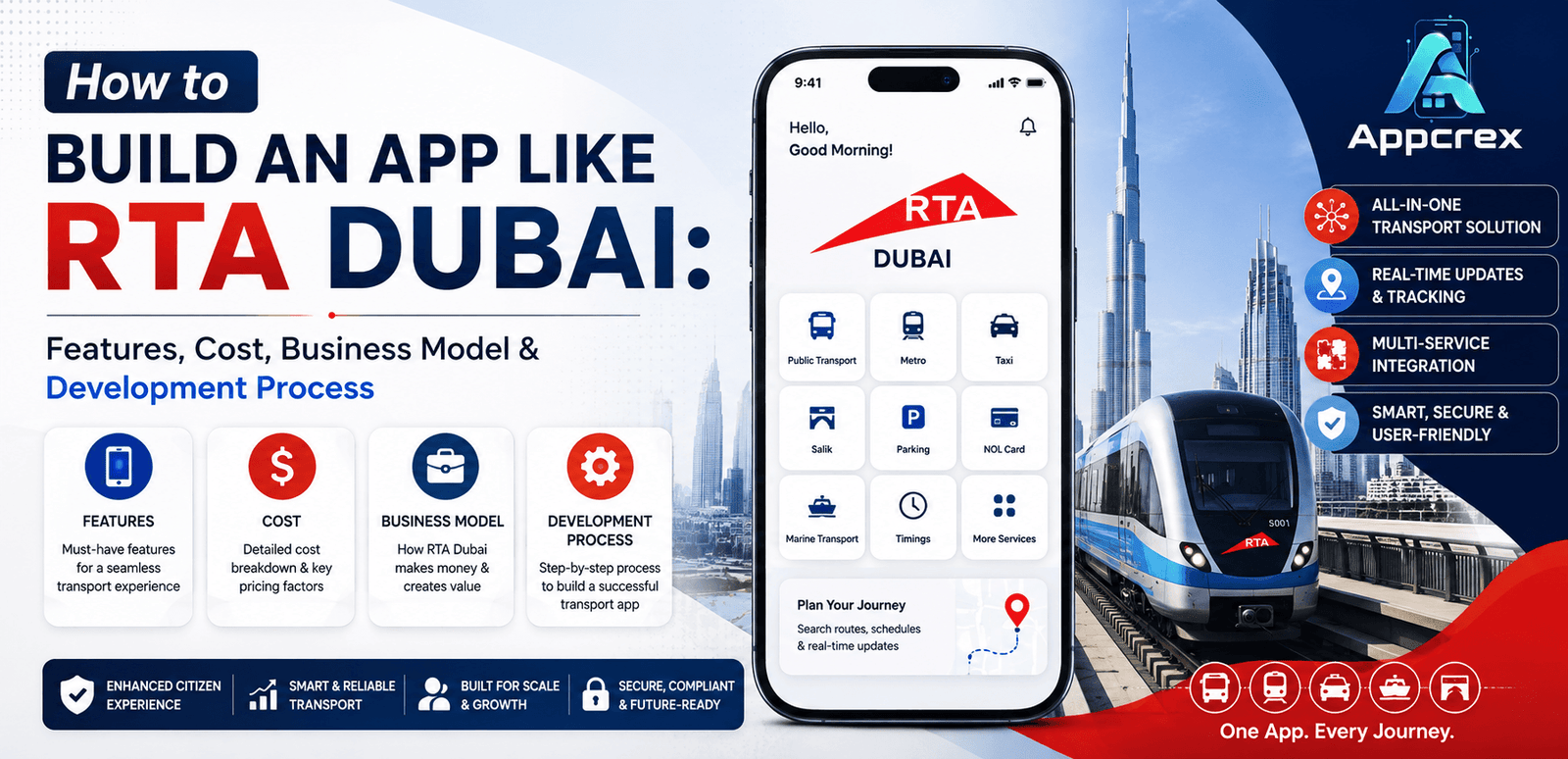
In this guide, we will cover the RTA Dubai app concept, key features, development cost, technology stack, AI opportunities, business model, development process, timeline, and ways to reduce development costs.
How Much Does It Cost to Build an App Like RTA Dubai?
The cost depends on the complexity of the transportation services, third-party integrations, payment systems, real-time data, maps, and administrative infrastructure.
| App Type | Estimated Cost |
|---|---|
| Basic Transport App MVP | $60,000–$90,000 |
| Standard RTA-Like App | $90,000–$150,000 |
| Advanced Smart Mobility App | $150,000–$250,000+ |
| Enterprise Multi-Service Platform | $250,000–$400,000+ |
A simple transportation application with route planning and basic booking will cost considerably less than a platform integrating public transport, taxi services, parking, payments, vehicle services, maps, real-time data, AI, and government systems.
If you work with an experienced mobile app development company, the development team can help prioritize features and create an MVP before investing in the complete platform.
What Is an RTA Dubai-Like App?
An RTA Dubai-style application can act as a centralized digital transportation platform where users access multiple mobility services from one place.
Depending on the business model, the platform can provide:
- Metro information
- Bus routes
- Taxi booking
- Parking services
- Transport-card services
- Fare calculation
- Journey planning
- Traffic information
- Vehicle services
- Driving services
- Digital payments
- Real-time transportation updates
- Customer support
The goal is to create a smart mobility application rather than a basic transportation app.
Why Build an App Like RTA Dubai?
Dubai’s transportation environment makes it an attractive market for digital mobility products.
A transportation platform can help users:
- Find the fastest route
- Book transportation
- Pay digitally
- Find parking
- Manage travel expenses
- Check public transport information
- Receive traffic updates
- Access vehicle-related services
For businesses, this creates opportunities in:
Taxi + Parking + Public Transport + Payments + AI + Mobility
Instead of developing separate applications for every service, businesses can combine multiple services into one platform.
Key Features of an RTA Dubai-Like App
1. User Registration & Login
Users should be able to register quickly using:
- Mobile number
- OTP
- Social login
- Digital identity
- Biometric authentication
For a Dubai-focused product, identity integration can be considered where the required authorization and technical access are available.
2. Personalized User Dashboard
The home screen should provide quick access to frequently used services.
For example:
- Book a taxi
- Find parking
- Plan a journey
- Check transport status
- Pay fines
- Recharge transport card
- View recent trips
Personalization can make the app much easier to use for regular commuters.
3. Journey Planner
A journey planner is one of the most important features.
Users enter:
Current Location → Destination
The system can show:
- Metro route
- Bus route
- Taxi
- Walking
- Cycling
- Combined routes
- Estimated travel time
- Estimated cost
An advanced journey planner can compare different transport modes and recommend the most efficient option.
4. Real-Time Public Transport Information
Users can view:
- Metro timings
- Bus timings
- Station information
- Route changes
- Service disruptions
- Estimated arrival times
Real-time data requires reliable APIs and backend infrastructure.
5. Taxi Booking
A taxi-booking module can allow users to:
- Select pickup location
- Enter destination
- Select vehicle type
- Estimate fare
- Book a ride
- Track driver
- Contact driver
- Cancel ride
- Rate the trip
This turns the transportation platform into a taxi booking app as well.
6. Live Vehicle Tracking
GPS tracking can display:
- Driver location
- Vehicle movement
- Estimated arrival
- Route
- Trip progress
The system typically uses GPS, maps, location services, and real-time communication between the driver and customer applications.
7. Parking Services
Parking is another important part of a smart mobility ecosystem.
Users can:
- Find nearby parking
- Check parking zones
- Pay parking fees
- Extend parking
- View parking history
- Receive expiry reminders
A more advanced version can integrate smart parking systems and parking sensors.
8. Transport Card Management
A Dubai-focused mobility application can potentially integrate transport-card services.
Possible functionality includes:
- Balance checking
- Recharge
- Transaction history
- Card management
- Digital payment
- Usage history
The exact functionality depends on the transport authority and available APIs.
9. Fare Calculator
Users can calculate the estimated cost of a journey before traveling.
The system can consider:
- Distance
- Transport mode
- Zones
- Time
- Vehicle type
- Number of passengers
A configurable fare engine allows administrators to update pricing rules without changing the entire application.
10. Traffic Information
A smart mobility app can provide:
- Traffic congestion
- Road incidents
- Road closures
- Construction alerts
- Alternative routes
- Estimated delays
Traffic data can be integrated through approved third-party or government data sources.
11. Vehicle & Driving Services
A broader RTA-like platform can include:
- Vehicle registration
- Driving-license services
- Fine payments
- Vehicle information
- Renewal reminders
- Inspection information
- Document management
These features can turn a mobility app into a wider transportation and vehicle-services platform.
12. Digital Payments
Users should be able to pay for services directly inside the application.
Potential payment methods include:
- Credit cards
- Debit cards
- Digital wallets
- Bank payments
- Local payment systems
Payment security, transaction reconciliation, refunds, and fraud monitoring need to be considered during development.
13. Digital Receipts
After every payment, users can receive:
- Transaction ID
- Digital receipt
- Payment confirmation
- Date and time
- Amount
- Service details
Users should also be able to access previous receipts.
14. Notifications
Push notifications can alert users about:
- Ride bookings
- Parking expiry
- Payment confirmation
- Transport delays
- Route changes
- Vehicle renewals
- Traffic incidents
Notifications can be personalized based on user activity.
Also Read : Push Notification Guide: Benefits, Types & Best Practices (2026)
15. Saved Locations
Users can save:
- Home
- Office
- Airport
- Favorite stations
- Frequent destinations
This reduces the number of steps required for regular journeys.
16. Trip History
Users can view:
- Previous taxi trips
- Public transport journeys
- Parking transactions
- Payments
- Bookings
- Receipts
This can also help businesses understand customer behavior.
17. Customer Support
The platform should provide:
- FAQs
- Help center
- Chat support
- Complaint submission
- Refund requests
- Lost-and-found support
AI chatbots can handle common questions while complex issues can be transferred to human agents.
18. Multilingual Support
Dubai has a highly international population, so multilingual support can be an important feature.
The app can initially support:
- English
- Arabic
Additional languages can be introduced based on user demand.
The UI should properly support both LTR and RTL layouts.
19. Admin Dashboard
A transportation platform needs a powerful backend dashboard.
Administrators can manage:
- Users
- Drivers
- Vehicles
- Bookings
- Payments
- Parking
- Routes
- Stations
- Fares
- Complaints
- Notifications
- Service providers
Role-based access ensures employees only see the information relevant to their responsibilities.
20. Driver App
If taxi services are included, a separate driver application is required.
Driver features can include:
- Registration
- Document upload
- Online/offline status
- Ride requests
- Navigation
- Trip management
- Earnings
- Ratings
- Support
This creates a complete passenger-driver ecosystem.
21. Service Provider Portal
If your platform works with multiple transportation companies, each provider can receive its own portal.
They can manage:
- Vehicles
- Drivers
- Bookings
- Earnings
- Service areas
- Performance
- Customer complaints
This makes the platform scalable as more mobility providers join.
AI Features for an RTA Dubai-Like App
AI can make a transportation platform significantly more useful.
AI Travel Assistant
Users could ask:
“How can I reach Dubai Mall from Dubai Marina?”
The AI assistant can provide:
- Metro route
- Bus options
- Taxi option
- Estimated time
- Estimated cost
- Walking distance
AI Route Optimization
AI can analyze traffic, historical travel patterns, and available transportation data to recommend potentially faster routes.
For example:
Route A: 35 minutes
Route B: 42 minutes
Route C: 30 minutes
The system can recommend Route C based on available real-time data.
AI Parking Assistant
Users could ask:
“Find parking near Dubai Marina.”
The system can use available parking data to suggest nearby options.
AI Customer Support
An AI chatbot can answer questions related to:
- Fares
- Parking
- Routes
- Bookings
- Payments
- Transport cards
- Vehicle services
This can reduce the workload for human support teams.
AI Predictive Analytics
Transportation companies can use AI to analyze:
- Peak travel periods
- Popular routes
- Taxi demand
- Parking demand
- User behavior
- Traffic patterns
This can help improve resource allocation.
AI Multilingual Assistant
An AI-powered language layer can allow users to communicate with the platform in their preferred language.
This can be especially valuable in Dubai’s multicultural environment.
Also Read : AI App Development Guide: Features, Cost & Process (2026)
Technology Stack for an RTA Dubai-Like App
Mobile App Development
Possible technologies include:
- Flutter
- React Native
- Kotlin
- Swift
A business looking to launch Android and iOS applications quickly may consider Flutter or React Native.
For highly specialized device-level functionality, native development can be used.
Backend Development
Possible technologies include:
- Node.js
- Java
- Python
- Go
The backend should be designed to handle high traffic, real-time tracking, payments, bookings, and third-party APIs.
Database
Potential technologies include:
- PostgreSQL
- MySQL
- MongoDB
- Redis
Redis can be used for caching and real-time data, while relational databases can handle transactional information.
Maps & Location
A transportation application requires location technology for:
- GPS tracking
- Route planning
- Geofencing
- Distance calculation
- Nearby services
- Navigation
Depending on the market, developers can integrate suitable mapping platforms and transportation APIs.
Also Read : GPS Navigation App Development Guide: Features, Cost & Development Process
Real-Time Technology
Real-time services may use:
- WebSockets
- Firebase
- Redis
- Message queues
These technologies can support:
- Live driver tracking
- Ride updates
- Arrival notifications
- Transport status
- Real-time booking updates
How Does an RTA-Like App Work?
A simplified architecture looks like:
User App → API Gateway → Backend → Maps + Transport APIs + Payment + Booking System
For taxi booking:
Passenger → Booking → Driver Matching → Driver App → Live Tracking → Trip Completion
For public transport:
User → Route Search → Transport Data → Route Engine → Recommended Journey
For payments:
User → Service → Payment Gateway → Transaction System → Receipt
A scalable architecture is essential because transportation services can experience large traffic spikes during peak hours.
Development Process
Step 1: Define the Business Model
Decide whether the platform will focus on:
- Taxi
- Public transport
- Parking
- Vehicle services
- Smart mobility
- All-in-one transportation
This determines the required architecture.
Step 2: Market Research
Study:
- Target customers
- Competitors
- Transportation providers
- Pricing
- Local regulations
- Available APIs
For Dubai, understanding the local mobility ecosystem is especially important.
Step 3: Define MVP Features
A good MVP can include:
- User registration
- Journey planner
- Taxi booking
- GPS tracking
- Parking
- Payments
- Notifications
- Admin panel
Additional services can be introduced after launch.
Step 4: UI/UX Design
Design:
- Home
- Map
- Journey planner
- Booking
- Live tracking
- Payments
- Profile
- History
- Support
The interface should be simple because users may use the app while walking or traveling.
Step 5: Backend Development
Build:
- Authentication
- Booking engine
- Driver management
- Route engine
- Payment system
- Notification system
- User management
- Analytics
Step 6: API Integration
Integrate:
- Maps
- Payment providers
- Transport systems
- Parking systems
- Vehicle databases
- Notifications
- Identity services
Step 7: Security
Implement:
- Encryption
- Secure authentication
- API security
- Role-based access
- Payment security
- Fraud prevention
- Audit logs
Step 8: Testing
Test:
- Booking
- Payments
- GPS
- Route accuracy
- Driver matching
- Notifications
- API reliability
- Security
- Performance
Step 9: Launch
Deploy the application to:
- Google Play Store
- Apple App Store
- Web dashboard
Then monitor user behavior and technical performance.
How Long Does It Take to Build an App Like RTA Dubai?
| Project Scope | Estimated Timeline |
|---|---|
| Basic Transport MVP | 4–6 months |
| Standard Mobility App | 6–9 months |
| Advanced RTA-Like Platform | 9–14 months |
| Enterprise Smart Mobility Platform | 14–20+ months |
The timeline depends on integrations, number of user roles, real-time tracking, payment systems, and government or transportation authority requirements.
RTA Dubai App Development Cost Breakdown
| Component | Estimated Cost |
|---|---|
| UI/UX Design | $7,000–$15,000 |
| Passenger Mobile App | $20,000–$40,000 |
| Driver App | $15,000–$30,000 |
| Backend Development | $25,000–$50,000 |
| Maps & GPS Integration | $8,000–$20,000 |
| Payment Integration | $7,000–$15,000 |
| Admin Dashboard | $10,000–$20,000 |
| API Integrations | $15,000–$40,000 |
| AI Features | $10,000–$30,000 |
| Testing & Security | $10,000–$25,000 |
The actual cost depends on the number of features and integrations.
What Factors Affect the Cost?
Number of User Roles
A passenger-only application costs less than a platform containing:
- Passenger app
- Driver app
- Admin panel
- Service provider portal
Real-Time Tracking
Live GPS tracking requires additional infrastructure and optimization.
Payment Integration
Multiple payment methods increase integration and testing requirements.
Government Integration
Government systems can involve additional technical, security, and authorization requirements.
AI Development
AI travel assistants, predictive analytics, smart parking, and intelligent customer support increase the development budget.
Multi-City Expansion
Supporting multiple cities requires configurable routes, fares, transportation providers, and service zones.
Business Model for an RTA-Like App
A private transportation platform can generate revenue through several channels.
Commission From Taxi Bookings
The platform can earn a commission from every completed ride.
Parking Service Fees
A small convenience or service fee can potentially be applied to parking transactions depending on the business model.
Premium Subscription
Users can receive:
- Advanced route planning
- Premium support
- Travel insights
- Exclusive offers
Business Accounts
Companies can use the platform for:
- Employee transportation
- Corporate rides
- Travel management
- Fleet services
Advertising
Relevant local businesses can advertise:
- Restaurants
- Hotels
- Shopping centers
- Travel services
- Car services
How to Make an RTA-Like App Different?
Instead of simply copying an existing transportation platform, focus on a specific competitive advantage.
AI-Powered Mobility
Make AI the central travel assistant.
Smart Parking
Focus on helping users discover and pay for available parking.
Corporate Transportation
Build transportation management tools for companies.
EV Mobility
Combine:
- EV charging
- Parking
- Navigation
- EV-friendly routes
Tourist Transportation
Create a Dubai-focused mobility platform designed specifically for tourists.
It could combine:
- Airport transfer
- Metro
- Taxi
- Attractions
- Parking
- Navigation
How to Reduce the Development Cost?
You don’t need to build the complete platform at launch.
Start with:
Phase 1
- Registration
- Journey planner
- Maps
- Taxi booking
- GPS tracking
- Payments
- Notifications
Phase 2
- Parking
- Public transport integration
- Transport-card services
- Vehicle services
Phase 3
- AI assistant
- Predictive analytics
- Smart parking
- Multimodal journey planning
- Corporate transportation
This phased approach allows businesses to validate the idea before making a larger investment.
If you plan to hire mobile app developers, choose a team experienced in real-time GPS, payment integration, transportation APIs, and scalable backend architecture rather than a general development team with no mobility experience.
Why Choose AppCrex for RTA-Like App Development?
AppCrex is a mobile app development company that can help businesses build custom transportation and smart mobility solutions for Dubai and international markets.
Our development services can include:
- Transportation App Development
- Taxi App Development
- Public Transport App Development
- Smart Mobility App Development
- GPS Tracking App Development
- Parking App Development
- Travel App Development
- AI App Development
- AI Integration Services
- Payment Gateway Integration
- Real-Time Tracking
- API Integration
- iOS App Development
- Android App Development
- Cross-Platform App Development
- Admin Dashboard Development
- Cloud Backend Development
- Maintenance & Support
Businesses can also hire mobile app developers from AppCrex for dedicated development requirements, whether they need a complete transportation platform or specific modules such as AI, GPS, payments, or real-time tracking.
Build an App Like RTA Dubai With AppCrex
The cost to build an app like RTA Dubai can start at approximately $60,000–$90,000 for a focused MVP and reach $250,000+ for an advanced smart mobility ecosystem.
The final investment depends on whether you are building a taxi application, public transportation platform, parking solution, or a complete mobility ecosystem.
The most important components include journey planning, GPS tracking, transportation APIs, digital payments, booking, parking, real-time updates, security, and scalable backend infrastructure.
Adding AI app development can take the platform further by introducing intelligent travel assistance, route recommendations, predictive analytics, multilingual support, smart parking, and AI-powered customer service.
For startups, the best approach is to launch with a focused MVP and gradually add transportation services as the user base grows.
Planning to build a transportation or smart mobility app in Dubai? Contact AppCrex to discuss your app idea, features, technology stack, development timeline, and estimated budget.
FAQs
Q. How much does it cost to build an app like RTA Dubai?
A basic transportation MVP can cost around $60,000–$90,000, while an advanced RTA-like smart mobility platform can cost $150,000–$250,000+.
Q. How long does it take to develop an RTA-like app?
A basic MVP may take 4–6 months, while a feature-rich mobility platform can take 9–14 months or more.
Q. What features should an RTA-like app have?
Core features can include journey planning, GPS, taxi booking, public transport information, parking, payments, notifications, fare calculation, vehicle services, and an admin dashboard.
Q. Can AI be integrated into a transportation app?
Yes. AI can be used for travel assistants, route recommendations, predictive analytics, smart parking, customer support, and multilingual communication.
Q. Can I hire mobile app developers for a transportation project?
Yes. You can hire dedicated mobile app developers with experience in GPS, real-time tracking, payment gateways, APIs, AI, and transportation platforms.
Q. Can an RTA-like app support both Android and iOS?
Yes. The application can be developed separately using native technologies or through cross-platform technologies such as Flutter or React Native.
Q. Can a transportation app integrate multiple services?
Yes. A scalable platform can integrate taxi, metro, bus, parking, vehicle services, payment providers, maps, and other mobility services through APIs and authorized integrations.
Q. Can AppCrex build an RTA Dubai-like app?
Yes. AppCrex can develop custom transportation, taxi, public transit, parking, smart mobility, and AI-powered applications according to your business requirements.