
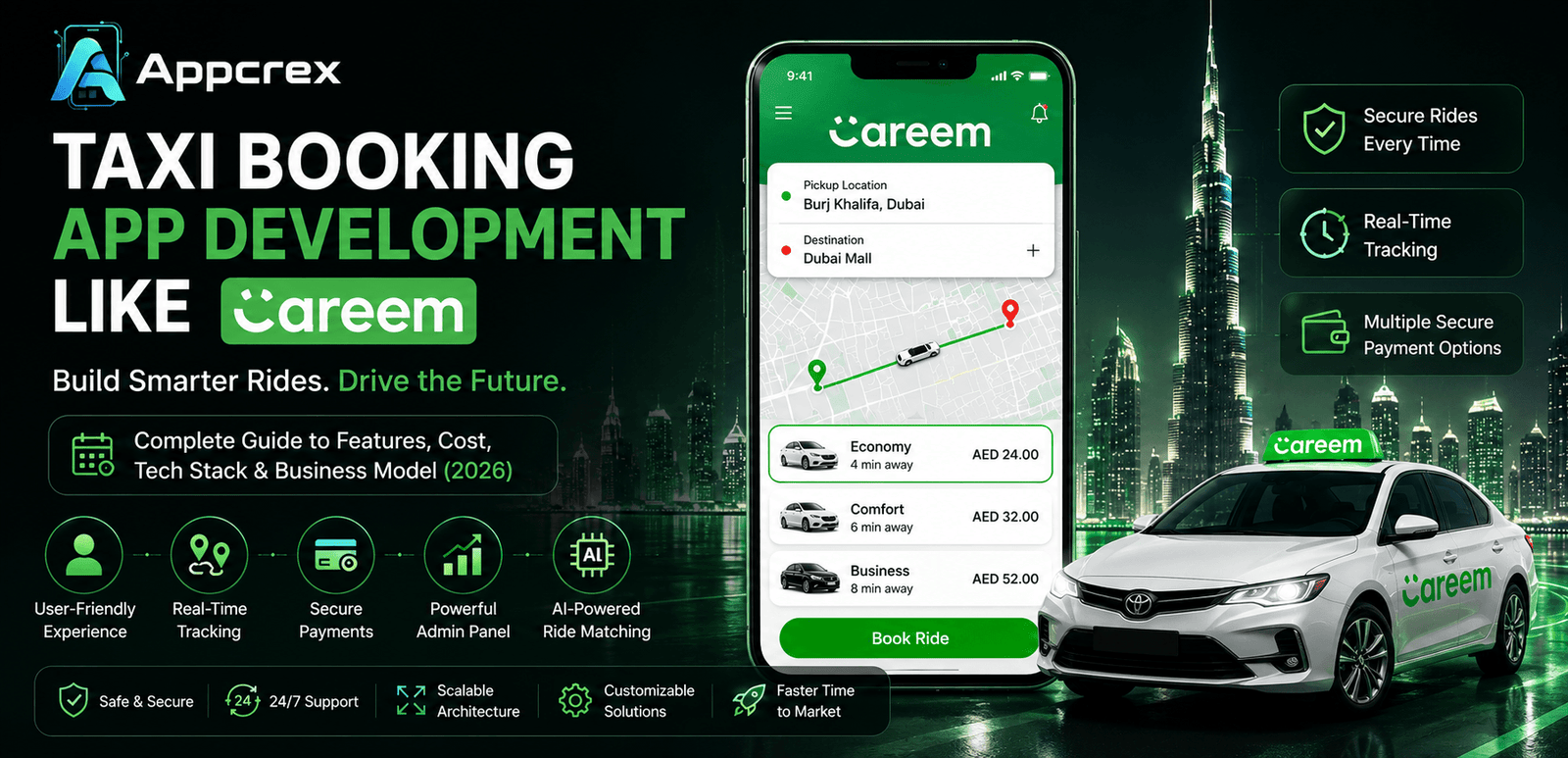
📌 Key Takeaways
- Build dedicated apps for passengers, drivers, and administrators to deliver a seamless ride-booking experience.
- Integrate GPS, real-time ride tracking, secure payments, and AI-powered ride matching for better performance.
- Choose a scalable technology stack that supports future expansion and high user traffic.
- Taxi booking app development costs typically range from $15,000 to $150,000+, depending on features and complexity.
- Partnering with an experienced taxi app development company helps reduce development risks and accelerate time to market.
Introduction
The ride-hailing industry has transformed urban transportation by making it easier for passengers to book rides anytime and anywhere using their smartphones. Platforms like Careem have become an essential part of daily commuting across the Middle East, particularly in the UAE, Saudi Arabia, Jordan, Egypt, and Pakistan. Their success has inspired many startups and enterprises to invest in taxi booking app development.
A taxi booking app like Careem is much more than a simple cab reservation platform. It combines GPS navigation, real-time ride tracking, digital payments, AI-powered ride matching, driver management, customer support, and analytics into one seamless ecosystem. With increasing smartphone adoption, cashless payments, and government initiatives supporting digital transformation, the demand for intelligent transportation solutions continues to grow.
Whether you’re planning to launch a local taxi service, build a ride-sharing platform, or develop a regional mobility solution, understanding the development process is the first step toward success.
In this complete guide, you’ll learn everything about Taxi Booking App Development Like Careem, including essential features, technology stack, development process, business models, monetization strategies, security, development costs, and the latest trends shaping the future of ride-hailing applications.
What Is a Taxi Booking App Like Careem?
A taxi booking app like Careem is an on-demand transportation platform that connects passengers with nearby drivers through a mobile application. It enables users to book rides, track drivers in real time, make secure online payments, and rate their overall experience.
Unlike traditional taxi services, modern ride-hailing applications use GPS technology, artificial intelligence, cloud computing, and digital payment systems to deliver a fast, secure, and user-friendly experience.
A Complete Careem-Like Platform Includes:
- Passenger Mobile App
- Driver Mobile App
- Admin Dashboard
- Dispatcher Panel (Optional)
- Customer Support Portal
Together, these components create a complete ecosystem for managing bookings, drivers, payments, and customer interactions.
Why Invest in Taxi Booking App Development in 2026?
The global ride-hailing industry continues to expand as more people rely on convenient and affordable transportation services.
Businesses are investing in taxi booking applications because they:
- Reduce operational costs
- Increase booking efficiency
- Improve customer satisfaction
- Generate recurring revenue
- Expand into multiple cities
- Enable digital payment adoption
Countries like the UAE and Saudi Arabia are witnessing significant growth in smart mobility initiatives, making this an ideal time to invest in ride-booking solutions.
Taxi Booking Market Overview
The demand for ride-hailing services continues to rise due to rapid urbanization, smartphone penetration, and changing consumer behavior.
Market Growth Drivers
- Growing urban population
- Increased smartphone usage
- Government support for smart transportation
- Expansion of cashless payment systems
- AI-powered mobility solutions
- Rising tourism and business travel
For startups and transportation companies, this creates significant opportunities to launch innovative taxi booking platforms.
How Does a Taxi Booking App Like Careem Work?
A taxi booking application follows a streamlined workflow to ensure a smooth user experience.
Step 1: User Registration
Passengers create an account using their mobile number, email, or social login.
↓
Step 2: Ride Booking
The user enters pickup and destination locations.
↓
Step 3: Fare Estimation
The app calculates the estimated fare based on distance, traffic, and demand.
↓
Step 4: Driver Matching
The system identifies and notifies the nearest available driver.
↓
Step 5: Ride Confirmation
The passenger receives driver details and estimated arrival time.
↓
Step 6: Live Ride Tracking
GPS enables real-time tracking of the driver’s location.
↓
Step 7: Payment
The passenger pays using cash, credit card, digital wallet, or other supported payment methods.
↓
Step 8: Rating & Feedback
Both the passenger and driver can rate each other, helping maintain service quality.
Core Features for the Passenger App
A user-friendly passenger app is essential for attracting and retaining customers.
Also Read : AI Agent Development Company: Complete Guide to Features, Benefits, Cost & Development Process (2026)
1. Easy Registration & Login
Allow users to sign up using:
- Mobile number
- Apple ID
- Social media accounts
2. Ride Booking
Passengers should be able to:
- Select pickup location
- Enter destination
- Choose ride type
- View fare estimates
- Schedule rides
3. Live GPS Tracking
Users can monitor the driver’s real-time location and estimated arrival time.
4. Fare Calculator
Display transparent fare estimates before confirming the booking.
5. Multiple Payment Options
Support various payment methods, including:
- Credit/Debit Cards
- Apple Pay
- Google Pay
- Digital Wallets
- Cash
- Buy Now, Pay Later (optional)
6. Ride History
Users can access previous bookings, invoices, and payment records.
7. Push Notifications
Notify users about:
- Ride confirmations
- Driver arrival
- Trip updates
- Payment status
- Promotional offers
8. Ratings & Reviews
Passengers can provide feedback after each ride, helping improve service quality.
9. SOS & Emergency Support
Provide emergency assistance by allowing passengers to:
- Share live location
- Contact emergency services
- Notify trusted contacts
10. In-App Chat & Calling
Enable secure communication between passengers and drivers without exposing personal phone numbers.
Driver App Features
The driver application is the backbone of a taxi booking platform. It helps drivers accept ride requests, navigate efficiently, manage earnings, and communicate with passengers.
1. Driver Registration & Verification
Drivers should be able to register quickly by submitting their personal and vehicle details.
Required Documents
- Driver’s License
- National ID/Passport
- Vehicle Registration
- Insurance Certificate
- Profile Photo
Admin approval ensures that only verified drivers can accept rides.
2. Online & Offline Status
Drivers can switch between:
- Online (Available for rides)
- Offline (Unavailable)
This gives drivers complete flexibility over their working hours.
3. Ride Request Management
Drivers receive instant ride requests showing:
- Passenger Name
- Pickup Location
- Destination
- Estimated Fare
- Distance to Pickup
Drivers can accept or decline requests based on availability.
Integrated navigation helps drivers reach passengers quickly.
- Google Maps
- Mapbox
- HERE Maps
Benefits include:
- Faster routes
- Traffic updates
- ETA calculation
6. Earnings Dashboard
Drivers should have access to:
- Daily Earnings
- Weekly Reports
- Monthly Income
- Incentives
- Bonuses
- Wallet Balance
7. Trip History
Drivers can view:
- Completed Trips
- Cancelled Trips
- Earnings Reports
- Customer Ratings
8. In-App Chat & Calling
Drivers can communicate securely with passengers without revealing personal phone numbers.
9. Ratings & Reviews
Passengers can rate drivers after every trip.
Higher ratings help drivers receive more ride requests.
10. SOS Button
Emergency support improves driver safety.
Drivers can instantly:
- Contact emergency services
- Notify company support
- Share live location
Admin Panel Features
The Admin Dashboard manages the complete taxi booking ecosystem.
1. Dashboard Analytics
View real-time statistics such as:
- Total Users
- Active Drivers
- Daily Trips
- Revenue
- Ride Completion Rate
2. Driver Management
Admins can:
- Approve Drivers
- Suspend Accounts
- Verify Documents
- Track Driver Performance
3. Passenger Management
Manage:
- Customer Profiles
- Ride History
- Wallet Balance
- Complaints
- Ratings
4. Booking Management
Monitor:
- Active Rides
- Completed Trips
- Cancelled Bookings
- Scheduled Rides
5. Fare Management
Configure:
- Base Fare
- Distance Charges
- Time Charges
- Peak Pricing
- Discounts
- Promo Codes
6. Payment Management
Track:
- Online Payments
- Cash Payments
- Wallet Transactions
- Driver Payouts
- Refund Requests
7. Reports & Analytics
Generate reports for:
- Revenue
- Ride Volume
- Driver Performance
- Customer Growth
- Cancellation Rate
8. Customer Support
Manage support tickets directly from the admin panel.
Advanced AI Features
Artificial Intelligence can significantly improve the performance and user experience of a Careem-like taxi booking application.
1. AI Ride Matching
AI automatically assigns the nearest and most suitable driver based on:
- Distance
- Traffic
- Driver Rating
- Availability
- Vehicle Type
2. Dynamic Pricing
AI adjusts pricing based on:
- Traffic Conditions
- Weather
- Demand
- Driver Availability
- Peak Hours
3. Route Optimization
AI recommends the fastest routes, helping reduce travel time and fuel consumption.
4. Fraud Detection
AI identifies suspicious activities such as:
- Fake Accounts
- Payment Fraud
- GPS Manipulation
- Duplicate Bookings
5. Demand Forecasting
Predict high-demand areas to improve driver availability and reduce passenger wait times.
6. Customer Support Chatbot
AI-powered chatbots provide instant assistance for:
- Ride Status
- Booking Issues
- Refund Requests
- FAQs
Also Read : AI Chatbot Integration Services: Benefits, Cost, Process & Business Use Cases (2026)
Business Models
Choosing the right business model is crucial for long-term profitability.
1. Aggregator Model
The platform connects passengers with independent drivers.
Examples:
- Careem
- Uber
2. Fleet Ownership Model
The company owns and manages all vehicles and drivers.
Ideal for premium transportation businesses.
3. Hybrid Model
Combines company-owned vehicles with independent drivers.
This offers greater flexibility and scalability.
4. Revenue Model
Successful taxi booking platforms generate income through multiple revenue streams.
Commission Per Ride
The platform earns a percentage of every completed ride.
Surge Pricing
Higher fares during peak demand increase revenue.
Subscription Plans
Drivers can subscribe to premium plans for additional benefits.
Advertisements
Businesses can promote their products within the app.
Cancellation Charges
Charge fees for late ride cancellations.
Corporate Accounts
Offer transportation services to businesses through monthly contracts.
Technology Stack
Selecting the right technology stack ensures scalability, security, and high performance.
1. Mobile App Development
- Flutter
- React Native
- Swift (iOS)
- Kotlin (Android)
2. Backend Development
- Node.js
- Python
- Django
- FastAPI
- .NET
3. Frontend Development
- React.js
- Angular
- Vue.js
4. Database
- PostgreSQL
- MongoDB
- MySQL
5. Cloud Services
- AWS
- Microsoft Azure
- Google Cloud Platform
- Google Maps API
- Mapbox
- HERE Maps
7. Payment Gateway
- Stripe
- PayPal
- Razorpay
- HyperPay
- Checkout.com
8. Push Notifications
- Firebase Cloud Messaging
- OneSignal
8. Third-Party Integrations
A Careem-like application depends on reliable third-party services.
9. Essential Integrations
- Maps API
- SMS Gateway
- Email Service
- Payment Gateway
- OTP Verification
- Analytics Tools
- Crash Reporting
- Customer Support Software
10. Taxi Booking App Architecture
Passenger App
        │
        ▼
API Gateway
        │
        ▼
Backend Server
        │
 ┌──────┼────────┐
 ▼      ▼        ▼
Driver  Admin   Database
 App    Panel
        │
        ▼
Google Maps + Payment Gateway
Careem vs Uber Comparison
| Feature | Careem | Uber |
|---|---|---|
| Middle East Focus | ✅ | Limited |
| Digital Wallet | ✅ | ✅ |
| Ride Scheduling | ✅ | ✅ |
| Corporate Accounts | ✅ | ✅ |
| Food Delivery | ✅ | ✅ |
| Multiple Ride Types | ✅ | ✅ |
Taxi Booking App Development Process
Developing a taxi booking application like Careem requires careful planning, robust technology, and a user-centric approach. Following a structured development process helps reduce risks, improve quality, and ensure timely delivery.
Step 1: Business Analysis
Begin by identifying your business objectives.
Define:
- Target audience
- Target cities or countries
- Revenue model
- Competitor analysis
- Unique selling proposition (USP)
This stage helps create a clear product roadmap.
Step 2: UI/UX Design
A clean and intuitive interface is critical for both passengers and drivers.
Design Deliverables
- User Flow
- Wireframes
- High-Fidelity UI
- Interactive Prototype
- Design System
A great user experience improves customer retention and engagement.
Step 3: Mobile App Development
Develop three separate applications:
Passenger App
For booking and managing rides.
Driver App
For accepting rides and tracking earnings.
Admin Dashboard
For managing users, drivers, rides, payments, and analytics.
Step 4: Backend Development
The backend powers all application functionalities.
Backend Modules
- Authentication
- Ride Matching Engine
- Payment Processing
- Notifications
- User Management
- Driver Management
- Analytics
Step 5: Third-Party Integrations
Connect your application with external services.
Integrations Include
- Google Maps API
- Payment Gateway
- SMS OTP
- Push Notifications
- Analytics
- Cloud Storage
- Email Services
Step 6: Testing
Thorough testing ensures a bug-free application.
Testing Types
- Functional Testing
- UI Testing
- Performance Testing
- Security Testing
- GPS Accuracy Testing
- Payment Testing
- User Acceptance Testing (UAT)
Step 7: Deployment
Launch the application on:
- Google Play Store
- Apple App Store
- Cloud Servers
Step 8: Maintenance & Updates
Continuous improvement keeps the platform competitive.
Ongoing Services
- Bug Fixes
- Feature Updates
- Security Patches
- Performance Optimization
- API Updates
Security Features
Security is one of the most critical aspects of a taxi booking application, as it handles sensitive user data, real-time locations, and online payments.
Secure Authentication
Support:
- OTP Login
- Email Verification
- Social Login
- Multi-Factor Authentication (MFA)
End-to-End Encryption
Encrypt:
- User Information
- Payment Details
- Chat Messages
- Ride Data
Secure Payment Processing
Use PCI DSS-compliant payment gateways to protect financial transactions.
Role-Based Access Control (RBAC)
Restrict access based on user roles such as passenger, driver, support agent, and administrator.
Also Read : App Store Optimization (ASO): Complete Guide to Improve App Visibility, Downloads & Rankings in 2026
GPS Security
Protect against fake GPS locations and spoofing attempts.
Fraud Detection
AI-powered monitoring can detect:
- Fake ride requests
- Duplicate accounts
- Payment fraud
- Suspicious driver behavior
How Much Does It Cost to Build a Taxi Booking App Like Careem?
The total development cost depends on app complexity, supported platforms, third-party integrations, and custom features.
Basic Taxi Booking App
Features
- Passenger App
- Driver App
- Admin Panel
- GPS Tracking
- Online Payments
Estimated Cost
$15,000 – $30,000
Medium Complexity Taxi App
Features
- Live Tracking
- Wallet
- Ratings
- Push Notifications
- Analytics
- Promotions
Estimated Cost
$30,000 – $60,000
Enterprise Taxi Platform
Features
- AI Ride Matching
- Dynamic Pricing
- Corporate Accounts
- Fleet Management
- Advanced Analytics
- Multi-City Support
- Loyalty Program
- Multi-Language
Estimated Cost
$60,000 – $150,000+
Cost Breakdown
| Development Stage | Estimated Cost |
|---|---|
| Business Analysis | $2,000–$5,000 |
| UI/UX Design | $3,000–$8,000 |
| Mobile App Development | $15,000–$45,000 |
| Backend Development | $10,000–$30,000 |
| API Integration | $3,000–$10,000 |
| Testing & QA | $3,000–$8,000 |
| Deployment | $1,000–$3,000 |
| Maintenance (Annual) | 15–20% of Development Cost |
Challenges in Taxi Booking App Development
Building a successful ride-hailing platform comes with several technical and operational challenges.
Driver Availability
Challenge: Insufficient drivers during peak hours.
Solution: Use AI-based demand forecasting and driver incentives.
GPS Accuracy
Challenge: Incorrect pickup or drop-off locations.
Solution: Integrate reliable mapping services and validate locations.
Payment Failures
Challenge: Interrupted or failed transactions.
Solution: Integrate multiple payment gateways with automatic retry mechanisms.
User Retention
Challenge: High competition in the ride-hailing industry.
Solution: Offer loyalty programs, referral bonuses, and personalized promotions.
Scalability
Challenge: Managing high traffic during busy periods.
Solution: Use cloud-native infrastructure with auto-scaling capabilities.
Future Trends in Taxi Booking Apps
The ride-hailing industry continues to evolve with emerging technologies.
AI-Powered Dispatch
Artificial intelligence will improve driver allocation and reduce passenger wait times.
Electric Vehicle (EV) Integration
Ride-hailing companies are increasingly adopting electric vehicles to reduce operational costs and support sustainability.
Autonomous Vehicles
Self-driving technology has the potential to reshape the future of urban mobility.
Voice-Based Booking
Users will be able to book rides through voice assistants for added convenience.
Super App Integration
Taxi services will increasingly be integrated into super apps that also offer food delivery, payments, shopping, and other digital services.
Why Choose AppCrex for Taxi Booking App Development?
At AppCrex, we build scalable, secure, and feature-rich taxi booking applications tailored to startups, enterprises, and transportation businesses.
Our Expertise
- Taxi Booking App Development
- Careem Clone App Development
- Uber-Like App Development
- On-Demand App Development
- Fleet Management Solutions
- AI-Powered Mobility Solutions
- GPS & Payment Integration
- Cross-Platform Mobile App Development
We focus on creating high-performance applications that deliver an exceptional experience for passengers, drivers, and administrators.
Frequently Asked Questions (FAQs)
Q. How long does it take to develop a taxi booking app like Careem?
Development typically takes 3–8 months, depending on the project’s complexity, features, and supported platforms.
Q. How much does a Careem-like app cost?
The estimated cost ranges from $15,000 to $150,000+, depending on customization, integrations, and scalability requirements.
Q. Which technologies are best for taxi booking app development?
Popular technologies include Flutter, React Native, Node.js, Python, AWS, Google Maps API, PostgreSQL, and Firebase.
Q. Can I launch the app on both Android and iOS?
Yes. Cross-platform frameworks such as Flutter and React Native allow businesses to build applications for both platforms efficiently.
Q. Which payment gateways can be integrated?
Popular options include Stripe, Checkout.com, HyperPay, PayPal, and regional payment providers depending on your target market.
Q. Can AI improve taxi booking applications?
Yes. AI can optimize ride matching, dynamic pricing, fraud detection, route planning, customer support, and demand forecasting.
Q. Is GPS tracking necessary?
Yes. Real-time GPS tracking is essential for ride booking, driver navigation, ETA calculation, and passenger safety.
Q. Can I build a white-label taxi booking solution?
Yes. A white-label solution can be customized with your branding, business model, and unique features, reducing development time and cost.
Conclusion
Taxi booking apps have transformed the transportation industry by offering fast, convenient, and reliable ride-hailing experiences. Inspired by platforms like Careem, businesses can create scalable mobility solutions that combine GPS tracking, secure payments, AI-powered dispatch, and seamless communication between passengers and drivers.
Whether you’re launching a local taxi service, expanding into multiple cities, or building the next generation of smart transportation solutions, investing in a feature-rich and scalable taxi booking platform can provide long-term business growth.
At AppCrex, we specialize in developing custom taxi booking applications that deliver outstanding user experiences, robust performance, and enterprise-grade security. From strategy and UI/UX design to development, deployment, and ongoing support, our team helps businesses bring innovative mobility solutions to market.