📌 Key Takeaways
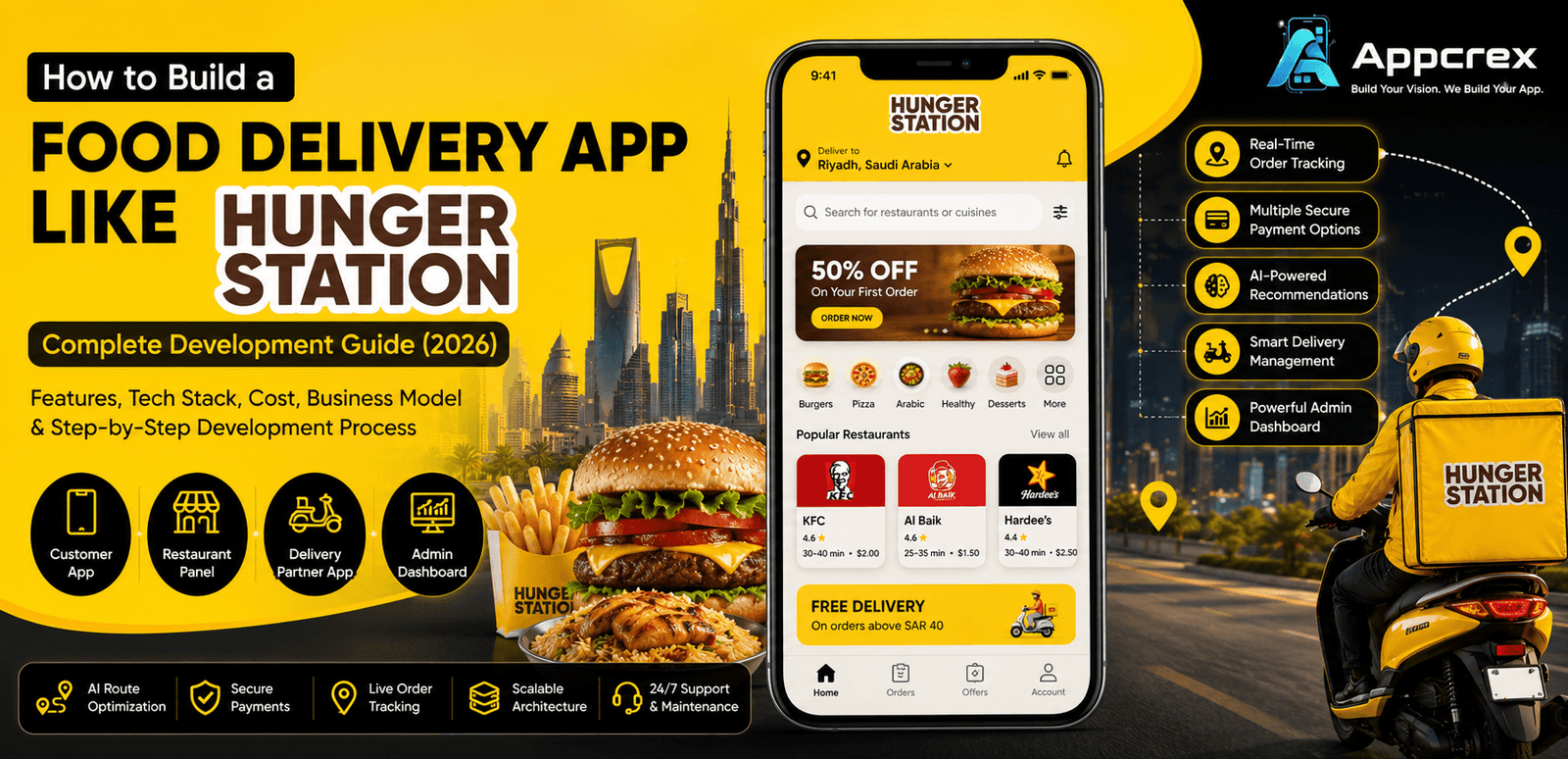
- Build separate apps for customers, restaurants, delivery partners, and admins.
- Include real-time tracking, secure payments, and AI-powered recommendations.
- Use a scalable tech stack like Flutter, React Native, Node.js, and AWS.
- A HungerStation-like app typically costs $20,000–$180,000+, depending on features.
- Launch a secure, scalable, and user-friendly platform to succeed in the growing food delivery market.
Introduction
The food delivery industry has experienced tremendous growth over the past decade, changing the way people order meals from restaurants. In Saudi Arabia, HungerStation has become one of the most recognized food delivery platforms by offering fast ordering, real-time delivery tracking, multiple payment options, and access to thousands of restaurants.
As consumer demand for convenience continues to grow, many startups, restaurant chains, and enterprises are investing in food delivery app development. A HungerStation-like platform enables businesses to connect customers, restaurants, and delivery partners through a single digital ecosystem while improving operational efficiency and customer satisfaction.
However, building a successful food delivery application involves much more than creating an attractive interface. Businesses need features such as real-time order tracking, secure payment gateways, restaurant management, delivery partner applications, AI-powered recommendations, route optimization, loyalty programs, and scalable cloud infrastructure.
Whether you want to launch a local food delivery service or create a multi-city delivery platform across Saudi Arabia and the GCC, understanding the development process is essential.
In this complete guide, you’ll learn everything about How to Build a Food Delivery App Like HungerStation, including essential features, technology stack, business model, development process, costs, security, monetization strategies, and future trends.
What is HungerStation?
HungerStation is one of Saudi Arabia’s leading food delivery platforms, connecting customers with thousands of restaurants, cafes, bakeries, grocery stores, pharmacies, and retail businesses. The platform enables users to browse menus, place orders, make secure online payments, and track deliveries in real time.
Since its launch, HungerStation has expanded across multiple cities in Saudi Arabia and has become a preferred choice for millions of users because of its wide restaurant network, fast delivery services, and seamless mobile experience.
A HungerStation-like application typically includes four major components:
- Customer Mobile App
- Restaurant Management Panel
- Delivery Partner App
- Admin Dashboard
Together, these components create a complete food delivery ecosystem that simplifies ordering, delivery, and business management.
Why Invest in Food Delivery App Development in 2026?
The food delivery industry continues to grow rapidly due to changing consumer behavior, digital payments, and increasing smartphone usage.
More people prefer ordering food online because it is faster, more convenient, and offers greater restaurant choices than traditional ordering methods.
Businesses investing in food delivery apps benefit from:
Higher Revenue
Restaurants receive more online orders without depending only on walk-in customers.
Better Customer Experience
Customers enjoy faster ordering, real-time tracking, secure payments, and personalized offers.
Business Expansion
Food delivery platforms allow restaurants to serve customers across multiple cities without opening additional locations.
Digital Payments
Modern payment gateways make transactions safer, faster, and more convenient.
Customer Loyalty
Reward programs, referral bonuses, and discount coupons encourage repeat orders.
Scalable Business Model
A HungerStation-like platform can gradually expand by adding grocery delivery, pharmacy delivery, cloud kitchens, and quick commerce services.
Also Read : Cost to Develop an App Like Toing Food Delivery App: Complete Guide
Food Delivery Market Overview
The online food delivery market continues to grow as consumers increasingly rely on digital ordering platforms.
Key Growth Drivers
- Higher smartphone adoption
- Expansion of cashless payment methods
- Urban lifestyles
- Increasing internet penetration
- Cloud kitchen growth
- AI-powered logistics
- Faster delivery expectations
Countries like Saudi Arabia, UAE, Qatar, and Kuwait continue investing heavily in digital commerce, making food delivery one of the fastest-growing mobile app categories.
How Does a Food Delivery App Like HungerStation Work?
A food delivery application follows a simple but highly optimized workflow.
Step 1
Customer registers or logs into the application.
↓
Step 2
Search restaurants based on:
- Location
- Cuisine
- Ratings
- Delivery Time
↓
Step 3
Browse the restaurant menu.
↓
Step 4
Add food items to the cart.
↓
Step 5
Apply coupons or promo codes.
↓
Step 6
Choose a payment method.
↓
Step 7
Restaurant receives the order.
↓
Step 8
Restaurant prepares the meal.
↓
Step 9
Delivery partner accepts the order.
↓
Step 10
Customer tracks delivery in real time.
↓
Step 11
Food is delivered successfully.
↓
Step 12
Customer rates the restaurant and delivery experience.
Customer App Features
The customer application is the face of your food delivery platform. It should provide a smooth, fast, and intuitive experience.
Easy Registration & Login
Allow users to sign up using:
- Mobile Number
- Google Account
- Apple ID
- Social Login
Smart Restaurant Search
Customers should easily find restaurants using filters such as:
- Nearby Restaurants
- Cuisine
- Delivery Time
- Ratings
- Offers
- Price Range
Menu Browsing
Display detailed information including:
- Food Images
- Descriptions
- Ingredients
- Prices
- Customization Options
Cart Management
Customers can:
- Add Items
- Remove Items
- Update Quantity
- Save Favorite Orders
Multiple Payment Methods
Support secure payment options such as:
- Credit Cards
- Debit Cards
- Apple Pay
- Google Pay
- Digital Wallets
- Cash on Delivery (where applicable)
Real-Time Order Tracking
Customers should receive live updates from order confirmation to delivery.
Tracking includes:
- Restaurant Preparation
- Rider Assigned
- Rider Location
- Estimated Delivery Time
Push Notifications
Send notifications for:
- Order Confirmation
- Food Preparation
- Rider Assigned
- Delivery Updates
- Promotional Offers
Ratings & Reviews
Allow customers to rate:
- Restaurant
- Food Quality
- Delivery Partner
- Overall Experience
Favorite Restaurants
Users can save frequently ordered restaurants for faster reordering.
Order History
Customers should be able to:
- View Previous Orders
- Download Invoices
- Reorder with One Click
Restaurant Panel Features
The restaurant dashboard helps restaurant owners efficiently manage incoming orders and daily operations.
Restaurant Registration
Restaurants can submit:
- Business Details
- Menu
- Licenses
- Delivery Information
Menu Management
Restaurants can:
- Add New Items
- Update Prices
- Upload Images
- Mark Items as Available or Unavailable
Order Management
Restaurant staff can:
- Accept Orders
- Reject Orders
- Update Preparation Status
- Notify Customers
Delivery Assignment
Restaurants can assign delivery requests to available riders or rely on automatic dispatch.
Sales Dashboard
Track:
- Daily Orders
- Weekly Revenue
- Monthly Sales
- Best-Selling Items
- Customer Ratings
Promotional Campaigns
Restaurants can create:
- Discount Offers
- Combo Deals
- Coupon Codes
- Loyalty Rewards
Also read : AI Agent Development Company: Complete Guide to Features, Benefits, Cost & Development Process (2026)
Delivery Partner App Features
Delivery executives play a critical role in ensuring timely deliveries and customer satisfaction.
Easy Registration
Delivery partners can register by submitting:
- Personal Details
- Driving License
- Vehicle Information
- Identity Proof
- Bank Account Details
Online & Offline Status
Delivery partners can control their availability by switching between online and offline modes.
Order Notifications
Receive instant notifications containing:
- Pickup Location
- Delivery Address
- Estimated Earnings
- Distance
Integrated navigation helps riders reach restaurants and customers quickly using optimized routes.
Earnings Dashboard
Track:
- Daily Earnings
- Weekly Income
- Incentives
- Bonuses
- Wallet Balance
Delivery History
View completed deliveries, canceled orders, customer ratings, and payment history.
In-App Chat & Calling
Secure communication with restaurants and customers without revealing personal contact information.
Ratings & Performance
Delivery partners can monitor their ratings and performance metrics to improve service quality.
Why These Features Matter?
A successful food delivery platform depends on delivering a seamless experience for all users:
- Customers need quick ordering and live tracking.
- Restaurants require efficient order and menu management.
- Delivery partners need reliable navigation and earnings tracking.
- Admins need complete control over operations and analytics.
Balancing the needs of all stakeholders helps create a scalable and competitive food delivery ecosystem.
Admin Dashboard Features
The admin dashboard acts as the central control panel of the entire food delivery ecosystem. It allows administrators to manage restaurants, customers, delivery partners, payments, promotions, and business analytics from a single interface.
Customer Management
The admin can:
- View customer profiles
- Block or suspend accounts
- Monitor order history
- Handle customer complaints
- Manage wallet balances
Restaurant Management
Administrators can:
- Approve restaurant registrations
- Verify business documents
- Manage restaurant listings
- Monitor restaurant performance
- Enable or disable restaurants
Delivery Partner Management
The admin dashboard enables:
- Driver verification
- Approval of delivery partners
- Performance monitoring
- Earnings management
- Suspension of inactive accounts
Order Management
Monitor every order in real time.
Features include:
- Pending Orders
- Preparing Orders
- Out for Delivery
- Completed Orders
- Cancelled Orders
- Refund Requests
Promotion Management
Create marketing campaigns such as:
- Coupon Codes
- Referral Programs
- Cashback Offers
- Festival Discounts
- Free Delivery Campaigns
Analytics Dashboard
Track important KPIs including:
- Daily Orders
- Monthly Revenue
- Active Customers
- Active Restaurants
- Delivery Success Rate
- Average Delivery Time
- Best Selling Restaurants
- Customer Retention Rate
Also Read : AI Chatbot Integration Services: Benefits, Cost, Process & Business Use Cases (2026)
AI Features for a HungerStation-Like App
Artificial Intelligence helps improve efficiency, customer satisfaction, and business profitability.
AI Food Recommendations
Recommend dishes based on:
- Previous Orders
- Favorite Restaurants
- Dietary Preferences
- Location
- Time of Day
Smart Delivery Assignment
AI automatically assigns orders to the most suitable delivery partner by considering:
- Distance
- Traffic
- Rider Availability
- Vehicle Type
- Delivery Time
Route Optimization
AI identifies the fastest delivery route to reduce delays and fuel costs.
Demand Prediction
Forecast peak hours and high-demand locations to improve restaurant and rider availability.
AI Customer Support
An AI chatbot can instantly answer common questions related to:
- Order Status
- Refund Requests
- Payments
- Delivery Delays
- Restaurant Information
Fraud Detection
AI helps identify suspicious activities such as:
- Fake Orders
- Coupon Abuse
- Payment Fraud
- Duplicate Accounts
Business Model
Several business models can be used to launch a food delivery platform.
Marketplace Model
The platform connects customers with multiple restaurants and delivery partners.
Example:
- HungerStation
Restaurant-Owned Model
A single restaurant chain manages its own deliveries.
Ideal for:
- Pizza Chains
- Fast Food Brands
- Cloud Kitchens
Hybrid Model
Combines restaurant-owned delivery with third-party delivery partners.
Revenue Model
A successful food delivery application generates income from multiple sources.
Commission from Restaurants
Charge a percentage commission for every completed order.
Delivery Charges
Customers pay a delivery fee based on:
- Distance
- Delivery Time
- Order Value
Subscription Plans
Offer premium memberships that include:
- Free Delivery
- Exclusive Discounts
- Priority Delivery
Advertisements
Restaurants can pay to promote their listings within the app.
Surge Pricing
Increase delivery charges during high-demand periods.
Featured Restaurant Listings
Restaurants can pay for premium placement in search results.
Technology Stack
Choosing the right technology stack is essential for building a secure, scalable, and high-performance food delivery platform.
Mobile App Development
- Flutter
- React Native
- Swift (iOS)
- Kotlin (Android)
Backend Development
- Node.js
- Python
- Django
- FastAPI
- .NET
Frontend Development
- React.js
- Angular
- Vue.js
Database
- PostgreSQL
- MongoDB
- MySQL
Cloud Platform
- AWS
- Microsoft Azure
- Google Cloud
- Google Maps API
- Mapbox
- HERE Maps
Payment Gateways
- Stripe
- Checkout.com
- HyperPay
- PayPal
Push Notifications
- Firebase Cloud Messaging
- OneSignal
Third-Party Integrations
A food delivery platform depends on multiple external services for smooth operations.
Essential Integrations
- Payment Gateway
- Maps & Navigation
- SMS OTP
- Email Notifications
- Push Notifications
- Cloud Storage
- Analytics Tools
- Customer Support Software
Food Delivery App Development Process
Step 1 – Business Planning
- Market Research
- Competitor Analysis
- Business Model
- Feature Planning
Step 2 – UI/UX Design
Create:
- Wireframes
- User Journey
- Interactive Prototype
- Final UI Design
Step 3 – App Development
Develop:
- Customer App
- Restaurant App
- Delivery Partner App
- Admin Dashboard
Step 4 – API Integration
Integrate:
- Maps
- Payment Gateway
- Notifications
- Authentication
- Analytics
Step 5 – Testing
Perform:
- Functional Testing
- Performance Testing
- Security Testing
- Device Compatibility Testing
- User Acceptance Testing (UAT)
Step 6 – Deployment
Publish the apps on:
- Google Play Store
- Apple App Store
Step 7 – Maintenance
Regular updates include:
- Bug Fixes
- Performance Improvements
- New Features
- Security Updates
Security Features
A secure food delivery application builds user trust and protects sensitive information.
Essential Security Measures
- Multi-Factor Authentication (MFA)
- End-to-End Data Encryption
- Secure Payment Processing
- Role-Based Access Control (RBAC)
- PCI DSS-Compliant Payment Gateways
- GDPR & Regional Privacy Compliance
- Real-Time Fraud Detection
- Regular Security Audits
How Much Does It Cost to Build a Food Delivery App Like HungerStation?
The development cost depends on app complexity, features, supported platforms, integrations, and scalability requirements.
| App Type | Estimated Cost |
|---|---|
| Basic MVP | $20,000–$40,000 |
| Medium Complexity | $40,000–$80,000 |
| Enterprise Platform | $80,000–$180,000+ |
Cost Breakdown
| Development Phase | Estimated Cost |
|---|---|
| Business Analysis | $3,000–$7,000 |
| UI/UX Design | $5,000–$10,000 |
| Mobile App Development | $20,000–$60,000 |
| Backend Development | $15,000–$40,000 |
| Third-Party Integrations | $5,000–$15,000 |
| Testing & QA | $5,000–$10,000 |
| Deployment | $2,000–$5,000 |
| Annual Maintenance | 15–20% of Development Cost |
Challenges & Solutions
| Challenge | Solution |
|---|---|
| High Order Volume | Cloud Auto-Scaling |
| Delivery Delays | AI Route Optimization |
| Payment Failures | Multiple Payment Gateways |
| Customer Retention | Loyalty Programs & Personalized Offers |
| Restaurant Management | Automated Dashboard & Analytics |
Future Trends in Food Delivery Apps
The food delivery industry is evolving rapidly with new technologies.
AI-Powered Personalization
Smarter recommendations based on user behavior.
Drone & Autonomous Delivery
Emerging delivery methods for faster service.
Voice Ordering
Integration with voice assistants for hands-free ordering.
Quick Commerce
Delivery within 10–30 minutes is becoming increasingly popular.
Sustainable Deliveries
Use of electric vehicles and eco-friendly packaging to reduce environmental impact.
Why Choose AppCrex?
AppCrex develops secure, scalable, and custom food delivery solutions tailored to your business goals.
Our Expertise
- Food Delivery App Development
- HungerStation Clone Development
- Restaurant App Development
- Grocery Delivery App Development
- On-Demand Delivery Solutions
- AI Integration
- Cross-Platform App Development
- Cloud-Based Backend Development
From planning and design to deployment and long-term support, we help businesses launch reliable and scalable food delivery platforms.
(FAQs)
Q. How long does it take to build a food delivery app like HungerStation?
A typical project takes 4–8 months, depending on features and complexity.
Q. How much does it cost?
Development usually ranges from $20,000 to $180,000+, based on the scope of the project.
Q. Which technologies are best?
Flutter, React Native, Node.js, Python, PostgreSQL, AWS, Google Maps API, and Firebase are widely used for modern food delivery applications.
Q. Can I launch on Android and iOS?
Yes. Cross-platform frameworks like Flutter and React Native support both platforms from a shared codebase.
Q. Which payment gateways can be integrated?
Stripe, Checkout.com, HyperPay, PayPal, and other regional payment providers can be integrated based on your target market.
Q. Can AI improve food delivery apps?
Yes. AI can optimize order assignment, route planning, customer support, recommendations, and fraud detection.
Q. Is real-time tracking necessary?
Yes. Live order tracking improves transparency, customer satisfaction, and delivery efficiency.
Q. Can I customize the platform for my business?
Absolutely. Features, branding, business model, and integrations can all be customized to meet your specific requirements.
Conclusion
Building a food delivery app like HungerStation requires a combination of intuitive design, scalable architecture, reliable payment systems, real-time logistics, and AI-powered automation. By offering dedicated applications for customers, restaurants, delivery partners, and administrators, businesses can create a seamless ecosystem that improves operational efficiency and customer satisfaction.
Whether you’re launching a local delivery startup or expanding into multiple cities across Saudi Arabia or the GCC, investing in a feature-rich food delivery platform can create long-term growth opportunities. Choosing the right technology stack and an experienced development partner will help ensure your platform is secure, scalable, and ready for future expansion.
Looking to build a food delivery app like HungerStation?
AppCrex specializes in developing custom food delivery platforms with advanced features such as AI-powered recommendations, real-time tracking, secure payment integration, restaurant management, and scalable cloud infrastructure. Contact our team to transform your food delivery app idea into a successful digital business.