📌 Key Takeaways
- Groww-like apps combine investing, portfolio management, payments, and financial APIs.
- KYC, secure transactions, market data, and portfolio tracking are essential features.
- Development cost depends on features, integrations, security, and compliance requirements.
- A focused MVP can help validate the investment app before adding advanced features.
- AI, analytics, and personalized experiences can help differentiate the platform.
Introduction
Digital investing has changed significantly with the growth of mobile-first financial platforms. Users no longer want to manage every investment activity through separate websites, offline processes, or complicated financial interfaces. They increasingly expect a simple mobile experience where they can discover investment products, complete onboarding, monitor their portfolio, and manage transactions from one place.
This has created a strong opportunity for businesses interested in investment app development.
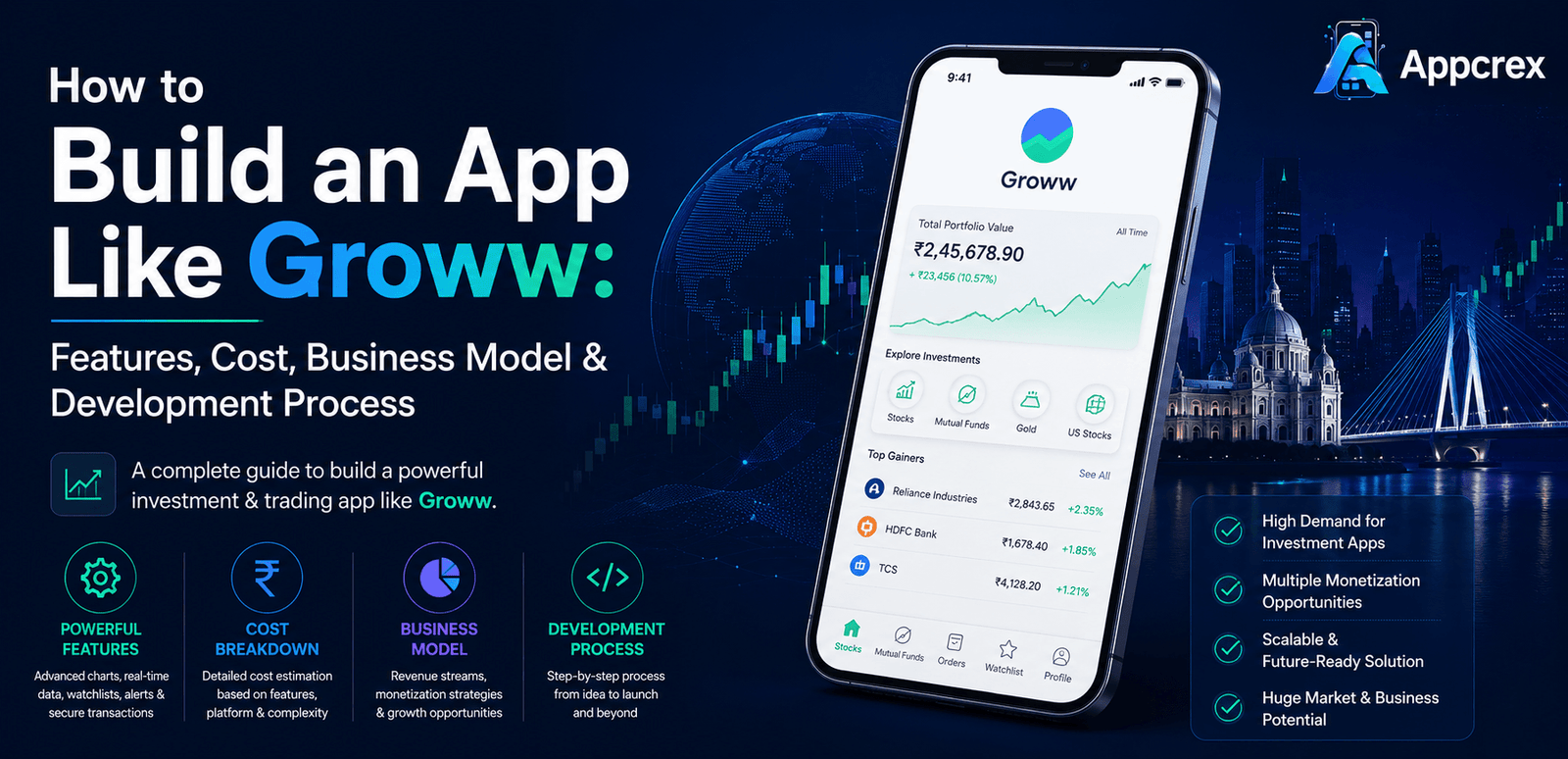
Platforms like Groww demonstrate how a simple user experience can bring multiple investment-related services together. However, building an app like Groww is not simply about copying the visible features of an existing platform. A successful investment platform requires a secure technical architecture, financial integrations, KYC and onboarding workflows, reliable market data, portfolio management, payment infrastructure, regulatory planning, and a scalable backend.
This guide explains how to build an app like Groww, including its features, development process, technology stack, security requirements, business model, development cost, timeline, and monetization opportunities.
What Is Groww?
Groww is a digital investment platform that provides users with access to investment-related products and services through a mobile and online experience.
The broader concept behind a Groww-like platform is to simplify investing by bringing different activities into one digital ecosystem.
Depending on the business model, target market, partnerships, and regulatory permissions, an investment platform can potentially support products and services such as:
- Stocks
- Mutual funds
- ETFs
- IPOs
- Bonds
- Digital investment products
- Portfolio management
- Investment research
- Financial education
- Market information
A company planning to build a similar product should first decide which financial products it wants to support rather than trying to launch everything simultaneously.
Just Read : Push Notification Guide: Benefits, Types & Best Practices (2026)
Why Build an App Like Groww?
The investment industry is increasingly moving toward digital experiences.
A mobile investment platform can provide customers with faster access to information and make account management more convenient.
Key business opportunities include:
- Growing demand for digital investment services
- Increasing smartphone usage
- Demand for simple financial interfaces
- Personalized financial experiences
- Digital onboarding
- Portfolio tracking
- Subscription-based premium services
- Financial education
- AI-powered financial assistance
For startups, financial businesses, and technology companies, an investment platform can also become the foundation for a larger financial ecosystem.
Instead of launching only a stock-trading product, a company can gradually expand into mutual funds, wealth management, financial education, analytics, and other permitted services.
How Does an App Like Groww Work?
A Groww-like application normally involves multiple systems working together.
A simplified architecture looks like:
User → Mobile App → Authentication → KYC → Backend → Financial APIs → Transaction Infrastructure → Portfolio → Notifications
The user interacts with the mobile application, while the backend communicates with financial service providers and other third-party systems.
Typical workflow:
- User downloads the application.
- User creates an account.
- Mobile number/email is verified.
- User completes required KYC.
- Bank and other financial details are verified.
- User explores investment products.
- Market and product information is displayed.
- User submits an investment or trading instruction.
- Relevant financial infrastructure processes the transaction.
- Portfolio and transaction information are updated.
- User receives confirmation and notifications.
This is why investment app development is more complex than ordinary eCommerce or service applications.
Key Features of an App Like Groww
The feature set should be divided into customer-facing features, financial infrastructure, and administrative functionality.
1. User Registration & Login
The onboarding process should be simple while maintaining appropriate security.
Features can include:
- Mobile number registration
- Email registration
- OTP verification
- Password/PIN
- Biometric authentication
- Device verification
- Secure login
- Account recovery
- Terms and consent management
A simple onboarding experience can reduce user drop-off.
2. Digital KYC & Verification
KYC is a critical component of a financial platform.
Depending on the target country and services provided, the application may require:
- Identity verification
- Government ID verification
- Address verification
- PAN or equivalent tax identification
- Bank account verification
- Selfie/liveness verification
- Digital signatures
- KYC status tracking
The exact workflow must be designed according to the applicable financial regulations and service providers.
3. Investment Dashboard
The dashboard should give users a quick understanding of their investments.
It can display:
- Total portfolio value
- Invested amount
- Current value
- Profit/loss
- Returns
- Asset allocation
- Recent transactions
- Watchlist
- Investment products
- Portfolio performance
The dashboard should avoid unnecessary complexity and present financial information in an understandable format.
4. Stock Investment & Trading
If stock trading is part of the business model, the application may include:
- Stock search
- Company information
- Market prices
- Price charts
- Buy/sell functionality
- Order status
- Holdings
- Watchlists
- Transaction history
- Market information
- Corporate-action information
The availability and timing of market information depend on data-provider arrangements and applicable market rules.
5. Mutual Fund Investment
Mutual funds can be integrated into an investment platform through appropriate financial infrastructure.
Possible features include:
- Fund discovery
- Fund categories
- Fund details
- Performance information
- Risk information
- SIP investment
- One-time investment
- Portfolio tracking
- Transaction history
- Fund comparison
A strong search and filtering experience can help users find relevant investment products more easily.
6. SIP Management
SIP functionality can allow users to schedule recurring investments.
Users may be able to:
- Create a SIP
- Select investment amount
- Choose frequency
- Select start date
- Modify SIP
- Pause SIP
- Cancel SIP
- View upcoming installments
- Track SIP performance
Automation makes recurring investments easier to manage.
7. IPO Investment
If IPO functionality is included, the platform can provide:
- Upcoming IPOs
- IPO information
- Subscription details
- Application functionality
- Application status
- Allotment information
- Notifications
The implementation depends on the relevant market infrastructure and regulatory requirements.
8. Portfolio Management
Portfolio management is one of the most important components of an investment app.
Users should be able to see:
- Individual holdings
- Total investment
- Current value
- Profit/loss
- Asset allocation
- Historical performance
- Transaction history
- Portfolio diversification
- Investment returns
Advanced platforms can provide portfolio analytics to help users understand their overall investment position.
9. Watchlist
A watchlist allows users to monitor financial products without immediately investing.
Users can add:
- Stocks
- ETFs
- Mutual funds
- Other supported products
The watchlist can display price changes, percentage movement, and other permitted market information.
10. Market Data & Charts
Market information is essential for investment applications.
Depending on data licensing, integrations may provide:
- Current market information
- Historical prices
- Charts
- Market indices
- Trading volume
- Company information
- Performance information
The application should clearly communicate whether information is real-time, delayed, or subject to other limitations.
11. Notifications & Alerts
Notifications keep users informed about account activity.
Examples include:
- Login alerts
- KYC updates
- Order confirmation
- Transaction confirmation
- SIP reminders
- Portfolio updates
- Price alerts
- IPO notifications
- Security alerts
Users should have control over non-essential marketing notifications.
12. Payment & Bank Integration
Investment platforms often require secure connections with banking and payment infrastructure.
Depending on the market, integrations may support:
- Bank verification
- Account linking
- Deposits
- Withdrawals
- Recurring payments
- Transaction confirmation
- Payment status
Financial transactions should be handled through appropriately authorized infrastructure.
13. Investment Research
Research functionality can make an investment platform more useful.
The platform can provide:
- Company information
- Fund information
- Market news
- Financial metrics
- Historical information
- Educational content
- Product comparisons
If a platform provides regulated investment advice or recommendations, additional legal and regulatory requirements may apply.
14. Financial Education
Investment applications can also provide educational content for beginners.
Examples include:
- Investment guides
- Market explainers
- Financial terminology
- Video tutorials
- Articles
- FAQs
- Investment basics
This can improve user understanding and engagement without turning the platform into an unsuitable recommendation engine.
15. Customer Support
Financial applications require reliable customer support.
A support system can include:
- Help center
- FAQs
- Chat support
- Support tickets
- Email support
- Call support
- Transaction assistance
AI-powered support can handle common questions, while sensitive or complex financial issues can be transferred to human support teams.
Also Read : How Much Does It Cost to Develop an App in 2026? Complete Pricing Guide
Advanced Features for a Groww-Like App
Once the core product is established, businesses can introduce advanced capabilities.
AI Investment Assistant
AI can be used for:
- Financial terminology explanations
- Product search
- Educational questions
- Document summarization
- Platform navigation
- Customer support
- Portfolio insights
However, AI-generated financial guidance should be carefully designed and reviewed against applicable regulations.
AI-Powered Search
Instead of using only traditional filters, users could search naturally.
For example:
“Show me technology companies with strong historical performance.”
The application can interpret the query and return relevant information based on permitted data and clearly defined criteria.
Personalized Dashboard
The application can customize the user’s experience using:
- Investment preferences
- Watchlists
- Portfolio information
- Product interests
- User activity
Portfolio Analytics
Advanced analytics can show:
- Asset allocation
- Portfolio concentration
- Historical returns
- Risk indicators
- Performance comparisons
- Diversification information
Admin Panel Features
A powerful admin dashboard is essential for managing the investment platform.
User Management
Administrators can manage:
- User accounts
- KYC status
- Verification
- Account activity
- User restrictions
- Support requests
Transaction Management
The admin panel can provide visibility into:
- Transactions
- Orders
- Payment status
- Investment activity
- Failed transactions
- Refunds where applicable
Product Management
Administrators can manage:
- Investment products
- Product information
- Categories
- Content
- Availability
Content Management
The platform can manage:
- Articles
- Financial education
- Notifications
- FAQs
- Market-related content
Analytics Dashboard
Business administrators can monitor:
- New registrations
- Active users
- Transactions
- Product engagement
- Revenue
- Customer retention
- Platform performance
Role-Based Access
Different employees should have different permissions.
For example:
- Support staff
- Compliance staff
- Finance team
- Operations team
- Administrators
This reduces the risk of unauthorized access to sensitive operations.
Also Read : What Is API Integration? A Complete Guide to Benefits, Types & Best Practices (2026)
Technology Stack for an App Like Groww
The technology stack should be selected according to the platform’s scale, financial integrations, security requirements, and long-term roadmap.
Mobile Development
- Flutter
- React Native
- Swift
- Kotlin
Frontend
- React
- Next.js
- TypeScript
Backend
- Node.js
- Python
- Java
- .NET
Databases
- PostgreSQL
- MySQL
- MongoDB
- Redis
Cloud
- AWS
- Microsoft Azure
- Google Cloud
APIs
- KYC APIs
- Payment APIs
- Banking APIs
- Market-data APIs
- Brokerage APIs
- Notification APIs
- Identity verification APIs
AI & Analytics
- Machine Learning
- Generative AI
- Natural Language Processing
- Predictive Analytics
- Recommendation systems
For financial applications, technology should be selected primarily around security, reliability, scalability, monitoring, and regulatory requirements.
Security Features for an Investment App
Security should be considered from the beginning of the development process.
An investment platform may store sensitive information related to:
- Identity
- Bank accounts
- Transactions
- Investments
- Personal data
Important security controls can include:
Data Encryption
Sensitive information should be appropriately encrypted during transmission and storage.
Multi-Factor Authentication
MFA can provide an additional layer of account protection.
Secure API Architecture
APIs should implement appropriate:
- Authentication
- Authorization
- Input validation
- Rate limiting
- Monitoring
Fraud Monitoring
Unusual account activity can be monitored to identify potentially suspicious behavior.
Audit Logs
Important administrative and transactional activities should be recorded.
Access Control
Employees should only receive access to the information and functions required for their roles.
Backup & Disaster Recovery
Financial platforms should have appropriate backup and recovery strategies to reduce the impact of infrastructure failures.
Compliance Considerations for a Groww-Like App
This is one of the biggest differences between a standard mobile application and an investment platform.
The regulatory requirements depend on:
- Country
- Investment products
- Business model
- Licensing
- Financial partners
- Custody structure
- Payment model
- Advisory services
For an India-focused product, applicable requirements may involve organizations and frameworks associated with SEBI, RBI, NPCI, and other relevant authorities depending on the exact services being provided.
A platform facilitating securities transactions may have very different obligations from an application that only provides financial education.
Therefore, businesses should determine their regulatory and licensing structure before development begins.
Technology and compliance teams should work together rather than treating compliance as a final-stage activity.
How to Build an App Like Groww?
Step 1: Define Your Business Model
Start by deciding what your platform will actually provide.
For example:
- Stock investment
- Mutual funds
- ETFs
- IPOs
- Wealth management
- Investment education
A focused MVP is usually easier to validate than a platform containing every financial product from day one.
Step 2: Research the Target Market
Study:
- Target customers
- Competitors
- Investment behavior
- Product demand
- Regulatory environment
- Revenue opportunities
This helps determine which features should be prioritized.
Step 3: Define Regulatory Requirements
Before writing code, determine:
- Licensing requirements
- KYC requirements
- Data protection obligations
- Transaction rules
- Financial disclosures
- Reporting requirements
- Partner requirements
This stage can significantly influence the application architecture.
Step 4: Select Financial Partners
Depending on your business model, you may require partnerships for:
- Brokerage
- Market data
- KYC
- Payments
- Banking
- Mutual funds
- Identity verification
The available partners will vary by country.
Step 5: Create UI/UX Design
Design important journeys such as:
- Registration
- KYC
- Investment discovery
- Product details
- Investment
- Portfolio
- Withdrawals
- Support
Financial interfaces should make complicated information easy to understand.
Step 6: Develop the Backend
The backend manages:
- Users
- KYC
- Transactions
- Portfolio data
- APIs
- Notifications
- Analytics
- Security
- Admin operations
A scalable backend is particularly important if the platform expects large numbers of users or high transaction volumes.
Also Read : How Much Does It Cost to Build an App in Delhi NCR? Complete Pricing Guide
Step 7: Develop the Mobile App
The customer application can be developed for Android, iOS, or both.
Depending on the product, businesses can select native development or cross-platform technologies such as Flutter or React Native.
Step 8: Integrate Financial APIs
Financial integrations connect the application to external infrastructure.
This may include:
- Market data
- KYC
- Brokerage
- Payments
- Banking
- Investment products
These integrations require careful error handling and extensive testing.
Step 9: Testing & Security
Testing should cover:
- Functional testing
- API testing
- Security testing
- Performance testing
- Device compatibility
- Authentication
- Transaction workflows
- Failure scenarios
Security reviews should be performed before production launch.
Step 10: Launch the MVP
Instead of launching a huge platform immediately, start with the most important features.
For example, an MVP might include:
- Registration
- KYC
- Investment discovery
- Portfolio
- Transactions
- Notifications
- Support
- Admin dashboard
Additional financial products can be introduced after validating the initial product.
How Much Does It Cost to Build an App Like Groww?
The cost depends heavily on the application’s scope.
A rough estimate is:
| Development Level | Estimated Cost |
|---|---|
| Basic Investment MVP | $25,000–$50,000 |
| Medium Investment Platform | $50,000–$100,000 |
| Advanced Investment App | $100,000–$180,000+ |
| Full Groww-Like Platform | $180,000–$300,000+ |
These are development estimates rather than guaranteed project prices. Actual costs depend on the product requirements, development location, integrations, security, compliance, and team structure.
Major Cost Factors
Number of Platforms
Android-only development may cost less than building both Android and iOS applications.
UI/UX Complexity
Advanced financial dashboards, charts, portfolio analytics, and personalized interfaces require additional design and development effort.
Financial Integrations
KYC, brokerage, market-data, payment, banking, and investment APIs can significantly affect project costs.
Real-Time Data
Real-time market functionality may require specialized infrastructure and licensed data feeds.
Security
Financial platforms require more extensive security engineering than ordinary consumer applications.
Compliance
Compliance-related workflows can increase both development and operational requirements.
AI Features
AI assistants, recommendation engines, document processing, and analytics add additional development complexity.
How Long Does It Take to Build an App Like Groww?
A basic investment MVP may require around 4–6 months.
A more advanced platform can require approximately 6–12 months or longer.
A typical project may follow this timeline:
| Development Stage | Approximate Time |
|---|---|
| Research & Planning | 2–4 weeks |
| UI/UX Design | 4–6 weeks |
| Core Development | 10–16 weeks |
| Financial Integrations | 4–10 weeks |
| Testing & Security | 4–8 weeks |
| Deployment | 1–2 weeks |
Some activities can be performed simultaneously, so the overall project duration varies.
How Does an App Like Groww Make Money?
An investment platform can have multiple monetization options.
Transaction-Based Revenue
The platform may generate permitted revenue from transactions or related services depending on its business structure.
Premium Subscriptions
A premium plan can provide:
- Advanced analytics
- Additional portfolio tools
- Research content
- Premium educational resources
Research Services
Where permitted, research-oriented products can be offered through subscription or other approved models.
Distribution Revenue
Certain financial product distribution models can generate permitted commissions or revenue.
B2B Financial Technology
A company can also develop financial infrastructure and technology services for other financial businesses.
The monetization strategy must always be aligned with the applicable regulatory framework.
MVP vs Full Groww-Like App
Businesses do not necessarily need to build the entire platform at once.
Investment MVP
An MVP can include:
- Registration
- KYC
- User profile
- Investment discovery
- Portfolio
- Basic transactions
- Notifications
- Admin panel
Advanced Platform
A larger platform can add:
- Stocks
- Mutual funds
- ETFs
- IPOs
- Advanced portfolio analytics
- AI assistant
- Personalized recommendations
- Financial education
- Advanced research
- Multiple payment options
- Advanced security
- Multiple financial integrations
Starting with an MVP can reduce initial development risk and provide an opportunity to validate the product.
Challenges of Building an App Like Groww
Regulatory Complexity
Financial services are highly regulated, and requirements vary between countries.
Security
The application handles sensitive personal and financial information.
Financial Integrations
Third-party APIs can introduce dependencies and technical challenges.
Market Data
Market information may require licensed data providers and specialized infrastructure.
Scalability
The platform should remain stable during periods of high market activity.
User Trust
Financial applications need transparent processes, accurate information, strong security, and reliable customer support.
Fraud Prevention
The system should be designed to detect and respond to suspicious activity.
How to Make Your Investment App Different From Groww?
Simply copying an established platform is unlikely to create a strong competitive advantage.
Instead, focus on a specific user problem.
For example, you could build:
AI-Focused Investment Platform
Use AI to simplify financial research and education.
Beginner Investment App
Focus on first-time investors with simplified explanations and guided experiences.
Wealth Management Platform
Provide deeper portfolio analytics and wealth-management tools.
Investment Education Platform
Combine financial education with permitted investment services.
Goal-Based Investment Platform
Organize the experience around goals such as:
- Retirement
- Education
- Home purchase
- Long-term wealth creation
The strongest product is usually one that solves a clearly defined problem rather than simply duplicating another application’s feature list.
App Maintenance & Scalability
Launching the app is only the beginning.
Post-launch maintenance can include:
- Bug fixing
- Security updates
- API updates
- Platform updates
- Performance optimization
- Database optimization
- New features
- Compliance updates
- Cloud scaling
As user numbers grow, the architecture may need additional infrastructure for:
- Load balancing
- Caching
- Database scaling
- Monitoring
- Disaster recovery
- High availability
A scalable architecture from the beginning can reduce the difficulty of future expansion.
Why Choose AppCrex for Investment App Development?
AppCrex provides end-to-end mobile app development services for businesses looking to create financial and investment technology products.
Our capabilities include:
- Product Strategy
- UI/UX Design
- Android Development
- iOS Development
- Flutter Development
- React Native Development
- Backend Development
- API Integration
- AI Integration
- Cloud Development
- QA & Testing
- Security Implementation
- App Deployment
- Maintenance & Support
We can help businesses move from an initial concept to an MVP and then expand the product as user requirements and business opportunities evolve.
FAQs
How much does it cost to build an app like Groww?
A basic investment MVP may cost approximately $25,000–$50,000, while an advanced platform can cost $100,000–$300,000+ depending on features, integrations, security, compliance, and development requirements.
How long does it take to build a Groww-like app?
A basic MVP can take around 4–6 months. A more advanced investment platform may require 6–12 months or longer.
What are the most important features of a Groww-like app?
Core features include registration, KYC, investment discovery, portfolio management, transactions, market information, notifications, payment integration, customer support, and an admin dashboard.
Can I build an app like Groww for another country?
Yes. The technology can be adapted to other markets, but KYC, licensing, financial regulations, payment systems, brokerage infrastructure, and market-data requirements must be evaluated for the target country.
Can I build a Groww-like app without copying Groww?
Yes. You can build an original investment platform using common industry functionality while creating your own branding, interface, workflows, features, and business model.
Can AI be added to an investment application?
Yes. AI can support search, education, customer support, document processing, personalization, and analytics. Any AI feature that provides financial advice or recommendations should be reviewed for applicable regulatory requirements.
Does an investment app require KYC?
Platforms involved in regulated financial activities generally need to address applicable KYC and identity-verification requirements. The exact process depends on the target market and services offered.
Can AppCrex develop both Android and iOS investment apps?
Yes. AppCrex can develop Android and iOS applications using native or cross-platform technologies based on the project’s requirements.
Also Read : What Is an MVP in App Development? A Complete Guide
Conclusion
Building an app like Groww requires a combination of mobile development, financial infrastructure, secure APIs, KYC, payment systems, portfolio management, market data, analytics, and regulatory planning.
The most practical approach is to start with a clearly defined investment product and develop an MVP around the most important user requirements. Once the product is validated, businesses can expand into additional investment products, AI-powered experiences, portfolio analytics, financial education, and advanced wealth-management capabilities.
The development cost can range from a relatively focused MVP to a much larger investment platform depending on the functionality, integrations, security requirements, and target market.
The key is to build a secure, scalable, user-friendly, and regulation-aware investment platform, rather than simply reproducing the visible features of an existing app.
Build Your Investment App With AppCrex
Planning to build an investment app like Groww?
AppCrex can help you turn your idea into a complete digital investment platform with UI/UX design, Android and iOS development, Flutter, React Native, backend development, API integrations, AI solutions, testing, security, deployment, and post-launch support.
Whether you are planning an investment MVP, stock-trading platform, mutual fund application, wealth-management solution, or AI-powered financial platform, our team can help define the technology roadmap and development strategy.
Talk to AppCrex today and start planning your investment app.