📌 Key Takeaways
- Mobile app development in Delhi NCR can range from a few lakh rupees to ₹50 lakh+, depending on product complexity.
- Backend, integrations, user roles and AI can influence cost more than the number of app screens.
- Delhi, Noida and Gurugram should be viewed as one connected but diverse technology ecosystem.
- An MVP-first strategy can reduce initial investment while allowing businesses to validate their product.
- The cheapest quotation isn’t necessarily the lowest-cost project—scope clarity, code quality, scalability and post-launch support matter just as much.
Introduction
Building a mobile app in Delhi NCR can cost anywhere from a few lakh rupees for a focused MVP to several tens of lakhs for a complex platform. The final budget depends less on the number of screens and more on what the app needs to do behind those screens.
A basic business app with login and a few informational pages is very different from a marketplace with payments, real-time tracking, multiple user roles, an admin panel, APIs and AI features.
Delhi NCR is also not a single development market. Delhi, Noida, Gurugram and the surrounding NCR region have different technology ecosystems and business requirements. The region has an active startup network spanning Delhi, Noida and Gurugram, with startups, investors, incubators and technology businesses operating across the corridor.
This guide explains the realistic factors behind mobile app development cost in Delhi NCR, how much different types of apps may cost, what affects the quotation, and how businesses can plan their development budget more effectively.
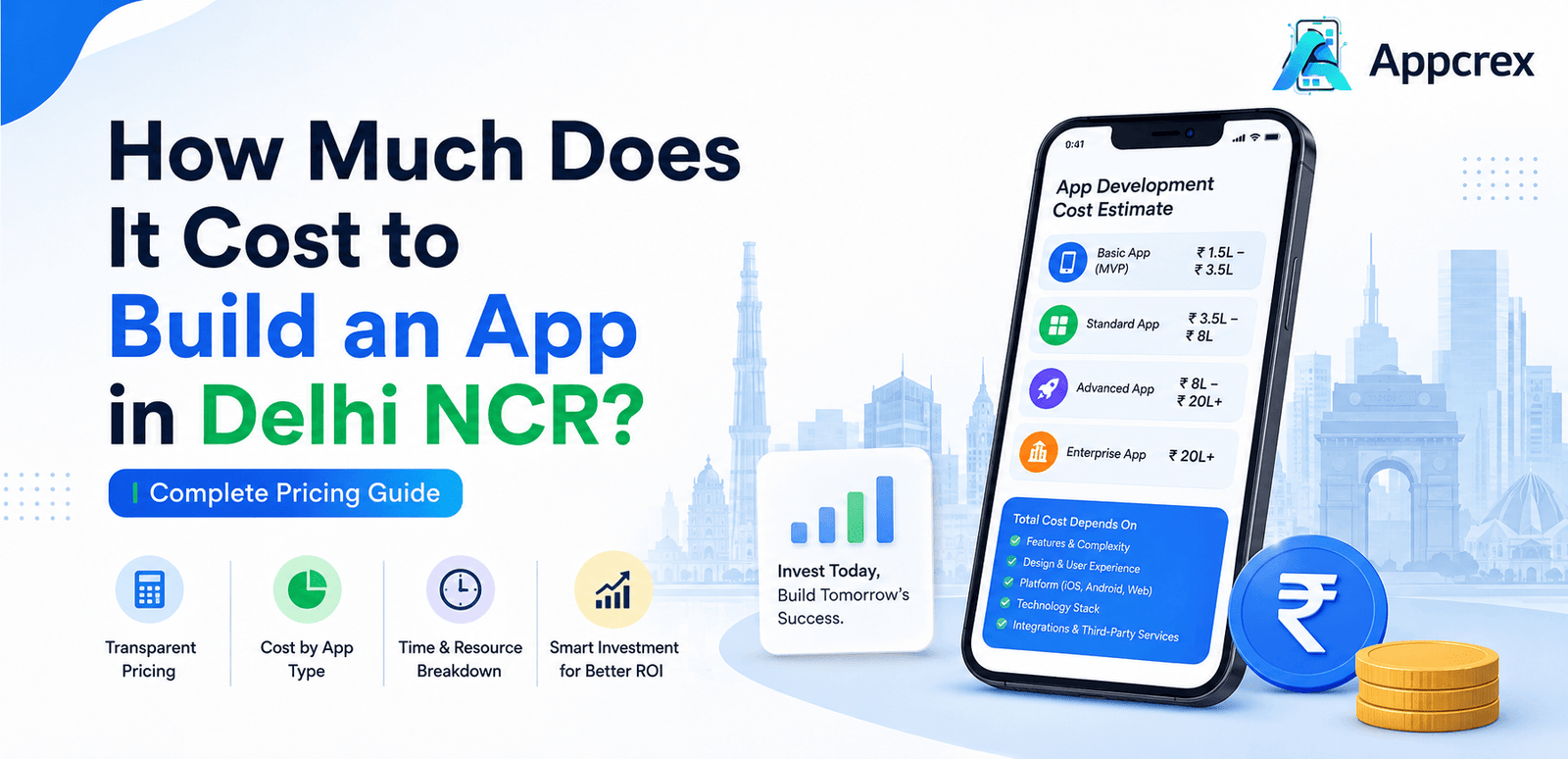
Quick Answer: How Much Does App Development Cost in Delhi NCR?
For initial planning, businesses can use these broad ranges:
| App Type | Estimated Cost |
|---|---|
| Simple MVP | ₹1.5–4 Lakh |
| Standard Business App | ₹4–10 Lakh |
| E-commerce App | ₹6–15 Lakh |
| Marketplace App | ₹8–20 Lakh+ |
| Advanced Mobile App | ₹10–25 Lakh+ |
| AI-Powered App | ₹15–40 Lakh+ |
| Enterprise App | ₹25–50 Lakh+ |
These are indicative ranges rather than fixed Delhi NCR prices. Published Indian market estimates show similarly wide variations because projects differ significantly in backend complexity, integrations, platforms and features.
For a proper quotation, the development scope needs to be defined first.
Why App Development Prices Vary So Much?
Two companies can quote ₹5 lakh and ₹15 lakh for what appears to be the “same app.”
That doesn’t automatically mean one company is overcharging.
The difference may come from:
- Number of platforms
- Backend architecture
- UI/UX complexity
- Number of user roles
- Third-party integrations
- Real-time functionality
- Security requirements
- AI functionality
- Admin dashboard
- Testing requirements
- Scalability
- Post-launch support
The important question isn’t:
“How much does an app cost?”
It is:
“What exactly am I getting for the quoted development cost?”
Delhi, Noida or Gurugram: Does Location Affect App Cost?
Delhi NCR should be viewed as a connected technology market rather than three completely separate development markets.
Delhi
Delhi has a broad business and startup ecosystem with opportunities across consumer services, commerce, education, healthcare, government-facing solutions and enterprise technology.
Noida
Noida has developed into a strong technology and software-development centre, with a significant concentration of IT, software, enterprise and digital businesses.
Gurugram
Gurugram has a strong corporate, startup, SaaS and multinational presence and is an important part of the wider NCR business ecosystem.
So rather than assuming that Delhi = expensive and Noida = cheap, businesses should compare the team, expertise, project scope and delivery model.
Cost by App Complexity
A useful way to estimate your budget is to classify the product by complexity.
1. Basic Mobile App — ₹1.5–4 Lakh
Suitable for businesses that need a relatively straightforward application.
Typical features:
- Login/signup
- User profile
- Static content
- Basic notifications
- Contact forms
- Simple API integration
- Basic admin panel
Examples:
- Company app
- Directory app
- Information app
- Basic booking app
- Simple service app
A basic MVP can sometimes be developed within a few months depending on scope.
2. Standard Business App — ₹4–10 Lakh
This level introduces more business logic and backend functionality.
Possible features:
- User authentication
- Profiles
- Search
- Filters
- Payments
- Push notifications
- Admin dashboard
- API integrations
- Analytics
- Content management
Examples include:
- Service booking
- Restaurant ordering
- Business management
- Fitness
- Education
- Appointment platforms
3. E-Commerce or Marketplace App — ₹6–20 Lakh+
These applications are more complicated because multiple workflows need to work together.
A marketplace may require:
Customer App + Seller App + Admin Panel + Backend
Features can include:
- Product catalogue
- Search
- Filters
- Cart
- Payments
- Orders
- Seller management
- Reviews
- Coupons
- Delivery tracking
- Notifications
A two-sided marketplace is therefore substantially more expensive than a simple shopping app.
Advanced Applications — ₹10–25 Lakh+
Advanced apps often contain multiple user types and complex workflows.
Examples include:
- Logistics platforms
- Healthcare platforms
- Learning platforms
- Enterprise apps
- Fleet management
- Social platforms
- On-demand services
These products may require:
- Multiple dashboards
- Real-time data
- Advanced APIs
- Location services
- Payment systems
- Analytics
- Complex backend logic
- Cloud infrastructure
AI-Powered App Development Cost
AI can significantly change the development budget.
A simple AI API integration is relatively different from developing a specialised AI platform.
Basic AI Integration
Examples:
- AI chatbot
- Text generation
- Summarisation
- AI search
- Content generation
Approximate additional scope: ₹2–6 lakh+
Advanced AI Application
Examples:
- AI recommendation engines
- AI agents
- Computer vision
- Predictive analytics
- Custom machine-learning models
Potential project range: ₹15–40 lakh+
The final cost depends on whether the project uses an existing AI model, custom data processing, fine-tuning, retrieval systems or a specialised model.
Also Read : AI Software Development Company: Custom AI Solutions, Cost & Development Process
What Does the Development Budget Actually Pay For?
App development isn’t simply paying developers to write code.
A professional project normally includes several stages.
Discovery & Planning
The team defines:
- User requirements
- Features
- Business workflows
- Technical architecture
- Integrations
- MVP scope
UI/UX Design
Designers create:
- User flows
- Wireframes
- Visual design
- Prototypes
- Design systems
Frontend Development
This is the part users interact with.
Backend Development
The backend handles:
- Authentication
- Databases
- APIs
- Business logic
- Payments
- Notifications
- User permissions
Quality Assurance
Testing checks:
- Functional issues
- UI problems
- Device compatibility
- API behaviour
- Security problems
- Performance
Deployment
The team prepares the application for release and configures the required infrastructure.
How Much Does UI/UX Design Cost?
UI/UX can represent a meaningful part of the project budget.
For a small application, design requirements may be relatively limited.
For a large platform, designers may need to create dozens of workflows and states.
A rough planning range:
| Design Scope | Estimated Cost |
|---|---|
| Basic UI | ₹50,000–₹1 Lakh |
| Standard Product Design | ₹1–2.5 Lakh |
| Complex Platform UX | ₹2.5–5 Lakh+ |
Good design isn’t simply about making the app look attractive.
It should make the product easy to understand and easy to use.
Backend Development: The Hidden Part of App Cost
Many first-time founders focus almost entirely on the mobile interface.
But the backend can represent a significant portion of the project.
It may include:
- Database
- APIs
- Authentication
- Business rules
- Payment processing
- Notifications
- File storage
- Admin controls
- Analytics
- Third-party integrations
For example, a food delivery app isn’t just a restaurant menu on a phone.
Behind it are:
Customer → Restaurant → Order → Payment → Delivery → Tracking → Notification → Admin
Each connection requires backend logic.
Native vs Cross-Platform Development
Your platform strategy also affects cost.
Native Development
Separate development for:
- Android
- iOS
This can provide strong platform-specific performance but generally requires maintaining separate codebases.
Cross-Platform Development
Technologies such as:
- Flutter
- React Native
allow businesses to share a significant portion of the codebase between Android and iOS.
For many startups and businesses, this can reduce development effort and accelerate the first release.
However, native development can still make sense when the product requires highly platform-specific functionality.
How Much Do Third-Party Integrations Add?
Integrations can change an otherwise simple application into a complex system.
Examples:
Payment
- Razorpay
- Stripe
- PayPal
Maps
- Google Maps
- Mapbox
Communication
- SMS
- Push notifications
Business Systems
- CRM
- ERP
- Accounting
- Inventory
AI
- Large language model APIs
- AI search
- Speech services
- Computer vision
The cost depends on the number and complexity of integrations.
Real-Time Features Increase Complexity
Real-time functionality requires additional backend and infrastructure work.
Examples:
- Live driver tracking
- Chat
- Delivery status
- Ride tracking
- Live dashboards
- Real-time notifications
- Multiplayer functionality
A standard application might refresh data when the user opens a screen.
A real-time platform may need to continuously synchronise information.
Also Read : Offshore Software Development Services: Everything Businesses Need to Know Before Hiring a Development Team
Location-Based Features
Delhi NCR businesses often build location-driven products.
These can include:
- Taxi apps
- Delivery apps
- Local marketplaces
- Real estate apps
- Service marketplaces
- Logistics platforms
Features may include:
- GPS
- Maps
- Geofencing
- Distance calculation
- Route optimisation
- Live tracking
The more sophisticated the location functionality, the more development effort is required.
Security and Compliance Costs
Security should not be treated as an optional feature.
Depending on the product, the development team may need:
- Secure authentication
- Encryption
- Role-based access
- API security
- Data protection
- Audit logs
- Secure cloud configuration
- Security testing
Apps handling financial, healthcare or sensitive personal information generally require more extensive security and compliance planning.
Maintenance Cost After Launch
Development doesn’t necessarily end when the app is published.
Post-launch expenses can include:
- Bug fixes
- OS updates
- Server costs
- Cloud services
- Security updates
- API changes
- Performance optimisation
- New features
A common planning approach is to reserve around 15–25% of the initial development budget annually for maintenance and improvements, although actual requirements vary considerably.
What Is the Cheapest Way to Build an App?
The cheapest approach isn’t necessarily hiring the lowest-cost developer.
Instead, control the scope.
Start With an MVP
Don’t build every possible feature on day one.
Choose the Right Platform
If both Android and iOS are needed, consider whether cross-platform development is appropriate.
Use Existing Services
Avoid rebuilding functionality that reliable APIs already provide.
Prioritise Features
Divide features into:
Must Have → Should Have → Future
Build for Validation
The first version should answer one question:
Will users actually use or pay for this product?
Also Read : What Is an MVP in App Development? A Complete Guide
How to Avoid an Unrealistic App Development Quote?
A low quotation can look attractive until additional charges appear.
Before signing a contract, check whether the quotation includes:
- UI/UX
- Frontend
- Backend
- Admin panel
- APIs
- Testing
- Deployment
- Source code
- Documentation
- Third-party integrations
- Maintenance
Also ask:
Who owns the source code?
What happens when the scope changes?
How are bugs handled after launch?
What is included in post-launch support?
These questions can prevent unexpected expenses later.
Fixed Price vs Hourly Development
Delhi NCR development companies may use different pricing models.
Fixed Price
The project is defined in advance and a price is agreed upon.
Best when:
- Requirements are clear
- MVP scope is fixed
- Deliverables are well defined
Hourly / Time & Material
You pay according to development effort.
Useful when:
- Requirements may change
- Product is evolving
- Long-term development is expected
Dedicated Development Team
You hire a team for an extended period.
Useful for:
- SaaS products
- Enterprise applications
- Long-term product development
- Continuous feature development
How Long Does It Take to Build an App in Delhi NCR?
A typical development timeline may look like:
| App Type | Approximate Timeline |
|---|---|
| Simple MVP | 2–4 months |
| Standard Business App | 3–5 months |
| E-commerce App | 4–7 months |
| Marketplace | 5–8 months |
| AI-Powered App | 5–9 months |
| Enterprise Platform | 8–14+ months |
These are planning estimates. Requirements, integrations, testing and regulatory considerations can change the schedule.
Delhi NCR Is More Than One Technology Market
One of the reasons this region is interesting for app development is the variety of businesses operating across the corridor.
Delhi NCR has an active startup network spanning Delhi, Gurugram and Noida, with founders, investors, incubators, coworking spaces and technology companies distributed across the region.
That means app development opportunities can range from:
- Consumer apps
- SaaS
- E-commerce
- Logistics
- Healthcare
- Education
- Enterprise software
- AI products
- IoT
- Media
- Local services
For a development company, understanding the business ecosystem behind the app can be just as important as understanding the technology.
Which Technology Should You Choose?
There isn’t one universally best technology.
Flutter
Good option when:
- Android + iOS are required
- Faster development is important
- A shared codebase is preferred
React Native
Useful when:
- Cross-platform development is needed
- The product requires a React-based ecosystem
- Web and mobile teams need technology alignment
Native Android
Consider when:
- Android-specific functionality is important
- Deep device integration is required
Native iOS
Consider when:
- Apple-specific capabilities are central
- High platform-specific optimisation is needed
The decision should come after defining the product requirements, not before.
Also Read : React Native vs Flutter: Which Framework Should You Choose for Mobile App Development in 2026?
How to Select an App Development Company in Delhi NCR?
Before selecting a company, evaluate five things.
1. Relevant Experience
Look for projects similar to yours.
2. Technical Capability
Check whether the team can handle:
- Mobile
- Backend
- APIs
- Cloud
- AI
- Security
3. Development Process
Ask how they manage:
- Sprints
- Testing
- Reviews
- Feedback
- Deployment
4. Transparency
The quotation should clearly explain what is included.
5. Post-Launch Support
Your relationship with the development team shouldn’t necessarily end on launch day.
Why AppCrex for Mobile App Development in Delhi NCR?
AppCrex provides mobile and custom software development services for startups and businesses.
Depending on project requirements, the team can support:
- Android app development
- iOS app development
- Flutter development
- React Native development
- SaaS development
- AI app development
- Generative AI integration
- AI agent development
- API integration
- Backend development
- Cloud solutions
- UI/UX design
- QA testing
- App maintenance
The development approach can be tailored around your budget, business model, target audience and product roadmap rather than forcing every project into the same package.
FAQs
Q. How much does it cost to build an app in Delhi NCR?
A simple app may start around ₹1.5–4 lakh, while advanced platforms can reach ₹25–50 lakh or more. The final cost depends on features, backend, integrations, platforms and complexity.
Q. Is app development cheaper in Noida than Delhi?
Not necessarily. Location can influence agency overhead, but project complexity, team expertise and scope have a much greater impact on the final quotation.
Q. How much does an AI app cost in Delhi NCR?
An AI-powered application can start around ₹15 lakh for a more substantial product and increase significantly for advanced AI agents, custom models, computer vision or enterprise integrations.
Q. Is Flutter cheaper than native app development?
It can reduce development effort when one codebase can serve both Android and iOS, but the actual savings depend on the project’s requirements.
Q. How long does it take to develop a mobile app?
A basic MVP can take around 2–4 months, while complex enterprise or AI-powered applications can require 8–14 months or longer.
Q. What is included in mobile app development cost?
Depending on the company and contract, the cost may include UI/UX, frontend, backend, APIs, testing, deployment and project management. Always confirm the exact deliverables before signing.
Q. Do I need an admin panel?
If your application involves users, orders, content, payments, bookings or business operations, an admin panel is often important for managing the platform.
Q. Can AppCrex build an app for businesses in Delhi NCR?
Yes. AppCrex can develop mobile applications and custom digital products for startups, SMEs and enterprises, including backend, AI, APIs, cloud infrastructure and ongoing support.
Final Thoughts
There is no single price tag for mobile app development in Delhi NCR.
A focused MVP might require only a few lakh rupees, while a marketplace, SaaS platform, AI product or enterprise application can require a much larger investment.
The biggest mistake is choosing a development budget before defining the product.
Instead, begin with:
Business Problem → Target Users → MVP Features → Technology → Development Scope → Budget → Roadmap
Delhi NCR provides a broad ecosystem for building digital products, with Delhi, Noida and Gurugram contributing different strengths across startups, software, enterprise technology and business services.
The right strategy isn’t to find the affordable mobile app development company. It is to find a development partner that can deliver the required product within a realistic budget while keeping the architecture ready for future growth.
Build Your App With AppCrex
Have an idea for a mobile app, SaaS platform, AI application, marketplace or enterprise solution in Delhi NCR?
AppCrex can help take your idea from planning and UI/UX to development, API integration, AI implementation, cloud deployment, testing and post-launch support.
Share your app idea with AppCrex and build a product designed for real users—not just another app.