📌 Key Takeaways
- Absher-like platforms centralize multiple government services in one digital ecosystem.
- Digital identity, KYC, documents, appointments, payments, and notifications are key features.
- Government APIs and secure integrations are critical for connecting different departments.
- Development cost depends on services, integrations, security, and platform scale.
- AI can improve service discovery, document processing, and citizen support.
Introduction
Digital government services are changing how citizens, residents, businesses, and visitors interact with public-sector organizations. Instead of visiting different government offices for routine services, users increasingly expect to complete registrations, renewals, appointments, document requests, payments, and identity-related services through a secure digital platform.
Saudi Arabia’s Absher is a strong example of this digital-government approach. The official Absher platform provides electronic services for citizens, residents, and visitors and connects services across multiple government and private-sector entities. According to the official platform, Absher supports more than 32 million digital identities across its channels, has processed more than 448 million electronic services, and its apps have exceeded 24 million downloads.
This has created an opportunity for governments, enterprises, and technology businesses to develop similar digital government service platforms for different countries and regions.
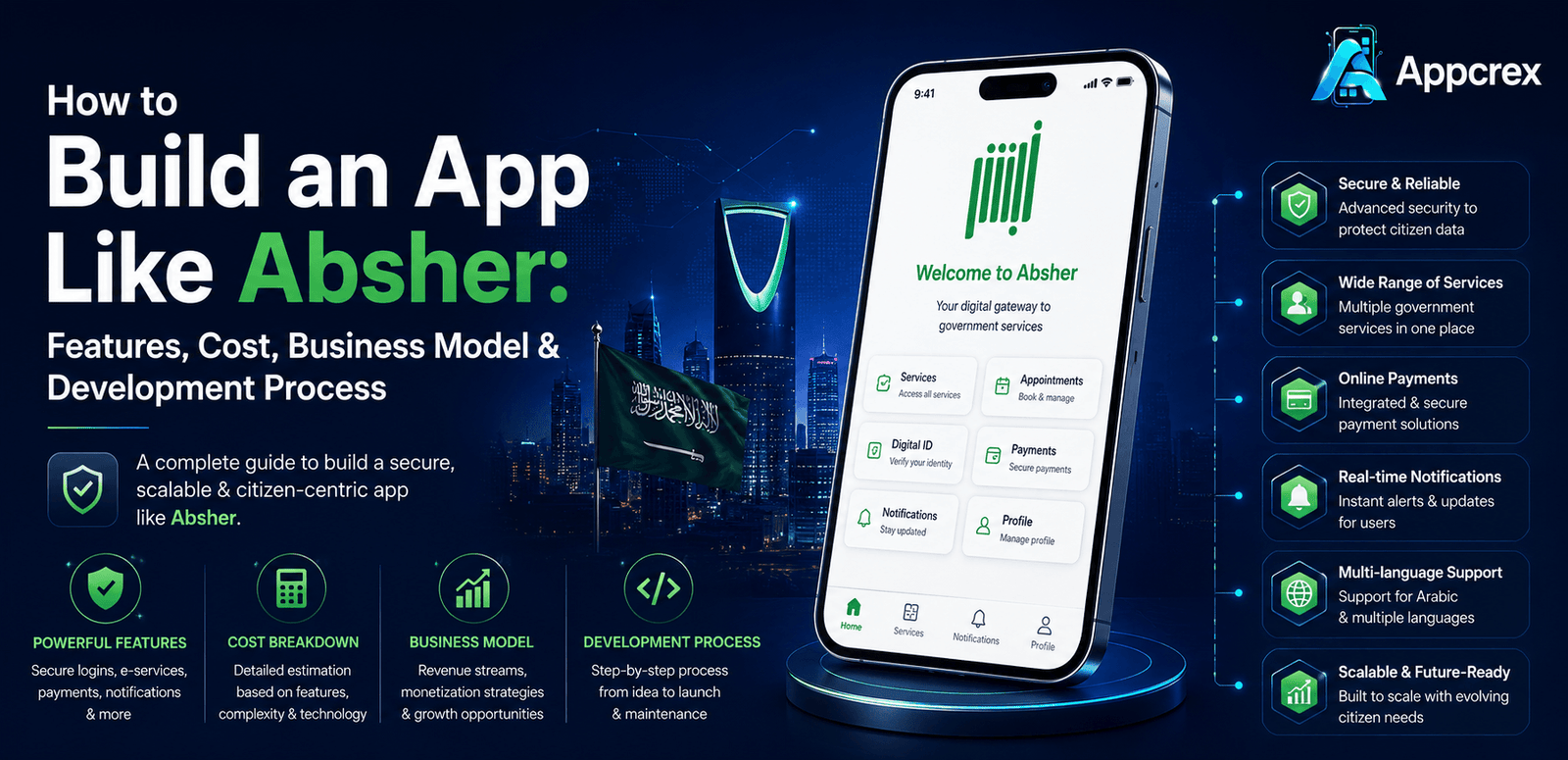
However, building an app like Absher is much more complex than developing a standard mobile app. It requires secure digital identity, government-system integrations, document management, authentication, appointment systems, notifications, payments, multilingual support, and strong privacy and security controls.
This guide explains how to build an app like Absher, including its features, development process, technology stack, cost, timeline, security requirements, and business considerations.
What Is Absher?
Absher is the electronic platform of Saudi Arabia’s Ministry of Interior and provides digital services to citizens, residents, and visitors. The platform has expanded across areas such as passports, traffic, civil affairs, and other government services.
The platform is designed to reduce the need for physical visits and paperwork by allowing users to complete eligible government transactions digitally.
Examples of services available through the platform include:
- Digital documents
- Identity-related services
- Passport services
- Traffic services
- Vehicle-related services
- Appointments
- Travel-related services
- Electronic reports
- Authorization services
- Address updates
- Document delivery
- Government inquiries
- Newborn registration
- Resident ID services
The official services guide lists a broad range of services across different government sectors.
Why Build an App Like Absher?
The shift toward digital government creates demand for centralized platforms that make public services easier to access.
A well-designed government-service application can help:
- Reduce paperwork
- Reduce physical office visits
- Improve service accessibility
- Centralize government services
- Improve processing efficiency
- Provide digital records
- Simplify appointment booking
- Improve communication
- Support multilingual users
- Create better digital experiences
For governments and public-sector organizations, such a platform can also become part of a broader digital transformation strategy.
For technology companies, the opportunity lies in building secure platforms that connect multiple government departments and service providers through one user experience.
How Does an App Like Absher Work?
A government-services platform typically connects users with multiple backend systems.
A simplified architecture looks like:
User → Mobile App → Digital Identity → Authentication → Government APIs → Service Systems → Database → Notifications
For example:
- A user registers on the platform.
- Identity information is verified.
- The user logs into the digital identity system.
- Available services are displayed.
- The user selects a government service.
- Required information or documents are submitted.
- The platform communicates with the relevant government department.
- The request is processed.
- The user receives status updates.
- Digital documents or confirmations are delivered through the platform.
The complexity increases when the application integrates dozens or hundreds of government services.
Key Features of an App Like Absher
1. Digital Registration
The first step is creating a secure user identity.
Registration may include:
- Mobile number
- Email address
- National ID
- Resident ID
- Passport details
- OTP verification
- Identity verification
- Password creation
- Terms and consent
The exact registration process depends on the country’s identity infrastructure.
2. Digital Identity
Digital identity is one of the most important components of a government-services platform.
A digital identity system can allow users to access multiple services through one verified account.
Features can include:
- Identity verification
- Secure login
- Biometric authentication
- Digital credentials
- Account verification
- Identity status
- Device management
A centralized identity layer can reduce the need for users to repeatedly create accounts for individual government services.
3. Government Service Dashboard
The home dashboard should make services easy to discover.
Users can see categories such as:
- Passports
- Traffic
- Civil affairs
- Vehicles
- Residency
- Appointments
- Documents
- Authorizations
- Payments
- Reports
Frequently used services can also be displayed prominently.
4. Passport & Residency Services
A government platform may provide digital services related to:
- Passport information
- Residency
- ID renewal
- Travel permissions
- Document requests
- Visa-related information
- Application status
The exact services depend on the country’s government departments and regulations.
5. Traffic Services
Traffic-related functionality can be another major category.
Features may include:
- Driving-license information
- Vehicle registration
- Traffic violations
- Traffic appointments
- Vehicle ownership
- Driver authorization
- Accident-related services
The official Absher service guide currently includes traffic appointments, vehicle-user authorization, accident objection/waiver services, and other traffic-related functions.
6. Vehicle Management
A centralized platform can allow users to manage vehicle-related services.
Possible functionality includes:
- Vehicle registration
- Registration renewal
- Ownership information
- Driver authorization
- Vehicle-user management
- Vehicle-related documents
- Service history
This can eliminate multiple physical processes for routine vehicle services.
7. Appointment Booking
Appointment management is an important feature for government services that still require physical attendance.
Users can:
- Select a government department
- Choose a service
- Select a location
- Select an available date
- Select a time
- Confirm the appointment
- Reschedule
- Cancel
- Receive reminders
Absher currently provides appointment services for areas including traffic and civil affairs.
8. Digital Documents
A government app can provide users with access to digital versions of eligible documents.
Features may include:
- Digital ID
- Digital licenses
- Digital certificates
- Document verification
- Document status
- Download/share functionality where permitted
The official Absher platform currently includes digital-document services.
9. Document Delivery
Some government documents may still need to be physically delivered.
A digital government platform can allow users to:
- Request delivery
- Select delivery information
- Track delivery
- View delivery status
- Receive notifications
Absher currently provides electronic document-delivery functionality for eligible processed documents.
10. Electronic Payments
If a service requires payment, the platform can integrate secure payment infrastructure.
Possible features include:
- Service fees
- Payment gateway
- Payment confirmation
- Transaction history
- Receipts
- Refund status
Government payment systems should be integrated according to the relevant country’s financial and public-sector requirements.
11. Electronic Authorizations
Some government processes require one person to authorize another individual to perform a specific service.
An authorization module can support:
- Create authorization
- Select authorized person
- Select service
- Set validity period
- Approve authorization
- Cancel authorization
- View authorization history
Absher provides electronic authorization services that allow users to authorize others for specified services.
12. Notifications & Alerts
Notifications keep citizens and residents informed about their government transactions.
Examples include:
- Application received
- Application approved
- Application rejected
- Document ready
- Appointment reminder
- Payment confirmation
- Identity alerts
- Renewal reminders
- Security notifications
Push notifications, SMS, email, and in-app notifications can be used according to the service requirements.
13. Service Tracking
Users should be able to see the status of their requests without contacting a government office.
A tracking screen can display:
Submitted → Under Review → Additional Information Required → Approved → Completed
This improves transparency and reduces unnecessary support requests.
14. Search & Service Discovery
A large government platform can contain hundreds of services, so search becomes essential.
Users should be able to search for services using:
- Keywords
- Service categories
- Department
- User type
- Frequently used services
For example, a user could search for:
“vehicle registration renewal”
and immediately find the appropriate service.
15. Multilingual Support
Government platforms often serve diverse populations.
A digital government application can support:
- Arabic
- English
- Additional local languages where required
Language switching should be available throughout the application.
16. Accessibility
Government platforms should be designed for a wide range of users.
Accessibility features can include:
- Screen-reader compatibility
- Adjustable text size
- High-contrast interfaces
- Simple navigation
- Voice assistance
- Accessible forms
- Clear error messages
Accessibility is particularly important when the platform becomes a primary channel for public services.
17. Help Center & Support
A centralized help system can include:
- FAQs
- Service guides
- Searchable knowledge base
- Chat support
- Support tickets
- Contact information
- Complaint submission
AI-powered assistants can also answer basic service questions and direct users toward the appropriate government service.
Also Read : Mobile App Development Company India: Custom Android, iOS & AI App Development Services
Admin Panel for an Absher-Like Platform
A powerful backend dashboard is required to manage a government-service ecosystem.
Government Department Management
Administrators can manage:
- Departments
- Services
- Service categories
- Service requirements
- Processing workflows
User Management
The system can manage:
- Citizen accounts
- Resident accounts
- Visitor accounts
- Identity status
- Account verification
- Access permissions
Application Management
Officials can view:
- Submitted applications
- Pending requests
- Approved requests
- Rejected applications
- Processing times
- Required documents
Appointment Management
Government departments can manage:
- Locations
- Available slots
- Working hours
- Appointment capacity
- Cancellations
- Rescheduling
Document Management
Administrators can manage:
- Document generation
- Digital documents
- Verification
- Delivery requests
- Document status
Analytics
The dashboard can provide:
- Service usage
- Application volume
- Processing time
- Active users
- Appointment utilization
- Failed transactions
- Service performance
Also Read : AI Customer Support Automation Services: Complete Guide to Benefits, Features, Implementation & Cost
Advanced Features for an Absher-Like App
AI Government Service Assistant
An AI assistant can help users discover services.
For example, a user could ask:
“I need to renew my vehicle registration. What should I do?”
The assistant can explain the relevant process and direct the user to the correct service.
The AI should provide informational guidance and follow approved government workflows rather than making unauthorized decisions.
AI Document Processing
AI and OCR technology can help process eligible documents.
Possible applications include:
- Document classification
- Data extraction
- Form processing
- Document validation
- Duplicate detection
Sensitive government documents require strict privacy and security controls.
Smart Service Recommendations
The platform can identify relevant services based on user interactions and eligibility information.
For example:
- Upcoming document renewal
- Vehicle registration renewal
- Appointment reminders
- Expiring permits
- Available government services
Recommendations should be transparent and based on authorized data.
Technology Stack for an Absher-Like App
A government-service platform requires an enterprise-grade technology architecture.
Mobile Development
- Flutter
- React Native
- Swift
- Kotlin
Web Application
- React
- Angular
- Next.js
- TypeScript
Backend
- Java
- Node.js
- Python
- .NET
Databases
- PostgreSQL
- MySQL
- MongoDB
- Redis
Cloud Infrastructure
- AWS
- Microsoft Azure
- Google Cloud
- Government-approved cloud infrastructure where applicable
APIs
- Government APIs
- Identity APIs
- Payment APIs
- SMS APIs
- Notification APIs
- Document verification APIs
- Appointment systems
AI & Automation
- OCR
- NLP
- Generative AI
- Machine learning
- Intelligent document processing
The architecture should prioritize reliability, security, interoperability, scalability, and long-term maintainability.
Security Requirements for an Absher-Like App
Security is arguably the most important part of a digital government platform.
The system can handle extremely sensitive information such as:
- National identity information
- Passport information
- Residency information
- Vehicle information
- Government documents
- Personal addresses
- Transaction history
Important security measures include:
Multi-Factor Authentication
Users can be required to provide multiple authentication factors for sensitive services.
Encryption
Sensitive information should be protected through appropriate encryption mechanisms.
Role-Based Access Control
Government employees should only have access to the systems and information required for their responsibilities.
Audit Logs
Important actions should be recorded for accountability and monitoring.
API Security
Government APIs require strong:
- Authentication
- Authorization
- Encryption
- Rate limiting
- Validation
- Monitoring
Fraud Detection
The platform can monitor unusual login activity, suspicious requests, and unauthorized access attempts.
Disaster Recovery
Government platforms should have appropriate backup, redundancy, and disaster-recovery strategies.
Also Read : AI Software Development Company: Custom AI Solutions, Cost & Development Process
Integration With Government Systems
This is one of the biggest technical challenges.
A single government application may need to communicate with:
- Ministry systems
- Immigration systems
- Traffic systems
- Civil affairs
- Payment infrastructure
- Identity systems
- Postal services
- Appointment systems
- Document management systems
Instead of building every service independently, an API-driven architecture can allow different departments to connect through standardized interfaces.
This makes it easier to expand the platform as new government services become available.
How to Build an App Like Absher
Step 1: Define the Government Services
First identify which services will be available.
For example:
- Identity
- Passport
- Residency
- Traffic
- Vehicles
- Appointments
- Documents
- Payments
Step 2: Identify Government Stakeholders
A digital government platform usually involves multiple stakeholders.
Define:
- Government departments
- Service providers
- Technology partners
- Identity providers
- Payment providers
- Security teams
- Compliance teams
Step 3: Plan the Digital Identity System
Determine how users will:
- Register
- Verify identity
- Log in
- Recover accounts
- Authenticate sensitive transactions
Identity architecture should be established early because many services depend on it.
Step 4: Design the Service Architecture
Map every service from beginning to end.
For each service, define:
- User input
- Documents
- Eligibility
- Government department
- Processing workflow
- Payment
- Approval
- Final output
Step 5: Develop the API Layer
The API layer connects the mobile application to government systems.
It should provide:
- Authentication
- Authorization
- Service requests
- Data exchange
- Error handling
- Monitoring
Step 6: Develop Mobile & Web Platforms
The platform can provide:
- iOS app
- Android app
- Web portal
- Admin portal
- Government department dashboards
A web version can be particularly useful for users who prefer desktop access to government services.
Step 7: Integrate Payments & Notifications
Integrate the required:
- Payment systems
- SMS
- Push notifications
Users should receive clear confirmation at every important stage.
Step 8: Test the Platform
Testing should cover:
- Functional testing
- Security testing
- API testing
- Performance testing
- Accessibility testing
- Integration testing
- Mobile testing
- Disaster-recovery testing
Because government platforms can serve millions of users, load and performance testing are especially important.
Step 9: Security & Compliance Review
Before launch, perform appropriate:
- Security audits
- Penetration testing
- Privacy reviews
- Access-control reviews
- API security reviews
- Compliance assessments
The exact requirements depend on the country and government entity.
Step 10: Launch & Scale
Launch the initial service set and gradually add more departments and services.
This approach allows the government to validate the platform before connecting a large number of systems simultaneously.
How Much Does It Cost to Build an App Like Absher?
The cost of building an Absher-like government-services platform varies significantly because of the number of services, integrations, security requirements, and government systems involved.
A broad development estimate can be:
| Platform Type | Estimated Cost |
|---|---|
| Basic Digital Government MVP | $50,000–$100,000 |
| Medium Government Services Platform | $100,000–$200,000 |
| Advanced Multi-Service Platform | $200,000–$400,000+ |
| Large-Scale Absher-Like Ecosystem | $400,000–$1M+ |
These are indicative software-development ranges, not official project quotations.
A nationwide platform involving multiple ministries, digital identity, high-security infrastructure, hundreds of services, and large-scale integrations can require a substantially larger budget.
Factors Affecting Development Cost
Number of Government Services
Ten services are considerably easier to implement than hundreds of interconnected services.
Number of Integrations
Every government department or third-party system can introduce additional integration work.
Digital Identity
Advanced identity verification, biometrics, and authentication increase development complexity.
Security
Government systems require strong security architecture and extensive testing.
Mobile & Web Platforms
Building Android, iOS, web, and administrative platforms increases the project scope.
AI Features
AI assistants, OCR, document processing, and automation add additional development effort.
Localization
Multilingual interfaces and region-specific workflows increase design and testing requirements.
Also Read : How Much Does It Cost to Develop an App in 2026? Complete Pricing Guide
How Long Does It Take to Build an Absher-Like App?
A basic digital-government MVP may take approximately 6–9 months.
A large multi-service platform can require 12–24 months or longer, depending on the number of departments, integrations, security requirements, and services.
A typical roadmap may include:
| Stage | Approximate Timeline |
|---|---|
| Research & Strategy | 4–8 weeks |
| Architecture | 4–8 weeks |
| UI/UX Design | 6–10 weeks |
| Core Development | 4–8 months |
| Government Integrations | 3–8 months |
| Testing & Security | 2–4 months |
| Pilot Launch | 4–8 weeks |
Several activities can run in parallel, so the final timeline depends on the project’s governance and integration structure.
Business Model for a Government Services Platform
Unlike commercial applications, a government-services platform does not necessarily need a traditional advertising or subscription model.
Possible funding and operating models include:
Government-Funded Platform
The platform can be funded as part of a government digital transformation program.
Service Fees
Certain government services may include official processing or service fees where legally applicable.
Enterprise Government Contracts
Technology providers can develop and maintain the platform through government contracts.
Platform-as-a-Service
Technology companies can build digital-government infrastructure for municipalities or government organizations.
The appropriate model depends on the country’s public-sector framework and procurement rules.
Also Read : What Is an MVP in App Development? A Complete Guide
Challenges of Building an Absher-Like Platform
Data Privacy
Government platforms handle highly sensitive personal information.
Interoperability
Different government departments may use different legacy systems and technologies.
Security
A government platform can become a high-value target for cyberattacks.
Scalability
The platform may need to serve millions of users.
Legacy Integration
Existing government systems may not have modern APIs.
Regulatory Requirements
Public-sector applications must comply with applicable government, privacy, cybersecurity, and data-residency requirements.
Service Reliability
Users may depend on the platform for essential government services, making uptime and disaster recovery critical.
How to Make an Absher-Like Platform Better?
A new digital government platform should not simply copy Absher’s interface.
It can improve the user experience through:
One Unified Search
Allow users to find any service through one search box.
Personalized Service Dashboard
Show users only the services relevant to their profile.
AI Government Assistant
Help users understand eligibility and service procedures.
Digital Document Wallet
Keep eligible government documents in one secure location.
Proactive Notifications
Notify users before important documents or registrations expire.
Single Digital Identity
Use one verified identity across multiple government services.
Service Tracking
Allow users to see exactly where their request is in the process.
These improvements can make government services more intuitive and accessible.
Why Choose AppCrex for Government App Development?
AppCrex can help businesses and organizations develop secure digital platforms with:
- Mobile App Development
- Web Development
- UI/UX Design
- Backend Development
- API Integration
- Cloud Solutions
- AI Integration
- Document Processing
- Identity Integration
- Payment Integration
- Testing
- Security Implementation
- Maintenance & Support
For an Absher-like platform, the development process can begin with a focused MVP and expand toward a larger digital-service ecosystem.
FAQs
Q. How much does it cost to build an app like Absher?
A basic digital government MVP may cost around $50,000–$100,000, while a large multi-service platform can cost $400,000–$1 million or more, depending on integrations, security, services, and infrastructure.
Q. How long does it take to build an Absher-like app?
A basic MVP may take around 6–9 months. A large government platform can require 12–24 months or longer.
Q. What are the main features of an Absher-like app?
Core features can include digital identity, government service discovery, document management, appointments, traffic services, passport services, payments, authorizations, notifications, and service tracking.
Q. Can an Absher-like platform be built for another country?
Yes. The technical architecture can be adapted for another country, but government systems, identity infrastructure, laws, regulations, languages, and service workflows will be different.
Q. Can AI be integrated into a government-services app?
Yes. AI can support service discovery, chat assistance, document processing, OCR, FAQs, and workflow automation, subject to government security and privacy requirements.
Q. Does an Absher-like app need a web portal?
For a large government ecosystem, a web portal can be highly useful alongside Android and iOS applications, especially for users and government employees who need desktop access.
Q. How many government services can one app support?
There is no fixed limit. A scalable API-driven architecture can support many departments and services, but every additional service requires its own workflow, integration, security, and testing requirements.
Q. Can AppCrex build an Absher-like government platform?
Yes. AppCrex can provide UI/UX, mobile development, backend engineering, API integrations, AI solutions, cloud infrastructure, testing, security implementation, deployment, and ongoing maintenance.
Conclusion
Building an app like Absher means creating much more than a mobile application. It means developing a complete digital-government ecosystem that connects citizens, residents, visitors, government departments, identity systems, payment infrastructure, documents, and service workflows through a secure digital platform.
The most important elements are digital identity, secure authentication, API integration, service automation, document management, notifications, scalability, privacy, and cybersecurity.
Instead of attempting to connect every government service from day one, organizations can start with a focused group of high-demand services, establish the underlying identity and API architecture, and then gradually expand the platform.
With the right architecture and implementation strategy, an Absher-like platform can become a centralized digital gateway for government services and contribute significantly to a country’s broader digital transformation.
Build Your Digital Government Platform With AppCrex
Planning to build an app like Absher for government services, public-sector organizations, or a digital transformation initiative?
AppCrex can help you develop a secure and scalable platform with mobile apps, web portals, digital identity integration, government APIs, document management, AI-powered services, payment integration, testing, security, and ongoing support.
Contact AppCrex to discuss your digital government platform idea and development roadmap.