📌 Key Takeaways
- A DoorDash-like app is a multi-sided delivery marketplace, not just a food ordering application.
- The core ecosystem includes customers, merchants, delivery partners and administrators.
- Food, grocery, convenience and retail can all be supported by the same underlying delivery architecture.
- A basic MVP may cost around $25,000–$45,000, while advanced platforms can require $90,000–$180,000+.
- Starting with one US city or vertical can allow a business to validate the model before expanding.
Introduction
The way people order food and everyday products has changed significantly. Instead of calling a restaurant or visiting a store, customers can now open an app, select what they need, pay online, track the order, and receive it at their doorstep.
DoorDash is one of the best-known examples of this on-demand delivery model. Founded in 2013, DoorDash has grown from restaurant delivery into a broader local-commerce platform connecting consumers with restaurants, grocery stores, convenience stores, retailers, and other businesses. The company says it now operates in more than 40 countries.
This has created an opportunity for startups, restaurant groups, retailers, grocery businesses, and entrepreneurs who want to build an app like DoorDash in the USA.
But a DoorDash-style application is much more than a food ordering app. Behind the customer experience is a complete ecosystem involving merchants, delivery partners, payments, order management, location tracking, dispatching, customer support, analytics, and administration.
In this guide, we explain how to build an app like DoorDash, what features you need, how the business model works, the technology stack, development process, estimated cost, timeline, and important considerations for the US market.
Just Read : Food Delivery App Development Company: Complete Guide to Features, Cost & Development Process
What Is an App Like DoorDash?
An app like DoorDash is an on-demand multi-vendor delivery platform that connects customers with businesses and delivery partners through a digital marketplace.
The basic ecosystem consists of three major sides:
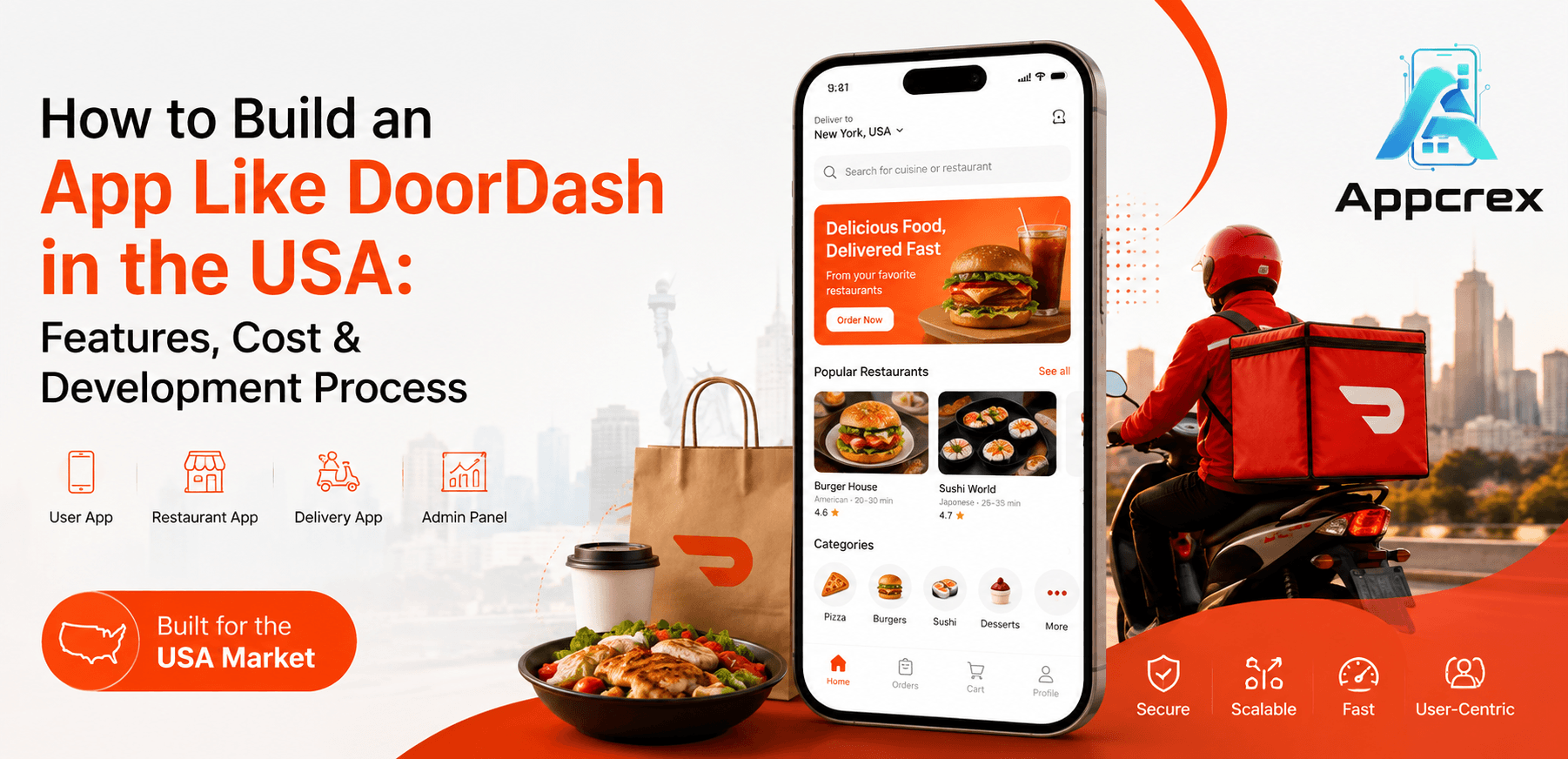
- Customer App – customers browse businesses, place orders and track deliveries.
- Merchant Panel – restaurants, grocery stores, and retailers manage products, menus and orders.
- Driver/Delivery App – delivery partners receive delivery requests, navigate to pickup locations and complete deliveries.
- Admin Panel – the business owner manages the complete platform.
DoorDash’s current model demonstrates how this ecosystem can expand beyond food. Its platform includes restaurants, grocery, convenience, retail, flowers, pet products and other categories.
Therefore, when businesses ask how to build a DoorDash-like app, they should first decide whether they want to focus on food delivery or build a broader local delivery marketplace.
How Does an App Like DoorDash Work?
The basic workflow is straightforward for the customer, but several systems operate in the background.
Step 1: Customer Opens the App
The user signs up and enters their delivery location.
The application displays nearby restaurants, grocery stores, retailers or other available businesses.
Step 2: Customer Selects a Business
Users can search by:
- Business name
- Cuisine
- Product
- Category
- Rating
- Delivery time
- Price
- Offers
Step 3: Customer Places an Order
The customer selects products or food items, adds them to the cart and confirms the order.
Step 4: Payment Is Processed
The app calculates:
- Item total
- Delivery fee
- Service fee
- Taxes
- Discounts
- Tip
The customer completes payment through the available payment method.
Step 5: Merchant Receives the Order
The merchant receives the order through its dashboard or POS integration and starts preparing it.
Step 6: Delivery Partner Is Assigned
The system identifies available delivery partners and sends a delivery request.
DoorDash describes its US delivery workflow similarly: customers place orders, nearby Dashers receive delivery offers, and the Dasher picks up and delivers the order.
Step 7: Customer Tracks the Delivery
The customer can see:
- Order status
- Estimated delivery time
- Driver location
- Pickup status
- Delivery progress
Step 8: Order Is Completed
The driver delivers the order and the system marks it as completed.
The customer can then rate the experience and leave feedback.
Why Build an App Like DoorDash in the USA?
The DoorDash model can be adapted to many types of local commerce.
Instead of creating another generic food delivery application, a business can target a specific market or vertical.
Potential ideas include:
- Restaurant delivery
- Grocery delivery
- Pharmacy delivery
- Convenience delivery
- Alcohol delivery where legally permitted
- Pet supply delivery
- Flower delivery
- Retail delivery
- Local marketplace delivery
- Same-day business delivery
DoorDash itself has expanded into grocery and retail in the US, showing how the underlying delivery infrastructure can support categories beyond restaurants.
For a startup, this means the technology can be designed around a specific niche first and expanded later.
Customer App Features
The customer application is the main interface for ordering.
User Registration
Allow users to register using:
- Phone number
- Apple
- Social login
Users should also be able to manage their profile and saved addresses.
Location Detection
Location is essential for an on-demand delivery platform.
The app can use GPS and map services to identify:
- Current location
- Nearby businesses
- Delivery zones
- Estimated delivery time
- Driver location
Search and Filters
Users should be able to search for restaurants, stores, products and categories.
Useful filters include:
- Cuisine
- Price
- Rating
- Delivery time
- Offers
- Distance
- Category
Restaurant or Store Listings
Each business profile can display:
- Name
- Logo
- Images
- Menu/catalog
- Ratings
- Reviews
- Delivery time
- Delivery fee
- Minimum order
- Offers
- Business hours
Cart and Checkout
The checkout experience should clearly display the complete order cost before payment.
This can include:
- Item price
- Quantity
- Taxes
- Delivery fee
- Service fee
- Discount
- Tip
- Final total
Multiple Payment Options
Depending on the business and market, payment support may include:
- Credit cards
- Debit cards
- Apple Pay
- Google Pay
- Digital wallets
- Other supported payment methods
Real-Time Order Tracking
Real-time tracking is one of the most important features in a DoorDash-style application.
Users can see the delivery status and, where supported, the driver’s location on a map.
Ratings and Reviews
Customers can rate:
- Restaurant/store
- Food or products
- Delivery experience
Reviews can help other customers make purchasing decisions.
Order History
Users should be able to view previous orders and reorder frequently purchased items.
Offers and Promotions
You can add:
- Promo codes
- Restaurant offers
- First-order discounts
- Free delivery campaigns
- Loyalty rewards
Merchant Features
The merchant side is equally important.
A restaurant, grocery store, or retailer needs a simple dashboard to manage its operations.
Merchant Registration
Businesses can submit:
- Business details
- Address
- Operating hours
- Tax information
- Bank/payment information
- Menu or product catalog
Menu and Product Management
Merchants should be able to:
- Add products
- Edit prices
- Upload images
- Add descriptions
- Create categories
- Mark products unavailable
- Create variations
Order Management
Merchants can:
- Accept orders
- Reject orders
- Update preparation time
- Mark orders ready
- View completed orders
- Manage cancellations
POS Integration
For larger merchants, integrating the platform with POS systems can reduce manual order entry.
DoorDash’s own merchant technology supports integrations with more than 40 POS systems for online ordering.
Business Analytics
The merchant dashboard can show:
- Orders
- Revenue
- Average order value
- Popular products
- Customer activity
- Repeat orders
- Reviews
Driver or Delivery Partner App
The delivery partner application manages the last-mile delivery process.
Important features include:
Driver Registration
Drivers can submit required information and complete the platform’s verification process.
Requirements will depend on the business model, vehicle type, location and applicable US regulations.
Delivery Requests
Available drivers receive delivery opportunities based on location and other dispatch rules.
The application can integrate mapping services to provide directions to:
- Pickup location
- Customer location
Earnings Dashboard
Drivers can view:
- Completed deliveries
- Base earnings
- Promotions
- Tips
- Weekly earnings
- Payment history
DoorDash’s current US Dasher model includes base pay, promotions and tips as components of Dasher earnings.
Delivery Status
Drivers can update:
- Arrived at store
- Order picked up
- On the way
- Delivered
Proof of Delivery
Depending on the delivery category, businesses may use:
- Delivery photo
- Signature
- PIN/OTP
- Customer confirmation
Admin Panel
The admin dashboard controls the entire ecosystem.
An advanced admin panel may include:
- Customer management
- Merchant management
- Driver management
- Order management
- Payment management
- Commission management
- Delivery zones
- Promotions
- Coupons
- Reviews
- Dispute management
- Notifications
- Reports
- Analytics
- Content management
The admin should also be able to monitor operational problems in real time.
Advanced Features for a DoorDash-Like App
Once the basic platform is established, you can introduce more advanced functionality.
AI-Powered Recommendations
AI can analyze customer activity and recommend:
- Restaurants
- Products
- Frequently ordered items
- Personalized offers
- Relevant categories
DoorDash has publicly discussed AI-powered recommendations as part of its broader product development.
Smart Driver Dispatch
AI and optimization algorithms can help assign delivery requests based on factors such as:
- Driver location
- Distance
- Estimated travel time
- Order requirements
- Driver availability
- Delivery zones
Demand Prediction
The system can analyze historical data to identify periods of high demand.
This can help businesses plan:
- Driver availability
- Promotions
- Delivery capacity
- Merchant staffing
Multi-Order Delivery
The platform can potentially combine compatible delivery requests where operationally appropriate.
This can improve delivery efficiency, although routing and customer experience need to be carefully managed.
Loyalty Program
Businesses can create:
- Points
- Memberships
- Discounts
- Referral rewards
- Repeat-order incentives
Subscription Membership
A DoorDash-style platform can also introduce a subscription model.
For example, customers could pay a recurring fee for benefits such as reduced delivery fees or member-only offers.
DoorDash currently offers DashPass as a subscription program with eligible-order benefits.
Technology Stack for an App Like DoorDash
A scalable delivery platform requires a reliable technology architecture.
Mobile Development
iOS: Swift / SwiftUI
Android: Kotlin
Cross-Platform: Flutter or React Native
Backend
Common backend technologies include:
- Node.js
- Python
- Java
- .NET
- PHP
Database
Depending on the architecture:
- PostgreSQL
- MySQL
- MongoDB
- Redis
Cloud Infrastructure
- AWS
- Google Cloud
- Microsoft Azure
APIs and Integrations
Your platform may require:
- Maps API
- Payment APIs
- SMS
- Push notifications
- POS integrations
- Analytics
- Customer support tools
How Much Does It Cost to Build an App Like DoorDash?
The cost depends heavily on the scope of the platform.
A basic restaurant delivery MVP is significantly less complex than a multi-category platform supporting food, grocery, retail, subscriptions, advanced dispatching and multiple integrations.
| App Type | Estimated Development Cost |
|---|---|
| Basic Delivery MVP | $25,000–$45,000 |
| Medium DoorDash-Like Platform | $45,000–$90,000 |
| Advanced Multi-Vendor Platform | $90,000–$180,000+ |
| Enterprise Delivery Ecosystem | $180,000–$350,000+ |
These figures are planning estimates, not fixed prices. Your final development cost will depend on:
- Number of apps
- UI/UX complexity
- iOS and Android requirements
- Backend architecture
- Real-time tracking
- Payment integrations
- POS integrations
- AI features
- Delivery optimization
- Admin functionality
- Third-party APIs
- Security requirements
- Testing
- Post-launch support
How Long Does It Take to Build an App Like DoorDash?
The development timeline can vary based on scope.
| Project Scope | Approximate Timeline |
|---|---|
| Basic MVP | 3–5 months |
| Medium Platform | 5–8 months |
| Advanced Platform | 8–12+ months |
| Enterprise Ecosystem | 12+ months |
A focused MVP can launch faster if you initially support one delivery category and a limited geographic area.
For example, instead of launching food + grocery + retail across the entire country, a startup could initially focus on restaurant delivery in a selected US market.
Also Read : Cost to Develop an App Like Toing Food Delivery App: Complete Guide
How Does a DoorDash-Like App Make Money?
There are several monetization options.
Commission From Merchants
The platform can charge merchants a percentage of each transaction according to the commercial agreement.
Delivery Fees
Customers may pay a delivery fee depending on the order, location, distance and business model.
Service Fees
A platform can charge service fees to support marketplace and operational costs.
Advertising
Restaurants and retailers can pay for promoted visibility.
DoorDash currently offers sponsored listings as one of its merchant advertising options.
Subscription
A recurring membership can offer customers selected delivery or other benefits.
Merchant Software
You can also offer merchants additional technology such as:
- Online ordering
- Branded websites
- Branded mobile apps
- Marketing tools
- Loyalty programs
- Analytics
DoorDash itself has expanded its merchant offering through its Commerce Platform, which includes tools for merchants’ own digital ordering channels and branded experiences.
DoorDash-Like App vs Traditional Food Delivery App
A traditional food delivery application may focus primarily on restaurants.
A broader DoorDash-style platform can support multiple categories.
| Feature | Food Delivery App | DoorDash-Like Platform |
|---|---|---|
| Restaurants | Yes | Yes |
| Grocery | Optional | Yes |
| Retail | Usually limited | Yes |
| Convenience | Optional | Yes |
| Multiple Merchant Types | Limited | Strong focus |
| Driver Network | Yes | Yes |
| Marketplace | Yes | Yes |
| Merchant Tools | Basic/Advanced | Advanced |
| Subscription | Optional | Possible |
| Local Commerce | Limited | Broad |
The key difference is platform scope.
If your goal is to create a scalable business, you can start with one vertical and gradually introduce additional categories.
Also Read : How to Build a Food Delivery App Like HungerStation: Complete Development Guide (2026)
How to Build an App Like DoorDash in the USA?
A practical development strategy can look like this:
1. Research the Market
Identify your target city, customer segment, merchant category and competitors.
2. Choose the Business Model
Decide whether you will focus on:
- Food
- Grocery
- Retail
- Convenience
- Local services
- Multi-category delivery
3. Define the MVP
Select the minimum features needed to launch.
4. Design UI/UX
Create customer, merchant, driver and admin experiences.
5. Develop the Backend
Build the APIs, database, authentication, order management, payments and business logic.
6. Build the Mobile Apps
Develop the customer and driver applications for iOS and Android.
7. Develop the Merchant System
Create the merchant dashboard for menus, products and orders.
8. Integrate Maps and Payments
Add location tracking, routing and payment functionality.
9. Test the Platform
Test:
- Ordering
- Payments
- Driver assignment
- Notifications
- Tracking
- Cancellations
- Refunds
- Peak traffic
10. Launch and Scale
Start with a focused market, measure performance and gradually expand into additional locations or categories.
USA Market Considerations
Building an on-demand delivery application for the USA requires more than just developing the software.
You also need to consider:
- Payment processing
- Tax handling
- Data security
- User privacy
- Driver onboarding
- Merchant agreements
- Delivery insurance considerations
- Local operating requirements
- Refund and cancellation policies
- Accessibility
- Customer support
The exact requirements can differ depending on the state, city, business model and type of goods being delivered, so legal and compliance requirements should be reviewed for the specific launch market.
Which US Cities Can You Target?
A startup does not necessarily need to launch nationwide from day one.
You can begin with a specific city or region and expand later.
Potential US markets include:
- New York
- Los Angeles
- Chicago
- Houston
- Phoenix
- Philadelphia
- San Antonio
- San Diego
- Dallas
- Austin
- Seattle
- Boston
- Miami
- Atlanta
- Washington, D.C.
- Charlotte
DoorDash currently reports availability across more than 7,000 US cities, including major markets such as Houston, Chicago and Los Angeles.
This illustrates why geographic expansion can be treated as a staged part of the business strategy rather than something that must happen immediately.
How to Make Your DoorDash-Like App Different?
You do not need to copy every feature offered by DoorDash.
Instead, identify a specific customer problem.
For example, your application could focus on:
- Local restaurants
- Independent grocery stores
- Ethnic food delivery
- Same-day retail delivery
- College campuses
- Corporate meal delivery
- Pharmacy delivery
- Local specialty stores
- Suburban delivery
- Faster neighborhood delivery
A focused value proposition can help a new platform establish its initial customer and merchant base.
Why Choose AppCrex for DoorDash-Like App Development?
AppCrex can help businesses build custom on-demand delivery platforms for the US market.
Our development services can cover:
- Customer app development
- Driver app development
- Merchant app/panel development
- Admin dashboard development
- UI/UX design
- Food delivery app development
- Grocery delivery app development
- Retail delivery solutions
- Real-time GPS tracking
- Payment integration
- Push notifications
- POS/API integration
- AI-powered recommendations
- Delivery management
- Cloud backend development
- Maintenance and support
Whether you are launching a restaurant-focused MVP or a broader local-commerce platform, the architecture can be designed around your target market and future expansion plans.
FAQs
Q. How much does it cost to build an app like DoorDash?
A basic DoorDash-style delivery MVP can cost approximately $25,000–$45,000, while an advanced multi-vendor platform may cost $90,000–$180,000+. Enterprise platforms can exceed $180,000 depending on functionality and integrations.
Q. How long does it take to build an app like DoorDash?
A basic MVP can take around 3–5 months. A more advanced platform with customer, merchant, driver and admin systems can take 8–12 months or longer.
Q. What features are required for an app like DoorDash?
Core features include customer registration, business listings, search, ordering, payments, GPS tracking, driver assignment, notifications, merchant management, driver management, ratings, reviews and an admin dashboard.
Q. Can I build an app like DoorDash for grocery delivery?
Yes. The same marketplace and delivery architecture can be adapted for grocery stores, convenience stores and retailers. DoorDash itself currently supports grocery and retail delivery alongside restaurants.
Q. Can I build a DoorDash-like app for one city?
Yes. Starting with one city or a limited service area can be a practical MVP strategy. You can validate the business model before expanding to additional US markets.
Q. Can AI be integrated into a DoorDash-like app?
Yes. AI can support personalized recommendations, demand forecasting, customer support, delivery optimization, fraud detection and other operational functions.
Q. Do I need separate apps for customers and drivers?
Usually, yes. Customer and driver workflows are different, so separate mobile experiences make the platform easier to use and manage. A merchant dashboard and admin panel are also typically required.
Q. Can I build an app like DoorDash without copying DoorDash?
Yes. You can build a platform based on a similar marketplace and delivery model while creating your own branding, UI/UX, business rules, features and value proposition.
Conclusion
Building an app like DoorDash in the USA requires a combination of marketplace technology, mobile applications, merchant tools, delivery management, payment infrastructure and real-time logistics.
The most important decision is to define what your platform will do differently. You could start with restaurant delivery, focus on grocery, serve independent retailers, or create a specialized local delivery marketplace.
Instead of trying to launch every feature and category at once, a focused MVP can help you test your business model and understand what customers and merchants actually need. From there, features such as AI recommendations, smart dispatching, subscriptions, loyalty programs, POS integrations and additional delivery categories can be added as the platform grows.
Build Your DoorDash-Like App with AppCrex
Planning to build an app like DoorDash in the USA? AppCrex can help you develop a custom on-demand delivery platform with customer, merchant, driver and admin applications, real-time tracking, payments, APIs, AI integration and scalable cloud infrastructure.
Hire mobile app developers from AppCrex to turn your DoorDash-like delivery idea into a scalable digital platform for the USA and global markets.