📌 Key Takeaways
- Custom food delivery apps improve customer experience, streamline restaurant operations, and create multiple revenue streams.
- AI, real-time GPS tracking, cloud kitchens, and contactless ordering are shaping the future of the food delivery industry.
- Food delivery app development costs typically range from $20,000 to $300,000+, depending on features and business requirements.
- Custom solutions provide better scalability, security, branding, and long-term ROI than ready-made software.
- AppCrex delivers end-to-end food delivery app development services for startups, restaurants, cloud kitchens, and enterprise businesses worldwide.
Introduction
The food delivery industry has experienced remarkable growth over the last decade, driven by changing consumer behavior, smartphone adoption, and the increasing demand for convenience. Today, customers expect to order meals from their favorite restaurants in just a few taps, track deliveries in real time, and pay securely through digital payment methods.
For restaurants, cloud kitchens, startups, and food delivery businesses, having a custom food delivery application is no longer a competitive advantage—it’s a business necessity. A well-designed platform helps businesses manage orders, restaurants, delivery partners, payments, customer relationships, and analytics while delivering a seamless user experience.
Whether you want to launch a restaurant-owned delivery app or build a multi-vendor marketplace like Uber Eats, DoorDash, Deliveroo, or Talabat, investing in custom food delivery app development enables you to create a scalable platform tailored to your business goals.
At AppCrex, we specialize in building secure, scalable, and feature-rich food delivery applications that help businesses automate operations, improve customer satisfaction, and accelerate growth. Our solutions are designed to support startups, restaurant chains, cloud kitchens, and enterprise food delivery platforms worldwide.
In this guide, you’ll learn everything about Food Delivery App Development, including business models, must-have features, development process, costs, technology stack, monetization strategies, and future industry trends.
Why Invest in Food Delivery App Development?
The online food delivery market continues to expand as consumers increasingly prefer ordering meals through mobile applications instead of dining out or placing phone orders. Businesses that invest in a custom food delivery app gain greater control over customer relationships, operations, and revenue.
Expand Your Customer Reach
A food delivery app enables restaurants and food businesses to serve customers beyond their physical location. Customers can browse menus, place orders, schedule deliveries, and make payments anytime, helping businesses attract more customers and increase order volume.
Improve Customer Experience
Customers expect a seamless digital experience. Features like personalized recommendations, one-click reordering, live order tracking, secure payments, and real-time notifications make ordering convenient and encourage repeat purchases.
Increase Revenue Opportunities
Food delivery platforms generate revenue through multiple channels, including delivery charges, restaurant commissions, subscription plans, promotional listings, and in-app advertising. A custom platform gives businesses complete control over their monetization strategy.
Streamline Business Operations
Managing customer orders, restaurant menus, delivery partners, and payments from a centralized dashboard reduces manual work and improves operational efficiency. Restaurant owners can focus more on food quality and customer service while the software automates routine tasks.
Gain Actionable Business Insights
Advanced analytics dashboards provide valuable insights into customer behavior, sales performance, peak ordering hours, delivery efficiency, and popular menu items. These insights help businesses make smarter decisions and optimize operations.
What is Food Delivery App Development?
Food delivery app development is the process of designing, building, testing, and maintaining digital platforms that connect customers, restaurants, delivery partners, and administrators in a single ecosystem.
Unlike traditional restaurant websites, a modern food delivery platform includes multiple applications that work together to manage the complete order lifecycle—from menu browsing and order placement to food preparation, delivery tracking, and customer feedback.
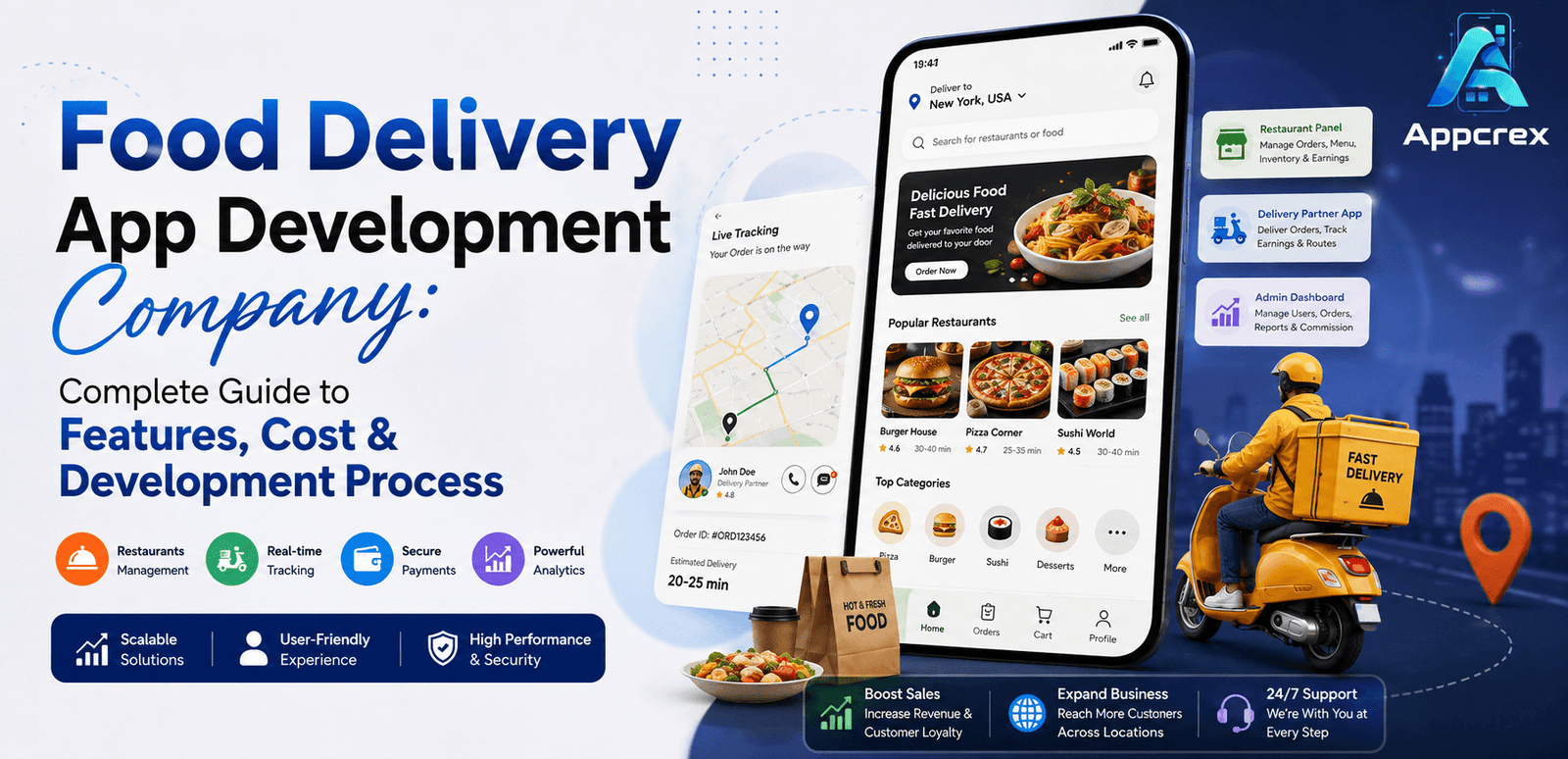
A typical food delivery solution includes:
- Customer Mobile App
- Restaurant Management Panel
- Delivery Partner App
- Admin Dashboard
These applications communicate in real time, allowing restaurants to receive orders instantly, delivery partners to optimize routes, and customers to monitor deliveries from their smartphones.
Custom food delivery applications can also integrate payment gateways, GPS tracking, AI recommendation engines, customer loyalty systems, and cloud infrastructure to create a secure and scalable platform.
Types of Food Delivery Apps
Choosing the right business model is one of the most important decisions before starting development. Different businesses require different types of food delivery solutions.
Single Restaurant Food Delivery App
Designed for restaurants that want to accept online orders directly from customers without paying commissions to third-party marketplaces. These apps help restaurants build direct customer relationships while increasing profit margins.
Multi-Restaurant Marketplace
A marketplace platform allows multiple restaurants to register, upload menus, and receive customer orders from a single application. This model is suitable for startups planning to build platforms similar to Uber Eats, DoorDash, or Deliveroo.
Cloud Kitchen Delivery App
Cloud kitchens operate without dine-in facilities and rely entirely on online orders. A dedicated cloud kitchen app helps manage orders, kitchen operations, delivery logistics, and customer communication efficiently.
Meal Subscription App
Subscription-based food delivery apps allow customers to purchase weekly or monthly meal plans. This model is commonly used by healthy meal providers, fitness brands, and meal preparation businesses.
Grocery & Food Delivery App
These platforms combine restaurant food delivery with grocery delivery, allowing users to order prepared meals, beverages, and daily essentials from a single application.
Also Read : Restaurant Management Software Development Company: Complete Guide to Features, Cost & Development Process
How to Build a Food Delivery App?
Building a successful food delivery app requires more than just coding. It involves understanding market demand, selecting the right business model, designing an intuitive user experience, and developing a scalable platform that can handle thousands of daily orders.
Step 1: Conduct Market Research
Analyze your target audience, competitors, and local food delivery trends. Decide whether you want to build a single restaurant app, a cloud kitchen platform, or a multi-vendor marketplace.
Step 2: Define Your Business Model
Choose how your platform will generate revenue through delivery fees, commissions, subscriptions, featured listings, or advertisements.
Step 3: Create an MVP
Start with core features such as user registration, restaurant listings, menu management, online ordering, payments, and order tracking. An MVP allows you to validate your idea before investing in advanced functionality.
Step 4: Design an Intuitive UI/UX
Develop user-friendly interfaces for customers, restaurant owners, delivery partners, and administrators. A simple and engaging design improves customer retention and overall satisfaction.
Step 5: Develop the Platform
Build the customer app, restaurant panel, delivery partner application, and admin dashboard using scalable technologies. Ensure the platform supports real-time communication, secure transactions, and cloud-based architecture.
Step 6: Integrate Essential Services
Integrate payment gateways, GPS navigation, push notifications, SMS services, customer support tools, and analytics platforms to create a complete ecosystem.
Step 7: Test Before Launch
Perform functional, performance, security, and usability testing to ensure the application works flawlessly across all supported devices.
Step 8: Launch & Improve
Deploy the application, monitor user feedback, release updates, introduce new features, and continuously improve the platform based on customer needs.
Must-Have Features of a Food Delivery App
The success of a food delivery application depends on how well it serves customers, restaurants, delivery partners, and administrators. A feature-rich platform improves user experience, streamlines operations, and helps businesses scale efficiently.
A modern food delivery solution typically consists of four modules:
- Customer App
- Restaurant Panel
- Delivery Partner App
- Admin Dashboard
Customer App Features
The customer application is the face of your food delivery platform. It should provide a fast, convenient, and secure ordering experience.
User Registration & Login
Allow users to sign up using email, phone number, Google, or Apple accounts for quick and secure access.
Restaurant Discovery
Customers should be able to search restaurants based on cuisine, ratings, distance, pricing, or delivery time.
Smart Search & Filters
Advanced filters help users quickly find restaurants, dishes, offers, vegetarian meals, vegan options, or nearby restaurants.
Menu Browsing
Display attractive menus with high-quality images, descriptions, prices, ingredients, and customization options.
Cart Management
Allow customers to add, remove, or modify items before placing an order.
Secure Online Payments
Support multiple payment methods including:
- Credit & Debit Cards
- Digital Wallets
- Apple Pay
- Google Pay
- PayPal
- Cash on Delivery (Optional)
Real-Time Order Tracking
Customers should receive live updates from order confirmation to food preparation, pickup, and delivery.
Push Notifications
Send instant notifications for:
- Order Confirmation
- Order Preparation
- Delivery Updates
- Promotional Offers
- Discount Coupons
Ratings & Reviews
Allow customers to rate restaurants, delivery partners, and food quality to build trust and improve service.
Favorites & Reordering
Customers can save favorite restaurants and reorder previous meals with a single tap.
Restaurant Panel Features
Restaurant owners require powerful tools to manage orders and daily operations efficiently.
1. Restaurant Registration
Restaurants can create business profiles and manage operational information.
2. Menu Management
Add, edit, or remove food items, categories, pricing, availability, and promotional offers.
3. Order Management
Receive, accept, reject, or update incoming orders in real time.
Kitchen Management
Monitor order preparation, estimated cooking time, and kitchen workload.
Inventory Management
Track ingredient availability, receive stock alerts, and reduce food wastage.
Revenue Dashboard
Monitor daily sales, completed orders, customer ratings, and business performance.
Promotional Campaigns
Create discounts, coupon codes, combo offers, and seasonal promotions.
Delivery Partner App Features
Delivery executives need a dedicated application to efficiently manage deliveries.
1. Profile Management
Drivers can update personal information, documents, vehicle details, and availability.
2. Order Requests
Receive nearby delivery requests with pickup and drop-off information.
Integrated maps provide optimized routes to reduce delivery time.
Delivery Status Updates
Drivers can update order status from pickup to successful delivery.
Earnings Dashboard
View completed deliveries, incentives, bonuses, and payment history.
Availability Toggle
Drivers can switch between Online and Offline modes based on their availability.
Admin Dashboard Features
The admin panel provides complete control over the platform and business operations.
User Management
Manage customers, restaurants, delivery partners, and administrators.
Restaurant Approval
Review and approve new restaurant registrations.
Delivery Partner Management
Verify delivery agents and monitor delivery performance.
Order Monitoring
Track all ongoing, completed, cancelled, and scheduled orders.
Commission Management
Configure restaurant commissions, delivery fees, taxes, and platform charges.
Reports & Analytics
Generate reports for:
- Revenue
- Orders
- Customer Growth
- Restaurant Performance
- Delivery Performance
Coupon & Promotion Management
Create platform-wide promotional campaigns and discount offers.
Content Management
Manage banners, restaurant categories, featured listings, blogs, FAQs, and app content.
AI Features in Food Delivery Apps
Artificial Intelligence is transforming food delivery platforms by improving customer engagement, operational efficiency, and business intelligence.
AI-Powered Food Recommendations
Recommend dishes based on customer preferences, previous orders, dietary habits, and browsing history.
Smart Delivery Route Optimization
AI identifies the fastest delivery routes by analyzing live traffic conditions, weather, and delivery locations.
Delivery Time Prediction
Provide accurate delivery estimates using historical order data and real-time traffic information.
AI Chatbot Support
Offer 24/7 customer support for order inquiries, refunds, restaurant information, and delivery updates.
Personalized Promotions
AI analyzes customer behavior to deliver personalized offers, loyalty rewards, and targeted marketing campaigns.
Demand Forecasting
Predict busy hours, seasonal demand, and popular menu items to help restaurants prepare inventory and staff efficiently.
Fraud Detection
AI monitors suspicious payment activities, fake accounts, coupon abuse, and fraudulent transactions to improve platform security.
Food Delivery App Development Process
Developing a successful food delivery application requires a structured development approach that ensures scalability, security, and long-term growth.
Step 1: Requirement Analysis
Understand business goals, target audience, business model, and technical requirements before starting development.
Step 2: UI/UX Design
Design intuitive interfaces for customers, restaurants, delivery partners, and administrators while ensuring a seamless user experience.
Step 3: Frontend & Backend Development
Develop customer apps, restaurant panels, delivery applications, backend services, databases, and APIs.
Step 4: Third-Party Integrations
Integrate essential services including payment gateways, GPS navigation, push notifications, analytics, customer support tools, and SMS providers.
Step 5: Testing & Quality Assurance
Perform functionality, security, performance, compatibility, and usability testing before deployment.
Step 6: Deployment & Maintenance
Launch the application on Android, iOS, and Web platforms while continuously monitoring performance, fixing bugs, and releasing new updates.
Technology Stack
Selecting the right technology stack ensures your food delivery app remains secure, scalable, and capable of handling high user traffic.
| Category | Technologies |
|---|---|
| Mobile App Development | Flutter, React Native |
| Web Frontend | React.js, Next.js |
| Backend | Node.js, Python, .NET |
| Database | PostgreSQL, MongoDB |
| Cloud Infrastructure | AWS, Google Cloud, Microsoft Azure |
| Maps & Navigation | Google Maps API, Mapbox |
| Payment Integration | Stripe, PayPal |
| Notifications | Firebase Cloud Messaging |
| Analytics | Google Analytics, Power BI |
| AI & Machine Learning | OpenAI, Gemini, TensorFlow |
A scalable technology stack ensures high performance, reliable uptime, secure transactions, and the flexibility to support future business growth.
Third-Party Integrations for Food Delivery Apps
A successful food delivery app relies on multiple third-party integrations to deliver a seamless experience for customers, restaurants, delivery partners, and administrators. These integrations automate operations, improve efficiency, and enhance the overall user experience.
Payment Gateway Integration
Secure payment processing is essential for any food delivery platform. Integrating trusted payment gateways enables customers to complete transactions safely using multiple payment methods.
Popular integrations include:
- Stripe
- PayPal
- Apple Pay
- Google Pay
- Credit & Debit Cards
- Digital Wallets
Supporting multiple payment options improves checkout experiences and reduces cart abandonment.
Also Read : Why Does Your Business Need Payment Gateway Integration Services?
Maps & GPS Integration
Real-time location services are critical for food delivery applications. GPS integration helps customers track their orders while enabling delivery partners to choose the fastest routes.
Key capabilities include:
- Live Order Tracking
- Driver Navigation
- Estimated Delivery Time (ETA)
- Route Optimization
- Address Auto Detection
Push Notification Services
Push notifications keep customers informed throughout the ordering process.
Notifications can be used for:
- Order Confirmation
- Food Preparation Updates
- Driver Assignment
- Delivery Status
- Promotional Campaigns
- Discount Coupons
- Loyalty Rewards
Also Read : Push Notification Guide: Benefits, Types & Best Practices (2026)
SMS & Email Integration
SMS and email services provide additional communication channels for important updates.
Common use cases include:
- OTP Verification
- Order Confirmation
- Payment Receipts
- Password Reset
- Marketing Campaigns
Restaurant POS Integration
Connecting restaurant POS systems eliminates duplicate data entry and synchronizes orders automatically.
Benefits include:
- Automatic Order Synchronization
- Menu Updates
- Inventory Synchronization
- Billing Integration
- Sales Reporting
CRM Integration
CRM systems help businesses manage customer relationships more effectively.
Features include:
- Customer Profiles
- Purchase History
- Loyalty Programs
- Personalized Offers
- Customer Segmentation
Analytics Integration
Analytics tools provide valuable insights into business performance.
Track metrics such as:
- Daily Orders
- Revenue Growth
- Customer Retention
- Average Order Value
- Restaurant Performance
- Delivery Efficiency
These insights help businesses optimize marketing campaigns and operational strategies.
How Much Does Food Delivery App Development Cost?
The cost of food delivery app development depends on several factors, including business model, features, supported platforms, UI/UX design, integrations, and overall project complexity.
A simple single-restaurant application costs significantly less than an enterprise-grade multi-vendor marketplace with AI-powered recommendations, delivery management, and advanced analytics.
Also Read : How Much Does It Cost to Develop an App in 2026? Complete Pricing Guide
Estimated Development Cost
| App Type | Estimated Cost | Timeline |
|---|---|---|
| Basic Food Delivery App | $20,000 – $40,000 | 2–3 Months |
| Standard Food Delivery App | $40,000 – $80,000 | 3–5 Months |
| Multi-Restaurant Marketplace | $80,000 – $150,000 | 5–8 Months |
| Enterprise Food Delivery Platform | $150,000 – $300,000+ | 8–12 Months |
Note: Development costs vary based on customization, technology stack, integrations, cloud infrastructure, AI capabilities, and ongoing maintenance requirements.
Factors Affecting Food Delivery App Development Cost
Several technical and business factors influence the overall development budget.
1. Feature Complexity
Advanced features such as AI-powered recommendations, live tracking, loyalty programs, subscription plans, and multi-language support require additional development time and investment.
2. Platform Selection
Developing applications for Android, iOS, Web, and tablets increases development effort compared to launching on a single platform.
3. UI/UX Design
An attractive and intuitive interface improves user engagement but requires additional design and testing.
4. Third-Party Integrations
Payment gateways, GPS navigation, restaurant POS systems, CRM software, and analytics platforms all contribute to overall development complexity.
5. Security Requirements
Food delivery platforms process sensitive customer and payment information. Implementing secure authentication, encryption, fraud detection, and compliance standards is essential.
6. Scalability
If your platform is expected to support multiple cities, countries, thousands of restaurants, and millions of users, it should be built using scalable cloud architecture.
Monetization Models for Food Delivery Apps
A successful food delivery platform should generate recurring revenue from multiple sources rather than relying on a single income stream.
1. Restaurant Commission
Charge restaurants a commission for every successful order processed through the platform. This is one of the most common revenue models used by marketplace apps.
2. Delivery Fees
Customers pay a delivery charge based on distance, delivery speed, or order value.
3. Subscription Plans
Offer premium memberships that include benefits such as free delivery, exclusive discounts, cashback rewards, and priority customer support.
4. Featured Restaurant Listings
Restaurants can pay to appear at the top of search results or on the home screen, increasing their visibility and attracting more orders.
5. In-App Advertising
Generate advertising revenue by allowing restaurants and food brands to promote special offers, new menu items, or seasonal campaigns.
6. Surge Pricing
Increase delivery charges during peak hours, weekends, holidays, or bad weather to balance demand and maximize revenue.
Custom Food Delivery App vs Ready-Made Solutions
Businesses often choose ready-made food delivery software because it is faster to launch and requires a lower initial investment. However, as the business grows, these solutions can become restrictive due to limited customization, scalability, and integration capabilities.
A custom food delivery app is built specifically around your business model, giving you complete control over features, branding, user experience, and future expansion.
| Ready-Made Solution | Custom Food Delivery App |
|---|---|
| Generic Features | Fully Customized Features |
| Limited Branding | Complete Brand Identity |
| Monthly Subscription Fees | One-Time Development Investment |
| Limited Integrations | Easy API & Third-Party Integrations |
| Difficult to Scale | Built for Business Growth |
| Vendor Dependency | Full Ownership & Control |
| Limited Customization | Tailored to Your Workflow |
For startups, restaurant chains, and enterprise businesses looking for long-term growth, custom food delivery app development offers greater flexibility, stronger security, and a higher return on investment.
Also Read : How Much Does It Cost to Build a React Native App in UAE? Complete Guide (2026)
Challenges in Food Delivery App Development
Building a successful food delivery platform involves more than developing a mobile application. Businesses must overcome technical and operational challenges to ensure smooth performance and an excellent user experience.
Managing High Order Volumes
During lunch hours, weekends, holidays, and special events, thousands of orders may be placed simultaneously. The platform must process these orders without affecting speed or performance.
Real-Time Order Tracking
Customers expect accurate live tracking from the moment an order is confirmed until it reaches their doorstep. Maintaining precise location updates requires robust GPS and mapping integrations.
Delivery Logistics
Assigning the right delivery partner, optimizing routes, and minimizing delivery times are essential for customer satisfaction and operational efficiency.
Multi-Restaurant Management
Marketplace platforms need centralized tools to manage multiple restaurants, menus, commissions, operating hours, and order workflows.
Secure Payment Processing
Handling online payments requires secure payment gateways, encrypted transactions, fraud detection, and compliance with international security standards.
Platform Scalability
As the business expands into new cities or countries, the platform should support more users, restaurants, delivery partners, and transactions without compromising performance.
Future Trends in Food Delivery App Development
The food delivery industry continues to evolve with emerging technologies that improve efficiency and customer experiences.
AI-Powered Personalization
Artificial Intelligence recommends restaurants, dishes, and promotional offers based on customer preferences, previous orders, and purchasing behavior.
Drone Delivery
Drone technology is gradually being explored for faster deliveries in suitable regions, helping reduce delivery times and operational costs.
Autonomous Delivery Vehicles
Self-driving delivery robots and autonomous vehicles are expected to improve last-mile delivery while reducing dependency on manual logistics.
Voice Ordering
Voice assistants allow customers to place orders using simple voice commands, creating a more convenient ordering experience.
Cloud Kitchens
Delivery-only restaurants continue to grow, increasing demand for software that manages multiple virtual brands from a single kitchen.
Predictive Analytics
AI-powered analytics help businesses forecast demand, optimize inventory, schedule staff efficiently, and improve customer retention.
Contactless Ordering & Payments
Digital menus, QR code ordering, and contactless payment methods have become standard features for modern food delivery platforms.
Why Choose AppCrex for Food Delivery App Development?
At AppCrex, we develop high-performance food delivery applications tailored to startups, restaurants, cloud kitchens, and enterprise businesses worldwide. Our team combines industry expertise with modern technologies to deliver scalable and secure digital solutions.
Our Food Delivery App Development Services
- Custom Food Delivery App Development
- Multi-Restaurant Marketplace Development
- Single Restaurant Ordering Apps
- Cloud Kitchen App Development
- Delivery Partner Applications
- Restaurant Management Dashboard
- Admin Panel Development
- Payment Gateway Integration
- GPS & Real-Time Order Tracking
- AI-Powered Food Delivery Solutions
- App Maintenance & Support
Why Businesses Choose AppCrex?
- Experienced Mobile & Web Development Team
- Custom UI/UX Design
- Scalable Cloud Architecture
- AI & Automation Expertise
- Secure Payment Integration
- Agile Development Process
- Transparent Communication
- End-to-End Development & Support
Whether you’re launching a new food delivery startup or expanding an existing restaurant business, AppCrex delivers solutions designed to support long-term growth and exceptional customer experiences.
(FAQs)
1. What is food delivery app development?
Food delivery app development is the process of creating mobile and web applications that enable customers to order food online while allowing restaurants, delivery partners, and administrators to manage the complete delivery workflow.
2. How much does food delivery app development cost?
The cost typically ranges from $20,000 to $300,000+, depending on the app’s complexity, features, supported platforms, integrations, and customization requirements.
3. How long does it take to build a food delivery app?
A basic application can take 2–3 months, while a feature-rich multi-restaurant platform with advanced AI capabilities may require 6–12 months.
4. What features should a food delivery app include?
Essential features include user registration, restaurant listings, menu management, online payments, live order tracking, push notifications, delivery partner management, admin dashboards, and analytics.
5. Can food delivery apps integrate with third-party services?
Yes. Modern food delivery apps can integrate with payment gateways, GPS navigation, POS systems, CRM platforms, SMS services, push notification providers, and analytics tools.
6. Which technologies are best for food delivery app development?
Popular technologies include Flutter, React Native, Node.js, React.js, PostgreSQL, MongoDB, AWS, Google Cloud, and AI services such as OpenAI and TensorFlow.
7. Why should I choose custom food delivery app development instead of ready-made software?
Custom development provides complete ownership, tailored features, better scalability, stronger security, seamless integrations, and long-term flexibility to grow your business.
Conclusion
The food delivery industry continues to expand as customers increasingly rely on digital platforms for convenient meal ordering. Investing in custom food delivery app development enables restaurants, cloud kitchens, and startups to improve customer experiences, automate operations, and create new revenue opportunities.
By combining modern technologies such as AI, GPS tracking, secure payment gateways, cloud infrastructure, and real-time analytics, businesses can build scalable platforms that meet evolving customer expectations and support long-term growth.
Whether you’re developing a single-restaurant ordering app or a global multi-vendor marketplace, partnering with an experienced mobile app development company ensures your platform is secure, future-ready, and built for success.
Build Your Food Delivery App with AppCrex
Ready to launch your own food delivery platform?
AppCrex provides end-to-end Food Delivery App Development Services, helping startups, restaurants, cloud kitchens, and enterprises build secure, scalable, and feature-rich applications. From business strategy and UI/UX design to development, deployment, and ongoing maintenance, our team supports you throughout the entire product lifecycle.
Contact AppCrex today to discuss your project and transform your food delivery idea into a powerful digital platform.