📌 Key Takeaways
- AI ERP integration connects AI, LLMs, machine learning, and automation with existing ERP systems.
- AI can improve finance, inventory, procurement, sales, HR, supply chain, and business reporting.
- LLM-powered ERP assistants allow employees to interact with business data using natural-language queries.
- AI-powered ERP solutions can support forecasting, workflow automation, anomaly detection, inventory optimization, and intelligent reporting.
- AI ERP integration costs depend on the ERP platform, number of modules, AI features, integrations, data requirements, security, and project complexity.
Businesses are increasingly moving beyond traditional automation toward AI agents that can understand information, make decisions, use business tools, and complete tasks with limited human intervention. However, building an AI agent is only one part of the process. To generate real business value, that agent needs to work with the systems a company already uses.
This is where AI Agent Integration Services become important.
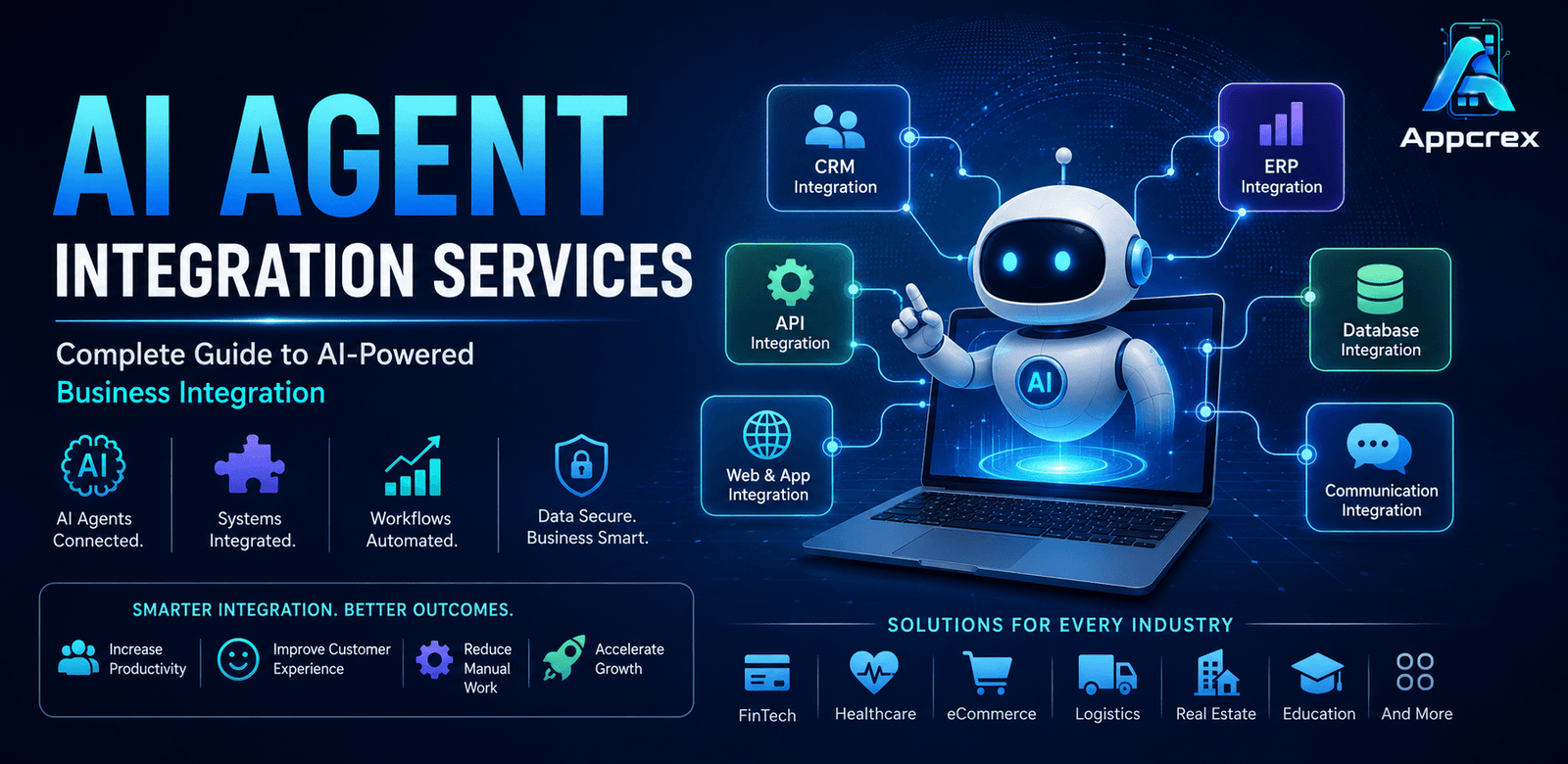
AI agent integration connects intelligent agents with existing CRM, ERP, websites, mobile apps, databases, APIs, SaaS platforms, communication tools, payment systems, and enterprise software. Instead of creating an isolated AI chatbot or assistant, businesses can integrate AI agents directly into their existing digital ecosystem.
AppCrex provides custom AI Agent Integration Services for startups, SMEs, and enterprises looking to introduce intelligent automation into their existing technology infrastructure.
What Are AI Agent Integration Services?
AI agent integration is the process of connecting an AI agent with existing software, business data, APIs, tools, and workflows so that the agent can perform useful actions.
For example, an AI customer-support agent can be integrated with a CRM. When a customer asks about an order, the agent can access authorized order information, understand the request, and provide an appropriate response.
Similarly, an AI sales agent could connect with a CRM and calendar to:
- Find customer information
- Qualify leads
- Update CRM records
- Prepare follow-up messages
- Schedule meetings
- Generate sales summaries
The basic architecture can be represented as:
User → AI Agent → LLM/AI Model → Tools & APIs → Business Systems → Action/Response
This makes AI agents much more useful than standalone conversational interfaces.
Just Read : AI CRM Integration Services: Complete Guide to Intelligent Customer Management
AI Agent Integration vs AI Agent Development
These two services are related but have different purposes.
| AI Agent Development | AI Agent Integration |
|---|---|
| Builds the AI agent | Connects the agent with existing systems |
| Defines agent behavior | Connects APIs and business tools |
| Develops agent architecture | Integrates CRM, ERP, apps, databases, etc. |
| Implements memory and reasoning | Enables the agent to perform real business actions |
| Creates custom AI capabilities | Deploys those capabilities into existing workflows |
For example, an AI Agent Development Company may build an autonomous sales agent, while an AI Agent Integration Company connects that agent to Salesforce, HubSpot, email, calendars, payment systems, or a company’s custom CRM.
Both can be part of the same AI transformation strategy, but the integration layer is what connects the agent to the real business environment.
Why Businesses Need AI Agent Integration?
Many organizations already have CRM, ERP, HR, accounting, eCommerce, customer-support, and communication systems.
Replacing these systems simply to introduce AI is often unnecessary.
AI agent integration allows businesses to add intelligent capabilities to their existing technology stack.
Businesses can use AI agents to:
- Automate repetitive tasks
- Access business information
- Respond to customer requests
- Update CRM records
- Analyze documents
- Generate reports
- Support sales teams
- Automate internal workflows
- Connect multiple business systems
- Assist employees
- Coordinate multi-step processes
This approach can help organizations introduce AI without completely rebuilding their existing infrastructure.
AI Agent Integration Services We Provide
AI CRM Agent Integration
CRM integration is one of the most practical applications of AI agents.
An AI agent can connect with a CRM to help sales and customer-service teams with tasks such as:
- Lead qualification
- Customer information retrieval
- Lead updates
- Follow-up reminders
- Sales summaries
- Customer support
- Meeting scheduling
- Pipeline analysis
For example, a sales representative could ask:
“Show me the leads that require follow-up today.”
The AI agent can retrieve authorized CRM data and present the relevant information.
AI ERP Agent Integration
AI agents can also be integrated with ERP systems to assist with business operations.
Potential applications include:
- Inventory queries
- Purchase order assistance
- Invoice information
- Financial reporting
- Procurement support
- Supply chain analysis
- Employee information
- Business reporting
An employee could ask:
“Which products are below the current inventory threshold?”
The agent can retrieve the required information from the ERP system and return a natural-language response.
AI Agent Integration With Mobile Apps
A modern mobile app development company can integrate AI agents into iOS and Android apps to provide intelligent functionality directly to users.
AI agents can be integrated into:
- Fintech apps
- Healthcare apps
- Education apps
- eCommerce apps
- Travel apps
- Fitness apps
- Real estate apps
- Food delivery apps
- Logistics apps
- Enterprise mobile apps
For example, an AI agent inside an eCommerce app could help users discover products, compare options, answer questions, and assist with order-related requests.
Also Read : Food Delivery App Development Company: Complete Guide to Features, Cost & Development Process
AI Agent Integration With Websites
AI agents can also be integrated into websites to improve customer engagement.
Unlike a basic FAQ chatbot, an integrated AI agent can potentially connect to business systems and perform authorized actions.
Examples include:
- Customer support
- Product recommendations
- Lead qualification
- Appointment booking
- Order tracking
- Sales assistance
- Service inquiries
- Personalized content discovery
This can turn a website into an interactive AI-powered customer experience.
AI Agent API Integration
APIs are fundamental to AI agent integration.
An AI agent can use APIs to interact with external systems and services.
Common API integrations include:
- CRM APIs
- ERP APIs
- Payment APIs
- Maps APIs
- Communication APIs
- Calendar APIs
- Banking APIs
- eCommerce APIs
- Shipping APIs
- Business intelligence APIs
With appropriate permissions and safeguards, API integration allows an AI agent to move from simply generating text to interacting with business systems.
AI Agent Integration With Databases
AI agents can be connected to structured business databases to retrieve relevant information.
Common database environments include:
- PostgreSQL
- MySQL
- MongoDB
- Microsoft SQL Server
- Enterprise data warehouses
- Cloud databases
A secure integration layer should control what information the AI agent can access.
For example, a customer-service agent may be allowed to access order status but should not automatically have access to confidential financial records.
LLM Integration for AI Agents
Large Language Models provide the language and reasoning capabilities behind many modern AI agents.
LLM integration can enable agents to:
- Understand natural-language requests
- Generate responses
- Summarize information
- Interpret documents
- Decide which tools to use
- Coordinate multiple actions
- Assist employees
- Retrieve relevant information
However, an LLM by itself does not automatically have access to a company’s systems. APIs, tools, permissions, retrieval systems, and integration layers are required to connect the agent to business data and actions.
RAG Integration With AI Agents
Retrieval-Augmented Generation (RAG) can connect AI agents with an organization’s approved knowledge sources.
A RAG-enabled agent can retrieve relevant information from:
- Internal documents
- Product catalogs
- Knowledge bases
- Company policies
- Technical documentation
- Support content
- Enterprise databases
This can help an agent provide responses based on company-specific information rather than relying solely on its general model knowledge.
AI Agent Integration With Popular Business Systems
AI agents can be integrated with different enterprise and SaaS environments depending on available APIs and technical capabilities.
Potential integrations include:
- Salesforce
- HubSpot
- Microsoft Dynamics
- SAP
- Oracle
- NetSuite
- Odoo
- Shopify
- Custom CRM
- Custom ERP
- Helpdesk platforms
- Project management platforms
The exact integration approach depends on the platform’s APIs, permissions, architecture, subscription plan, and business requirements.
AI Agent Integration Across Industries
AI agents are not limited to one industry. Their integration possibilities extend across multiple sectors.
FinTech
AI agents can support:
- Customer service
- Transaction-related queries
- Financial information retrieval
- Document processing
- Internal employee assistance
- Compliance workflow support
High-impact financial decisions should retain appropriate human oversight and regulatory controls.
Healthcare
AI agents can assist with administrative and information-based workflows such as:
- Appointment support
- Patient communication
- Document retrieval
- Staff assistance
- Healthcare knowledge search
- Administrative workflows
Healthcare implementations require strong privacy, security, and regulatory controls.
Also Read : Healthcare App Development Guide: Features, Cost & Process (2026)
eCommerce
AI agents can integrate with eCommerce platforms to support:
- Product discovery
- Customer support
- Order tracking
- Product recommendations
- Returns assistance
- Personalized shopping experiences
Logistics & Transportation
AI agents can connect with logistics systems to support:
- Shipment tracking
- Delivery information
- Driver communication
- Customer support
- Route-related information
- Logistics reporting
Real Estate
AI agents can integrate with property databases and CRM systems to assist with:
- Property search
- Lead qualification
- Customer inquiries
- Appointment scheduling
- Property recommendations
- Follow-up automation
Also Read : Real Estate App Development Company: Complete Guide to Features, Cost & Development Process
Education
AI agents can integrate with education platforms for:
- Student support
- Course information
- Learning assistance
- Administrative queries
- Content discovery
- Faculty support
Manufacturing
AI agents can interact with manufacturing systems to assist with:
- Production information
- Inventory queries
- Maintenance information
- Supplier communication
- Operational reporting
Trending AI Agent Integration Solutions
Modern AI agent integration is moving beyond simple chatbots toward systems that can use tools and coordinate multiple tasks.
AI Copilots
AI copilots can assist employees inside existing software environments.
AI Customer Support Agents
Agents can handle routine customer conversations and escalate complex cases to human representatives.
AI Sales Agents
Sales agents can assist with lead qualification, CRM updates, outreach preparation, and meeting coordination.
AI Voice Agents
Voice-enabled AI agents can interact with customers through phone or voice interfaces.
Multi-Agent Systems
Multiple specialized agents can collaborate on complex workflows.
For example:
Sales Agent → Research Agent → CRM Agent → Scheduling Agent
AI Agents With RAG
RAG allows agents to retrieve relevant company knowledge before generating responses.
AI Agents With Tool Calling
Tool calling allows agents to interact with authorized APIs and software systems.
AI-Powered Business Assistants
Enterprise assistants can provide employees with a unified interface for accessing approved business information.
Key Features of AI Agent Integration
A custom AI agent integration solution can include:
- LLM integration
- API integration
- CRM integration
- ERP integration
- Database integration
- RAG
- Tool calling
- Function calling
- Agent memory
- Multi-agent workflows
- AI chatbot integration
- AI voice integration
- Authentication
- Role-based access
- Data permissions
- Workflow automation
- Real-time notifications
- Analytics dashboards
- Audit logging
- Human handoff
- Monitoring
- Error handling
The appropriate features depend on the business workflow and integration requirements.
AI Agent Integration Development Process
1. Business & System Analysis
First, we understand the existing software ecosystem, business workflows, data sources, user roles, and AI objectives.
2. Identify Integration Opportunities
The next step is identifying where AI agents can create measurable value.
For example:
- Customer support
- Sales
- Finance
- HR
- Operations
- Procurement
3. Integration Architecture
The architecture is designed around:
- AI models
- APIs
- Databases
- Business systems
- Authentication
- Security
- Agent tools
4. API & Data Integration
The required APIs, databases, SaaS platforms, and enterprise systems are connected through a secure integration layer.
5. AI Agent Configuration
Agent instructions, tools, memory, retrieval capabilities, and workflows are configured according to the use case.
6. RAG & Knowledge Integration
If required, company-specific documents and knowledge sources are connected through retrieval systems.
7. Testing
The system is tested for:
- Response quality
- API functionality
- Data accuracy
- Security
- Permissions
- Workflow execution
- Error handling
- Performance
8. Deployment
The integrated AI agent is deployed within the required cloud or enterprise environment.
9. Monitoring & Optimization
Agent behavior, API usage, performance, errors, and business outcomes are monitored after deployment.
Technology Stack for AI Agent Integration
AI & LLM
- OpenAI-compatible LLM APIs
- Anthropic-compatible LLM APIs
- Google AI models
- Open-source LLMs
- RAG
- Embedding models
Backend
- Python
- Node.js
- Java
- .NET
APIs
- REST
- GraphQL
- Webhooks
- OAuth
- API gateways
Databases
- PostgreSQL
- MySQL
- MongoDB
- Redis
- Vector databases
Cloud
- AWS
- Microsoft Azure
- Google Cloud
The final stack should be selected according to the existing business ecosystem rather than simply choosing the newest technology.
Security in AI Agent Integration
AI agents may interact with sensitive business systems, so security should be part of the architecture from the beginning.
Important considerations include:
- Authentication
- Authorization
- Role-based access control
- API security
- Encryption
- Secure credential management
- Data minimization
- Audit logging
- Monitoring
- Human approval for sensitive actions
For example, an AI sales agent may be permitted to update a lead but not delete customer records.
Similarly, a finance-related agent may be allowed to retrieve reports while requiring human approval before executing sensitive transactions.
How Much Does AI Agent Integration Cost?
The cost depends on the number of systems being connected, agent complexity, AI model requirements, security, data architecture, and workflow complexity.
| Integration Type | Estimated Cost |
|---|---|
| Basic AI Agent Integration | $8,000 – $15,000 |
| AI Agent + CRM/API Integration | $12,000 – $25,000 |
| Multi-System AI Agent Integration | $20,000 – $40,000 |
| Advanced Enterprise AI Agent Integration | $40,000 – $80,000+ |
These are indicative development estimates, not fixed quotations.
Factors Affecting Cost
- Number of integrations
- API complexity
- AI model selection
- RAG implementation
- Database integration
- Agent memory
- Multi-agent architecture
- Security requirements
- User roles
- Cloud infrastructure
- Real-time processing
- Voice integration
- Testing and monitoring
AI Agent Integration Company for Global Markets
Businesses across major technology markets are adopting AI agents to improve customer experiences and internal operations.
USA
AI agent integrations for SaaS, healthcare, fintech, retail, eCommerce, logistics, and enterprise businesses.
UK
AI agents for customer service, sales, financial services, healthcare, retail, and business automation.
Canada
Custom AI agent integration for startups, SMEs, SaaS businesses, and enterprises.
UAE & Dubai
AI agent solutions for fintech, real estate, logistics, tourism, eCommerce, retail, and enterprise businesses.
Saudi Arabia
AI agent integration for businesses in Riyadh and across Saudi Arabia, including customer support, enterprise automation, fintech, retail, and logistics.
India
AI agent integration for startups, IT companies, eCommerce businesses, fintech, healthcare, education, logistics, and enterprises.
Singapore
AI agent solutions for fintech, logistics, eCommerce, manufacturing, and technology businesses.
Australia
AI agent integration for healthcare, retail, finance, logistics, professional services, and enterprise operations.
These are target service markets and do not imply a physical AppCrex office in every listed location.
Common Challenges in AI Agent Integration
Legacy Systems
Older software may have limited API capabilities, making integration more complicated.
Data Access
AI agents need controlled access to the information required for their tasks.
Security
Connecting AI agents to business systems increases the importance of authentication, authorization, and monitoring.
AI Reliability
AI-generated responses and actions should be validated, especially when they affect important business operations.
Integration Complexity
Connecting multiple systems can require custom middleware, APIs, data transformation, and workflow orchestration.
Human Oversight
Sensitive or irreversible actions may require human approval before execution.
Why Choose AppCrex for AI Agent Integration Services?
AppCrex helps businesses connect AI agents with their existing technology infrastructure.
Custom Integration Architecture
We design integration solutions around your existing CRM, ERP, APIs, databases, applications, and workflows.
AI & LLM Integration
Our solutions can incorporate LLMs, RAG, AI copilots, voice AI, and agentic workflows where appropriate.
Cross-Industry Experience
AI agent integration can be designed for fintech, healthcare, eCommerce, logistics, education, real estate, manufacturing, SaaS, and other industries.
Mobile & Web Integration
As a mobile app development company and software development partner, AppCrex can integrate AI agents into mobile applications, websites, and enterprise software.
Enterprise Integration
AI agents can be connected with CRM, ERP, databases, APIs, communication platforms, and other business systems.
Security-Focused Development
Authentication, access control, secure APIs, logging, monitoring, and human approval workflows can be incorporated based on project requirements.
FAQs
Q. What are AI Agent Integration Services?
AI Agent Integration Services connect AI agents with existing business systems such as CRM, ERP, websites, mobile apps, APIs, databases, and SaaS platforms.
Q. What is the difference between AI agent development and integration?
AI agent development focuses on building the agent itself, while integration focuses on connecting the agent to existing software, data, APIs, and business workflows.
Q. Can AI agents integrate with CRM systems?
Yes. AI agents can be integrated with CRM platforms to support lead qualification, customer support, data retrieval, follow-ups, sales assistance, and CRM updates.
Q. Can AI agents integrate with ERP systems?
Yes. Depending on the ERP’s capabilities, AI agents can assist with inventory, procurement, finance, reporting, supply chain, and other ERP-related workflows.
Q. Can AI agents be integrated into mobile applications?
Yes. AI agents can be integrated into iOS and Android applications across industries such as fintech, healthcare, eCommerce, education, travel, logistics, and real estate.
Q. How much does AI agent integration cost?
Basic integrations may start around $8,000–$15,000, while multi-system and enterprise implementations can cost significantly more.
Q. Can an AI agent use APIs?
Yes. API and tool integration allow an AI agent to retrieve information or perform authorized actions in external systems.
Q. Is RAG required for AI agent integration?
Not always. RAG is useful when the agent needs to retrieve information from company-specific documents, knowledge bases, or other approved data sources.
Conclusion
AI Agent Integration Services help businesses connect intelligent AI agents with the software and systems they already use. Instead of keeping AI isolated inside a chatbot, organizations can connect agents with CRM, ERP, mobile apps, websites, databases, APIs, SaaS platforms, and enterprise workflows.
This opens the door to practical applications such as AI sales agents, customer-support agents, voice agents, enterprise copilots, AI-powered assistants, and multi-agent workflows.
The most effective implementations focus on a clear business objective, secure system access, reliable integrations, appropriate AI models, and human oversight where necessary.
Build an AI-Connected Business With AppCrex
AppCrex provides AI Agent Integration Services for startups, SMEs, and enterprises looking to connect AI with their existing digital infrastructure.
Whether you need CRM integration, ERP integration, mobile app AI integration, LLM integration, RAG, AI voice agents, AI copilots, API integration, or multi-agent business workflows, AppCrex can help design and implement an integration strategy around your requirements.
Ready to Integrate AI Into Your Existing Systems?
Talk to AppCrex about building a secure, scalable, and intelligent AI agent integration solution.