📌 Key Takeaways
- AI recommendation engines use machine learning, user behavior, product data, and contextual signals to deliver personalized recommendations.
- Recommendation systems can be used across eCommerce, fintech, OTT, food delivery, travel, real estate, education, healthcare, and marketplaces.
- Modern recommendation solutions can combine machine learning, semantic search, embeddings, RAG, and LLMs for more intelligent personalization.
- AI recommendation engines can integrate with websites, mobile apps, CRM, ERP, eCommerce platforms, APIs, and databases.
- AI recommendation engine development costs depend on data volume, model complexity, real-time requirements, integrations, personalization needs, and scalability.
Businesses today have access to enormous amounts of customer and product data. The challenge is turning that data into personalized experiences. Customers expect platforms to understand their interests and show relevant products, services, content, or offers instead of making them search through endless options.
This is where an AI recommendation engine can make a significant difference.
AI-powered recommendation systems use machine learning, customer behavior, contextual signals, and increasingly large language models to identify patterns and generate personalized recommendations. They are used across eCommerce, fintech, OTT platforms, food delivery, travel, healthcare, education, real estate, marketplaces, and SaaS products.
As a leading AI development and app development company, AppCrex provides custom AI recommendation engine development services for startups, growing businesses, and enterprises.
What Is an AI Recommendation Engine?
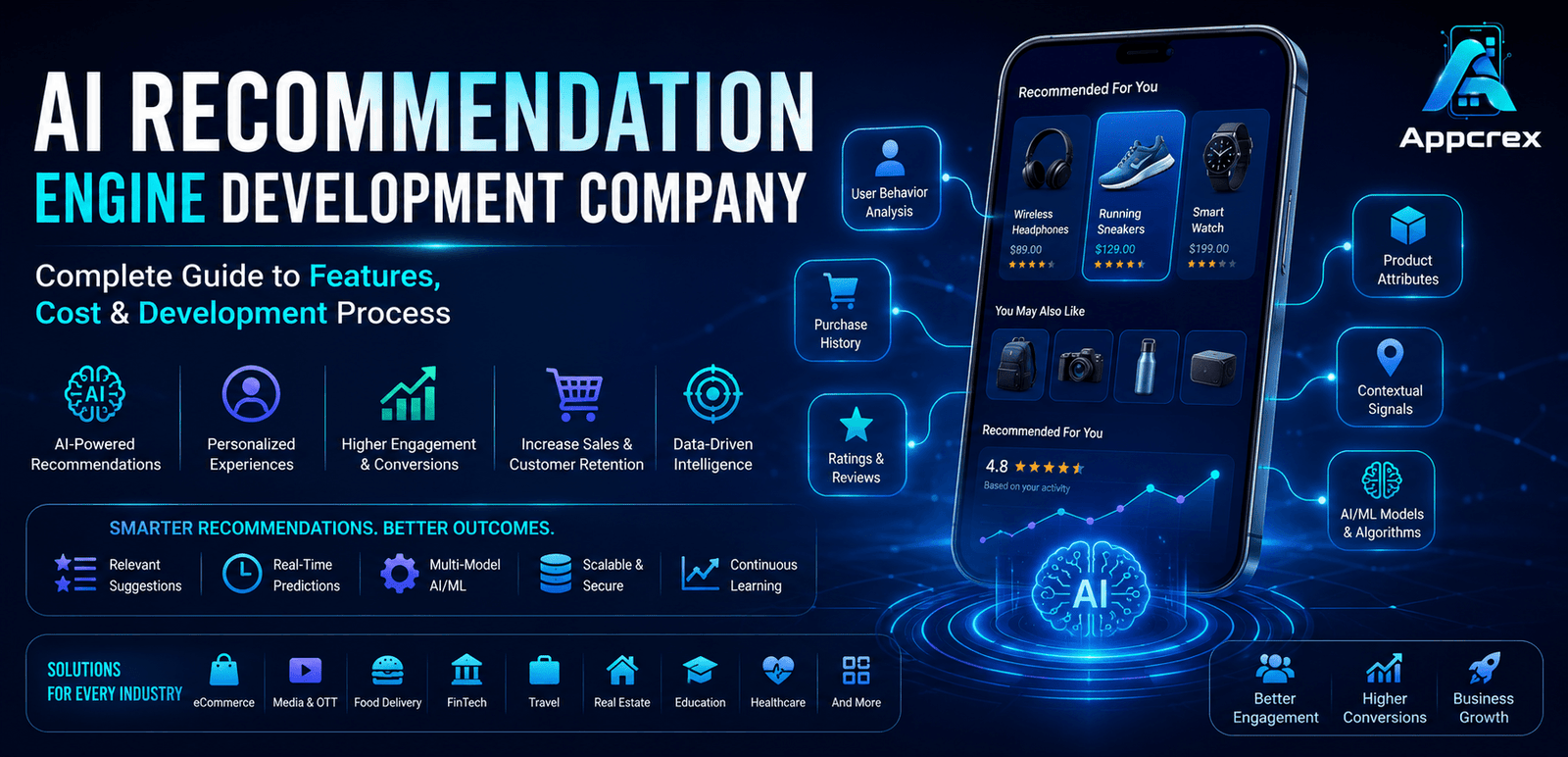
An AI recommendation engine is a software system that analyzes user behavior, preferences, contextual information, and other relevant data to recommend products, services, content, or actions.
For example, an eCommerce platform can analyze:
- Products viewed
- Previous purchases
- Search behavior
- Cart activity
- Product ratings
- Price preferences
- Browsing patterns
The system can then recommend products that are likely to be relevant to the customer.
A simplified recommendation flow is:
User Data → AI/ML Model → Preference Analysis → Recommendation Generation → Personalized Experience
Unlike basic rule-based recommendation systems, modern AI recommendation engines can learn from changing user behavior and continuously improve their predictions.
Why Businesses Need AI Recommendation Engines?
Customers are exposed to thousands of products, services, videos, articles, properties, and other digital options.
Personalization helps businesses reduce this complexity.
AI recommendation engines can help businesses:
- Improve customer engagement
- Increase product discovery
- Personalize user experiences
- Improve conversion opportunities
- Increase repeat purchases
- Improve customer retention
- Deliver relevant content
- Increase average order value
- Support cross-selling and upselling
- Improve search and discovery
The objective is not simply to recommend more items. It is to recommend more relevant items at the right time and in the right context.
AI Recommendation Engine Development Services
Custom Recommendation Engine Development
AppCrex can develop recommendation engines tailored to specific business models.
The engine can be designed around:
- Customer behavior
- Product catalogs
- Content libraries
- Transaction history
- User preferences
- Business rules
- Contextual signals
This approach is useful when standard recommendation plugins cannot support the required personalization logic.
Personalized Product Recommendations
AI recommendation engines are widely used in eCommerce and marketplace platforms.
Recommendations can include:
- Similar products
- Frequently purchased products
- Recently viewed products
- Complementary products
- Trending products
- Personalized offers
- Recommended products based on previous purchases
For example, if a customer frequently purchases fitness products, the system can prioritize relevant products instead of showing completely unrelated categories.
Content Recommendation Engine
Content platforms can use AI to personalize what users see.
Potential applications include:
- Videos
- Movies
- Music
- Articles
- Courses
- Podcasts
- News
- Social content
The recommendation system can consider previous interactions, viewing time, preferences, and content characteristics.
AI Recommendation Engine for Mobile Apps
A mobile app development company can integrate AI recommendation engines directly into iOS and Android applications.
Common applications include:
- Shopping apps
- Food delivery apps
- Travel apps
- Fitness apps
- Education apps
- Fintech apps
- Social platforms
- Entertainment apps
- Real estate apps
For example, a food delivery app can recommend restaurants or dishes based on previous orders, location, cuisine preferences, time of day, and other permitted signals.
AI Recommendation Engine for eCommerce
eCommerce is one of the strongest use cases for recommendation systems.
An AI engine can personalize:
Homepage Recommendations
Show users products based on their previous behavior and preferences.
Similar Products
Recommend products with similar characteristics.
Frequently Bought Together
Identify products that customers commonly purchase together.
Upselling
Recommend a higher-value alternative when appropriate.
Cross-Selling
Recommend complementary products.
Personalized Search
Improve search results using user intent and historical behavior.
This can create a more relevant shopping experience while helping businesses improve product discovery.
Just Read : AI App Development Guide: Features, Cost & Process (2026)
AI Recommendation Engine for FinTech
Recommendation technology can also be used in financial platforms.
Potential use cases include:
- Personalized financial content
- Relevant financial products
- Personalized offers
- Investment education content
- Customer engagement
- Financial service discovery
Because financial recommendations can have significant consequences, organizations should apply appropriate compliance, transparency, suitability, and human-review controls.
AI Recommendation Engine for OTT & Media
OTT platforms need to help users discover relevant content from large libraries.
AI can analyze:
- Viewing history
- Search activity
- Watch duration
- Genres
- Ratings
- Content preferences
- Session behavior
The platform can then recommend:
- Movies
- TV shows
- Videos
- Documentaries
- Music
- Similar content
This type of personalization can help users discover content more efficiently.
Just Read : FinTech API Integration Services: Complete Guide to Banking APIs, Payments & Security
AI Recommendation Engine for Food Delivery
Food delivery platforms can use recommendation systems to personalize:
- Restaurants
- Dishes
- Cuisines
- Meal combinations
- Offers
- Repeat orders
For example, a customer who frequently orders vegetarian meals may receive more relevant restaurant and menu recommendations.
Context can also influence recommendations, such as time of day, location, previous orders, and current availability.
AI Recommendation Engine for Travel
Travel platforms can use AI to recommend:
- Hotels
- Flights
- Destinations
- Activities
- Restaurants
- Travel packages
- Experiences
The engine can consider previous searches, travel preferences, budgets, destinations, dates, and other available information.
AI Recommendation Engine for Real Estate
Real estate platforms can use AI to recommend properties based on:
- Location
- Budget
- Property type
- Bedrooms
- Amenities
- Search history
- Previous interactions
Instead of displaying thousands of listings, users can receive a more personalized property discovery experience.
AI Recommendation Engine for Education
AI recommendation systems can personalize learning experiences.
Potential applications include:
- Course recommendations
- Learning resources
- Practice materials
- Educational videos
- Skill development paths
- Personalized learning content
The recommendation engine can consider a learner’s interests, progress, previous activity, and learning objectives.
Also Read : How to Build a Food Delivery App Like HungerStation: Complete Development Guide (2026)
How AI Recommendation Engines Work?
Modern recommendation systems can combine multiple techniques.
1. Data Collection
The system collects relevant information from permitted data sources.
Examples include:
- User interactions
- Purchases
- Searches
- Ratings
- Product information
- Content metadata
- Session activity
2. Data Processing
Raw data is cleaned, transformed, and prepared for model training and inference.
3. User & Item Representation
The system creates useful representations of users, products, content, or other entities.
4. Recommendation Model
Machine learning models identify relationships between users and items.
5. Ranking
Potential recommendations are scored and ranked based on relevance.
6. Personalization
The system adjusts recommendations based on the user’s current context and historical behavior.
7. Continuous Learning
The system can be retrained or updated as new interaction data becomes available.
Types of AI Recommendation Systems
Collaborative Filtering
Collaborative filtering uses interactions between users and items to identify patterns.
For example:
Users with similar behavior → Similar preferences → Relevant recommendations
It is commonly used when sufficient interaction data is available.
Content-Based Recommendation
Content-based systems recommend items based on their characteristics and the user’s previous preferences.
For example, if a user frequently reads AI technology articles, the system can recommend other content with similar characteristics.
Hybrid Recommendation Systems
Hybrid systems combine multiple recommendation techniques.
For example:
Collaborative Filtering + Content-Based Filtering + Contextual Signals
Hybrid systems can be useful when businesses want to combine user behavior with product or content information.
Context-Aware Recommendations
Context-aware systems consider the situation in which the recommendation is being made.
Context can include:
- Time
- Location
- Device
- Session
- Availability
- User activity
For example, a food delivery platform may provide different recommendations during lunch and dinner.
Generative AI & LLM-Based Recommendations
Large language models can add another layer to recommendation systems.
LLMs can help users interact with recommendations using natural language.
Instead of selecting multiple filters, a user could ask:
“Show me affordable smartphones suitable for photography.”
An AI-powered system can interpret the request, identify relevant attributes, retrieve suitable products, and present recommendations.
LLMs can also help explain why a recommendation may be relevant.
However, recommendation quality should still rely on appropriate structured data, retrieval systems, ranking models, and business rules rather than treating an LLM alone as the recommendation engine.
Key Features of an AI Recommendation Engine
A custom recommendation platform can include:
- Personalized recommendations
- Product recommendations
- Content recommendations
- Similar-item recommendations
- Cross-selling
- Upselling
- Personalized search
- User profiling
- Behavioral analysis
- Context-aware recommendations
- Real-time recommendations
- Recommendation ranking
- A/B testing
- Analytics dashboard
- Recommendation APIs
- Admin dashboard
- Machine learning pipelines
- Feedback processing
- Model monitoring
- Business-rule controls
Benefits of AI Recommendation Engine Development
Better Personalization
Users can receive content, products, and services that are more relevant to their interests.
Improved Product Discovery
Recommendation systems help users discover products or content they may not have found through traditional browsing.
Higher Engagement
Relevant recommendations can encourage users to interact with a platform more frequently.
Better Customer Experience
Personalization can reduce the effort required to find relevant products or information.
Increased Business Opportunities
Businesses can use recommendations to support cross-selling, upselling, repeat purchases, and content engagement.
Data-Driven Personalization
AI allows businesses to use behavioral and contextual data to continuously improve recommendations.
Also Read : Large Language Model (LLM) Integration Services: Complete Guide to Benefits, Process, Cost & Use Cases
AI Recommendation Engine Development Process
Step 1: Business Requirement Analysis
The development team identifies the recommendation objectives, target users, data sources, business rules, and KPIs.
Step 2: Data Collection & Assessment
Available customer, product, content, and transaction data is evaluated.
Step 3: Data Engineering
Data pipelines are developed to clean, transform, and prepare information for recommendation models.
Step 4: Model Selection
The appropriate recommendation approach is selected, such as:
- Collaborative filtering
- Content-based filtering
- Hybrid models
- Deep learning
- Context-aware models
Step 5: Model Training
The model learns from historical interaction data.
Step 6: Recommendation API Development
An API layer can be created so websites, mobile apps, SaaS platforms, and other products can request recommendations.
Step 7: Integration
The recommendation engine is integrated with the required:
- Website
- Mobile app
- CRM
- ERP
- eCommerce platform
- Content platform
- Database
Step 8: Testing
Recommendations are tested for:
- Relevance
- Performance
- Accuracy
- Latency
- Scalability
- Data quality
Step 9: Deployment & Monitoring
The system is deployed and continuously monitored to evaluate model performance and changing user behavior.
Technology Stack for AI Recommendation Engine Development
Programming Languages
- Python
- Java
- JavaScript
- TypeScript
AI & Machine Learning
- Scikit-learn
- TensorFlow
- PyTorch
- XGBoost
Data Processing
- Pandas
- NumPy
- Apache Spark
Databases
- PostgreSQL
- MySQL
- MongoDB
- Redis
Vector Search
- Vector databases
- Embedding models
- Semantic search technologies
Cloud Platforms
- AWS
- Microsoft Azure
- Google Cloud
The technology stack depends on the size of the recommendation system, real-time requirements, data volume, existing infrastructure, and business objectives.
AI Recommendation Engine Integration
Recommendation engines can be integrated with existing business systems through APIs and data pipelines.
CRM Integration
Customer preferences and engagement data can support personalized recommendations.
ERP Integration
Inventory and product availability can be considered when generating product recommendations.
eCommerce Integration
Product catalogs, orders, carts, and customer interactions can be connected to the recommendation engine.
Mobile App Integration
Mobile applications can retrieve recommendations through APIs and display them in real time.
Website Integration
Websites can use recommendation APIs to personalize homepages, product pages, search results, and content feeds.
How Much Does It Cost to Develop an AI Recommendation Engine?
The cost depends on the type of recommendation engine, data requirements, number of integrations, model complexity, real-time capabilities, and platform requirements.
| Development Level | Estimated Cost |
|---|---|
| Basic Recommendation Engine | $10,000 – $18,000 |
| Custom AI Recommendation System | $18,000 – $35,000 |
| Advanced ML Recommendation Platform | $30,000 – $60,000 |
| Enterprise Recommendation Engine | $60,000 – $100,000+ |
These figures are indicative estimates, not fixed project quotations.
Factors Affecting Development Cost
- Recommendation model
- Data volume
- Data quality
- Real-time requirements
- Number of platforms
- API integrations
- AI/ML complexity
- Personalization requirements
- Dashboard requirements
- Cloud infrastructure
- Security
- Testing
- Ongoing model optimization
AI Recommendation Engine Development for Global Markets
AppCrex can develop recommendation solutions for businesses targeting different technology markets.
USA
AI recommendation solutions for eCommerce, SaaS, fintech, media, retail, marketplaces, and enterprise platforms.
UK
Personalized recommendation systems for retail, finance, education, travel, media, and technology businesses.
Canada
Custom AI recommendation solutions for startups, SaaS companies, marketplaces, and enterprises.
UAE & Dubai
AI-powered recommendations for eCommerce, real estate, travel, hospitality, fintech, and retail platforms.
Saudi Arabia
Recommendation solutions for eCommerce, fintech, marketplaces, food delivery, travel, and digital businesses across Saudi Arabia.
India
AI recommendation engine development for startups, eCommerce companies, OTT platforms, food delivery businesses, fintech companies, and marketplaces.
Singapore
AI personalization solutions for fintech, eCommerce, logistics, travel, and technology companies.
Australia
Recommendation systems for retail, education, travel, fintech, media, healthcare, and enterprise businesses.
These are target service markets and do not imply a physical AppCrex office in every listed location.
Common Challenges in AI Recommendation Engine Development
Cold Start Problem
New users or products may have limited interaction data, making personalization more difficult.
Data Quality
Incorrect, incomplete, or inconsistent data can negatively affect recommendation quality.
Over-Personalization
Excessive personalization can limit discovery and repeatedly show similar content.
Scalability
Large platforms may need to generate recommendations for millions of users with low latency.
Privacy
User behavior and preference data must be handled according to applicable privacy and security requirements.
Model Drift
Customer preferences can change over time, requiring continuous monitoring and model updates.
Why Choose AppCrex for AI Recommendation Engine Development?
AppCrex develops custom AI-powered solutions for businesses that want to introduce personalization into their digital products.
Custom AI Development
Recommendation systems can be designed around your specific business model and user journey.
Mobile & Web Expertise
As an app development company, AppCrex can integrate recommendation engines into mobile applications and web platforms.
Industry-Focused Solutions
Recommendation systems can be developed for:
- eCommerce
- FinTech
- OTT
- Food delivery
- Travel
- Real estate
- Education
- Healthcare
- Marketplaces
- SaaS
AI & ML Integration
Solutions can incorporate machine learning, deep learning, semantic search, embeddings, RAG, and LLM capabilities where appropriate.
Scalable Architecture
The system can be designed to support growing users, products, content, and recommendation requests.
Also Read : AI & ML Development Company: Complete Guide to Services, Cost & Development Process
FAQs
Q. What is an AI recommendation engine?
An AI recommendation engine uses machine learning, user behavior, product or content data, and contextual signals to generate personalized recommendations.
Q. How much does it cost to develop an AI recommendation engine?
A basic recommendation system may cost around $10,000–$18,000, while advanced enterprise systems can exceed $60,000 depending on complexity and integrations.
Q. Can AI recommendation engines be integrated into mobile apps?
Yes. Recommendation APIs can be integrated into iOS and Android applications to provide personalized products, content, services, or offers.
Q. What industries use recommendation engines?
Common industries include eCommerce, fintech, OTT, food delivery, travel, real estate, education, healthcare, marketplaces, and SaaS.
Q. Can an AI recommendation engine use ChatGPT or other LLMs?
Yes. LLMs can complement recommendation systems by understanding natural-language preferences, improving conversational discovery, and explaining recommendations. They can work alongside traditional recommendation and ranking models.
Q. What data is required for an AI recommendation engine?
Depending on the use case, data can include product information, customer interactions, purchases, searches, ratings, content metadata, and contextual signals.
Q. How long does it take to build a recommendation engine?
The timeline depends on data readiness, model complexity, integrations, platform requirements, and scalability. A precise timeline requires a project-specific assessment.
Conclusion
An AI Recommendation Engine Development Company can help businesses turn customer and product data into personalized digital experiences. From eCommerce and OTT platforms to fintech, food delivery, travel, education, real estate, and marketplaces, recommendation technology can improve how users discover products, services, and content.
Modern recommendation systems can combine machine learning, behavioral analytics, contextual signals, semantic search, embeddings, and LLMs to deliver more intelligent personalization.
However, successful recommendation technology requires more than simply adding an AI model. Businesses need quality data, suitable algorithms, scalable infrastructure, API integration, continuous monitoring, and responsible handling of user information.
Build Your AI Recommendation Engine With AppCrex
AppCrex provides AI Recommendation Engine Development Services for startups, SMEs, and enterprises looking to build personalized digital experiences.
Whether you need an eCommerce recommendation engine, OTT recommendation system, fintech personalization solution, food delivery recommendation engine, marketplace personalization, AI-powered search, or custom recommendation platform, our team can help you plan, develop, integrate, and scale the solution.
Ready to Build a Personalized AI-Powered Platform?
Talk to AppCrex about your AI recommendation engine project and turn your customer data into smarter, more relevant experiences.