📌 Key Takeaways
- AI CRM integration connects AI, LLMs, machine learning, and automation with existing CRM systems to improve customer management.
- AI-powered CRM can assist with lead scoring, sales automation, customer support, personalization, predictive analytics, and CRM data analysis.
- LLM integration enables natural-language CRM assistants that can summarize conversations, generate emails, retrieve permitted customer information, and support sales teams.
- Security and data privacy are essential when connecting AI with customer and CRM data, requiring appropriate access controls, authentication, encryption, and monitoring.
- AI CRM integration costs vary according to the CRM platform, AI features, number of integrations, data requirements, security needs, and overall project complexity.
Businesses today collect customer information from websites, mobile apps, social media, emails, sales platforms, and support channels. Managing all this information manually can make it difficult for sales and customer service teams to understand customer needs and respond quickly.
AI CRM Integration Services help businesses connect artificial intelligence capabilities with their existing CRM systems to automate customer management, improve sales processes, analyze customer behavior, and deliver more personalized experiences.
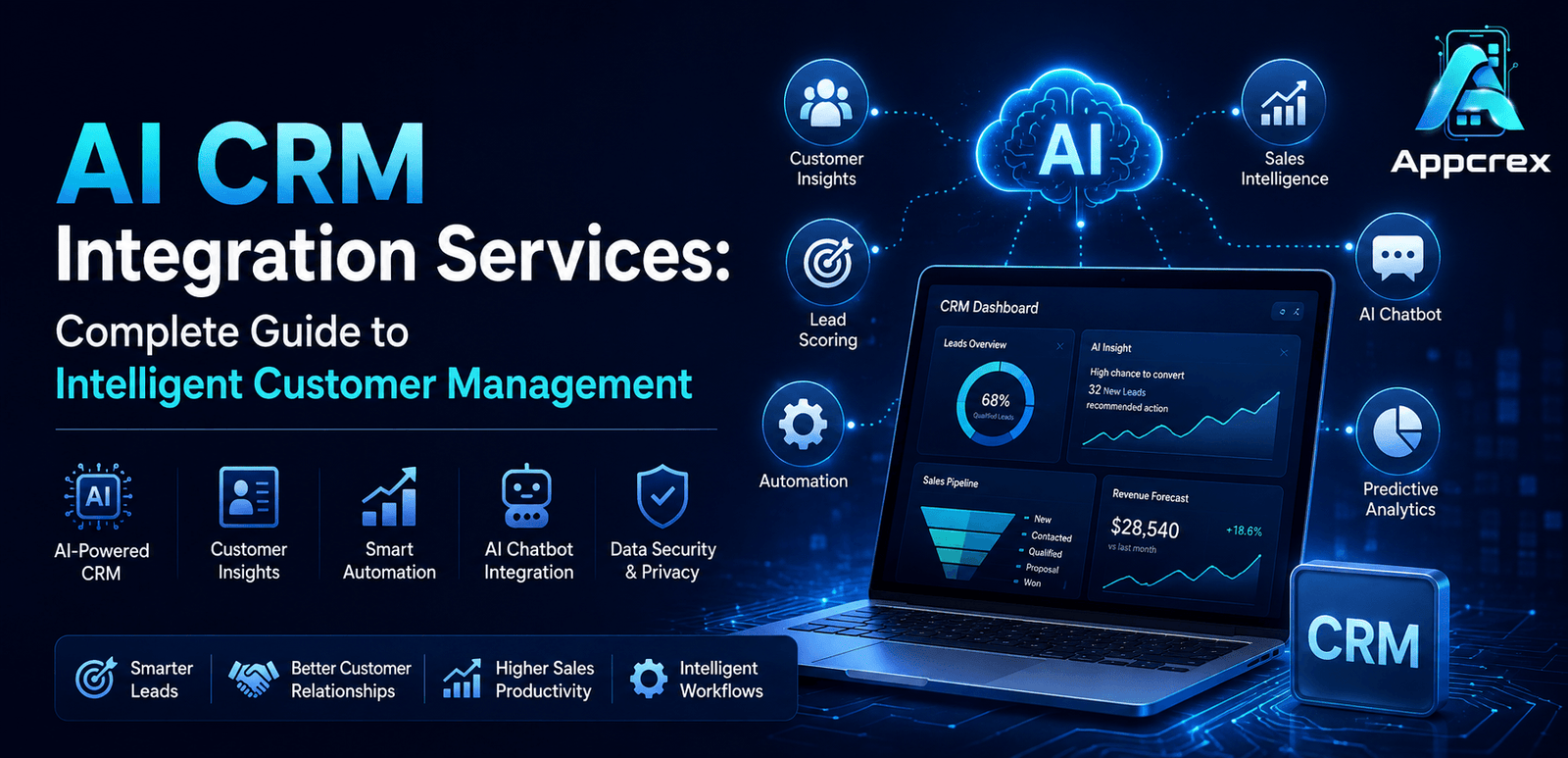
With AI-powered CRM integration, businesses can combine customer data, CRM automation, predictive analytics, generative AI, chatbots, lead scoring, sales intelligence, and workflow automation in a single ecosystem.
AppCrex provides custom AI CRM Integration Services for startups, enterprises, SaaS companies, eCommerce businesses, financial organizations, healthcare businesses, real estate companies, and other industries looking to make their CRM systems more intelligent.
What Is AI CRM Integration?
AI CRM integration is the process of connecting AI technologies and services with an existing Customer Relationship Management (CRM) platform.
A traditional CRM primarily stores and organizes customer information. AI integration adds intelligent capabilities that can analyze this information and automate selected business workflows.
A simplified architecture looks like:
Customer Data → CRM → AI Layer → Analysis/Prediction → Automated Action
For example, an AI-integrated CRM can analyze customer interactions, identify potentially high-value leads, summarize conversations, recommend follow-up actions, or generate personalized communication.
AI CRM integration can involve:
- Generative AI
- Large Language Models (LLMs)
- Machine learning
- Predictive analytics
- AI chatbots
- Natural language processing
- Recommendation systems
- Intelligent automation
- Speech and text analysis
Why Businesses Need AI CRM Integration?
Traditional CRM systems are useful for storing customer information, but businesses increasingly need systems that can turn that information into actionable insights.
AI can help CRM users move from “What happened?” to “What should we do next?”
For example, AI can help businesses:
- Identify high-quality leads
- Automate repetitive CRM tasks
- Summarize customer conversations
- Predict customer behavior
- Personalize communication
- Recommend sales actions
- Automate customer support
- Analyze customer sentiment
- Generate reports
- Improve sales productivity
Instead of replacing the CRM, AI integration can make the existing CRM more intelligent.
AI CRM Integration Services We Provide
AI-Powered CRM Integration
AppCrex can integrate AI capabilities into existing CRM platforms and custom CRM systems.
Depending on business requirements, the integration can support customer analysis, sales automation, content generation, lead qualification, customer support, and predictive insights.
Generative AI CRM Integration
Generative AI can help CRM users create and summarize information using natural language.
Possible use cases include:
- Email generation
- Customer conversation summaries
- Sales message generation
- Follow-up recommendations
- Meeting summaries
- CRM note generation
- Report generation
- Knowledge-based responses
For example, a salesperson could ask:
“Summarize this customer’s recent interactions and suggest the next follow-up.”
The AI system can process the permitted CRM information and provide a structured response.
LLM Integration for CRM
Large Language Models can provide natural-language interaction with CRM data and workflows.
An LLM-powered CRM assistant may allow employees to ask questions such as:
- “Show my highest-priority leads.”
- “Summarize this customer’s history.”
- “Which opportunities need follow-up?”
- “Create a follow-up email.”
- “Summarize today’s sales activity.”
The actual capabilities depend on the CRM APIs, permissions, data architecture, and AI model being used.
AI Lead Scoring
AI-powered lead scoring can evaluate multiple customer signals to help sales teams prioritize leads.
Potential signals can include:
- Customer interactions
- Website activity
- Previous purchases
- Engagement history
- Communication patterns
- Demographic or firmographic information
- Previous sales outcomes
The system can then assign a score or category based on the selected business criteria.
Predictive CRM Analytics
Predictive analytics can help businesses identify patterns in historical customer and sales data.
Potential use cases include:
- Sales forecasting
- Customer churn prediction
- Lead conversion prediction
- Customer segmentation
- Revenue forecasting
- Opportunity prioritization
Predictive models should be monitored and evaluated regularly because customer behavior and business conditions can change.
AI Chatbot Integration With CRM
One of the most practical AI CRM use cases is connecting an AI chatbot with customer and sales data.
A typical workflow can look like:
Customer → AI Chatbot → CRM → Customer Data/Knowledge → AI Response
Depending on permissions and business requirements, the chatbot can:
- Answer customer questions
- Capture leads
- Qualify prospects
- Check customer information
- Create support requests
- Schedule appointments
- Update CRM records
- Route conversations to human agents
For customer-facing systems, businesses should carefully control what information the AI can access and what actions it can perform.
Intelligent Sales Automation
AI can help sales teams reduce repetitive administrative work.
An AI-enabled CRM can support:
- Lead prioritization
- Follow-up reminders
- Email drafting
- Meeting summaries
- Opportunity analysis
- Sales recommendations
- Activity summaries
- Automated CRM updates
This allows sales representatives to spend more time on customer interactions rather than repetitive data entry.
AI Customer Support Integration
AI CRM integration can connect customer support systems with CRM records.
Support agents can receive relevant information such as:
- Customer history
- Previous conversations
- Purchase information
- Open tickets
- Account information
- Previous support issues
AI can also summarize long conversations and suggest responses, helping support teams handle customer requests more efficiently.
Key Features of AI CRM Integration
A customized AI CRM solution can include:
- AI CRM assistant
- AI chatbot
- Lead scoring
- Predictive analytics
- Customer segmentation
- Sentiment analysis
- Sales forecasting
- Customer churn prediction
- Automated email generation
- Conversation summarization
- Meeting summarization
- AI recommendations
- Workflow automation
- Customer support automation
- CRM data analysis
- Natural-language CRM search
- Report generation
- Voice-to-CRM capabilities
- AI-powered dashboards
- Role-based access
- API integration
- Audit logging
The final feature set depends on the CRM platform, business workflow, available data, and AI requirements.
AI CRM Integration With Popular CRM Platforms
AI can be integrated with existing CRM platforms through APIs, webhooks, middleware, custom backend services, and approved extensions.
Businesses may integrate AI capabilities with platforms such as:
- Salesforce
- HubSpot
- Microsoft Dynamics 365
- Zoho CRM
- Pipedrive
- Freshsales
- Custom CRM platforms
The integration approach depends on the platform’s API capabilities, subscription plan, permissions, and technical architecture.
AI CRM Integration Use Cases
1. E-commerce
AI CRM integration can help businesses analyze customer purchase behavior, personalize communication, prioritize customers, and automate support.
2. Real Estate
Real estate businesses can use AI to qualify leads, summarize conversations, recommend follow-ups, and organize customer interactions.
3. Healthcare
Where appropriate and legally permitted, AI CRM systems can help manage customer or patient communication, appointment workflows, and support operations. Sensitive information requires appropriate privacy and security controls.
4. Financial Services
AI CRM integration can support customer segmentation, relationship management, sales assistance, support automation, and risk-related workflows.
5. SaaS Businesses
SaaS companies can use AI to analyze customer engagement, identify potential churn, prioritize accounts, and automate customer communication.
6. Education
Education businesses can use AI CRM systems to manage inquiries, student communication, lead qualification, and support workflows.
Benefits of AI CRM Integration
Better Customer Insights
AI can analyze customer information and interactions to identify useful patterns and trends.
Higher Sales Productivity
Sales teams can automate repetitive tasks and focus on higher-value customer interactions.
Personalized Customer Experiences
AI can help businesses tailor recommendations and communication based on available customer information.
Faster Customer Support
AI assistants can handle common questions and provide agents with relevant customer context.
Automated Workflows
AI can automate selected CRM activities such as summaries, notifications, lead qualification, and follow-up preparation.
Data-Driven Decisions
Predictive analytics can help businesses make decisions based on historical and current customer data.
Better CRM Adoption
Natural-language interfaces can make CRM systems easier for employees to use.
How LLMs Are Changing CRM Systems
Large Language Models are introducing a more conversational way of interacting with CRM platforms.
Traditional CRM interaction often requires users to navigate multiple screens, filters, and reports.
With an LLM-powered CRM assistant, users can interact with customer information using natural language.
For example:
“Which customers have not been contacted in the last 30 days?”
The AI layer can interpret the request, retrieve permitted CRM information, and present the result.
LLMs can also assist with:
- Sales email drafting
- Conversation summaries
- Customer sentiment analysis
- Knowledge retrieval
- Meeting notes
- Customer support responses
- CRM search
- Sales recommendations
However, LLM outputs should be appropriately validated, especially when they influence financial, legal, healthcare, or other high-impact decisions.
Also Read : Large Language Model (LLM) Integration Services: Complete Guide to Benefits, Process, Cost & Use Cases
AI CRM Integration Development Process
1. Business & CRM Analysis
We first understand your existing CRM, customer journey, business workflows, data sources, and AI objectives.
2. Integration Planning
The required APIs, AI services, data sources, permissions, workflows, and integration architecture are identified.
3. AI Use-Case Selection
We determine where AI can provide measurable value.
For example:
- Lead scoring
- Customer support
- Sales automation
- Predictive analytics
- CRM assistant
- Generative AI
4. Data & AI Architecture
We design how CRM data will flow through the AI layer while maintaining appropriate access controls and data protection.
5. API & Backend Integration
Developers connect the CRM APIs, AI services, databases, business systems, and required third-party services.
6. AI Model Integration
Depending on the use case, the solution may integrate LLMs, machine learning models, recommendation systems, or other AI services.
7. Testing
Testing can cover:
- CRM functionality
- API integration
- AI responses
- Authentication
- Permissions
- Data handling
- Performance
- Security
- Failure scenarios
8. Deployment
The completed system is deployed to the required cloud or enterprise environment.
9. Monitoring & Optimization
AI performance, API reliability, system usage, and business outcomes can be monitored after launch.
Also Read : Healthcare CRM Software Development: Complete Guide to Features, Benefits, Cost & AI Integration (2026)
Technology Stack for AI CRM Integration
The technology stack depends on the CRM platform and AI use cases.
AI & Machine Learning
- Python
- TensorFlow
- PyTorch
- Scikit-learn
- Machine learning models
Generative AI
- LLM APIs
- Retrieval-Augmented Generation (RAG)
- Vector databases
- Embedding models
- AI orchestration frameworks
Backend
- Node.js
- Python
- Java
- .NET
- PHP
Databases
- PostgreSQL
- MySQL
- MongoDB
- Redis
- Vector databases
Cloud
- AWS
- Microsoft Azure
- Google Cloud
Integration
- REST APIs
- GraphQL
- Webhooks
- OAuth
- API gateways
The final stack should be selected according to your CRM, data volume, AI requirements, security architecture, and scalability needs.
Also Read : How Much Does It Cost to Build an App Like Zoho in 2026? Complete Development Guide
AI CRM Data Security
AI integration introduces additional considerations because customer information may be processed by AI services.
A secure architecture should consider:
- Authentication
- Authorization
- Role-based access
- Data encryption
- API security
- Secure token management
- Audit logs
- Data minimization
- Access monitoring
- Vendor security
- Data retention policies
Businesses should also review the data-handling terms and privacy controls of third-party AI and CRM providers before integrating sensitive customer information.
How Much Does AI CRM Integration Cost?
The cost of AI CRM integration depends on the complexity of the CRM, AI features, integrations, data requirements, and security architecture.
| Project Type | Estimated Cost |
|---|---|
| Basic AI CRM Integration | $5,000 – $12,000 |
| AI Chatbot + CRM Integration | $8,000 – $20,000 |
| AI Lead Scoring & Automation | $10,000 – $25,000 |
| Advanced AI CRM Platform | $20,000 – $50,000+ |
| Enterprise AI CRM Ecosystem | $40,000 – $100,000+ |
These are indicative development estimates, not fixed quotations.
Factors Affecting AI CRM Integration Cost
- CRM platform
- Number of integrations
- AI features
- LLM usage
- Custom AI models
- Data volume
- RAG implementation
- Dashboard requirements
- Security requirements
- Number of users
- Mobile/web requirements
- Third-party services
- Ongoing AI infrastructure
Also Read : AI Chatbot Integration Services: Benefits, Cost, Process & Business Use Cases (2026)
AI CRM Integration Company for Global Markets
AppCrex provides AI CRM integration services for businesses targeting major global markets.
USA
AI CRM solutions for SaaS, eCommerce, fintech, healthcare, real estate, and enterprise businesses.
UK
AI-powered CRM integration for sales automation, customer support, analytics, and intelligent customer management.
Canada
Custom AI CRM integrations for startups, enterprises, SaaS businesses, and customer-centric organizations.
Dubai & UAE
AI CRM solutions for businesses seeking intelligent sales, customer service, lead management, and automation.
Saudi Arabia
AI CRM integration for businesses in Riyadh and across Saudi Arabia, supporting sales, customer management, automation, and analytics.
India
AI CRM integration for startups, enterprises, SaaS companies, eCommerce businesses, and service providers.
Singapore
AI-powered CRM solutions for fintech, SaaS, eCommerce, and enterprise businesses.
Australia
Custom AI CRM integration for sales, customer support, analytics, and business automation.
These are target service markets and do not imply a physical AppCrex office in every listed location.
AI CRM Integration vs Traditional CRM
| Feature | Traditional CRM | AI-Integrated CRM |
|---|---|---|
| Customer Data | Stores data | Stores + analyzes data |
| Lead Management | Manual/rule-based | AI-assisted prioritization |
| Reporting | Standard reports | Predictive insights |
| Customer Support | Manual | AI-assisted |
| Content | Manually created | AI-assisted generation |
| Search | Filters/queries | Natural-language interaction |
| Automation | Workflow-based | Workflow + AI-assisted |
| Recommendations | Limited | AI-powered |
AI does not necessarily replace the traditional CRM. Instead, it can act as an intelligence layer that improves how teams use CRM data and workflows.
Common Challenges in AI CRM Integration
Data Quality
AI systems depend heavily on the quality and consistency of available data.
CRM Compatibility
Different CRM platforms provide different APIs, permissions, and integration capabilities.
Data Privacy
Customer information must be handled according to applicable privacy and contractual requirements.
AI Accuracy
AI-generated recommendations and responses should be evaluated and monitored.
Integration Complexity
Connecting CRM, AI, analytics, communication platforms, and other enterprise systems can require careful architecture.
Ongoing Maintenance
AI models, APIs, CRM platforms, and business processes can change over time, requiring ongoing maintenance.
Why Choose AppCrex for AI CRM Integration?
AI & LLM Expertise
AppCrex can integrate AI, machine learning, and LLM capabilities into existing CRM environments.
Custom Solutions
We design integrations around your business processes rather than forcing your organization into a fixed workflow.
CRM Integration Experience
Connect AI capabilities with existing CRM platforms, custom CRMs, websites, mobile applications, and enterprise systems.
Scalable Architecture
Build an architecture that can grow with your customer data, users, integrations, and AI workloads.
Security-Focused Development
Implement appropriate access controls, authentication, encryption, API security, and monitoring.
Flexible Engagement Models
Businesses can work with:
- AI developers
- AI integration developers
- LLM developers
- CRM developers
- Dedicated development teams
- AI consultants
FAQs
Q. What is AI CRM integration?
AI CRM integration connects artificial intelligence technologies with CRM platforms to improve customer management, sales automation, analytics, support, and other business workflows.
Q. Can AI be integrated with an existing CRM?
Yes. AI can often be integrated with existing CRM platforms through APIs, webhooks, middleware, custom backend services, and supported extensions.
Q. Can ChatGPT or LLMs be integrated with CRM?
Yes. LLM-based systems can be integrated with CRM platforms for tasks such as conversation summaries, natural-language search, email generation, customer support, and sales assistance.
Q. How much does AI CRM integration cost?
Basic integrations may start around $5,000–$12,000, while advanced and enterprise implementations can cost significantly more depending on AI features, integrations, data, and security requirements.
Q. Can AI CRM integration automate lead management?
Yes. AI can assist with lead scoring, qualification, prioritization, follow-up recommendations, and CRM workflow automation.
Q. Can AI CRM integration improve customer support?
Yes. AI chatbots, conversation summaries, knowledge retrieval, and agent-assistance features can help customer support teams respond more efficiently.
Q. How long does AI CRM integration take?
The timeline depends on the CRM platform, number of integrations, AI functionality, data requirements, and testing scope. A project-specific timeline can be determined after requirements analysis.
Conclusion
AI CRM integration is changing how businesses manage customer relationships by combining traditional CRM capabilities with artificial intelligence, machine learning, predictive analytics, generative AI, and LLM-powered assistants.
From intelligent lead scoring and sales automation to AI chatbots, customer support, predictive analytics, and natural-language CRM search, businesses can use AI to make customer management more efficient and data-driven.
The key is not simply adding AI to a CRM. A successful implementation requires the right use cases, data architecture, API integrations, security controls, AI models, and monitoring strategy.
Build an Intelligent CRM With AppCrex
AppCrex provides AI CRM Integration Services for businesses looking to connect AI capabilities with their existing CRM systems.
Whether you need LLM integration, AI chatbot integration, lead scoring, predictive analytics, sales automation, customer support automation, or a complete AI-powered CRM ecosystem, our team can help you design and develop the right solution.
Ready to Make Your CRM More Intelligent?
Talk to AppCrex about building a secure, scalable, and AI-powered customer management solution.