📌 Key Takeaways
- A Jahez-like platform needs customer, restaurant, driver, and admin solutions.
- GPS tracking, payments, menus, orders, and notifications are core features.
- A basic MVP can cost around $25,000–$45,000.
- Restaurant commissions, delivery fees, ads, and subscriptions can generate revenue.
- AI can improve recommendations, support, offers, and delivery operations.
Introduction
Food delivery has become an important part of the digital economy, particularly across Saudi Arabia and the wider GCC region. Customers increasingly expect to discover restaurants, order meals, make digital payments, track deliveries, and receive support from a single mobile platform.
Jahez is a well-known example of a food delivery platform built around this model. A Jahez-like platform connects customers with restaurants and delivery operations through a technology-driven marketplace.
For entrepreneurs and businesses planning to enter the food delivery market, building an app like Jahez can be an attractive opportunity. However, a successful platform requires more than a customer mobile app. It needs restaurant management, delivery operations, real-time tracking, payments, notifications, promotions, analytics, and a powerful admin system.
This guide explains how to build an app like Jahez, including its business model, essential features, technology stack, development process, estimated cost, timeline, monetization strategies, and ways to make your platform different.
What Is Jahez?
Jahez is a Saudi food delivery platform that connects customers with restaurants and facilitates online food ordering and delivery.
The basic concept is straightforward:
Customer → Restaurant → Order Processing → Delivery Partner → Customer
However, behind this simple experience is a complex technology ecosystem.
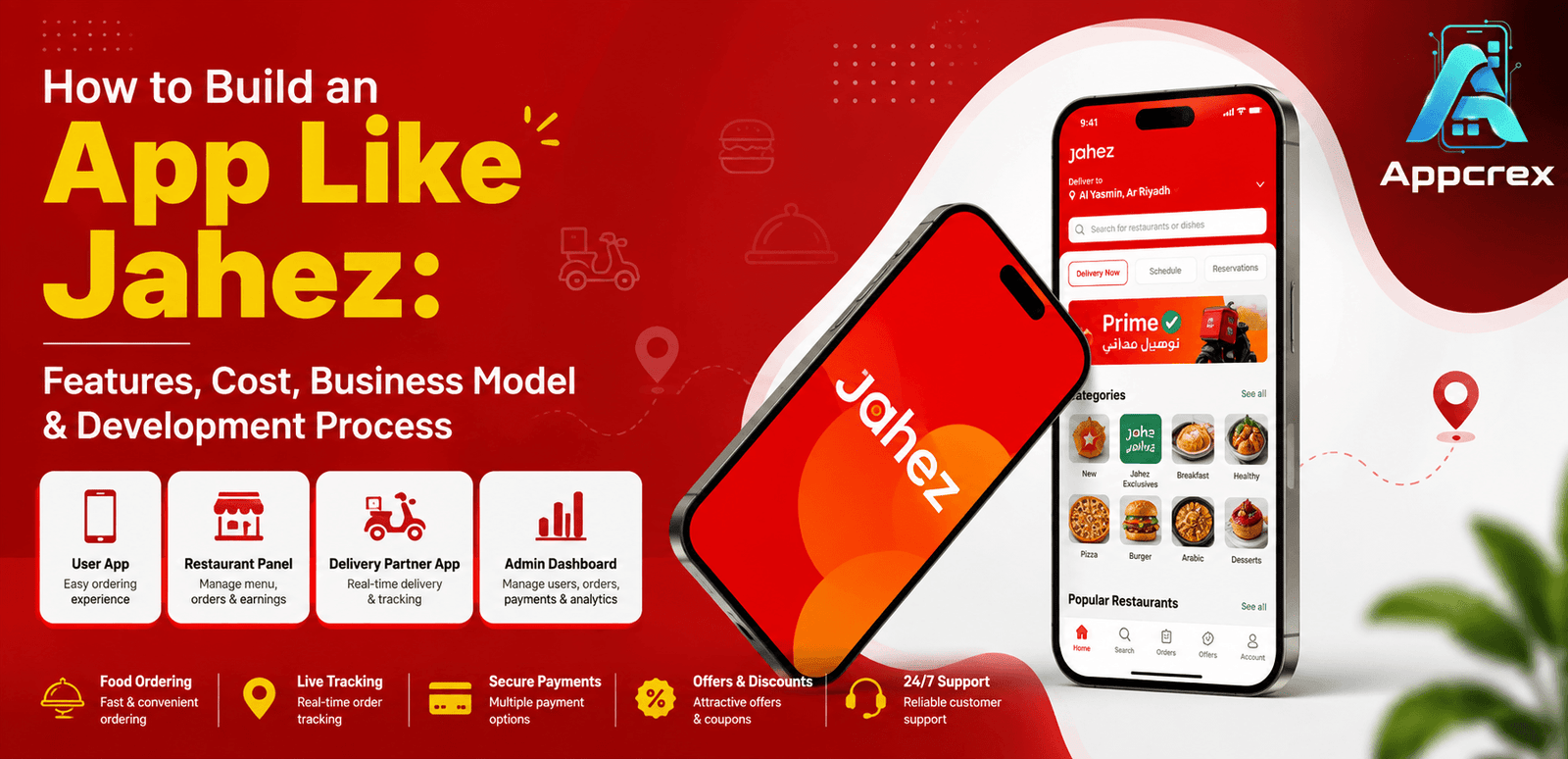
A Jahez-like platform may include:
- Customer mobile app
- Restaurant panel
- Delivery partner app
- Admin dashboard
- Payment system
- Restaurant management
- Order management
- GPS tracking
- Push notifications
- Promotions
- Customer support
- Analytics
This multi-sided structure makes food delivery app development more complex than developing a simple restaurant ordering application.
Why Build an App Like Jahez?
The food delivery market provides opportunities for businesses that can offer better convenience, restaurant selection, delivery speed, pricing, or customer experience.
A Jahez-like platform can create value for three primary groups:
Customers
Customers get:
- Convenient food ordering
- Multiple restaurant options
- Digital payments
- Delivery tracking
- Offers and discounts
Restaurants
Restaurants receive:
- Digital visibility
- New customers
- Online ordering
- Delivery support
- Sales analytics
Delivery Partners
Drivers can receive:
- Delivery opportunities
- Flexible working options
- Navigation support
- Earnings information
- Order management
The platform earns revenue by connecting these different participants.
Looking for : Mobile App Development Company in Saudi Arabia
How Does a Jahez-Like App Work?
A typical food delivery platform follows this process:
- Customer opens the application.
- Location is detected or entered.
- Nearby restaurants are displayed.
- Customer browses menus.
- Food items are added to the cart.
- Customer selects delivery instructions.
- Payment is completed.
- Restaurant receives the order.
- Restaurant accepts and prepares the food.
- Delivery partner receives the delivery request.
- Driver picks up the order.
- Customer tracks the delivery.
- Food is delivered.
- Customer rates the order.
The backend coordinates each stage and keeps the customer, restaurant, and driver synchronized.
Just Read : Food Delivery App Development Company: Complete Guide to Features, Cost & Development Process
Key Features of a Jahez-Like App
1. Customer Registration & Login
Users should be able to create accounts quickly.
Possible options include:
- Mobile number
- OTP
- Social login
- Password
- Biometric login
For Saudi and GCC markets, mobile-based registration can provide a convenient onboarding experience.
2. Location Detection
Location is fundamental to food delivery.
The application can use GPS to identify:
- Current location
- Nearby restaurants
- Delivery availability
- Estimated delivery time
- Delivery fees
Users should also be able to manually enter or select a delivery address.
3. Restaurant Discovery
The restaurant discovery experience should be fast and intuitive.
Users can search restaurants based on:
- Cuisine
- Restaurant name
- Location
- Rating
- Delivery time
- Price
- Offers
- Popularity
Categories can include:
- Arabic
- Indian
- Chinese
- Italian
- Burgers
- Pizza
- Desserts
- Fast food
- Healthy food
- Coffee
4. Restaurant Profile
Each restaurant should have a dedicated profile.
It can display:
- Restaurant name
- Logo
- Images
- Rating
- Reviews
- Cuisine
- Delivery time
- Delivery fee
- Minimum order
- Offers
- Menu
This helps customers make purchasing decisions before placing an order.
5. Digital Menu
The menu should be easy to browse.
Restaurant owners can organize products into categories such as:
- Starters
- Main course
- Burgers
- Pizza
- Drinks
- Desserts
Each item can include:
- Name
- Image
- Description
- Price
- Ingredients
- Add-ons
- Customization
- Availability
6. Food Customization
Customization can increase order flexibility.
Customers may be able to:
- Add toppings
- Remove ingredients
- Select portion size
- Choose sauces
- Add extras
- Select spice level
- Add special instructions
This is particularly useful for restaurants with customizable menus.
7. Shopping Cart
The cart should clearly show:
- Selected items
- Quantity
- Item price
- Add-ons
- Delivery fee
- Taxes where applicable
- Discounts
- Final amount
Customers should be able to modify the order before checkout.
8. Promo Codes & Discounts
Promotions are important for customer acquisition.
Features can include:
- Coupon codes
- First-order discounts
- Restaurant offers
- Percentage discounts
- Fixed discounts
- Free delivery
- Referral offers
- Limited-time campaigns
The admin can control eligibility and campaign duration.
9. Checkout
The checkout screen should provide all important order information.
It can include:
- Delivery address
- Contact information
- Order summary
- Payment method
- Promo code
- Delivery instructions
- Estimated delivery time
A simple checkout process can reduce cart abandonment.
10. Online Payments
A Jahez-like application can support multiple payment methods depending on the target market.
These may include:
- Debit cards
- Credit cards
- Digital wallets
- Apple Pay
- Google Pay
- Other regional payment methods
Payment information should be handled through secure and appropriate payment infrastructure.
11. Cash on Delivery
Depending on the business model and market, cash on delivery can also be supported.
The platform should track:
- COD orders
- Collection status
- Delivery completion
- Driver settlement
12. Real-Time Order Tracking
Real-time tracking is one of the most important features of food delivery apps.
Customers can see:
Restaurant Confirmed → Food Preparing → Ready for Pickup → Driver Assigned → Picked Up → On the Way → Delivered
GPS tracking can display the driver’s approximate location during the delivery journey.
13. Push Notifications
Notifications keep customers informed.
Examples include:
- Order received
- Restaurant accepted
- Food preparation started
- Driver assigned
- Order picked up
- Driver nearby
- Delivery completed
- Promotional offers
14. Ratings & Reviews
After delivery, customers can rate:
- Restaurant
- Food
- Delivery experience
They can also provide written reviews where supported.
Ratings help customers discover reliable restaurants and give restaurants feedback.
15. Order History
Users should be able to view previous orders.
The order history can include:
- Restaurant
- Items
- Date
- Amount
- Payment method
- Delivery status
A Reorder button can allow customers to quickly place a similar order again.
16. Favorites
Users can save:
- Favorite restaurants
- Favorite dishes
- Favorite addresses
This improves convenience for repeat customers.
17. Customer Support
Food delivery platforms need fast support because orders can involve multiple parties.
Support features can include:
- Help center
- FAQs
- Live chat
- Support tickets
- Order-related complaints
- Refund requests
- Delivery issues
AI-powered customer support can handle simple questions before transferring complex cases to human agents.
Also Read : How Much Does It Cost to Develop an App in 2026? Complete Pricing Guide
Restaurant Panel Features
A Jahez-like platform also requires a dedicated restaurant dashboard or application.
Restaurant Registration
Restaurants can submit:
- Business information
- Restaurant details
- Documents
- Location
- Bank/payment information
- Menu
The admin can review and approve restaurant accounts.
Menu Management
Restaurant staff can:
- Add items
- Edit prices
- Upload images
- Create categories
- Add variations
- Set availability
- Mark items unavailable
Order Management
Restaurants should be able to:
- Receive orders
- Accept/reject orders
- Update preparation time
- Mark food ready
- View order history
Restaurant Analytics
The dashboard can show:
- Orders
- Revenue
- Popular products
- Customer ratings
- Cancellation rate
- Average preparation time
Delivery Partner App Features
The driver application is another critical component.
Driver Registration
Drivers can submit required information and documents.
The platform can manage:
- Identity
- Driving license
- Vehicle information
- Verification
- Availability
Online/Offline Status
Drivers can choose whether they are:
- Online
- Offline
- Busy
When online, they can receive delivery requests.
Delivery Requests
A driver can see:
- Pickup location
- Restaurant
- Customer location
- Estimated distance
- Delivery information
The app can integrate mapping and navigation services.
Order Pickup
Drivers can confirm when an order is collected.
Delivery Confirmation
Delivery can be confirmed using an appropriate mechanism such as:
- OTP
- Customer confirmation
- Delivery status
- Proof of delivery where required
Earnings Dashboard
Drivers can view:
- Completed deliveries
- Earnings
- Bonuses
- Incentives
- Payment history
Admin Panel Features
The admin dashboard controls the complete marketplace.
User Management
Administrators can manage:
- Customers
- Restaurants
- Drivers
- Accounts
- Verification
Restaurant Management
Admins can:
- Approve restaurants
- Manage categories
- Review restaurant performance
- Suspend accounts where necessary
Driver Management
Admins can monitor:
- Driver status
- Deliveries
- Performance
- Earnings
- Verification
Order Management
The admin panel can display:
- Active orders
- Completed orders
- Cancelled orders
- Failed orders
- Refund requests
Commission Management
The platform can configure restaurant commissions and other applicable fees.
Promotion Management
Admins can create:
- Coupons
- Campaigns
- Free delivery offers
- Referral campaigns
Analytics
The dashboard can provide:
- Orders
- Revenue
- Active customers
- Restaurant performance
- Driver performance
- Average delivery time
- Cancellation rate
Also Read : Cost to Develop an App Like Toing Food Delivery App: Complete Guide
Advanced Features for a Jahez-Like App
Once the core platform is stable, businesses can add advanced functionality.
AI-Powered Food Recommendations
AI can recommend restaurants or dishes based on:
- Previous orders
- Cuisine preferences
- Time of day
- Location
- Search behavior
For example:
“You usually order burgers on Friday evening. Here are highly rated options near you.”
AI Customer Support
AI can answer questions such as:
- Where is my order?
- How can I cancel my order?
- Why is my delivery delayed?
- How can I request support?
Complex complaints can be transferred to human agents.
Smart Delivery Assignment
AI and optimization algorithms can help assign delivery requests based on:
- Driver location
- Restaurant location
- Customer location
- Driver availability
- Estimated preparation time
- Traffic conditions
This can help improve delivery efficiency.
Dynamic Delivery Estimation
The system can calculate estimated delivery times using:
- Restaurant preparation time
- Driver availability
- Distance
- Traffic
- Historical delivery data
Personalized Offers
Instead of showing the same promotion to every customer, the platform can create personalized offers based on user behavior.
Technology Stack for a Jahez-Like App
The technology stack should support real-time communication, location services, payments, and high transaction volumes.
Mobile App
- Flutter
- React Native
- Swift
- Kotlin
Frontend
- React
- Next.js
- TypeScript
Backend
- Node.js
- Java
- Python
- .NET
Database
- PostgreSQL
- MySQL
- MongoDB
- Redis
Cloud
- AWS
- Microsoft Azure
- Google Cloud
APIs
- Payment APIs
- Maps APIs
- GPS/location APIs
- SMS APIs
- Push notification services
- Restaurant integrations
- Analytics APIs
Real-Time Technology
Technologies such as WebSockets can be used for real-time order updates and delivery tracking.
Also Read : How to Build a Food Delivery App Like HungerStation: Complete Development Guide (2026)
How to Build an App Like Jahez?
Step 1: Define Your Business Model
Decide whether you want to build:
- Restaurant marketplace
- Food delivery platform
- Cloud kitchen marketplace
- Restaurant ordering platform
- Multi-service delivery platform
A focused business model makes the initial development easier.
Step 2: Research Your Target Market
Analyze:
- Customer behavior
- Restaurant demand
- Delivery competition
- Pricing
- Delivery expectations
- Popular cuisines
For Saudi Arabia, you should also study city-level demand across markets such as Riyadh, Jeddah, Dammam, and other major locations.
Step 3: Define the MVP
Start with the most important functionality.
A basic MVP can include:
- Customer app
- Restaurant panel
- Driver app
- Admin dashboard
- Restaurant discovery
- Menu
- Cart
- Checkout
- Payment
- Order tracking
- Notifications
Additional features can be added after launch.
Step 4: Design UI/UX
Create separate experiences for:
- Customers
- Restaurants
- Drivers
- Administrators
The customer journey should be as simple as:
Search → Select → Order → Pay → Track → Receive
Step 5: Develop the Backend
The backend manages:
- Users
- Restaurants
- Menus
- Orders
- Drivers
- Payments
- Promotions
- Notifications
- Tracking
The architecture should be designed for scalability from the beginning.
Step 6: Integrate APIs
Integrate required third-party services for:
- Maps
- Payments
- SMS
- Notifications
- Authentication
- Analytics
Step 7: Develop Customer, Restaurant & Driver Apps
The platform normally requires at least three major interfaces:
Customer App
For ordering food.
Restaurant App/Panel
For managing menus and orders.
Driver App
For accepting and completing deliveries.
Step 8: Test the Platform
Testing should include:
- Functional testing
- Payment testing
- API testing
- GPS testing
- Performance testing
- Security testing
- Device testing
- Real-time tracking testing
Step 9: Launch in One Market
Instead of launching across an entire country immediately, start with one city or selected service area.
This allows you to test:
- Restaurant onboarding
- Driver supply
- Delivery operations
- Customer acquisition
- Pricing
- Support
After the model works, expand into additional cities.
Also Read : GPS Navigation App Development Guide: Features, Cost & Development Process
How Much Does It Cost to Build an App Like Jahez?
The cost depends on the number of applications, features, integrations, design complexity, and development team.
A general estimate is:
| Platform Level | Estimated Cost |
|---|---|
| Basic Food Delivery MVP | $25,000–$45,000 |
| Medium Jahez-Like Platform | $45,000–$90,000 |
| Advanced Food Delivery Platform | $90,000–$160,000 |
| Large-Scale Multi-Service Platform | $160,000–$250,000+ |
These are indicative development ranges. The final budget depends on the exact product scope and target market.
Major Factors Affecting Development Cost
Number of Applications
Building customer, restaurant, driver, and admin platforms increases development effort.
Real-Time Tracking
GPS tracking and live delivery updates require additional backend infrastructure.
Payment Integration
Multiple payment methods increase integration and testing requirements.
Restaurant Integrations
Connecting restaurant POS or third-party systems can increase complexity.
AI Features
Recommendation engines, AI support, and delivery optimization add development costs.
UI/UX
Custom interfaces and advanced animations require additional design and development work.
Development Location
Development rates vary depending on the location and experience of the development team.
Also Read : Why Does Your Business Need Payment Gateway Integration Services?
How Long Does It Take to Build an App Like Jahez?
A basic food delivery MVP may take approximately 4–6 months.
A more advanced Jahez-like platform can require 6–10 months or longer.
A typical roadmap can look like:
| Stage | Approximate Timeline |
|---|---|
| Research & Planning | 2–4 weeks |
| UI/UX Design | 4–6 weeks |
| Backend Development | 8–14 weeks |
| Mobile Development | 10–16 weeks |
| API Integration | 3–6 weeks |
| Testing | 4–6 weeks |
| Launch | 1–2 weeks |
Some development activities can run in parallel.
How Does Jahez-Like Food Delivery App Make Money?
A food delivery marketplace can use multiple revenue streams.
Restaurant Commission
The platform can charge restaurants a percentage of eligible orders according to the commercial agreement.
Delivery Fees
Customers may pay delivery fees depending on:
- Distance
- Restaurant
- Order value
- Promotions
- Delivery conditions
Advertising
Restaurants can pay for increased visibility through sponsored placements or promotional campaigns.
Subscription Plans
A platform can introduce a subscription model offering benefits such as:
- Free delivery
- Exclusive discounts
- Special promotions
Featured Restaurants
Restaurants can pay for additional visibility within the marketplace where the model permits.
Corporate Food Ordering
Businesses can offer corporate ordering solutions for employees and events.
Also Read : Restaurant Management Software Development Company: Complete Guide to Features, Cost & Development Process
How to Make Your Jahez-Like App Different?
The food delivery market can be highly competitive. Simply copying an established platform may not provide a strong competitive advantage.
Instead, focus on a specific customer problem.
Faster Delivery
Build operations around shorter delivery times.
Better Restaurant Discovery
Use personalization and better search.
AI Recommendations
Provide smarter food suggestions.
Local Cuisine Focus
Build a platform around specific regional cuisines.
Subscription-Based Delivery
Offer attractive recurring delivery benefits.
Corporate Food Delivery
Target offices and business customers.
Healthy Food Marketplace
Focus specifically on healthy and fitness-oriented restaurants.
Multi-Service Delivery
Expand beyond food into groceries, pharmacy, flowers, or other permitted categories.
Challenges of Building a Jahez-Like App
Restaurant Onboarding
A marketplace needs enough restaurants to attract customers.
Driver Availability
Insufficient delivery partners can increase delivery times.
Delivery Operations
Managing thousands of orders requires efficient dispatching.
Customer Acquisition
Food delivery is competitive, so promotions and strong user experience are important.
Order Accuracy
Incorrect orders can lead to refunds and customer dissatisfaction.
Peak Demand
Lunch, dinner, weekends, and holidays can produce significant traffic spikes.
Payment Failures
The platform should handle failed payments without creating duplicate or lost orders.
How to Scale a Jahez-Like Platform?
Start with one city and gradually expand.
Phase 1
Launch with:
- Selected restaurants
- Limited delivery zones
- Customer app
- Driver app
- Restaurant panel
Phase 2
Add:
- More restaurants
- More delivery partners
- Better analytics
- Promotions
- Loyalty
Phase 3
Expand to additional cities.
Phase 4
Introduce:
- AI
- Subscriptions
- Corporate ordering
- Advanced analytics
- Additional delivery categories
This phased approach can reduce operational risk.
Why Choose AppCrex for Food Delivery App Development?
AppCrex provides end-to-end food delivery app development services for startups, restaurants, entrepreneurs, and businesses.
Our services include:
- Food Delivery App Development
- Android App Development
- iOS App Development
- Flutter Development
- React Native Development
- Restaurant App Development
- Delivery Partner App Development
- Admin Panel Development
- Payment Integration
- GPS & Map Integration
- Real-Time Tracking
- AI Integration
- Cloud Development
- QA & Testing
- Maintenance & Support
Whether you want to build a basic food delivery MVP or a large marketplace similar to Jahez, the platform can be designed around your business model, target market, and growth strategy.
FAQs
Q. How much does it cost to build an app like Jahez?
A basic food delivery MVP may cost around $25,000–$45,000, while an advanced Jahez-like platform can cost $90,000–$160,000 or more, depending on features, integrations, and scale.
Q. How long does it take to build a Jahez-like app?
A basic MVP can take around 4–6 months. A larger platform may require 6–10 months or longer.
Q. What are the main features of a Jahez-like app?
Important features include restaurant discovery, menus, cart, checkout, payments, order tracking, GPS, notifications, ratings, restaurant management, driver management, and admin controls.
Q. Do I need separate apps for customers and drivers?
For a full food delivery marketplace, separate customer and driver experiences are usually recommended because their workflows are very different.
Q. Can I build a Jahez-like app for Saudi Arabia?
Yes. A food delivery platform can be designed for the Saudi market with Arabic/English support, local payment methods, location services, restaurant onboarding, delivery operations, and other market-specific requirements.
Q. Can AI be integrated into a food delivery app?
Yes. AI can be used for food recommendations, customer support, personalized offers, demand forecasting, and delivery assignment.
Q. How does a food delivery app make money?
Common revenue models include restaurant commissions, delivery fees, advertising, featured listings, subscriptions, and corporate food-ordering services.
Q. Can I start with one city?
Yes. Starting with one city can help validate the restaurant, customer, and delivery-partner model before expanding to other locations.
Conclusion
Building an app like Jahez requires a complete food delivery ecosystem rather than a single mobile application. The platform needs customer ordering, restaurant management, delivery operations, payments, GPS tracking, notifications, support, analytics, and a powerful backend.
The estimated development cost can range from $25,000 for a focused MVP to $160,000+ for an advanced platform, depending on the features and integrations required.
The best strategy is to start with a focused market and essential features, validate the business model, and then expand into additional cities, restaurants, delivery services, subscriptions, AI, and other capabilities.
A strong Jahez-like platform should ultimately compete not only on technology but also on restaurant selection, delivery speed, pricing, customer experience, operational efficiency, and local market understanding.
Build Your Food Delivery App With AppCrex
Planning to build an app like Jahez for Saudi Arabia, the UAE, GCC, or another market?
AppCrex can help you develop the complete platform, including customer app, restaurant panel, delivery partner app, admin dashboard, payment integration, GPS tracking, AI features, backend development, testing, deployment, and ongoing support.
Contact AppCrex to discuss your food delivery app idea and development roadmap.