
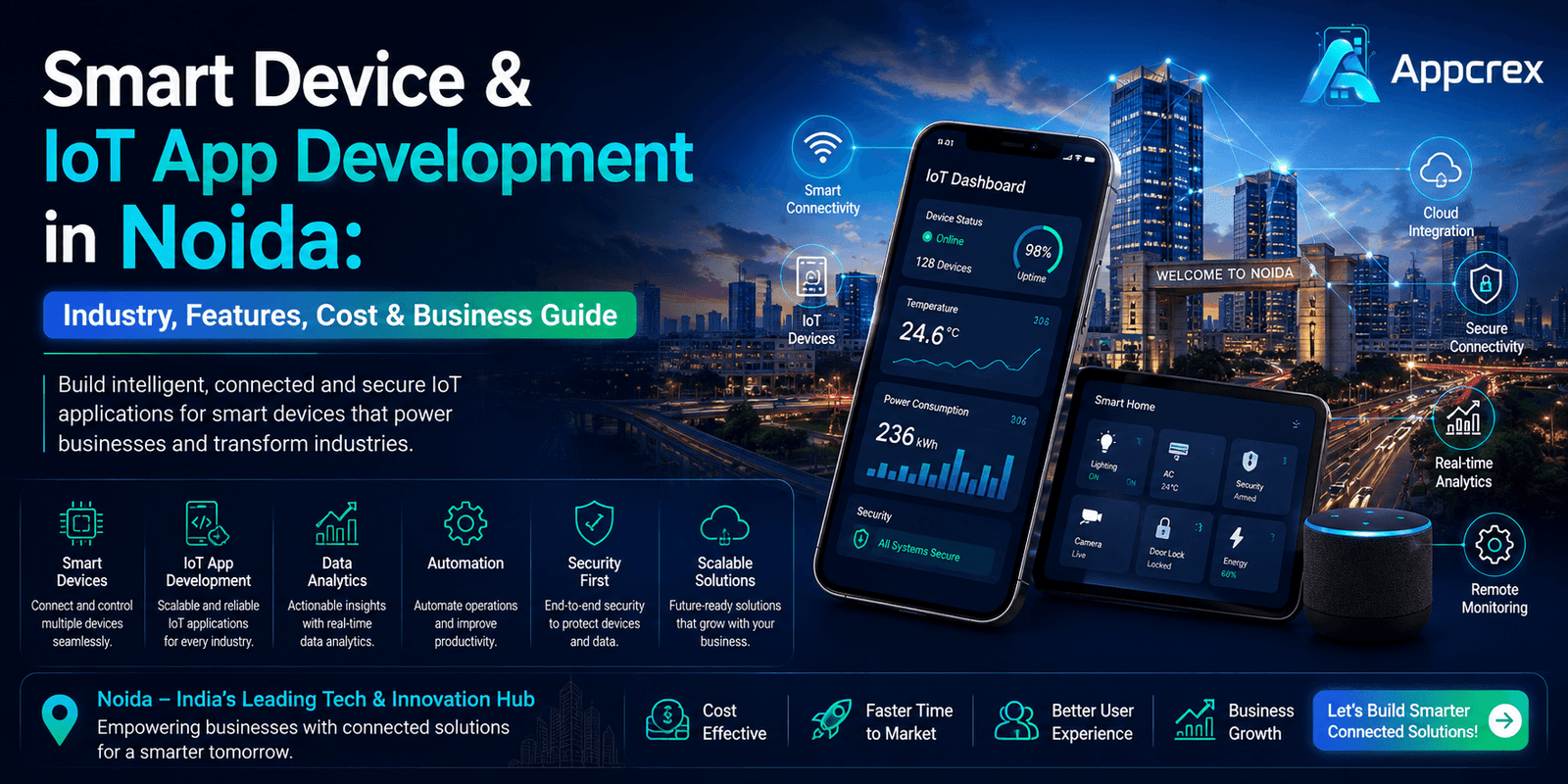
📌 Key Takeaways
- Noida’s strongest differentiator is the combination of software and electronics, making IoT and connected-product development a natural content angle.
- AI can make IoT platforms more valuable through predictive maintenance, anomaly detection and intelligent analytics.
- Smart-device, manufacturing, logistics, automotive and enterprise IoT apps offer multiple business opportunities.
- IoT development requires more than mobile coding—device connectivity, cloud, APIs, security and data architecture are equally important.
- Noida’s expanding electronics, GCC and digital infrastructure ecosystem can support new opportunities for connected technology businesses.
Introduction
Noida has developed into much more than a conventional IT and services destination. Its proximity to Delhi, established technology companies, electronics manufacturing infrastructure, Global Capability Centres, data centres, and the wider NCR business market has created a strong environment for connected products and smart technology solutions.
The opportunity becomes even more interesting when mobile applications are combined with IoT, smart devices, cloud platforms, analytics, automation, and AI.
Uttar Pradesh currently positions electronics manufacturing, IT/ITeS, GCCs, data centres, and emerging technologies as strategic growth sectors. The state also reports a significant electronics manufacturing base, while Noida and Greater Noida have become important locations within that ecosystem.
For businesses, this means a mobile app can increasingly act as the control centre for a physical product, connected device, enterprise workflow, or smart service.
This guide explains how businesses can approach IoT and smart-device app development in Noida, what features matter, what technologies are involved, how much development may cost, and where the biggest opportunities are in 2026.
Just Read : Mobile App Development Company India: Custom Android, iOS & AI App Development Services
Why Noida Is Becoming Important for Smart Technology
Noida’s technology ecosystem has a distinctive advantage: it sits at the intersection of software and hardware.
Greater Noida hosts major electronics manufacturing operations, while Uttar Pradesh is actively developing its electronics component and semiconductor ecosystem. Invest UP reports that the state accounts for a substantial share of India’s mobile manufacturing and has more than 230 operational ESDM companies.
The ecosystem is also moving beyond smartphone assembly.
Current state initiatives include opportunities around:
- Mobile devices
- IT hardware
- Consumer electronics
- Telecom equipment
- Robotics
- IoT
- Drones
- Medical electronics
- Automotive electronics
- Semiconductor-related products
That creates an important development opportunity: software that connects physical products to users and businesses.
What Is a Smart Device Application?
A smart-device app allows users to interact with connected hardware through software.
A typical architecture can look like:
Smart Device → IoT Connectivity → Cloud Platform → API → Mobile App → User
For example, a connected-device application could allow a user to:
- Monitor device status
- Turn a device on or off
- Change settings
- Receive alerts
- View historical data
- Track usage
- Manage multiple devices
- Receive maintenance notifications
For businesses, the application can also provide a management dashboard and analytics platform.
Just Read : Mobile App Development in India: Cost, Technologies, Process & Business Opportunities
Noida’s IoT Opportunity
The IoT opportunity is broader than smart-home products.
Businesses can develop connected solutions for:
Manufacturing
- Machine monitoring
- Predictive maintenance
- Production tracking
- Equipment diagnostics
- Factory dashboards
Logistics
- Vehicle tracking
- Asset monitoring
- Temperature monitoring
- Fleet management
- Delivery visibility
Consumer Electronics
- Smart appliances
- Connected devices
- Wearables
- Entertainment products
- Home automation
Healthcare
- Connected medical devices
- Patient monitoring
- Device dashboards
- Remote data collection
Automotive
- Vehicle diagnostics
- Fleet monitoring
- Connected-car services
- Driver analytics
Also Read : Healthcare CRM Software Development: Complete Guide to Features, Benefits, Cost & AI Integration (2026)
The Mobile App Is Only One Part of the Product
A connected-product ecosystem normally requires multiple components.
1. Mobile Application
The customer-facing interface.
2. IoT Layer
Responsible for communication between devices and software.
3. Cloud Backend
Stores and processes device information.
4. API Layer
Connects the mobile application, devices, and other systems.
5. Admin Dashboard
Allows businesses to manage devices and customers.
6. Analytics Layer
Converts raw device data into useful information.
This makes IoT development considerably different from building a conventional mobile application.
Features to Include in an IoT Mobile App
The feature set depends on the connected product.
User Registration
Users can create accounts and manage their profiles.
Device Pairing
Allow users to connect compatible devices to their account.
Device Dashboard
Display:
- Device status
- Connectivity
- Battery
- Usage
- Alerts
- Performance
Remote Controls
Depending on the product, users may be able to:
- Start or stop a device
- Change settings
- Schedule operations
- Lock or unlock
- Adjust operating modes
Notifications
Send alerts for:
- Device errors
- Maintenance
- Low battery
- Abnormal activity
- Connectivity problems
Historical Data
Users can view device performance over time.
Multiple Device Management
Useful for businesses and customers managing several connected products.
Advanced Features for Business Applications
Enterprise IoT platforms require additional capabilities.
Device Fleet Management
Businesses can monitor thousands of devices from a single dashboard.
Role-Based Access
Different users can receive different permissions.
Remote Diagnostics
Support teams can identify device problems remotely.
Predictive Maintenance
Data can be analysed to identify potential equipment problems before failure.
Automated Alerts
Rules can trigger alerts when predefined conditions occur.
Analytics Dashboard
Businesses can monitor:
- Device performance
- Utilisation
- Downtime
- Energy consumption
- Maintenance
- Customer usage
Where AI Fits Into IoT Apps?
AI can make IoT systems considerably more useful.
Instead of simply showing raw sensor data, AI can identify patterns and provide actionable insights.
For example:
Sensor Data → Data Processing → AI Model → Pattern Detection → Alert/Recommendation
Possible applications include:
- Predictive maintenance
- Anomaly detection
- Demand forecasting
- Energy optimisation
- Device performance analysis
- Usage prediction
- Automated recommendations
This can be particularly useful for industrial and enterprise applications.
Also Read : IoT Integration Services: Complete Guide to Benefits, Process, Cost & Use Cases
Generative AI for Smart Device Platforms
Generative AI can also become the user interface for connected systems.
Instead of searching through multiple dashboards, a business user could ask:
“Which machines reported abnormal activity today?”
Or:
“Show me the devices that require maintenance this week.”
An AI interface can translate natural-language requests into authorised queries and return relevant information.
However, the AI layer should operate with controlled permissions, especially when it can trigger actions on physical devices.
AI Agents + IoT
The combination of AI agents and IoT creates another development opportunity.
An AI agent could potentially monitor authorised device data and coordinate predefined workflows.
For example:
Device Alert → AI Agent → Verify Condition → Create Maintenance Task → Notify Team
A more advanced system might:
- Monitor equipment
- Detect an anomaly
- Create a service ticket
- Notify the responsible team
- Track the resolution
For safety-critical environments, automated actions should be carefully constrained and validated.
Also Read : Multi-Agent AI Development: Complete Guide to Architecture, Benefits, Cost & Use Cases
Technologies Used for IoT App Development
IoT development requires a combination of mobile, cloud and device technologies.
Mobile
- Flutter
- React Native
- Kotlin
- Swift
Backend
- Node.js
- Python
- Java
- .NET
Databases
- PostgreSQL
- MySQL
- MongoDB
- Redis
IoT Communication
Depending on the device, developers may work with:
- MQTT
- HTTP
- WebSockets
- Bluetooth Low Energy
- Wi-Fi
- Cellular connectivity
Cloud
- AWS
- Microsoft Azure
- Google Cloud
The final architecture depends on the number of devices, communication requirements, data volume, latency and security requirements.
IoT Security Cannot Be an Afterthought
Connected devices introduce additional security considerations because the system includes both software and hardware.
Important areas include:
- Secure authentication
- Device identity
- Encryption
- API security
- Secure communication
- Role-based permissions
- Firmware security
- Secure updates
- Monitoring
- Audit logs
A compromised device could potentially expose more than a conventional application, so security should be included from the architecture stage.
How Much Does IoT App Development Cost in Noida?
IoT development costs vary substantially depending on whether the project involves an existing device, custom hardware, multiple devices, real-time data, AI, or enterprise integrations.
For initial planning:
| Project Type | Indicative Development Cost |
|---|---|
| Basic Connected Device App | ₹10–18 lakh |
| Mid-Level IoT Platform | ₹18–35 lakh |
| Advanced IoT Solution | ₹35–60 lakh+ |
| AI-Powered IoT Platform | ₹45–80 lakh+ |
| Enterprise IoT Ecosystem | ₹60 lakh–₹1.5 crore+ |
These are indicative planning ranges, not fixed Noida development quotes.
The actual cost depends on:
- Hardware integration
- Number of devices
- Mobile platforms
- Backend complexity
- IoT protocols
- Cloud architecture
- Real-time processing
- AI requirements
- Dashboard functionality
- Security
- Third-party integrations
What Makes an IoT Project More Expensive?
Custom Hardware
If the software needs to communicate with newly designed hardware, additional engineering is required.
Large Device Networks
Managing 100 devices is very different from managing 100,000 devices.
Real-Time Data
Real-time monitoring requires appropriate infrastructure and communication architecture.
AI
Predictive analytics and machine-learning systems increase development complexity.
Enterprise Integrations
Connecting the IoT platform to ERP, CRM, logistics or manufacturing systems adds engineering work.
A typical development timeline can look like this:
| Project | Approx. Timeline |
|---|---|
| Basic Device App | 3–5 months |
| Medium IoT Platform | 5–8 months |
| Advanced IoT Platform | 7–10 months |
| AI + IoT Platform | 8–12+ months |
| Enterprise IoT Ecosystem | 10–15+ months |
Hardware development and testing can extend the timeline considerably.
Also Read : AI & SaaS App Development in Bengaluru: Startup, Technology & Business Guide
A Practical Development Roadmap
Instead of developing everything simultaneously, businesses can divide the project into stages.
Phase 1 — Product Discovery
Define:
- Target users
- Connected devices
- Business model
- Core workflows
- Data requirements
Phase 2 — Device & Architecture Planning
Decide how the device communicates with the cloud and application.
Phase 3 — UX/UI Design
Design the mobile application and business dashboard.
Phase 4 — MVP Development
Build the essential device-control and monitoring features.
Phase 5 — Device Integration
Connect real hardware and test communication.
Phase 6 — Cloud & Analytics
Implement data storage, processing and reporting.
Phase 7 — AI Layer
Add predictive or intelligent capabilities where appropriate.
Phase 8 — Testing & Deployment
Test devices, applications, APIs, security and real-world scenarios.
Noida’s Electronics Ecosystem Creates New App Opportunities
The growth of electronics manufacturing in Noida and Greater Noida can create demand for software around physical products.
Invest UP reports that Uttar Pradesh has become one of India’s important electronics manufacturing destinations and that Greater Noida hosts major mobile-device manufacturing operations.
This can create opportunities for software companies working on:
- Device companion apps
- Factory dashboards
- IoT platforms
- Smart-home apps
- Equipment monitoring
- Product analytics
- Supply-chain platforms
- Device lifecycle management
- Remote diagnostics
In other words, Noida’s hardware ecosystem can create software opportunities beyond traditional IT services.
GCCs and Enterprise Technology in Noida
Noida is also relevant for enterprise software because of its position within the NCR technology ecosystem.
NASSCOM has identified Noida as a GCC hub and notes the presence of global technology organisations, including Samsung’s R&D operations and Adobe’s SaaS business.
The Uttar Pradesh government is simultaneously positioning IT/ITeS, GCCs and data centres as strategic growth areas.
This creates another potential market for:
- Enterprise mobile apps
- Internal business applications
- Automation platforms
- Data dashboards
- IoT management systems
- AI-powered enterprise tools
- Custom SaaS platforms
Who Should Build an IoT App in Noida?
Electronics Manufacturers
Connect physical products with software.
Consumer Electronics Brands
Provide customers with smart-device applications.
Manufacturing Companies
Monitor machines and production infrastructure.
Logistics Companies
Track vehicles and connected assets.
Automotive Businesses
Develop connected mobility solutions.
Healthcare Technology Companies
Connect devices and digital health platforms.
Startups
Build new connected products and IoT services.
Enterprises
Digitise physical operations through connected technology.
How to Select an IoT App Development Company?
IoT projects require more than standard mobile development experience.
Before selecting a development partner, check whether the team understands:
- Mobile development
- Backend architecture
- IoT protocols
- Cloud infrastructure
- APIs
- Device integration
- Data analytics
- Security
- AI/ML
- Real-time systems
Also ask how the company will handle device onboarding, scalability, communication failures, security, firmware changes, monitoring and post-launch support.
Why AppCrex for IoT & Smart App Development?
AppCrex can help businesses develop mobile and digital platforms that connect users, devices and backend systems.
Our capabilities include:
- IoT mobile app development
- Flutter development
- React Native development
- Android development
- iOS development
- Backend development
- API integration
- Cloud development
- AI integration
- AI agent development
- Real-time dashboards
- UI/UX design
- QA testing
- Maintenance and support
For Noida-based businesses, the development approach can be tailored to electronics, smart devices, manufacturing, logistics, enterprise technology, or connected-product use cases.
FAQs
Q. Why is Noida suitable for IoT app development?
Noida and Greater Noida have strong links to electronics manufacturing, IT/ITeS, GCCs and emerging technology infrastructure, creating opportunities for connected-product software.
Q. How much does it cost to develop an IoT app in Noida?
A basic connected-device app may start around ₹10 lakh, while advanced enterprise IoT platforms can cost ₹60 lakh or more depending on hardware, integrations, scale and AI requirements.
Q. Can an IoT app include AI?
Yes. AI can be used for anomaly detection, predictive maintenance, analytics, recommendations and other suitable workflows.
Q. Can one app control multiple devices?
Yes. A properly designed IoT backend can allow users or businesses to manage multiple registered devices.
Q. Which IoT protocols can be used?
Depending on the product, technologies such as MQTT, HTTP, WebSockets, Bluetooth Low Energy, Wi-Fi and cellular communication may be appropriate.
Q. Can an IoT platform connect with ERP or CRM software?
Yes. APIs can connect an IoT platform with ERP, CRM, logistics, inventory and other enterprise systems.
Q. How long does an IoT application take to build?
A basic product may take 3–5 months, while an advanced enterprise IoT ecosystem can require 10–15 months or more.
Final Perspective
Noida presents a different technology opportunity from Bengaluru.
While Bengaluru is particularly strong around AI, SaaS and startup technology, Noida’s combination of electronics manufacturing, IT/ITeS, GCCs, data centres, IoT, robotics and emerging semiconductor activity makes connected technology a particularly relevant content and business angle.
The state’s current electronics strategy includes mobile manufacturing, IT hardware, telecom, robotics, IoT and semiconductor-related opportunities, while the broader IT ecosystem continues to expand.
For businesses, this means the next generation of applications may not exist only on a smartphone. They can become the software layer connecting devices, factories, vehicles, machines, customers and enterprise systems.
The strongest IoT products will therefore combine reliable device connectivity with a simple mobile experience, secure cloud infrastructure, useful analytics and—where there is a genuine business case—AI-powered intelligence.
Build Your IoT or Smart Device App With AppCrex
Planning a smart-device application, IoT platform, connected-product app or enterprise monitoring solution in Noida?
AppCrex can help take the product from concept and UI/UX to mobile development, backend engineering, device integration, APIs, cloud infrastructure, AI features, testing and ongoing support.
Turn your connected-product idea into a scalable digital platform with AppCrex.
