📌 Key Takeaways
- Mobile app development consulting helps businesses validate ideas, define requirements, and plan applications before development begins.
- Consulting can cover product strategy, technical feasibility, architecture, UI/UX, platform selection, security, and modernization.
- A structured consulting process can reduce unclear requirements, unnecessary features, and avoidable development rework.
- Consulting costs depend on project complexity, the depth of analysis, required documentation, and the consultant’s involvement.
- Businesses should evaluate industry understanding, technical expertise, communication, deliverables, and long-term support before selecting a consulting partner.
Introduction
Building a mobile application involves more than choosing features and hiring developers. Businesses must understand their target users, validate the app idea, select the right technology, plan the budget, define the product architecture, and prepare for future growth. Without proper planning, even a well-developed application can face usability problems, unexpected costs, technical limitations, or poor user adoption.
Mobile app development consulting helps businesses make these decisions before committing significant time and money to development. It provides strategic and technical guidance at different stages of the application lifecycle, from idea validation and product planning to architecture, development oversight, modernization, and post-launch improvement.
Whether you are a startup planning your first mobile product or an established business improving an existing application, consulting can help you identify what needs to be built, why it matters, and how to approach development effectively.
In this guide, we explain mobile app consulting, its services, process, benefits, estimated costs, and the factors to consider when choosing a consultant.
What Is Mobile App Development Consulting?
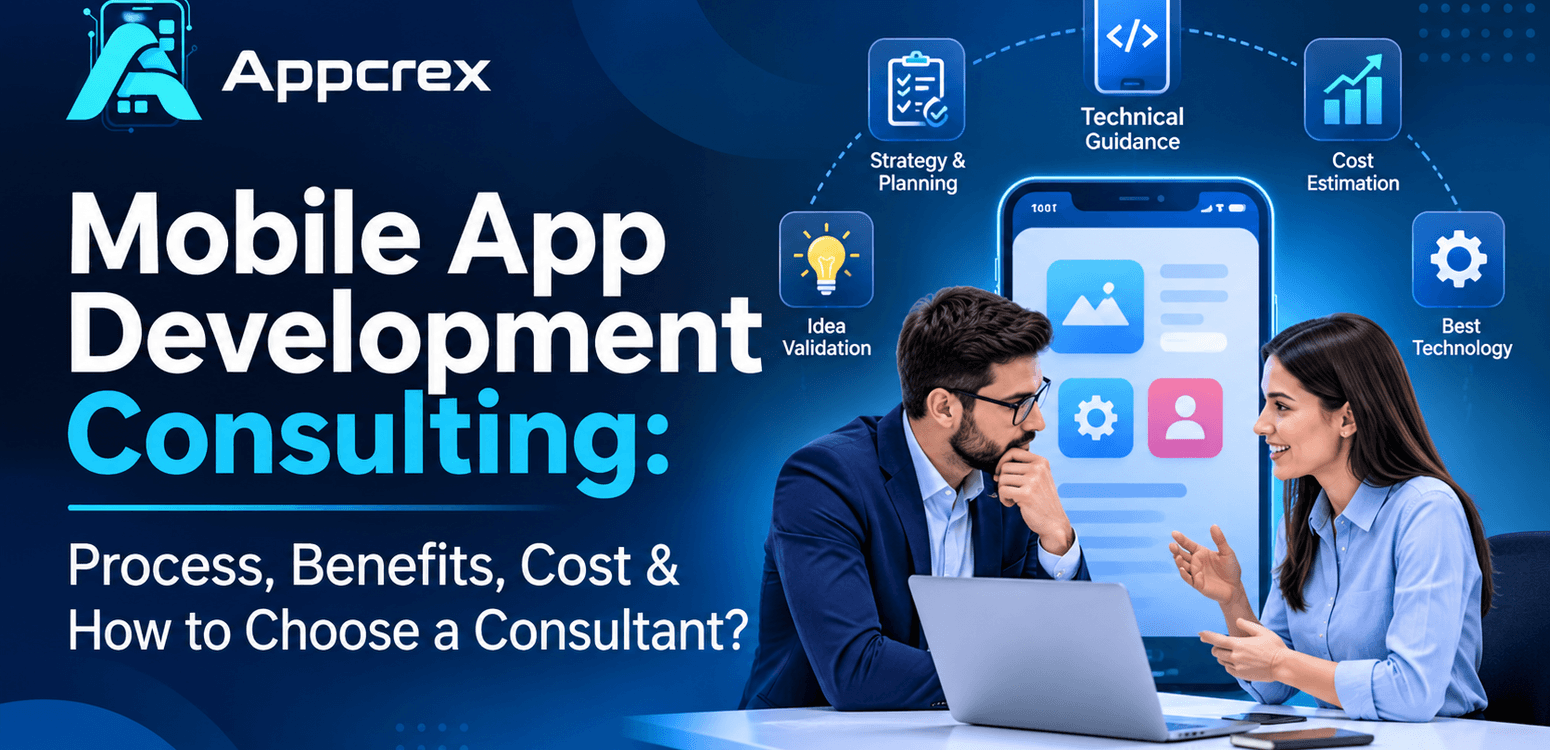
Mobile app development consulting is a professional advisory service that helps businesses plan, evaluate, design, and improve mobile applications. It focuses on making informed product and technical decisions before and during development.
A mobile app consultant studies the business objective, target audience, application requirements, expected functionality, budget, and technical constraints. Based on this assessment, the consultant recommends a suitable development approach and prepares a practical roadmap.
Consulting does not always mean building the application. In many cases, a business needs expert guidance before deciding whether to develop an app, which features to prioritise, or how to modernise an existing product.
For example, a business planning an on-demand service application may need to understand:
-
Whether it needs separate customer, service-provider, and admin interfaces.
-
Which features should be included in the first release.
-
Whether Android, iOS, or both platforms are required.
-
How bookings, payments, notifications, and location tracking will work.
-
What backend infrastructure and integrations are needed.
-
How much development and ongoing maintenance may cost.
A consulting engagement helps turn these questions into clear requirements and actionable recommendations.
Just Read : Mobile App Development Process: Step-by-Step Guide from Idea to Launch
Why Do Businesses Need Mobile App Consulting?
Starting development without a clear plan can create problems later. Businesses may spend money on features users do not need, select an unsuitable architecture, or discover important technical requirements after development has started.
Mobile app consulting helps address these challenges early.
1. Validate the App Idea Before Development
Not every app idea needs to move directly into development. Businesses should first understand the problem the application will solve and whether the intended users are likely to use it.
A consultant can help evaluate the target audience, user expectations, existing alternatives, business model, and product feasibility.
This process helps businesses identify weak assumptions and refine the concept before making a larger investment.
2. Define the Right Features
Adding too many features to the first release can increase cost, complexity, and development time.
Consulting helps separate essential features from optional improvements. Businesses can prioritise functionality based on user needs and business objectives.
For example, an initial appointment-booking application may need:
-
User registration and profile management.
-
Service or professional listings.
-
Availability and appointment scheduling.
-
Booking confirmation and notifications.
-
Payment functionality, if required.
-
An admin dashboard.
Advanced analytics, loyalty programmes, and automated recommendations may be planned for later releases.
3. Choose the Right Development Approach
The choice between native and cross-platform development affects performance, maintenance, development effort, and the overall budget.
A consultant evaluates the application requirements, device capabilities, user experience expectations, available resources, and long-term plans before recommending an approach.
The objective is not to choose the most popular technology. It is to choose an approach that fits the product.
4. Estimate the Budget More Accurately
An app development budget includes more than coding. Design, backend development, integrations, testing, infrastructure, deployment, and maintenance also affect the total investment.
Consulting helps identify these cost components and prepare a more realistic estimate.
5. Reduce Technical and Business Risks
Issues such as unclear ownership, weak security planning, poor scalability, and incomplete requirements can create problems during or after development.
A structured assessment helps identify potential risks early and recommends ways to manage them.
What Do Mobile App Development Consulting Services Include?
Mobile application consulting services can cover the complete planning and improvement lifecycle. The exact scope depends on the business requirements and the stage of the application.
1. Mobile App Strategy Consulting
App strategy consulting helps businesses connect their application idea with measurable business objectives.
It may include:
-
Understanding business goals.
-
Identifying target user groups.
-
Defining the application’s purpose.
-
Evaluating the proposed business model.
-
Prioritising product objectives.
-
Planning the initial release.
-
Preparing a long-term product roadmap.
A clear strategy gives the development team direction and helps stakeholders understand what the application is expected to achieve.
2. App Idea Validation and Feasibility Analysis
Idea validation examines whether a proposed application is practical from business, user, and technical perspectives.
The assessment may cover:
-
Target audience and user problems.
-
Core application functionality.
-
Technical feasibility.
-
Required integrations.
-
Operational dependencies.
-
Estimated development effort.
-
Potential challenges and risks.
The outcome is a clearer understanding of what can be built, what needs further research, and what should be changed before development.
3. Technical Architecture Consulting
Application architecture defines how different components of a mobile product communicate and operate.
A consultant can help plan:
-
Mobile application structure.
-
Backend services.
-
Database design.
-
API architecture.
-
Authentication and access control.
-
Cloud infrastructure requirements.
-
Data storage and processing.
-
Scalability and performance requirements.
Good architecture planning is particularly important for applications that expect high user activity, complex workflows, multiple user roles, or large volumes of data.
4. Technology Stack Consulting
Technology selection should depend on the application’s requirements rather than trends.
Consultants evaluate factors such as:
-
Required platform support.
-
Performance expectations.
-
Device-specific functionality.
-
Development timeline.
-
Available technical skills.
-
Integration requirements.
-
Maintenance complexity.
-
Future scalability.
The recommendation should explain why a particular approach is suitable and what trade-offs the business should understand.
5. Android and iOS App Consulting
Businesses planning mobile applications must decide which platforms they need to support.
Android app consulting may focus on device compatibility, platform-specific features, performance, security, and release planning.
iOS app consulting may cover platform requirements, user experience, device capabilities, performance, privacy, and deployment preparation.
For businesses targeting both audiences, consultants can compare separate native applications with a shared cross-platform approach.
6. Cross-Platform Mobile Development Consulting
Cross-platform consulting helps businesses evaluate whether one shared application development approach can meet their requirements across multiple mobile platforms.
The assessment considers:
-
User experience consistency.
-
Device-specific functionality.
-
Performance requirements.
-
Code sharing.
-
Maintenance effort.
-
Integration complexity.
-
Long-term development costs.
Cross-platform development can be suitable for many business applications, but it is not automatically the best choice for every product.
7. UI/UX Consulting
An application should be easy to understand and use. A complicated interface can make users abandon important tasks, even when the underlying functionality works correctly.
UI/UX consulting may include:
-
User journey mapping.
-
Navigation planning.
-
Wireframe review.
-
Screen structure recommendations.
-
Accessibility considerations.
-
Usability evaluation.
-
Interface consistency.
-
Prototype feedback.
The objective is to make important user actions clear and reduce unnecessary steps.
8. Mobile App Modernization Consulting
Existing applications may need improvements when their technology becomes outdated, performance declines, user expectations change, or business requirements evolve.
Mobile app modernization consulting can include:
-
Reviewing the existing application architecture.
-
Identifying performance bottlenecks.
-
Evaluating outdated components.
-
Assessing security weaknesses.
-
Reviewing user experience.
-
Planning backend improvements.
-
Evaluating migration requirements.
-
Preparing a phased modernization roadmap.
Modernization does not always require rebuilding the entire application. In some cases, targeted improvements can address the most important issues.
Also Read : Android App Development: Complete Guide to Process, Technologies & Cost
9. Security and Performance Consulting
Security and performance should be considered during planning rather than treated as final-stage tasks.
A consultant may review:
-
Authentication and authorisation.
-
Sensitive data handling.
-
API security.
-
Data encryption requirements.
-
Session management.
-
Application performance.
-
Error handling.
-
Backup and recovery planning.
-
Monitoring requirements.
The recommendations should reflect the application’s data sensitivity, industry, users, and operational environment.
10. Mobile App Growth and Optimization Consulting
Consulting can also help businesses improve an application after launch.
This may involve reviewing user behaviour, identifying usability issues, evaluating conversion journeys, and recommending product improvements.
Common areas include onboarding, registration completion, checkout experience, user retention, feature adoption, and application performance.
Growth recommendations should be based on actual application data wherever possible rather than assumptions.
Mobile App Development Consulting Process: Step by Step
A structured consulting process helps businesses move from an initial idea to a practical development plan.
THE CONSULTING WORKFLOW
Step 1: Discovery and Business Understanding
The consultant understands the business model, application idea, target users, objectives, current challenges, budget expectations, and project timeline.
Step 2: Requirement Analysis
Functional and non-functional requirements are identified. These may include user roles, workflows, integrations, security, performance, and platform requirements.
Step 3: Feasibility and Risk Assessment
The proposed application is evaluated from technical and operational perspectives. Dependencies, limitations, and potential risks are documented.
Step 4: Feature Prioritisation
Features are grouped into essential, important, and future-release categories. This helps define a manageable first version.
Step 5: Architecture and Technology Planning
The consultant recommends an application architecture, platform approach, backend structure, database requirements, and integration strategy.
Step 6: UI/UX and User Journey Planning
Key screens, navigation, user journeys, and interface requirements are reviewed before development begins.
Step 7: Budget and Timeline Estimation
Development activities, resource requirements, dependencies, and expected costs are organised into a practical project plan.
Step 8: Development Roadmap and Ongoing Guidance
The final roadmap defines the next steps. Depending on the engagement, the consultant may also support development reviews, testing, launch preparation, and future improvements.
What Deliverables Should You Expect from an App Consulting Engagement?
A consulting project should produce useful documents and decisions, not just general advice.
Depending on the agreed scope, deliverables may include:
| Deliverable | What it explains |
|---|---|
| Project requirement document | Features, user roles, workflows, and project scope |
| Feasibility assessment | Technical and operational viability |
| Product roadmap | Development phases and priorities |
| Feature list | Essential and future functionality |
| Architecture recommendations | Application components and system structure |
| Technology assessment | Suitable platforms and development approach |
| UI/UX recommendations | User journeys, navigation, and interface structure |
| Cost estimate | Expected development and operational expenses |
| Risk assessment | Potential issues and mitigation recommendations |
| Development plan | Timeline, milestones, and next steps |
Before starting, businesses should confirm which deliverables are included in the consulting agreement.
How Much Does Mobile App Development Consulting Cost?
The cost of mobile app development consulting depends on the complexity of the application, the level of technical analysis, the number of stakeholders, and the expected deliverables.
A short consultation will generally cost less than a detailed architecture review or a complete product discovery engagement.
The following figures are indicative planning ranges in USD, not fixed market rates or quotations.
| Consulting service | Indicative cost |
|---|---|
| Initial app idea consultation | $100–$300 |
| Business and feasibility assessment | $300–$1,000 |
| Platform and technology consultation | $500–$1,500 |
| UI/UX and user journey assessment | $500–$2,000 |
| Technical architecture review | $1,000–$3,000 |
| MVP planning and feature prioritisation | $750–$2,500 |
| Existing app modernization assessment | $1,000–$4,000 |
| Complete consulting and product roadmap | $2,000–$5,000+ |
Factors That Affect Consulting Costs
Project complexity: Applications with multiple user roles, advanced workflows, or complex integrations require deeper analysis.
Scope of consulting: A basic consultation differs significantly from a complete product strategy and technical planning engagement.
Existing application condition: Reviewing an existing codebase, architecture, security, and performance may require additional effort.
Documentation requirements: Detailed requirement documents, architecture diagrams, prototypes, and implementation roadmaps can increase the engagement scope.
Consultant involvement: One-time advice, scheduled reviews, and continuous consulting support involve different levels of effort.
How to Plan Your Consulting Budget?
Before requesting a quotation, define the decisions you need help with.
For example, a startup may only need idea validation, feature prioritisation, and MVP planning. An established business may require architecture assessment, performance analysis, and modernization recommendations.
A clearly defined scope makes it easier to compare proposals and understand what you are paying for.
Also Read : How Can You Choose the Best Application Developers in Adelaide?
Mobile App Consulting vs. Mobile App Development: What Is the Difference?
Consulting and development are related, but they serve different purposes.
| Area | Mobile app consulting | Mobile app development |
|---|---|---|
| Main purpose | Plan and guide the project | Build and implement the application |
| Main focus | Strategy, feasibility, architecture, and decisions | Design, coding, testing, and deployment |
| Typical starting point | Business idea or existing app | Approved requirements and scope |
| Key output | Recommendations and development roadmap | Working mobile application |
| Main activities | Analysis, planning, evaluation, and guidance | UI/UX, backend, frontend, integrations, QA |
| Business value | Helps make informed decisions | Delivers the planned digital product |
Businesses may need consulting before development, during implementation, or after launch. Some projects require both services as part of one coordinated engagement.
When Should You Hire a Mobile App Development Consultant?
Hiring a consultant can be useful at several stages of a product’s lifecycle.
When You Have an App Idea but No Technical Plan?
You may understand the problem you want to solve but not know which features, platforms, or architecture are required. Consulting can help turn the idea into a structured project.
When You Are Planning an MVP?
Startups often need to launch a focused first version without spending their entire budget. A consultant can help identify the minimum features required to test the product concept.
When Your Development Budget Is Unclear?
If you have received different estimates or do not understand the cost breakdown, consulting can help evaluate the scope, technical requirements, and expected effort.
When You Are Choosing Between Native and Cross-Platform Development?
A consultant can compare both approaches based on your users, functionality, performance expectations, budget, and maintenance plans.
When Your Existing App Has Performance Issues?
If users experience slow loading, crashes, navigation problems, or unreliable functionality, an assessment can help identify possible causes and prioritise improvements.
When You Need to Modernise an Existing Application?
Businesses with older applications may need to improve architecture, security, integrations, or user experience. Consulting helps create a phased improvement plan.
When Your Application Must Support Business Growth?
An application designed for a small user base may need architectural improvements as usage increases. Consulting can help evaluate scalability, infrastructure, and operational requirements.
How to Choose the Right Mobile App Development Consultant?
Selecting a consultant is an important decision because their recommendations can influence your product direction, development budget, and long-term technology choices.
Consider these factors before making a decision.
1. Evaluate Relevant Experience
Look for experience with applications that have similar functionality, user roles, integrations, or industry requirements.
A consultant who understands your product category may identify practical challenges more effectively.
2. Check Technical Knowledge
The consultant should understand mobile platforms, application architecture, APIs, databases, security, cloud infrastructure, and development approaches.
They should also explain technical decisions in simple business language.
3. Review the Consulting Methodology
Ask how the consultant will evaluate your idea, collect requirements, identify risks, and prepare recommendations.
A structured process is more useful than a general discussion without clear outcomes.
4. Confirm the Deliverables
Understand exactly what you will receive after the engagement.
This may include requirement documents, architecture recommendations, feature prioritisation, cost estimates, and a development roadmap.
5. Understand Communication and Reporting
Consulting requires regular discussions and clear explanations. The consultant should be able to communicate progress, raise concerns, and explain the reasoning behind recommendations.
6. Compare Scope Before Price
A low quotation may exclude important activities. Compare the number of consulting hours, deliverables, technical depth, and support included in each proposal.
7. Discuss Confidentiality and Ownership
If you are sharing a new business idea, sensitive information, or existing application details, discuss confidentiality arrangements before sharing access or documents.
Also clarify ownership of project-specific documentation and design materials.
Also Read : React Native App Development Cost in Canada: 5 Red Flags in Your Development Quote
Common Mistakes to Avoid During App Consulting
Even with professional guidance, businesses should stay involved in important product decisions.
Avoid these common mistakes:
-
Starting without clear objectives: Define the business problem before discussing features.
-
Adding too many features: Prioritise the first release instead of trying to build everything at once.
-
Choosing technology based only on popularity: Evaluate actual product requirements and long-term maintenance.
-
Ignoring user experience: Technical functionality alone does not guarantee an easy-to-use application.
-
Underestimating integrations: Payment, location, Push notification, analytics, and internal systems can affect project complexity.
-
Ignoring security requirements: Plan data protection and access controls from the beginning.
-
Treating launch as the final stage: Budget for monitoring, maintenance, updates, and future improvements.
-
Accepting unclear deliverables: Agree on the expected documents, recommendations, and responsibilities before work begins.
Industries That Can Benefit from Mobile App Consulting
Mobile app consulting is relevant across industries because each business has different user needs, workflows, and operational requirements.
Healthcare
Healthcare businesses may need patient applications, appointment scheduling, telehealth workflows, medical records access, and secure communication. Consulting helps define user roles, privacy requirements, and system integrations.
Banking and Financial Services
Financial applications require careful planning for authentication, transaction workflows, data security, and regulatory considerations. Consulting helps businesses assess technical and operational requirements before development.
Retail and E-commerce
Retail businesses may need product browsing, shopping carts, payment processing, order tracking, customer accounts, and personalised experiences. Consulting helps prioritise features and plan the customer journey.
Education
Educational applications may include online learning, course management, assessments, student dashboards, and live sessions. Consulting helps organise learning workflows and access requirements.
Logistics and Transportation
Logistics applications may require real-time tracking, route planning, driver management, delivery updates, and operational dashboards. Consulting helps map workflows across customers, drivers, and administrators.
Real Estate
Real estate applications may include property listings, search filters, saved properties, enquiries, virtual tours, and agent management. Consulting helps define the user experience and business processes.
Food Delivery and On-Demand Services
These applications may involve customers, service providers, delivery partners, and administrators. Consulting helps define booking workflows, order management, payment processes, and real-time notifications.
Questions to Ask Before Starting a Consulting Project
Before hiring a consultant, prepare a few questions to understand the engagement.
-
What information do you need before evaluating my app idea?
-
How will you assess technical feasibility?
-
What deliverables will I receive?
-
Will you help prioritise features for the first release?
-
How will you recommend the development approach?
-
Will the assessment include backend and API requirements?
-
Can you review an existing application’s architecture?
-
How will you estimate development cost and timeline?
-
What happens if the project requirements change?
-
Can you provide guidance during development and after launch?
Clear answers help establish expectations and reduce misunderstandings.
How AppCrex Helps Businesses Plan Mobile Applications?
AppCrex helps businesses move from an initial application idea to a structured development plan. The focus is on understanding business requirements, evaluating technical possibilities, and recommending an approach that supports the intended product goals.
Our mobile app consulting approach can cover:
-
Product discovery: Understanding the business model, target users, and application objectives.
-
Requirement planning: Identifying user roles, workflows, features, and functional requirements.
-
Technical feasibility: Evaluating whether the proposed functionality can be implemented within the expected scope.
-
Platform recommendations: Assessing Android, iOS, and cross-platform requirements.
-
Architecture planning: Defining backend, database, API, and integration requirements.
-
UI/UX guidance: Planning user journeys, navigation, and interface requirements.
-
Cost and timeline estimation: Preparing project estimates based on features, complexity, and technical dependencies.
-
Development roadmap: Organising project activities into clear phases.
Businesses that need implementation support can also explore AppCrex’s mobile application development services.
The objective is to help businesses make informed decisions before investing in development and create a practical foundation for a reliable mobile application.
FAQs
1. What is mobile app development consulting?
Mobile app development consulting is a professional service that helps businesses plan, evaluate, and improve mobile applications. It can include idea validation, requirement analysis, technology selection, architecture planning, UI/UX guidance, cost estimation, and modernization.
2. Why is mobile app consulting important before development?
Consulting helps businesses define requirements, prioritise features, evaluate technical feasibility, and estimate project costs before development begins. This can reduce unclear requirements and avoidable rework.
3. What does a mobile app development consultant do?
A mobile app development consultant evaluates business objectives and technical requirements, recommends suitable development approaches, reviews architecture, helps prioritise features, and prepares a development roadmap.
4. How much do mobile app consulting services cost?
Costs depend on the scope and complexity of the engagement. A short consultation may cost a few hundred dollars, while a detailed feasibility assessment, architecture review, or complete product roadmap can cost several thousand dollars.
5. Can a consultant help validate my app idea?
Yes. A consultant can evaluate the target audience, proposed features, business objectives, technical feasibility, and potential challenges. This helps determine whether the idea is ready for development or needs further refinement.
6. Should I consult before hiring app developers?
Consulting before hiring developers can help you prepare clear requirements, prioritise features, understand the budget, and select an appropriate development approach. It can make the development process more organised.
7. What is included in mobile application consulting services?
Services may include product strategy, idea validation, requirement analysis, technical architecture, platform selection, UI/UX planning, security assessment, cost estimation, modernization, and post-launch optimisation.
8. Can mobile app consultants help with an existing application?
Yes. Consultants can review an existing application’s performance, architecture, security, usability, integrations, and maintenance requirements. They can then recommend improvements or a modernization roadmap.
9. How long does mobile app consulting take?
A basic consultation may take a few hours or days. A detailed discovery and planning engagement may take several weeks, depending on the application scope, stakeholder involvement, and required documentation.
10. Is cross-platform development suitable for every mobile application?
No. Cross-platform development can be suitable for many business applications, but some products require platform-specific capabilities, advanced device integration, or performance characteristics that may favour native development. The decision should depend on the actual requirements.
11. What is the difference between app consulting and app development?
Consulting focuses on planning, evaluation, recommendations, and technical direction. Development focuses on designing, coding, testing, and deploying the application. Businesses may need both services.
12. Can mobile app consulting reduce development costs?
Consulting can help identify unnecessary features, unclear requirements, technical risks, and integration dependencies before development. This may reduce avoidable rework, although it cannot guarantee a particular cost saving.
13. Do startups need mobile app consulting?
Startups can benefit from consulting when they need to validate an idea, define an MVP, estimate costs, choose a development approach, or prepare a roadmap before investing in a full application.
14. What should I prepare before an app consultation?
Prepare a brief description of your business idea, target users, expected features, business objectives, preferred platforms, budget range, and any existing documents or application details. You do not need a complete technical specification to begin.
15. Can AppCrex help with both consulting and development?
AppCrex can help businesses with mobile app planning and development requirements, from understanding the product scope to evaluating technical needs and planning implementation.
Conclusion
Mobile app development consulting helps businesses make better decisions before investing in application development. From validating an idea and prioritising features to selecting a development approach, planning architecture, and estimating costs, consulting creates a clearer direction for the project.
The right consulting approach depends on the business stage and application requirements. Startups may need idea validation and MVP planning, while established businesses may require architecture reviews, performance assessments, or modernization strategies.
By defining objectives, understanding technical requirements, and preparing a realistic roadmap, businesses can approach development with greater clarity.
If you are planning a new mobile application or improving an existing product, AppCrex can help you evaluate your requirements and plan the next steps. Explore our mobile app development services to discuss your project.