Introduction
If you are planning to build a mobile app in Canada, you may already know that React Native app development cost can vary significantly from one development company to another.
One company may quote CAD 25,000, while another may propose CAD 80,000 or even CAD 150,000+ for what appears to be the same application.
That does not automatically mean that one company is overcharging.
The real issue is usually what the quote actually includes.
In 2026, Canadian React Native development estimates can range from roughly CAD 25,000 for a focused MVP to CAD 175,000+ for a complex application with backend systems, integrations, QA, infrastructure, and post-launch support. Other market estimates extend considerably higher for enterprise applications.
React Native can reduce duplicated development work because one cross-platform codebase can support both iOS and Android. However, the overall project cost still depends on the backend, APIs, design, integrations, testing, security, infrastructure, and business logic.
So before choosing a React Native app development company in Canada, look beyond the headline number.
This guide explains the typical cost, what a professional quote should contain, and 5 red flags that may indicate that your development quote is incomplete, poorly scoped, or unnecessarily expensive.
How Much Does React Native App Development Cost in Canada?
The cost of developing a React Native app in Canada depends on the application’s complexity, features, backend requirements, integrations, design, security requirements, and development team.
A practical planning range is:
| App Type | Estimated Cost in Canada | Typical Timeline |
|---|---|---|
| Basic React Native MVP | CAD 25,000–45,000 | 2–4 months |
| Standard Business App | CAD 45,000–80,000 | 3–5 months |
| Advanced App | CAD 80,000–150,000+ | 5–8 months |
| Enterprise Application | CAD 150,000–300,000+ | 8–12+ months |
These are planning ranges rather than fixed market prices. Current Canadian sources show similarly broad ranges because the definition of a “mobile app” varies substantially between projects.
For example, a simple appointment-booking MVP is very different from a fintech application with payments, identity verification, real-time transactions, analytics, compliance requirements, and multiple backend integrations.
What Actually Determines the Cost?
The final React Native development cost is influenced by:
- Number and complexity of features
- UI/UX requirements
- Backend development
- API development
- Third-party integrations
- Payment functionality
- Real-time functionality
- Admin dashboard
- Cloud infrastructure
- Security requirements
- Testing requirements
- App Store and Google Play deployment
- Post-launch maintenance
- Development team location and experience
This is why comparing two quotes only by their final price can be misleading.
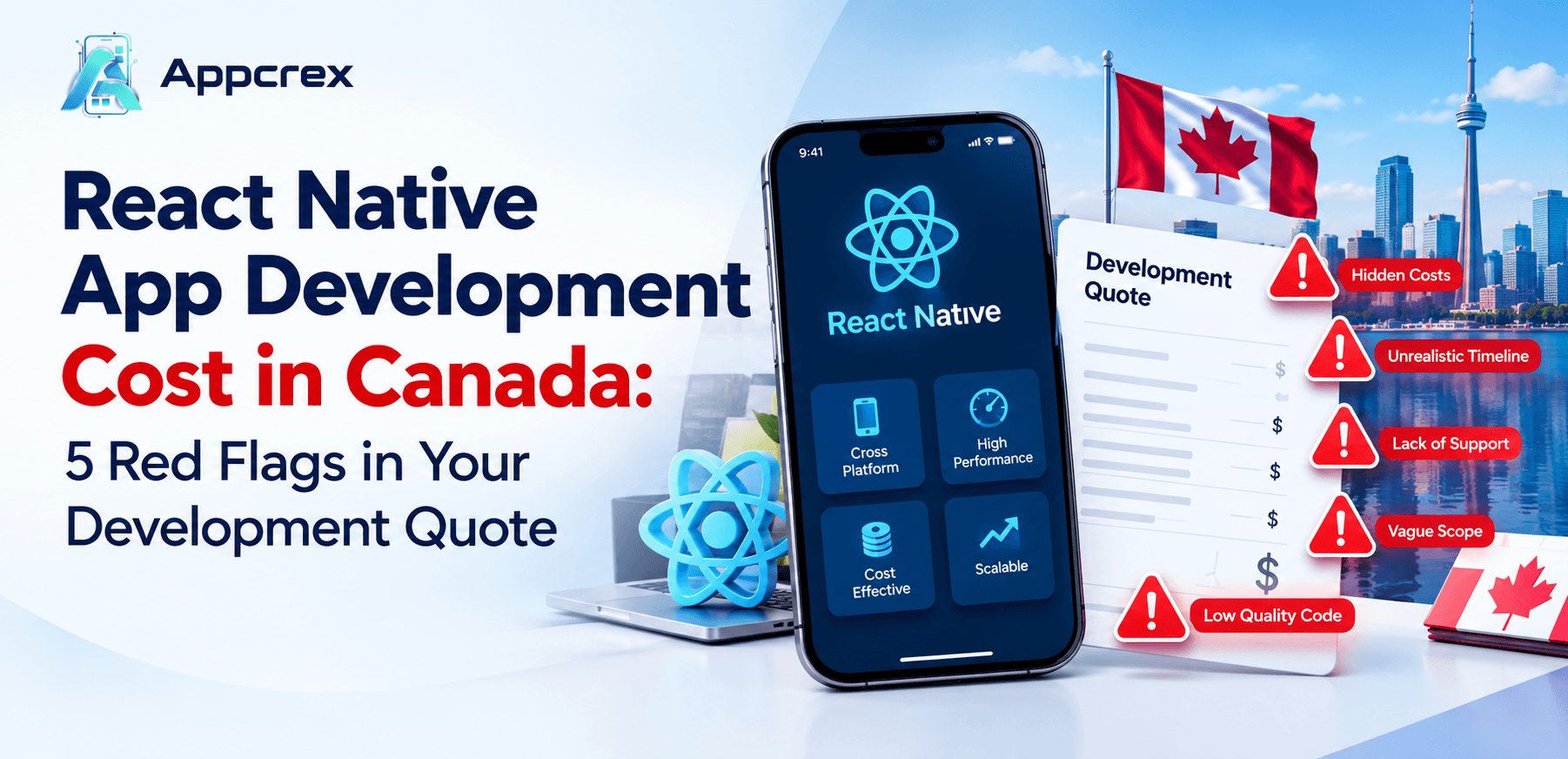
5 Red Flags in a React Native Development Quote
A low quote is not automatically bad, and a high quote is not automatically better.
Instead, examine what you are paying for.
Here are five warning signs worth investigating before signing a development contract.
Red Flag #1: The Quote Is Based Mainly on the Number of Screens
One of the easiest ways to make a development quote look simple is to price the project according to the number of screens.
For example:
“Your app has 20 screens, so development will cost CAD 30,000.”
The problem is that screens do not tell you how complicated the application actually is.
A basic profile screen may take relatively little engineering effort, while a single checkout screen could involve:
- Payment gateway integration
- Tax calculation
- Discount logic
- Order creation
- Inventory validation
- Authentication
- Error handling
- Payment confirmation
- Notifications
- Backend APIs
- Security checks
Therefore, 20 simple screens can be less expensive than five highly interactive screens.
What a Better Quote Should Show
A professional React Native app development quote should break the project into functionality and modules rather than simply counting screens.
For example:
| Module | What Should Be Considered |
|---|---|
| Authentication | Login, signup, OTP, social login, security |
| User Profile | Account management, preferences, settings |
| Payments | Gateway integration, transactions, refunds |
| Backend | APIs, database, business logic |
| Notifications | Push notifications and event triggers |
| Admin Panel | Users, content, reports, controls |
| Integrations | Maps, CRM, ERP, analytics, third-party APIs |
| QA | Functional, device, performance and regression testing |
What to ask:
“Can you provide a feature-level scope and estimated effort instead of pricing the app by screen count?”
Red Flag #2: Backend and API Development Are Missing
This is one of the most important things to check.
A mobile application is usually only one part of the overall product.
A typical architecture might look like:
React Native App → API Layer → Backend → Database → Third-Party Services
If your quote covers only the React Native frontend, you may later discover that backend development is a separate project.
Some current 2026 pricing analyses identify backend and APIs as one of the largest cost components of a production application.
Backend Work May Include
- REST or GraphQL APIs
- Database architecture
- Authentication
- User management
- Business logic
- Payment processing
- Order management
- File storage
- Notifications
- Admin APIs
- Analytics
- Security
- Cloud deployment
For example, an e-commerce React Native application may require product APIs, inventory management, cart logic, order processing, payment integration, customer accounts, shipping integration, and an admin system.
If the quote only says:
“React Native development – CAD 35,000”
ask what happens to the backend.
What to Ask
“Is backend development, database development, API development and cloud deployment included in this price?”
If the answer is no, you do not yet have the complete project cost.
Red Flag #3: QA, Device Testing and Deployment Are Excluded
React Native gives you a shared development approach, but that does not mean testing becomes unnecessary.
Your application still needs to work across different:
- iPhone models
- Android devices
- Screen sizes
- Operating-system versions
- Network conditions
- Performance conditions
Android device fragmentation can introduce additional testing requirements, while iOS has its own platform and App Store requirements.
A complete quote should explain how testing will be handled.
QA Should Ideally Cover
- Functional testing
- UI testing
- Regression testing
- API testing
- Device testing
- Performance testing
- Security checks
- Crash testing
- Payment testing
- Notification testing
- App Store / Play Store release testing
Deployment should also be discussed.
That can include:
- Apple App Store setup
- Google Play setup
- Production builds
- Signing and certificates
- Store submission
- Release configuration
- Privacy information
- Post-submission fixes
Some Canadian app cost analyses specifically identify testing, deployment, and post-launch work as areas that can disappear from an initial quote.
What to Ask
“How many QA hours are included, which devices will be tested, and is app-store deployment included?”
Red Flag #4: A Cheap Hourly Rate Hides a Large Number of Hours
When comparing development companies, hourly rate can be useful—but it should never be your only metric.
Suppose two companies provide these proposals:
Company A:
CAD 60/hour × 900 hours = CAD 54,000
Company B:
CAD 100/hour × 500 hours = CAD 50,000
At first glance, Company A appears cheaper because its hourly rate is lower.
But the total project cost is actually higher.
This is why you should evaluate:
Hourly Rate × Estimated Hours + Scope + Deliverables + Support
Current 2026 market data also shows significant differences between developer rates based on country and experience, so comparing hourly rates without comparing scope can produce the wrong conclusion.
What to Look For
A good proposal should explain:
- Estimated development hours
- Team composition
- Seniority of developers
- QA hours
- Project management effort
- Design effort
- Backend effort
- DevOps effort
- Included revisions
- Post-launch support
The Important Question
Don’t ask only:
“What is your hourly rate?”
Also ask:
“How many total hours do you estimate for the complete scope, and what deliverables are included?”
That gives you a much more meaningful comparison.
Red Flag #5: Maintenance, Integrations and Post-Launch Costs Are Missing
Your development budget does not necessarily end when the app reaches the App Store.
Once the application is live, you may need:
- Bug fixes
- OS compatibility updates
- React Native upgrades
- Security patches
- Server maintenance
- Database optimization
- Performance monitoring
- New API integrations
- Minor feature improvements
- App Store compliance updates
Third-party services can also introduce recurring expenses.
For example:
- Payment services
- Maps
- SMS
- Cloud storage
- Analytics
- Crash monitoring
- AI APIs
- Video services
- Authentication services
Some Canadian estimates recommend planning a recurring maintenance budget rather than treating post-launch work as an unexpected expense.
Ask About These Costs Before Signing
Ask your development partner:
- How long is bug-fix support included?
- What happens after the warranty period?
- Are React Native upgrades included?
- Are third-party API costs included?
- Who pays for cloud infrastructure?
- Are future OS updates covered?
- How are new features priced?
Getting clear answers early can prevent unexpected costs later.
Also Read : React Native vs Flutter: Which Framework Should You Choose for Mobile App Development in 2026?
What Should a Good React Native App Development Quote Include?
A transparent proposal should give you enough information to understand where your money is going.
A strong quote may include:
1. Discovery and Planning
Requirements gathering, technical architecture, user flows, project planning, and feature prioritization.
2. UI/UX Design
Wireframes, prototypes, design system, responsive layouts, and final interface designs.
3. React Native Development
Development of the iOS and Android application using React Native.
4. Backend Development
APIs, database, business logic, authentication, cloud services, and administration.
5. Integrations
Payment gateways, maps, analytics, CRM, ERP, social login, AI APIs, or other third-party services.
6. Quality Assurance
Functional testing, device testing, regression testing, performance testing, and bug fixing.
7. Deployment
App Store and Google Play preparation and submission.
8. Post-Launch Support
A clearly defined warranty period, maintenance plan, monitoring, and future development options.
The more transparent the proposal, the easier it is to compare development companies based on actual scope rather than marketing language.
React Native App Development Cost by App Complexity
Instead of asking only “How much does React Native cost?”, it is better to define the type of application you want.
Basic React Native MVP
Estimated cost: CAD 25,000–45,000
Typical features:
- User registration
- Login
- User profile
- Basic dashboard
- Simple API integration
- Push notifications
- Basic admin functionality
Suitable for startups validating an initial product idea.
Standard Business Application
Estimated cost: CAD 45,000–80,000
May include:
- Custom UI/UX
- Backend
- Multiple user roles
- Payments
- Notifications
- API integrations
- Analytics
- Admin dashboard
- More comprehensive QA
Advanced React Native Application
Estimated cost: CAD 80,000–150,000+
May include:
- Real-time functionality
- Advanced payments
- Complex business workflows
- Multiple integrations
- AI features
- Location services
- Advanced dashboards
- High scalability requirements
- Advanced security
Enterprise React Native Application
Estimated cost: CAD 150,000–300,000+
Enterprise projects can include:
- SSO
- Enterprise APIs
- ERP/CRM integration
- Advanced security
- Multiple environments
- Large-scale infrastructure
- Compliance requirements
- Advanced analytics
- Multi-region deployment
- Dedicated support
The final price should always be based on your actual scope rather than a generic industry average.
Also Read : What a $50K React Native App in New York Could Cost in Miami or Austin
React Native Development Cost in Major Canadian Locations
Development costs can vary by team structure, experience, agency model, and location.
For businesses researching a React Native app development company in Canada, major technology markets include:
Toronto
Toronto has one of Canada’s largest technology ecosystems. Businesses looking for enterprise applications, fintech platforms, SaaS products, and consumer apps may find a broad range of development agencies and specialists.
Vancouver
Vancouver has a strong technology and startup ecosystem, with companies working across SaaS, digital products, ecommerce, and emerging technologies.
Calgary
Calgary is another important Canadian technology market. Current React Native cost estimates for Calgary place projects broadly within the same overall Canadian range, while emphasizing that scope and team composition are major cost drivers.
Montreal
Montreal has a large technology and software-development ecosystem. Businesses targeting Quebec may also need to consider French-language localization and applicable provincial requirements when defining their application scope.
Ottawa
Ottawa’s technology ecosystem has strong connections to enterprise, government, telecom, and technology businesses.
The important point is that location alone should not determine which development company you choose. Compare the complete scope, team experience, deliverables, QA process, communication model, and post-launch support.
Canada vs Offshore React Native Development
Canadian businesses may also compare local development companies with teams in India or other international markets.
For example:
| Factor | Canadian Team | Offshore Team |
|---|---|---|
| Time-zone overlap | Usually high for Canadian businesses | May require coordination |
| Hourly rates | Generally higher | Often lower |
| Communication | Usually easier for local teams | Depends on team |
| Project management | Varies by company | Varies by company |
| Development quality | Depends on team | Depends on team |
| QA | Must be evaluated | Must be evaluated |
| Total project cost | Scope-dependent | Scope-dependent |
| Support | Depends on contract | Depends on contract |
A lower hourly rate does not automatically mean a lower total project cost.
The better comparison is:
Total project scope + team quality + communication + QA + support + long-term maintenance.
For businesses evaluating an app development company in India, the same principle applies: compare the complete proposal rather than selecting a provider solely because the hourly rate is lower.
How to Avoid Overpaying for React Native Development?
The goal should not be finding the cheapest development quote.
The goal should be getting a transparent quote for the right scope.
Here are practical ways to control your budget.
Define the MVP Clearly
Separate:
Must-have features
from
Future features
Building everything in version one can increase the initial budget significantly.
Request a Feature-Level Estimate
Ask the development company to estimate major features and modules separately.
Ask for Backend Details
Confirm whether backend, APIs, database, authentication, and cloud deployment are included.
Clarify QA
Find out how much testing is included and which devices are covered.
Discuss Third-Party Costs
Identify recurring API, cloud, payment, analytics, SMS, and other service costs.
Define Post-Launch Support
Understand exactly what happens after launch.
Compare Complete Proposals
Instead of comparing:
CAD 40K vs CAD 70K
compare:
CAD 40K — what’s included?
against:
CAD 70K — what’s included?
That is the more useful question.
Questions to Ask a React Native Development Company Before Signing
Before selecting a development partner, ask:
- Is backend development included?
- Are APIs included?
- Is UI/UX design included?
- How many development hours are estimated?
- Who will work on the project?
- What React Native experience does the team have?
- Is QA included?
- Which devices will be tested?
- Is deployment included?
- How long is post-launch support?
- Are third-party API costs included?
- What happens if the scope changes?
- Who owns the source code?
- How will project milestones be tracked?
- What is the estimated total cost of ownership after launch?
These questions can reveal differences between two proposals that otherwise appear almost identical.
Why React Native Can Still Be a Cost-Effective Choice?
React Native allows businesses to build applications for iOS and Android using a shared cross-platform development approach.
That can reduce duplicated frontend development effort compared with maintaining two completely separate native applications.
However, React Native does not eliminate backend development, QA, design, infrastructure, integrations, or product management.
The financial advantage therefore depends on the project.
For standard business applications, ecommerce products, marketplaces, SaaS companion apps, booking platforms, and many consumer applications, React Native can be an efficient development option.
For applications requiring extensive platform-specific functionality, advanced hardware integration, or highly specialized native performance, additional native development may still be necessary.
FAQs
Q. How much does React Native app development cost in Canada?
React Native app development in Canada can range from around CAD 25,000 for a basic MVP to CAD 150,000+ for advanced applications, while enterprise projects can exceed CAD 300,000 depending on scope and complexity. Current 2026 Canadian estimates show wide variation because projects differ significantly in backend, integrations, testing, and infrastructure requirements.
Q. Is React Native cheaper than native app development?
It can be, particularly when the same product needs to support both iOS and Android. A shared codebase can reduce duplicated development work, although the final savings depend on the application’s requirements.
Backend work, third-party integrations, QA, infrastructure, post-launch maintenance, and platform updates are common areas that may not be fully visible in an initial quote.
Q. Should I choose a Canadian React Native development company?
That depends on your project requirements, budget, communication needs, time-zone requirements, and technical expectations. A Canadian provider is one option; businesses can also evaluate distributed or international teams.
Q. What should a React Native development quote include?
A complete quote should clearly describe discovery, UI/UX, React Native development, backend, APIs, integrations, QA, deployment, project management, and post-launch support.
Q. How can I compare two React Native development quotes?
Compare the scope, estimated hours, team composition, deliverables, backend, integrations, QA, timeline, ownership, and support, not just the final price.
Q. Is CAD 20,000 enough to build a React Native app in Canada?
It may be possible for a very small MVP or limited application, but a production-ready application with backend systems, integrations, authentication, payments, and comprehensive testing can require substantially more. Current Canadian estimates commonly place broader React Native projects above this level.
Conclusion
The right question is not simply “How much does React Native app development cost in Canada?”
A better question is:
“What exactly am I getting for the quoted price?”
A CAD 40,000 quote can be reasonable for one application and completely unrealistic for another. Likewise, a CAD 100,000 quote may be justified when the project includes complex backend architecture, integrations, security, advanced functionality, extensive QA, and long-term support.
Before choosing a React Native app development company, examine the scope behind the number.
Look for the five major warning signs: screen-based pricing, missing backend work, limited QA, inflated hours behind a low rate, and unclear post-launch costs.
A transparent proposal should make the development scope, timeline, responsibilities, costs, and support model easy to understand.
Looking for a React Native App Development Company?
AppCrex helps businesses build scalable React Native applications for iOS and Android, covering UI/UX, backend development, APIs, integrations, testing, deployment, and ongoing support.
If you are comparing React Native development quotes in Canada and want a clear scope-based estimate, talk to AppCrex about your application requirements and development roadmap.