📌 Key Takeaways
- Handyman apps connect customers with professionals for repairs, maintenance, installations, and home-improvement services.
- The business model can work across the USA, Dubai, UAE, and wider Middle Eastern markets.
- Customer, provider, and admin interfaces are the foundation of a complete handyman platform.
- AI can improve provider matching, customer support, demand forecasting, and job estimation.
- Development costs can range from approximately $20,000 for an MVP to $130,000+ for a sophisticated marketplace.
Introduction
Home repair and maintenance services are becoming increasingly digital. Customers no longer want to spend hours searching for a plumber, electrician, carpenter, painter, appliance technician, or general handyman. They want to describe the problem, find an available professional, see the estimated cost, select a convenient time, and book the service from their phone.
This shift has created a strong opportunity for businesses looking to build a handyman app.
A modern handyman platform can connect customers with verified professionals while giving service providers tools for scheduling, job management, navigation, payments, communication, and earnings.
The model is already gaining traction in different markets. In the USA, digital platforms connect consumers with professionals for tasks ranging from furniture assembly and repairs to broader home-maintenance work. In Dubai and the UAE, home-service marketplaces are also offering handyman and maintenance services alongside cleaning, moving, and other household services.
For startups and established service businesses, this makes handyman app development an interesting opportunity in the USA, Dubai, UAE, and wider Middle East.
Just Read : Home Services App Development Company USA: Features, Cost & Development Process
What Is a Handyman App?
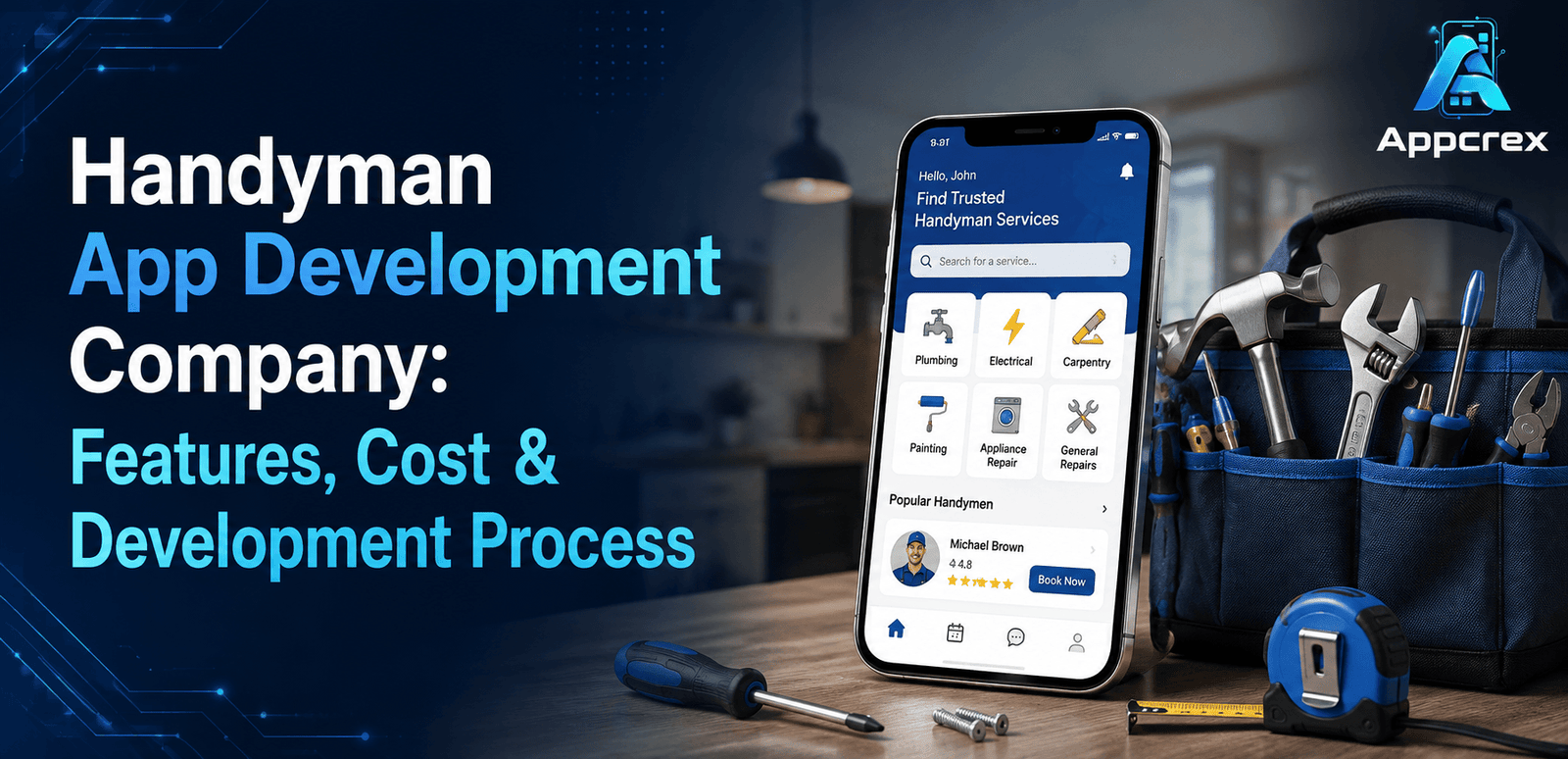
A handyman app is a mobile platform that allows customers to find and book professionals for home repair, maintenance, installation, and improvement services.
A customer can use the app to:
- Select a service
- Describe a problem
- Upload photos or videos
- Find nearby professionals
- Compare profiles and ratings
- Request a quote
- Schedule a visit
- Track the handyman
- Communicate with the professional
- Pay digitally
- Rate the completed service
On the business side, the platform can manage professionals, bookings, service areas, pricing, payments, commissions, customer support, and analytics.
The platform can be designed as a single-business app or as a multi-provider marketplace.
Why Build a Handyman App in 2026?
The traditional home-repair process can be inconvenient.
A customer might need to:
- Search online for a professional.
- Call several businesses.
- Explain the problem repeatedly.
- Wait for availability.
- Negotiate a price.
- Coordinate arrival.
- Make payment after the job.
A handyman app can bring these steps into one digital journey.
The customer can submit a job request, receive a suitable professional, schedule the service, and follow the job from the same platform.
Recent U.S. activity also shows continued interest in digital platforms for household tasks and physical services.
For entrepreneurs, the opportunity is particularly interesting because handyman services can cover many categories rather than depending on a single service.
Handyman App Opportunities in the USA
The U.S. market can support several types of handyman platforms.
A handyman app development USA project can focus on:
- Home repairs
- Furniture assembly
- Plumbing
- Electrical work
- Carpentry
- Painting
- Appliance installation
- TV mounting
- Door and lock repair
- Drywall repair
- Flooring work
- General maintenance
- Smart-home installation
The app can target homeowners, renters, landlords, property managers, Airbnb operators, and businesses.
One useful strategy is to begin with small and frequently requested jobs and expand the service categories after establishing a customer base.
Handyman App Development Dubai & UAE
Dubai provides another interesting environment for home-service technology.
The UAE already has digital platforms offering home maintenance and handyman services, demonstrating that consumers are becoming familiar with online home-service booking.
A handyman app development Dubai project can include:
- Apartment maintenance
- Villa maintenance
- Plumbing
- Electrical services
- AC-related maintenance
- Carpentry
- Painting
- Furniture assembly
- Appliance installation
- General handyman services
- Property maintenance
The platform can initially focus on Dubai and later expand to Abu Dhabi, Sharjah, and other UAE markets.
For the wider Middle East, Arabic and English support can be incorporated into the platform, along with market-specific pricing, payment methods, service areas, and business rules.
What Services Can a Handyman App Offer?
A major advantage of this business model is the ability to support multiple service categories.
Plumbing
Customers can request:
- Leak repairs
- Faucet installation
- Drain issues
- Pipe repairs
- Toilet repairs
Electrical
Services can include:
- Switch installation
- Lighting installation
- Socket repair
- Wiring-related maintenance
- Electrical troubleshooting
Carpentry
Customers can book:
- Furniture repair
- Cabinet work
- Door repair
- Shelving
- Custom installations
Painting
The platform can support:
- Room painting
- Wall touch-ups
- Exterior painting
- Commercial painting
Furniture Assembly
Customers can request professional help assembling furniture, shelves, desks, beds, and other products.
Appliance Installation
Services can include installation of:
- Washing machines
- Dishwashers
- TVs
- Ovens
- Other household appliances
General Home Maintenance
A general category can cover smaller jobs that don’t fit into a specific service category.
Different Handyman App Business Models
Before development begins, it is important to decide how the platform will make money.
Single-Service Business App
An existing handyman company can build its own branded app.
Customers book directly with the company’s professionals.
This model provides greater control over:
- Pricing
- Employees
- Service quality
- Customer relationships
Handyman Marketplace
Multiple independent professionals can join the platform.
Customers can compare providers based on:
- Rating
- Reviews
- Price
- Experience
- Availability
- Location
The platform can earn a commission from completed jobs.
On-Demand Handyman App
Customers request immediate assistance for urgent jobs.
This model can work well for:
- Emergency repairs
- Plumbing problems
- Electrical issues
- Lock-related services
- Appliance failures
Also Read : Build an On-Demand Grocery App Development Company | Features, Cost & Guide (2026)
B2B Handyman Platform
The platform can focus on businesses and property managers.
Potential customers include:
- Property management companies
- Hotels
- Offices
- Retail stores
- Restaurants
- Airbnb operators
- Real estate companies
This can create recurring maintenance contracts rather than relying only on individual bookings.
Customer App Features
The customer experience should be designed around speed and trust.
Simple Registration
Users can register using:
- Phone number
- Social login
Profiles can store addresses, service history, preferences, and payment information.
Service Discovery
Customers can browse categories and quickly identify the required service.
For example:
Plumbing → Leak Repair → Select Location → Book
Problem Description
A useful feature is the ability to describe the problem in text.
Customers can also upload:
- Photos
- Videos
- Documents
This can help the professional understand the job before arriving.
Quote Request
For jobs where fixed pricing isn’t practical, customers can request quotes from professionals.
Providers can submit their estimated price through the platform.
Provider Profiles
Profiles can show:
- Name
- Business
- Experience
- Skills
- Ratings
- Reviews
- Completed jobs
- Availability
- Service area
This gives customers more confidence before booking.
Booking & Scheduling
Customers can select:
- Date
- Time
- Service location
- Service type
- Additional instructions
The platform can automatically show available slots based on provider schedules.
Live Tracking
Once a professional is assigned, GPS tracking can show the approximate arrival location.
Customers can also receive an estimated arrival time.
In-App Chat
Customers and handymen can communicate about:
- Access instructions
- Parking
- Job details
- Materials
- Additional requirements
Digital Payments
Payment functionality can support:
- Credit/debit cards
- Digital wallets
- Service deposits
- Tips
- Refunds
- Promotional codes
- Digital invoices
Ratings & Reviews
After completion, customers can rate the professional and provide feedback.
Also Read : What Makes an On-Demand Service App Successful Today?
Handyman App Features for Service Providers
The provider app should make daily work easier.
Professionals can manage:
- Profile
- Skills
- Service categories
- Service areas
- Availability
- Job requests
- Quotes
- Bookings
- Navigation
- Customer communication
- Earnings
Job Requests
Providers can receive nearby service requests and choose whether to accept them.
Quote Management
For custom jobs, providers can submit estimates directly through the app.
Schedule Management
Professionals can block unavailable times and manage multiple appointments.
Integrated maps can provide directions to customer locations.
Job Status
Providers can update statuses such as:
Accepted → On the Way → Arrived → Work Started → Completed
Earnings Dashboard
Professionals can view:
- Completed jobs
- Earnings
- Pending payments
- Commission
- Withdrawals
Admin Dashboard
The admin dashboard controls the entire marketplace.
Administrators can manage:
- Customers
- Handymen
- Businesses
- Services
- Bookings
- Quotes
- Payments
- Commissions
- Service zones
- Promotions
- Reviews
- Complaints
- Notifications
Analytics can show:
- Total bookings
- Revenue
- Active providers
- Popular services
- Repeat customers
- Cancellation rates
- Average booking value
- Provider performance
For a multi-city business, the admin system can also manage different locations independently.
Also Read : AI Customer Support Automation Services: Complete Guide to Benefits, Features, Implementation & Cost
AI Features for a Handyman App
AI can become particularly useful when a platform has thousands of service requests and professionals.
AI Problem Classification
A customer might write:
“The kitchen sink is leaking underneath.”
AI can identify that the likely category is plumbing and route the request toward relevant professionals.
AI-Based Provider Matching
AI can consider:
- Location
- Skill
- Availability
- Rating
- Previous jobs
- Customer preferences
- Estimated travel time
and recommend suitable professionals.
Digital marketplaces are already exploring AI-based matching to improve how customers are connected with skilled workers.
AI Quote Assistance
For certain standardized jobs, AI can help estimate potential costs using historical job data.
For complicated work, the system can still request a professional quote.
AI Customer Support
An AI assistant can answer questions about:
- Services
- Pricing
- Booking
- Rescheduling
- Cancellation
- Payments
- Warranty policies
Predictive Maintenance
For connected homes or IoT-enabled equipment, data can potentially be used to identify maintenance requirements before a major failure occurs.
AI Demand Forecasting
AI can analyze historical booking data to predict demand by:
- Service
- Location
- Day
- Time
- Season
This can help businesses plan provider capacity.
How Much Does It Cost to Develop a Handyman App?
The cost depends on whether you are building a simple business app or a multi-provider marketplace.
A general planning estimate is:
| Platform Type | Estimated Cost |
|---|---|
| Basic Handyman MVP | $20,000 – $40,000 |
| Medium-Level App | $40,000 – $75,000 |
| Advanced Marketplace | $75,000 – $130,000+ |
| AI-Powered Multi-City Platform | $120,000 – $200,000+ |
These figures are approximate development ranges, not fixed quotations.
Factors That Affect Cost
Number of apps: Customer and provider apps require separate workflows.
Admin dashboard: A sophisticated management system increases development scope.
GPS: Live location, ETA, route management, and service-area logic require additional development.
Quote system: Dynamic quotes and negotiation workflows add complexity.
Payments: Deposits, refunds, tips, subscriptions, and multiple payment methods increase the workload.
AI: Custom matching, predictive analytics, image analysis, and AI assistants require additional engineering.
Multiple countries: Supporting the USA, UAE, and other Middle Eastern markets can require different currencies, languages, payment systems, and business rules.
How to Build a Handyman App?
A successful app should be built around the actual service workflow.
1. Define Your Target Market
Decide whether your first market is:
- USA
- Dubai
- UAE
- Saudi Arabia
- Wider Middle East
You can then determine the services and business requirements for that market.
2. Select Your Business Model
Choose between:
- Single service company
- Marketplace
- On-demand platform
- B2B maintenance platform
- Subscription service
3. Select Your Services
Don’t necessarily launch every category immediately.
A focused MVP could start with:
Plumbing + Electrical + Carpentry + General Repairs
Additional services can be added later.
4. Plan the User Journey
Map the complete process:
Service Selection → Problem Description → Provider/Quote → Booking → Arrival → Job Completion → Payment → Review
5. Design UI/UX
Customer and provider interfaces should have different priorities.
For Middle Eastern markets, Arabic/English and RTL support can be planned from the beginning.
6. Develop the MVP
The first release can include:
- Registration
- Service categories
- Provider profiles
- Booking
- Scheduling
- Quotes
- GPS
- Payments
- Notifications
- Reviews
- Admin management
7. Integrate APIs
Depending on the business model, integrations may include:
- Maps
- Payment gateways
- SMS
- Push notifications
- Analytics
- CRM
- Accounting systems
8. Test the Platform
Testing should cover:
- Booking
- Quotes
- Payments
- GPS
- Notifications
- Provider workflows
- Security
- Performance
- Different mobile devices
9. Launch and Scale
After launch, customer behavior and business data can determine which features should be added next.
Technology Stack for Handyman App Development
A typical technology stack can include:
Mobile: Flutter, React Native, Swift, Kotlin
Backend: Node.js, Python, Java, or comparable technologies
Database: PostgreSQL, MySQL, MongoDB
Cloud: AWS, Microsoft Azure, Google Cloud
Maps: Google Maps APIs or equivalent services
Payments: Stripe and market-specific payment providers
AI: AI APIs, machine learning models, recommendation engines, and custom solutions
The technology should be selected according to expected traffic, integrations, security requirements, development budget, and long-term scalability.
How Does a Handyman App Make Money?
Several monetization models are available.
Commission
The platform receives a percentage of each completed booking.
Customer Service Fee
A small platform fee can be added to the customer’s order.
Provider Subscription
Handymen can pay a monthly fee to access the marketplace and additional business tools.
Lead Generation
Professionals can pay for qualified service leads.
Featured Listings
Providers can pay to receive better visibility.
Emergency Service Fees
Urgent or after-hours bookings can carry additional charges.
Maintenance Memberships
Customers can purchase annual or monthly maintenance plans that include priority service or discounted visits.
Handyman App Security & Trust
Trust is especially important when professionals enter customers’ homes.
A platform can include:
- Provider identity verification
- Business verification
- Background-check workflows where appropriate
- Secure authentication
- Customer reviews
- Provider ratings
- Secure payments
- Encrypted communication
- Role-based access
- Fraud monitoring
- Complaint management
- Digital service records
The exact verification and legal requirements should be reviewed according to the country, state, service category, and business model.
Why Choose AppCrex for Handyman App Development?
AppCrex can help businesses develop a complete handyman technology platform rather than simply a booking interface.
Services can include:
- Business consultation
- Product strategy
- UI/UX design
- iOS app development
- Android app development
- Cross-platform development
- Backend development
- Customer app
- Provider app
- Admin dashboard
- GPS integration
- Payment integration
- AI integration
- API development
- Cloud deployment
- Testing and QA
- Maintenance and support
Whether you want to build a handyman app in the USA, launch a handyman app in Dubai, or create a broader Middle Eastern home-maintenance marketplace, the platform can be customized around your target audience and operational model.
For Dubai and other Middle Eastern markets, AppCrex can also build features such as Arabic/English interfaces, RTL support, multi-city operations, location-based service areas, and market-specific payment options.
FAQs
Q. How much does it cost to build a handyman app?
A basic MVP may cost approximately $20,000–$40,000, while an advanced marketplace can reach $75,000–$130,000+. AI, IoT, and multi-city capabilities can increase the overall investment.
Q. How long does it take to develop a handyman app?
A basic MVP can take around 3–5 months. A more complex marketplace with customer, provider, admin, GPS, payments, and AI features may take 6–10 months or longer.
Q. Can I build a handyman app for the USA?
Yes. The platform can be designed for U.S. customers, contractors, handymen, property managers, and local service companies.
Q. Can I build a handyman app for Dubai?
Yes. A Dubai-focused platform can support apartment and villa maintenance, plumbing, electrical, carpentry, painting, furniture assembly, and other home services.
Q. Can one app work in both the USA and UAE?
Yes. The backend can be designed for multiple markets with different currencies, languages, service areas, payment methods, and operational rules.
Q. Can customers request a quote instead of paying a fixed price?
Yes. A quote-based workflow can allow customers to describe the job, upload photos, and receive estimates from one or more professionals.
Q. Can AI match customers with handymen?
Yes. AI can consider location, skills, availability, ratings, previous jobs, and other factors to recommend suitable providers.
Q. Can I offer emergency handyman services?
Yes. An on-demand workflow can support urgent requests and allow nearby available professionals to accept them.
Q. Can multiple handymen join my platform?
Yes. A marketplace can support multiple independent professionals or service companies.
Conclusion
The traditional handyman industry is increasingly moving toward digital service discovery, scheduling, communication, and payments. Customers want reliable professionals without spending hours searching and calling, while service providers need better tools to manage their jobs and grow their businesses.
A well-designed handyman app can bring both sides together.
In the USA, the platform can focus on home repairs, furniture assembly, maintenance, property management, and specialized trades. In Dubai and the Middle East, it can support apartment and villa maintenance, plumbing, electrical services, carpentry, painting, furniture installation, and broader home-service requirements.
The strongest approach is to begin with a focused MVP, prove the business model in a specific market, and then expand into additional services, cities, subscriptions, AI automation, and B2B maintenance contracts.
Build Your Handyman App with AppCrex
Planning to launch a handyman app in the USA, Dubai, UAE, or the Middle East?
AppCrex can help you build a scalable platform with customer and provider apps, admin management, booking, quotes, GPS tracking, payments, AI, notifications, and automation.
Talk to AppCrex experts to discuss your handyman app idea, required features, development timeline, and estimated budget.