📌 Key Takeaways
- Home services apps can digitize booking, scheduling, payments, and technician management.
- The U.S. market supports specialized apps for HVAC, plumbing, cleaning, electrical, handyman, and other services.
- A complete platform generally includes customer, provider, and admin interfaces.
- AI, GPS, IoT, and predictive analytics can turn a basic booking app into a smarter service platform.
- Development cost can range from roughly $25,000 for an MVP to $140,000+ for an advanced marketplace, depending on scope.
Introduction
Home service businesses in the USA are becoming increasingly digital. Customers now expect to find a professional, check availability, compare pricing, book a service, make a payment, and track the technician—all from their smartphone.
That is where a home services app can create a strong business opportunity.
Whether you want to build an app for HVAC services, plumbing, electrical work, home cleaning, landscaping, pest control, handyman services, appliance repair, or multiple home services, a well-designed platform can connect customers with verified professionals and make the entire service process easier to manage.
AppCrex helps businesses build custom home services apps for the USA, including customer apps, service-provider apps, admin dashboards, booking systems, payment integration, GPS tracking, AI-powered automation, and scalable backend infrastructure.
What Is a Home Services App?
A home services app is a digital platform that allows customers to book professionals for services at their homes.
Instead of searching Google, calling multiple contractors, waiting for callbacks, or coordinating appointments manually, customers can use one platform to:
- Find nearby professionals
- Select a required service
- View pricing
- Choose a convenient time
- Book a professional
- Track the service provider
- Communicate through the app
- Make digital payments
- Rate and review the service
For businesses, the platform can handle bookings, technicians, customers, payments, invoices, schedules, service areas, and performance analytics from a centralized dashboard.
This makes a home services app development company USA a valuable technology partner for startups, local service businesses, franchises, and companies planning to build a multi-service marketplace.
Why Build a Home Services App in the USA?
The U.S. home services market covers a huge range of recurring and emergency services.
Customers may need:
- Plumbing
- HVAC repair and maintenance
- Electrical services
- House cleaning
- Appliance repair
- Pest control
- Landscaping
- Roofing
- Painting
- Handyman services
- Moving services
- Pool maintenance
- Home security
- Garage door repair
The opportunity becomes even stronger when an app focuses on convenience.
For example, a customer with a broken air conditioner doesn’t necessarily want to spend an hour finding contractors. They want to open an app, select AC Repair, choose an available technician, see an estimated price, and schedule the visit.
This creates opportunities for both on-demand home service apps and subscription-based service platforms.
Types of Home Services Apps You Can Build
You don’t necessarily need to create one app covering every service. Your business model can determine the right approach.
1. On-Demand Home Services App
Customers request immediate services and nearby professionals accept the job.
Ideal for:
- Plumbing
- HVAC emergencies
- Electrical repairs
- Locksmith services
- Appliance repair
2. Home Services Marketplace
The platform connects multiple independent professionals with customers.
Providers can create profiles, list services, set availability, and receive bookings.
3. Single-Service App
A business can build an app specifically around one service.
Examples include:
- HVAC service app
- Cleaning service app
- Plumbing app
- Handyman app
- Pest control app
4. Multi-Service Home Maintenance App
A single platform can provide multiple household services under one brand.
This model can potentially increase customer lifetime value because users can return to the same platform for different requirements.
Essential Features of a Home Services App
A successful home services platform generally needs three major components:
Customer App + Service Provider App + Admin Dashboard
Each serves a different purpose.
Customer App Features
The customer experience should be simple because people often use these apps when they need a service quickly.
User Registration
Customers can register through:
- Phone number
- Social login
Profiles can include addresses, preferred payment methods, service history, and saved locations.
Service Categories
Customers should be able to quickly browse categories such as:
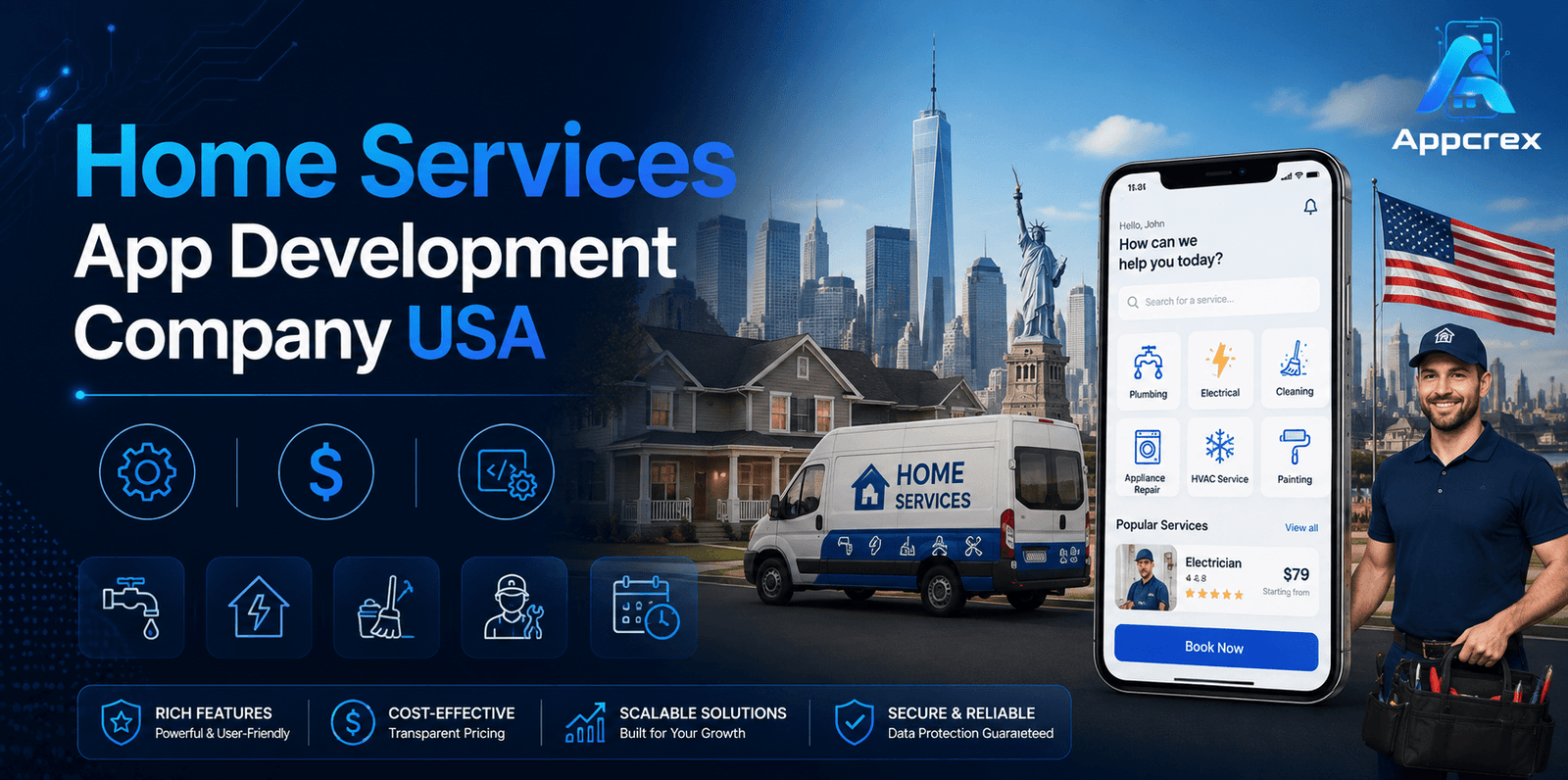
HVAC | Plumbing | Cleaning | Electrical | Handyman | Pest Control | Landscaping
Location-Based Search
GPS can identify the customer’s location and show professionals who serve that area.
Users can also manually enter their ZIP code or address.
Service Provider Profiles
Profiles can display:
- Professional name
- Business information
- Ratings
- Reviews
- Experience
- Services
- Pricing
- Availability
- Service area
This helps customers make informed decisions.
Booking & Scheduling
Customers can choose:
- Date
- Time slot
- Service type
- Address
- Additional instructions
For urgent jobs, the platform can offer an ASAP/Now booking option.
Price Estimation
The app can provide an estimated cost before booking.
Pricing can depend on:
- Service type
- Job complexity
- Location
- Parts/materials
- Labor
- Urgency
- Distance
Real-Time Technician Tracking
GPS tracking can allow customers to see the technician’s location and estimated arrival time.
In-App Chat & Calling
Customers and professionals can communicate without exposing personal contact information.
Digital Payments
Depending on the business model, you can integrate payment options such as:
- Credit/debit cards
- Digital wallets
- Online payment gateways
The platform can also support deposits, service charges, tips, refunds, and invoices.
Just Read : Digital Wallet App Development: Complete Guide to Features, Cost, Security & Trends (2026)
Ratings & Reviews
After service completion, customers can rate professionals and leave feedback.
This also helps businesses identify high-performing providers.
Service Provider App Features
The provider side is equally important.
Professionals should be able to manage their entire workflow from their phones.
Key features include:
- Provider registration
- Identity/business verification
- Service selection
- Service-area management
- Availability calendar
- Booking management
- Job acceptance/rejection
- Navigation
- Customer information
- In-app messaging
- Job status updates
- Digital invoices
- Earnings dashboard
- Payment history
- Ratings and reviews
- Push notifications
For example, an HVAC technician could receive a notification for a new AC repair request, review the job details, accept it, navigate to the customer’s location, update the job status, upload service details, and complete payment—all through the provider app.
Admin Dashboard
The admin panel gives the business complete control over the platform.
Administrators can manage:
- Customers
- Service providers
- Services
- Bookings
- Locations
- Payments
- Commissions
- Promotions
- Reviews
- Complaints
- Notifications
- Reports
- Provider verification
An advanced dashboard can also provide real-time business analytics.
For example, administrators can monitor:
- Total bookings
- Completed jobs
- Cancelled jobs
- Revenue
- Average order value
- Active providers
- Customer retention
- Popular services
- High-demand locations
AI Features for Home Services Apps
AI can take a home services platform beyond simple booking.
AI Service Recommendation
A customer can describe a problem in natural language:
“My AC is running but the room isn’t getting cold.”
AI can analyze the description and suggest an appropriate service category.
AI Chatbot
An AI assistant can answer common questions about:
- Services
- Pricing
- Availability
- Booking
- Cancellation
- Payments
- Service policies
Smart Technician Matching
AI can match customers with professionals based on:
- Location
- Skills
- Availability
- Ratings
- Previous jobs
- Estimated arrival time
Predictive Maintenance
For connected appliances or equipment, IoT data can potentially identify unusual behavior and predict maintenance requirements before a breakdown happens.
AI-Based Job Estimation
AI can help estimate service duration, technician requirements, and potential job complexity based on historical service data.
This can improve scheduling and resource allocation.
GPS, IoT & Smart Home Integration
A modern home services app development company can also integrate connected technologies.
For example, IoT-enabled HVAC systems can provide information about:
- Temperature
- Equipment status
- Energy consumption
- Error conditions
- Maintenance requirements
Instead of waiting for a customer to report a problem, the platform could identify potential issues and recommend maintenance.
GPS integration can also support:
- Technician tracking
- Route optimization
- Service-area verification
- ETA calculation
- Distance-based pricing
These capabilities can turn a basic booking platform into a more intelligent home-service ecosystem.
Also Read : IoT Integration Services: Complete Guide to Benefits, Process, Cost & Use Cases
How Much Does It Cost to Develop a Home Services App in the USA?
The cost depends heavily on the app’s complexity, number of platforms, integrations, features, and design requirements.
A general estimate can look like this:
| App Type | Estimated Development Cost |
|---|---|
| Basic MVP | $25,000 – $45,000 |
| Medium-Complexity App | $45,000 – $80,000 |
| Advanced Marketplace | $80,000 – $140,000+ |
| AI/IoT-Powered Platform | $120,000 – $200,000+ |
These are planning-level estimates, not fixed quotations.
The final price can change significantly depending on requirements.
Factors That Affect Development Cost
The biggest cost factors include:
Number of apps: Customer + provider + admin increases development effort.
Platforms: Building for both iOS and Android requires additional work unless a suitable cross-platform approach is selected.
UI/UX complexity: A highly customized user experience requires more design and development time.
Real-time functionality: GPS tracking, chat, notifications, and live status updates add backend complexity.
Payment integration: Multiple payment methods, refunds, subscriptions, tips, and invoicing require additional development.
AI: Custom AI assistants, matching algorithms, predictive analytics, or computer vision can significantly increase project cost.
Third-party integrations: Maps, payment gateways, CRM, accounting systems, IoT platforms, and communication services can influence both development and ongoing costs.
Also Read : Mobile App Development in India: Cost, Technologies, Process & Business Opportunities
How to Build a Home Services App in the USA?
Building the platform successfully requires more than simply developing an app.
Step 1: Define the Business Model
First determine whether you want:
- A marketplace
- A single-service platform
- A multi-service platform
- An app for your existing service company
- A franchise management platform
Step 2: Identify the Target Customers
Your audience could include:
- Homeowners
- Renters
- Property managers
- Landlords
- Businesses
- Facility managers
Defining the audience helps determine the features and pricing model.
Step 3: Select the Services
Start with a focused service category instead of launching everything simultaneously.
For example, an MVP could initially focus on:
HVAC + Plumbing + Electrical
Additional categories can be introduced later.
Step 4: Design the UX/UI
The customer should be able to book a service in as few steps as possible.
The provider interface should focus on jobs, navigation, schedules, and earnings.
Step 5: Develop the MVP
The first version can include:
- Registration
- Service categories
- Provider profiles
- Booking
- Scheduling
- GPS
- Payments
- Notifications
- Ratings
- Admin dashboard
Also Read : What Is an MVP in App Development? A Complete Guide
Step 6: Integrate Third-Party Services
Depending on requirements, integrations may include:
- Maps
- Payment services
- SMS
- Push notifications
- Analytics
- CRM
- Accounting software
Step 7: Test the Platform
Testing should cover:
- User flows
- Payments
- GPS
- Push Notifications
- Security
- Performance
- Different devices
- Provider/customer interactions
Step 8: Launch & Scale
After launch, analytics and customer feedback can determine which services and features should be developed next.
Technology Stack for Home Services App Development
A typical technology stack may include:
Mobile: Flutter, React Native, Swift, Kotlin
Backend: Node.js, Python, Java, or similar scalable frameworks
Database: PostgreSQL, MySQL, MongoDB
Cloud: AWS, Microsoft Azure, or Google Cloud
Maps & Location: Google Maps APIs or suitable location services
Payments: Stripe and other region-appropriate payment providers
AI: OpenAI-compatible APIs, machine learning frameworks, recommendation systems, or custom AI models
Notifications: Firebase Cloud Messaging and SMS/email services
The final technology stack should be selected according to the platform’s scalability, integrations, security requirements, and long-term roadmap—not simply because a particular technology is popular.
How Do Home Services Apps Make Money?
There are several monetization models.
Commission Model
The platform charges a percentage of every completed booking.
Service Fee
Customers pay a platform or convenience fee on each order.
Provider Subscription
Professionals pay a monthly or annual fee to access customers and platform tools.
Featured Listings
Service providers can pay for higher visibility within search results.
Lead Generation
Professionals pay for qualified customer leads.
Membership Plans
Customers can purchase memberships that offer benefits such as discounted service fees, priority scheduling, or maintenance plans.
A hybrid model can combine commissions, subscriptions, and premium listings.
Security & Compliance Considerations
A home services platform handles sensitive customer and business information, so security should be considered from the beginning.
Important measures include:
- Secure authentication
- Encrypted data transmission
- Role-based access
- Secure payment processing
- API security
- Data backups
- Fraud monitoring
- Secure cloud infrastructure
- Privacy controls
- Audit logging
Payment card information should generally be handled through compliant payment providers rather than stored unnecessarily within the application backend.
For a U.S.-focused platform, privacy, consumer protection, payment, and state-specific requirements should be reviewed according to the exact business model and data being collected.
Why Choose AppCrex for Home Services App Development in the USA?
AppCrex can help businesses move from an initial home-service concept to a scalable digital platform.
Our development approach can cover:
- Business and technical consultation
- UX/UI design
- iOS app development
- Android app development
- Cross-platform development
- Backend development
- Admin dashboard development
- GPS & location integration
- Payment integration
- AI integration
- IoT integration
- Cloud deployment
- API integration
- Testing and quality assurance
- Post-launch maintenance
Whether you want to build a home services marketplace, launch an HVAC booking platform, digitize an existing home-maintenance company, or create an AI-powered service ecosystem, the platform can be designed around your business model.
FAQs
Q. How much does it cost to build a home services app in the USA?
A basic MVP can start around $25,000–$45,000, while an advanced marketplace can reach $80,000–$140,000+. AI and IoT capabilities can push the investment beyond that range.
Q. How long does it take to develop a home services app?
A basic MVP may take around 3–5 months, while a feature-rich marketplace with advanced integrations can require 6–10 months or more.
Q. Can I build an app for one home service?
Yes. A specialized app for HVAC, plumbing, cleaning, electrical services, landscaping, pest control, or handyman services can be developed.
Q. Can the app support multiple service providers?
Yes. A marketplace model can allow multiple contractors or service companies to register, verify their profiles, manage availability, accept jobs, and receive payments.
Q. Can AI be integrated into a home services app?
Yes. AI can support customer chatbots, service recommendations, technician matching, price estimation, predictive maintenance, demand forecasting, and operational automation.
Q. Can I launch the app for multiple U.S. cities?
Yes. The architecture can be designed to support multiple cities, ZIP codes, service areas, providers, and regional pricing.
Q. Should I build an MVP first?
For most startups, an MVP is a practical approach. It allows you to validate demand and the business model before investing in a large multi-service platform.
Conclusion
A home services app can solve a very practical problem: making it easier for customers to find reliable professionals while giving service businesses better tools to manage jobs, schedules, payments, and customers.
The strongest approach is not necessarily to launch hundreds of features on day one. Start with a focused service offering, build a smooth booking experience, validate the market, and then expand into AI, automation, IoT, subscriptions, and additional service categories.
If you’re planning to launch a home services app in the USA, AppCrex can help turn your idea into a scalable mobile platform designed around your target customers and business model.
Build Your Home Services App with AppCrex
Have an idea for an HVAC, plumbing, cleaning, handyman, electrical, or multi-service home services app?
Talk to AppCrex experts to discuss your concept, features, technology requirements, development timeline, and estimated budget.