appcrex

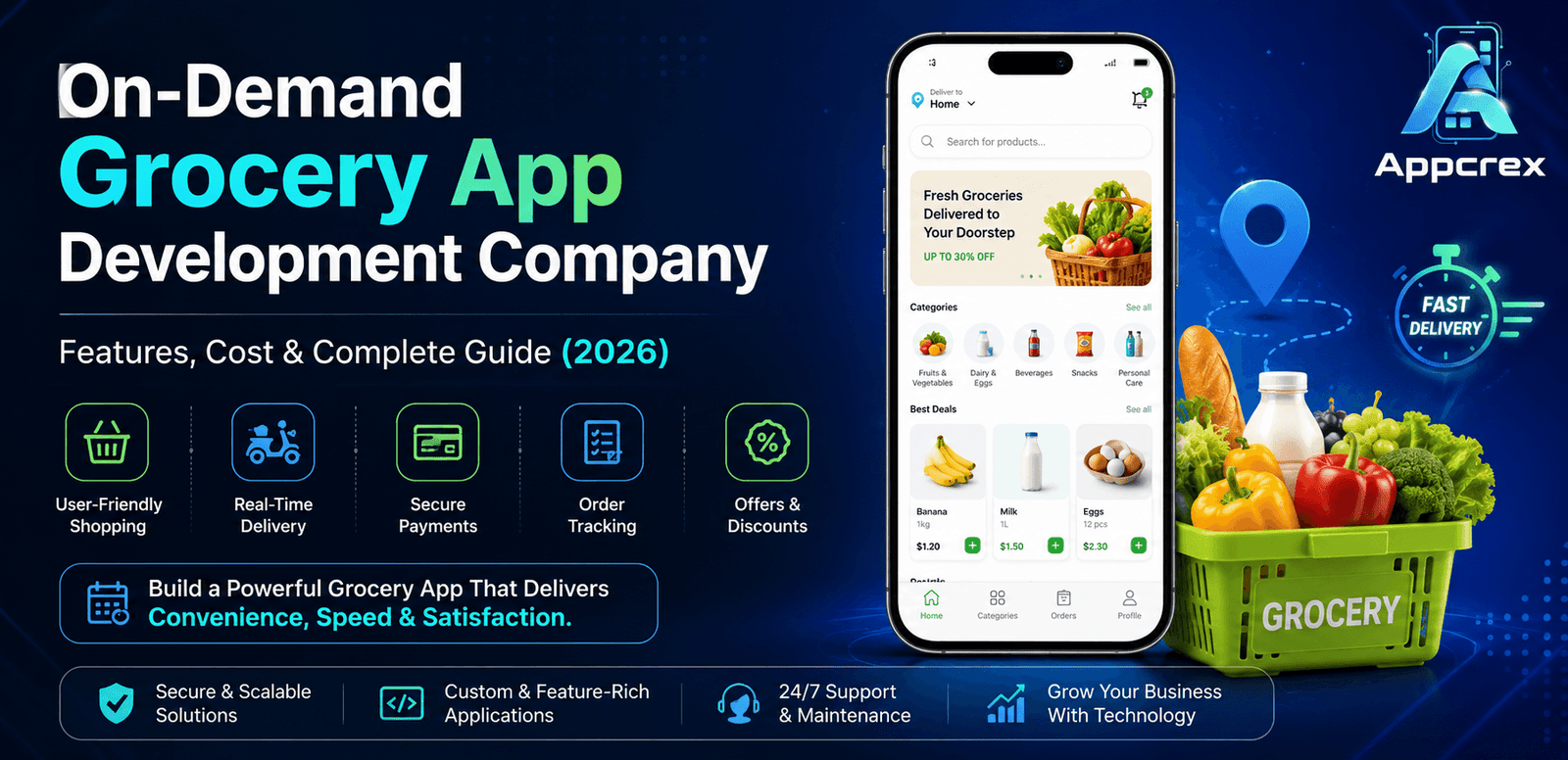
Build an On-Demand Grocery App Development Company | Features, Cost & Guide (2026)

📌 *Key Takeaways*

  • Choose the right business model, such as a single-store app, multi-vendor marketplace, or quick commerce platform.
  • Include essential modules for customers, delivery partners, vendors, and administrators.
  • AI-powered recommendations, smart search, and real-time tracking improve user experience and operational efficiency.
  • Development costs vary based on features, platforms, integrations, and scalability requirements.
  • Partnering with an experienced company like AppCrex helps you build a secure, scalable, and future-ready grocery delivery platform.

Introduction

The way people shop for groceries has changed dramatically over the last few years. Instead of visiting supermarkets, customers now expect fresh groceries, household essentials, and daily needs to be delivered directly to their doorstep within minutes. This growing demand has fueled the rapid rise of on-demand grocery delivery apps, making them one of the fastest-growing segments in the eCommerce industry.

From global platforms like Instacart to quick commerce leaders such as Blinkit and Zepto, grocery delivery apps have transformed how businesses connect with customers. With features like real-time order tracking, digital payments, AI-powered recommendations, and lightning-fast deliveries, these apps provide a seamless shopping experience while helping businesses increase revenue and customer loyalty.

If you’re planning to launch a grocery delivery platform, choosing the right on-demand grocery app development company is the first step toward building a scalable, secure, and future-ready solution.

In this comprehensive guide, you’ll learn everything about grocery app development, including its business models, essential features, technology stack, development process, estimated costs, and the latest trends shaping the grocery delivery industry in 2026.

What Is an On-Demand Grocery App?

An on-demand grocery app is a mobile and web-based platform that enables customers to order groceries, fresh produce, beverages, household products, and daily essentials online. Customers can browse products, add items to their cart, make secure payments, and track deliveries in real time—all from their smartphones.

These platforms connect customers with grocery stores, supermarkets, dark stores, or warehouse fulfillment centers. Depending on the business model, deliveries can be completed within 10–30 minutes (quick commerce) or scheduled for a later time based on customer preference.

Today’s grocery delivery apps go beyond simple online ordering. They use artificial intelligence, location tracking, personalized recommendations, and inventory management systems to improve the overall shopping experience and streamline operations.

Types of On-Demand Grocery Delivery Apps

Choosing the right business model is one of the most important decisions before starting grocery app development. Different models serve different business goals and customer needs.

1. Single Store Grocery App

This model is designed for individual grocery stores or supermarkets that want to sell directly to customers without relying on third-party marketplaces.

Best For

  • Local grocery stores
  • Organic food shops
  • Independent supermarkets
  • Regional grocery chains

Benefits

  • Full control over branding
  • Direct customer relationships
  • Better profit margins
  • Personalized promotions
  • Customer loyalty programs

2. Multi-Vendor Grocery Marketplace

A marketplace platform allows multiple grocery stores and vendors to register and sell products through a single application.

Customers can compare products, prices, delivery times, and offers from different stores before placing an order.

Best For

  • Grocery startups
  • Hyperlocal delivery businesses
  • Large marketplaces
  • Regional grocery platforms

Benefits

  • Larger product catalog
  • Multiple revenue sources
  • Commission-based income
  • Easy business expansion

3. Chain Supermarket App

Large supermarket brands often build dedicated apps to serve customers across multiple cities and branches.

The app integrates inventory, customer accounts, payment systems, loyalty programs, and delivery management into one platform.

Best For

  • National supermarket chains
  • Retail franchises
  • Large grocery brands

4. Dark Store Grocery App

Dark stores are fulfillment centers built specifically for online grocery orders. Unlike traditional supermarkets, they are not open to walk-in customers.

Orders are packed and dispatched quickly, making this model ideal for rapid delivery services.

Benefits

  • Faster order fulfillment
  • Better inventory management
  • Reduced operational costs
  • Higher delivery efficiency

5. Quick Commerce App

Quick commerce (Q-Commerce) focuses on delivering groceries in 10–30 minutes.

This model relies on strategically located dark stores, AI-based route optimization, and efficient delivery partner management.

Ideal For

  • Urban areas
  • High-demand neighborhoods
  • Convenience shopping
  • Daily essentials

Why Businesses Are Investing in Grocery App Development?

Consumer shopping habits continue to shift toward digital experiences, creating significant opportunities for grocery businesses of all sizes.

Here are the major reasons why investing in grocery app development makes business sense.

Growing Customer Demand

Modern consumers value convenience more than ever. Ordering groceries through a mobile app saves time, reduces travel, and provides access to thousands of products with just a few taps.

Higher Revenue Opportunities

Mobile apps generate additional sales through:

  • Personalized product recommendations
  • Subscription plans
  • Premium memberships
  • Flash sales
  • Combo offers
  • Cross-selling
  • Upselling

These features encourage customers to purchase more frequently and increase average order value.

Better Customer Retention

Features like reward points, loyalty programs, cashback offers, personalized discounts, and push notifications help businesses keep customers engaged and encourage repeat purchases.

Acquiring a new customer is often more expensive than retaining an existing one, making customer loyalty a key driver of long-term profitability.

Operational Efficiency

A well-designed grocery app automates many business operations, including:

  • Order management
  • Inventory tracking
  • Delivery assignment
  • Customer support
  • Payment processing
  • Sales reporting

Automation reduces manual work, minimizes errors, and improves operational efficiency.

Real-Time Business Insights

Modern grocery platforms provide advanced analytics that help businesses understand:

  • Best-selling products
  • Customer buying behavior
  • Peak shopping hours
  • Delivery performance
  • Inventory turnover
  • Revenue trends

These insights enable smarter business decisions and more effective marketing strategies.

AI-Powered Shopping Experiences

Artificial intelligence is transforming grocery shopping by offering:

  • Personalized product recommendations
  • Smart search suggestions
  • Demand forecasting
  • Inventory optimization
  • Dynamic pricing
  • Automated customer support
  • Predictive shopping lists

These AI-driven features enhance customer satisfaction while improving operational efficiency.

Grocery Delivery Market Statistics (2026)

The online grocery industry continues to experience strong growth, driven by changing consumer habits, increased smartphone adoption, and advancements in delivery technology.

Some key trends shaping the market include:

  • Millions of consumers now prefer ordering groceries online instead of visiting physical stores.
  • Quick commerce has become one of the fastest-growing segments in the retail industry.
  • AI-powered recommendation engines are helping businesses increase average order values through personalized shopping experiences.
  • Digital wallets and contactless payments have become the preferred payment methods for grocery purchases.
  • Businesses are increasingly investing in cloud-based inventory systems, real-time analytics, and automated fulfillment to improve operational efficiency.
  • Subscription-based grocery delivery models are gaining popularity as customers seek convenience and recurring savings.
  • Hyperlocal delivery services continue to expand in metropolitan and tier-2 cities, reducing delivery times and improving customer satisfaction.

As customer expectations continue to evolve, businesses that invest in scalable, technology-driven grocery delivery platforms will be better positioned to compete in the rapidly growing digital commerce market.
Essential Features of an On-Demand Grocery App

The success of a grocery delivery app depends on its ability to offer a fast, secure, and user-friendly shopping experience. A complete grocery solution typically includes four modules: Customer App, Delivery Partner App, Store Panel, and Admin Panel.

Customer App Features

The customer application is the face of your grocery business. It should make shopping simple, convenient, and personalized.

User Registration & Login

Allow users to sign up using email, mobile number, Google, or Apple ID for quick and secure access.

Smart Search

Enable customers to search for products using keywords, categories, brands, or voice search.

Product Categories

Organize products into categories such as fruits, vegetables, dairy, snacks, beverages, personal care, and household essentials for easy navigation.

Advanced Filters

Help users find products based on price, brand, ratings, discounts, dietary preferences, and availability.

Product Details

Display high-quality images, descriptions, nutritional information, pricing, customer reviews, and stock availability.

Shopping Cart

Allow users to add, remove, or update product quantities before checkout.

Wishlist

Let customers save favorite products for future purchases.

Multiple Payment Options

Support secure payment methods, including:

  • Credit/Debit Cards
  • Digital Wallets
  • UPI
  • Net Banking
  • Cash on Delivery

Real-Time Order Tracking

Provide live tracking from order confirmation to delivery using GPS.

Push Notifications

Keep users informed about order updates, offers, discounts, and delivery status.

Ratings & Reviews

Allow customers to review products and delivery services.

AI Product Recommendations

Suggest products based on previous purchases, browsing history, and customer preferences.

Delivery Partner App Features

An efficient delivery partner app ensures faster deliveries and better customer satisfaction.

Delivery Requests

Drivers receive instant notifications for new delivery assignments.

Route Optimization

AI-powered navigation helps delivery partners choose the fastest route.

Order Status Updates

Drivers can update the delivery status in real time.

Earnings Dashboard

Delivery partners can track completed orders, incentives, and total earnings.

Digital Wallet

Enable fast payouts and transaction history.

In-App Chat & Calling

Allow direct communication between customers and delivery partners when required.

Delivery History

Maintain records of completed and ongoing deliveries.

Store Panel Features

Store owners need an easy-to-use dashboard to manage products and orders efficiently.

Inventory Management

Update product availability automatically to avoid stock issues.

Product Management

Add, edit, or remove products, pricing, and descriptions.

Order Management

View, process, pack, and dispatch incoming orders.

Discount Management

Create promotional offers, coupons, and seasonal campaigns.

Sales Reports

Track daily, weekly, and monthly sales performance.

Admin Panel Features

The admin dashboard controls the complete grocery delivery ecosystem.

Dashboard Overview

Monitor total users, vendors, orders, revenue, and delivery performance from a single dashboard.

User Management

Manage customer accounts, delivery partners, and vendors.

Vendor Management

Approve new vendors, monitor performance, and manage commissions.

Delivery Management

Assign drivers, monitor deliveries, and optimize logistics.

Commission Management

Configure platform commission rates for vendors.

Analytics & Reports

Generate detailed business reports and customer insights.

Content Management

Manage banners, promotions, FAQs, and marketing campaigns.

Security Management

Monitor suspicious activities and maintain platform security.

Advanced Features That Give Your Grocery App a Competitive Edge

To stand out in the competitive grocery delivery market, businesses should integrate advanced technologies that improve customer experience and operational efficiency.

AI-Powered Recommendations

Recommend products based on customer preferences and purchase history.

Voice Search

Allow users to search for groceries using voice commands.

Barcode Scanner

Customers can scan products to reorder them instantly.

Smart Shopping Lists

Automatically suggest shopping lists based on previous purchases.

Personalized Offers

Display customized discounts and promotional offers.

Loyalty & Rewards Program

Encourage repeat purchases through reward points and cashback.

Subscription Plans

Offer weekly or monthly grocery subscriptions with exclusive benefits.

Referral Program

Reward users for inviting friends and family.

AI Chatbot

Provide instant customer support and answer common queries 24/7.

Express Delivery

Allow customers to choose premium delivery options for faster service.

Also Read : AI Chatbot Development Company: Complete Guide to Features, Benefits, Cost & Trends (2026)

Technology Stack for Grocery App Development

Selecting the right technology stack ensures scalability, security, and long-term performance.

Component Recommended Technologies
Mobile App Flutter, React Native, Kotlin, Swift
Frontend React.js, Angular
Backend Node.js, Laravel, Python, Java
Database PostgreSQL, MongoDB, MySQL
Cloud AWS, Microsoft Azure, Google Cloud
Maps Google Maps API
Payment Gateway Stripe, Razorpay, PayPal
Notifications Firebase Cloud Messaging
Analytics Google Analytics, Firebase Analytics
AI OpenAI, TensorFlow, ML Models
Security SSL, OAuth, JWT Authentication

On-Demand Grocery App Development Process

Building a successful grocery delivery app requires a structured development approach.

Step 1: Business Analysis

Understand the target audience, business goals, competitors, and preferred business model.

Step 2: UI/UX Design

Design intuitive user interfaces that provide a seamless shopping experience.

Step 3: App Development

Develop customer, vendor, delivery, and admin applications using scalable technologies.

Step 4: Third-Party Integrations

Integrate payment gateways, maps, notifications, analytics, and customer support tools.

Step 5: Quality Assurance

Test the application for performance, security, usability, and compatibility across devices.

Step 6: Deployment

Launch the app on Android, iOS, and web platforms.

Step 7: Maintenance & Support

Continuously monitor performance, fix bugs, release updates, and add new features based on customer feedback.

Third-Party Integrations

A modern grocery delivery app becomes more powerful with reliable third-party integrations.

How Much Does It Cost to Build an On-Demand Grocery App in 2026?

The cost of developing an on-demand grocery app depends on several factors, including app complexity, supported platforms, third-party integrations, UI/UX design, AI capabilities, and customization requirements.

Here’s a general cost estimate:

App Type Estimated Development Time Estimated Cost
Basic MVP Grocery App 2–3 Months $15,000–$30,000
Standard Grocery Delivery App 3–5 Months $30,000–$60,000
Multi-Vendor Grocery Marketplace 5–7 Months $60,000–$100,000
AI-Powered Enterprise Grocery Platform 7–10 Months $100,000+

Note: These are estimated ranges. The final cost depends on your business requirements, feature set, integrations, and the development team’s location and expertise.

Factors That Affect Grocery App Development Cost

Several factors influence the overall development budget.

App Complexity

A simple grocery ordering app costs significantly less than a multi-vendor marketplace with AI-powered features.

Supported Platforms

Developing for Android, iOS, and Web simultaneously requires additional development effort compared to a single-platform app.

UI/UX Design

A custom, user-friendly interface improves customer engagement but also increases design time and cost.

Third-Party Integrations

Payment gateways, maps, SMS verification, push notifications, CRM, ERP, and analytics integrations contribute to the overall budget.

AI & Automation

Features such as personalized recommendations, demand forecasting, AI chatbots, and smart search require additional development and machine learning expertise.

Security & Compliance

Implementing secure authentication, encrypted payments, data protection, and compliance with privacy regulations is essential for a trustworthy platform.

Also Red : AI Chatbot Integration Services: Benefits, Cost, Process & Business Use Cases (2026)

Estimated Development Timeline

The project timeline depends on the application’s scope and feature requirements.

Phase Estimated Duration
Discovery & Planning 1–2 Weeks
UI/UX Design 2–3 Weeks
App Development 10–20 Weeks
Third-Party Integrations 2–4 Weeks
Testing & QA 2–3 Weeks
Deployment 1 Week

Overall Timeline: Approximately 3–8 months, depending on the project’s complexity.

Challenges in Grocery App Development

Building a grocery delivery platform involves more than just creating a mobile app. Businesses must address several operational and technical challenges.

Real-Time Inventory Management

Product availability changes frequently, making accurate inventory synchronization essential.

Fast Delivery Management

Efficient delivery routing and driver allocation are critical to meeting customer expectations.

Peak Traffic Handling

The platform should remain stable during festivals, weekends, and promotional campaigns when order volumes increase.

Secure Payment Processing

Customers expect fast, secure, and reliable payment options with minimal transaction failures.

Vendor Coordination

Managing multiple vendors requires efficient product updates, order processing, and commission management.

Customer Retention

Businesses need loyalty programs, personalized offers, and excellent customer support to encourage repeat purchases.

Future Trends in Grocery App Development

Technology continues to reshape the grocery delivery industry. Businesses that adopt emerging innovations will be better positioned for long-term success.

AI Shopping Assistants

AI-powered assistants help customers discover products, build shopping lists, and receive personalized recommendations.

Voice Commerce

Voice search and voice ordering make shopping faster and more convenient.

Predictive Inventory Management

AI forecasts product demand to reduce stock shortages and minimize waste.

Quick Commerce Expansion

Ultra-fast delivery models will continue to grow in urban markets.

Smart Delivery Optimization

Machine learning helps optimize delivery routes, reduce costs, and improve delivery times.

Personalized Shopping Experience

Data-driven recommendations and targeted promotions increase customer engagement and average order value.

Sustainable Deliveries

Businesses are adopting eco-friendly packaging and optimized delivery routes to reduce their environmental impact.

Why Choose AppCrex for On-Demand Grocery App Development?

At AppCrex, we build scalable, secure, and feature-rich grocery delivery solutions tailored to your business goals. Whether you’re launching a local grocery store app or a multi-vendor marketplace, our team delivers modern applications designed for growth.

Our Expertise

  • Custom Grocery App Development
  • Android & iOS App Development
  • Flutter & React Native Development
  • Multi-Vendor Marketplace Solutions
  • AI-Powered Grocery Apps
  • Quick Commerce App Development
  • ERP & CRM Integration
  • Secure Payment Gateway Integration
  • Cloud-Based Scalable Architecture
  • Post-Launch Maintenance & Support

From idea validation to deployment and ongoing support, we help businesses create reliable grocery delivery platforms that deliver exceptional customer experiences.


Frequently Asked Questions (FAQs)

1. What is an on-demand grocery app?

An on-demand grocery app allows customers to order groceries online and receive deliveries at their preferred location through a mobile or web application.

2. How long does it take to build a grocery delivery app?

A basic app can take around 3 months, while a fully featured multi-vendor or AI-powered solution may require 6–8 months.

3. How much does grocery app development cost?

The cost typically ranges from $15,000 to $100,000+, depending on features, complexity, supported platforms, and integrations.

4. Which features are essential for a grocery delivery app?

Key features include product search, secure payments, real-time order tracking, delivery management, inventory management, push notifications, and an admin dashboard.

5. Can AI improve a grocery delivery app?

Yes. AI can power personalized product recommendations, smart search, demand forecasting, chatbots, and delivery optimization, improving both customer experience and operational efficiency.

Conclusion

The demand for online grocery delivery continues to grow as consumers seek faster, more convenient shopping experiences. Businesses that invest in a scalable, feature-rich grocery delivery platform can improve customer satisfaction, streamline operations, and create new revenue opportunities.

Whether you’re planning a single-store grocery app, a multi-vendor marketplace, or an AI-powered quick commerce platform, partnering with an experienced on-demand app development company is essential for long-term success. With the right technology, user-focused design, and scalable architecture, your grocery app can compete in today’s fast-evolving digital commerce landscape.

Ready to Build Your On-Demand Grocery Delivery App?

Whether you’re launching a local grocery store app, a hyperlocal delivery platform, or a full-scale quick commerce solution, AppCrex has the expertise to turn your vision into reality.

Our experienced developers create secure, scalable, and high-performance grocery delivery applications with advanced features, AI integrations, and seamless user experiences. Contact AppCrex today for a free consultation and let’s build a grocery app that helps your business grow.

Leave a Comment

Your email address will not be published. Required fields are marked *

    Ready to turn your app idea into reality?
    Fill out the form and let’s discuss your application development requirements!

    • We value your privacy – your details are 100% secure.
    • Our team usually responds within 24 hours.
    • Let’s build a secure, scalable, and user-friendly mobile application tailored to your business.
    Scroll to Top