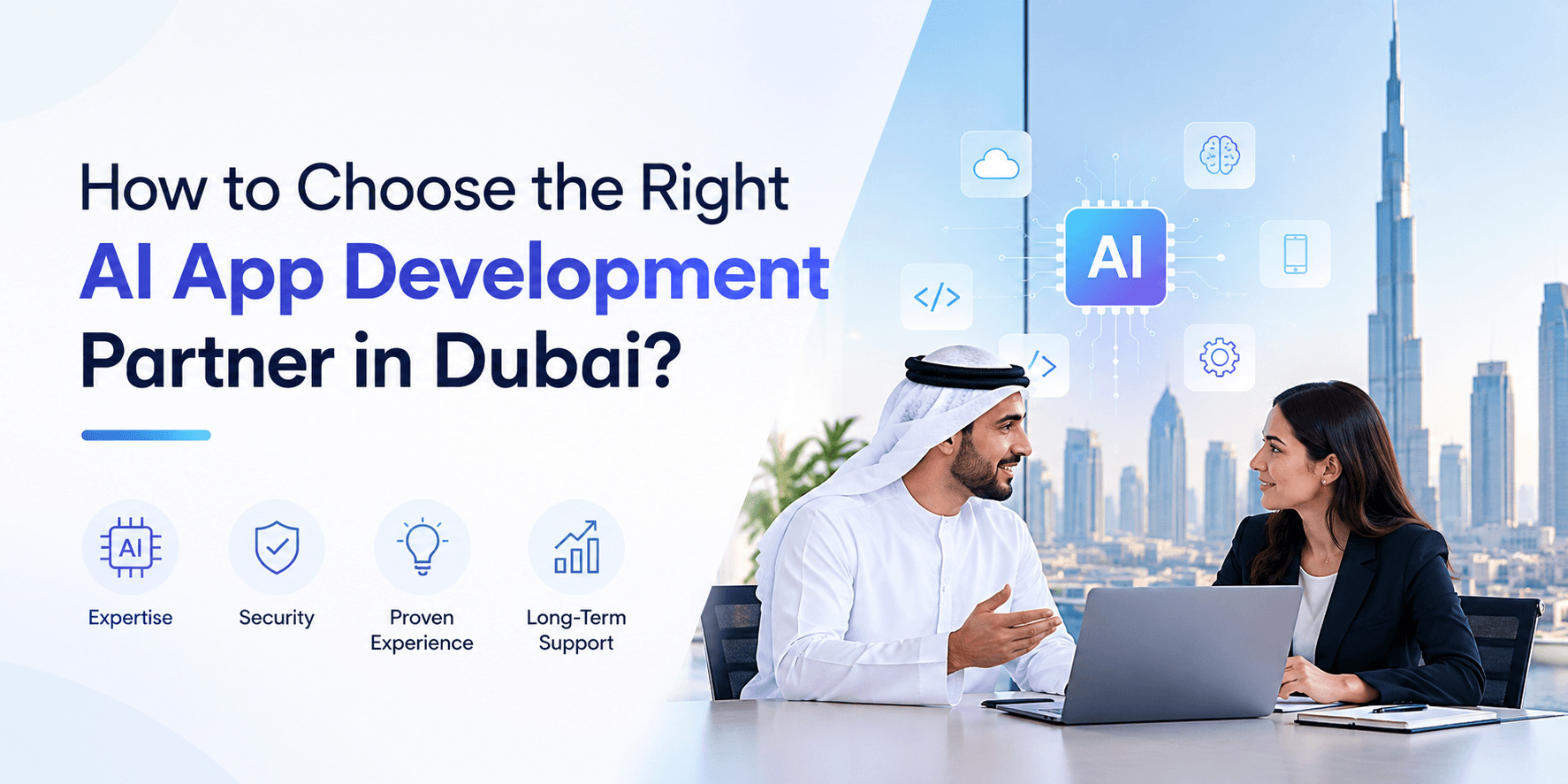
📌 Key Takeaways
- Define your business problem before selecting AI technologies or development partners.
- Evaluate practical AI engineering skills, including data processing, model integration, testing, and deployment.
- RAsk for relevant project examples and evidence of production-ready applications.
- Review data protection, security controls, intellectual property rights, and applicable UAE requirements.
- Compare project scope, delivery timelines, operating costs, and maintenance plans.
Introduction
Artificial intelligence is helping businesses automate repetitive tasks, analyse business data, improve customer support, and build more personalised digital experiences. From AI-powered mobile applications to intelligent business platforms, companies in Dubai are exploring AI to improve operations and develop new digital products.
Choosing the right AI app development partner is an important step in this process. The right partner understands your business objectives, recommends suitable AI technologies, protects sensitive information, and develops software around measurable requirements. The wrong choice often leads to unclear project scope, rising costs, unreliable AI outputs, or an application that fails to meet user expectations.
To choose the right AI app development partner in Dubai, evaluate technical expertise, relevant project experience, data security, UAE regulatory awareness, development costs, communication, and post-launch support. Review real project examples, compare detailed proposals, and test the proposed solution through a defined proof of concept before committing to a large project.
This guide explains how to evaluate AI app development companies in Dubai, which questions to ask, how to compare proposals, what affects development costs, and which warning signs to avoid.
What Does an AI App Development Partner Do?
An AI app development partner helps businesses plan, design, build, test, deploy, and maintain applications that use artificial intelligence.
Depending on the project, the partner might develop a mobile app, web application, enterprise platform, chatbot, recommendation engine, document-processing system, or AI-powered workflow.
Typical services include:
- AI strategy and technical consultation
- Custom AI application development
- Generative AI and large language model (LLM) integration
- AI chatbot and virtual assistant development
- Machine learning model development
- Natural language processing (NLP)
- Retrieval-augmented generation (RAG) systems
- AI integration with CRM, ERP, and business software
- Data engineering and preparation
- AI testing, monitoring, and maintenance
A capable partner should explain which parts of your proposed solution require AI and which are better handled through conventional software.
For example, a business rules engine might be sufficient for a fixed approval workflow. An AI model might provide greater value when the application needs to interpret documents, classify unstructured information, or respond to natural-language questions.
The goal is to solve the business problem effectively, not to add AI to every feature.
Why Do Dubai Businesses Need the Right AI Development Partner?
Dubai businesses operate across sectors such as retail, financial services, healthcare, real estate, logistics, hospitality, and professional services. Each sector has different data requirements, operational workflows, and customer expectations.
A suitable AI development partner helps translate these needs into a practical application.
1. Automating Business Processes
AI applications support tasks such as document classification, customer enquiry handling, information extraction, and workflow assistance.
The development team should identify which tasks are suitable for automation and where human approval remains necessary.
2. Improving Customer Experiences
AI-powered assistants, search tools, and recommendation systems help users find information and complete tasks through more natural interactions.
For Dubai businesses serving multilingual audiences, assess whether the proposed system supports the required languages and real customer use cases.
3. Making Better Use of Business Data
Many organisations store information across documents, databases, CRM platforms, ERP systems, and internal knowledge bases.
An AI application might help employees search this information, summarise records, or identify patterns. The quality of the result depends on data quality, access permissions, integration design, and model evaluation.
4. Supporting Digital Product Development
Startups and established companies might use AI to build new products, introduce intelligent features into existing applications, or develop specialised tools for their industries.
An experienced partner helps assess feasibility, define an MVP, and plan the transition from prototype to production.
5. Addressing Regional Requirements
Businesses operating in the UAE need to assess applicable data protection, cybersecurity, sector-specific, and contractual requirements.
Dubai’s government AI policy highlights responsible AI use, risk management, privacy, security, accountability, and lifecycle oversight. Businesses should identify the requirements applicable to their own projects rather than assuming one policy covers every organisation. https://www.dof.gov.ae/en-us/profile/Pages/AI-Policy.aspx
1. Define Your Business Requirements Before Searching
Start by documenting what you want the AI application to achieve. A clear brief makes it easier to compare development companies on the same criteria.
Identify the problem
Describe the business issue in practical terms.
Examples include:
- Reducing the time required to answer customer enquiries
- Searching internal documents more efficiently
- Extracting information from invoices and contracts
- Helping sales teams prepare customer responses
- Improving product discovery in an eCommerce application
- Automating parts of a logistics or inventory workflow
Avoid defining the project only as “building an AI app.” Identify the task, the users, the expected result, and the current process.
Define the target users
Identify who will use the application, such as customers, employees, administrators, managers, or external business partners.
Each group might require different permissions, interfaces, and workflows.
Set measurable objectives
Choose metrics that help determine whether the application provides value.
Examples include:
- Average time required to complete a task
- Customer support response time
- Percentage of documents processed successfully
- Accuracy on a defined evaluation dataset
- Cost per completed workflow
- User adoption and task completion rates
Set baseline measurements before development begins. This provides a fair way to evaluate the results after deployment.
2. Evaluate the Company’s AI Technical Expertise
AI development requires more than connecting a chatbot interface to a model API. The company should understand the data, software architecture, evaluation process, and operational requirements behind the application.
AI and machine learning knowledge
Ask about the company’s experience with machine learning, generative AI, natural language processing, computer vision, or other technologies relevant to your use case.
The partner should explain why a particular approach fits the problem and identify its limitations.
Large language model integration
For generative AI applications, ask how the team handles model selection, prompt design, response validation, context limits, latency, and usage costs.
The company should also explain how the application behaves when a model produces an incorrect, incomplete, or unsupported response.
Retrieval-augmented generation
If the application needs to answer questions from company documents or internal knowledge, RAG might be an appropriate approach.
Ask how the partner plans to prepare documents, retrieve relevant information, enforce access permissions, and provide source references. RAG helps ground responses in selected information, but it does not eliminate all errors.
Data engineering
AI applications depend on usable data. A strong partner should assess data quality, formats, access rights, duplication, and integration requirements before promising results.
Ask who will prepare the data and whether the project requires data cleaning, labelling, transformation, or ongoing maintenance.
Software engineering and deployment
The partner should also demonstrate conventional software development skills, including APIs, databases, authentication, testing, cloud infrastructure, monitoring, and deployment.
AI functionality must work reliably within the wider application.
3. Review Relevant Portfolio Projects and Case Studies
A portfolio helps you understand whether a company has experience related to your project. However, a list of technologies or attractive screenshots does not prove that an application performs reliably in production.
What should you review?
Look for projects involving comparable workflows, data types, integrations, user groups, and security requirements.
For each relevant project, ask:
- What business problem did the application address?
- Which AI technologies were used, and why?
- Was the solution a prototype, pilot, or production application?
- What data sources and integrations were involved?
- How was output quality evaluated?
- What happened when the AI returned an incorrect response?
- How was the application maintained after launch?
Request a live demonstration where possible. If client confidentiality prevents public disclosure, ask whether the company has anonymised demonstrations or other evidence it is permitted to share.
Verify measurable results
If a company claims improved productivity, higher accuracy, or lower operating costs, ask how those results were measured.
Understand the baseline, evaluation period, dataset, and conditions behind the reported figures.
Do not treat unverified marketing claims as evidence of performance.
4. Check Industry Experience in Dubai and the UAE
Industry knowledge helps a development team understand workflows, terminology, data sensitivity, and integration requirements.
AI for real estate
Potential applications include property search, listing classification, document processing, customer enquiry assistance, and lead prioritisation.
Evaluate whether the proposed system connects with relevant property databases, CRM tools, and existing business processes.
AI for healthcare
Healthcare applications might support administrative workflows, appointment management, document processing, or access to approved information.
If a product handles health data or supports clinical decisions, additional privacy, security, validation, and regulatory considerations apply.
AI for retail and eCommerce
Retail businesses might use AI for product recommendations, customer support, product search, inventory insights, and catalogue management.
Ask how the partner measures recommendation relevance and handles changes in product data.
AI for finance
Financial applications might use AI for document extraction, internal knowledge search, customer service, and selected risk-analysis workflows.
Projects involving financial information require careful assessment of access controls, auditability, data handling, and relevant regulatory requirements.
AI for logistics and operations
Potential use cases include document processing, demand forecasting, route-planning support, and operational reporting.
The partner should explain which data sources are required and how the system will handle incomplete or changing information.
Choose a company based on relevant expertise rather than a broad claim that it serves every industry.
5. Assess Data Security, Privacy, and UAE Compliance
Security and compliance should be discussed before the project begins, especially if the application processes personal, financial, health, or confidential business information.
Data protection
Ask where the application will collect, process, store, and transmit data. Confirm which third-party services receive information and whether data is retained by those providers.
The UAE Personal Data Protection Law and other applicable rules should be assessed according to the organisation, data, processing activity, and any relevant exceptions. Businesses operating in financial or healthcare sectors, or in free zones with separate regimes, might face additional requirements.
Obtain qualified legal or compliance advice when the project’s obligations are unclear.
Data residency
If your organisation has specific requirements for data location, ask where application data, backups, logs, and model processing will reside.
Do not assume every AI project must use UAE-based hosting. Determine the actual legal, contractual, and operational requirements for your use case.
Security controls
Ask the development partner to explain how it handles:
- Encryption for data in transit and at rest
- Authentication and role-based access controls
- Secret and API key management
- Secure development and code reviews
- Vulnerability testing and dependency updates
- Audit logging and incident response
- Backup and disaster recovery
- Third-party model and cloud provider risks
Request evidence for relevant security certifications or independent assessments when those are required. Do not accept a certification claim without verifying its scope and validity.
AI-specific risks
AI applications introduce risks beyond traditional software vulnerabilities. These include prompt injection, unintended disclosure of sensitive information, unreliable outputs, and misuse of tools or connected systems.
Ask how the partner tests these risks and limits the application’s permissions.
6. Check Arabic and English Language Capabilities
Many Dubai businesses serve customers who communicate in Arabic and English. Language requirements should be defined according to the actual audience and application.
A bilingual interface is different from a system that understands Arabic questions and produces accurate Arabic responses.
If your app requires Arabic AI functionality, ask the partner to demonstrate:
- Arabic and English input handling
- Right-to-left interface layouts
- Mixed Arabic-English messages
- Relevant regional terminology and dialects
- Search and retrieval across both languages
- Accuracy testing using representative user queries
Request an evaluation using realistic examples from your intended audience. Do not rely on a generic demonstration or assume that translation quality guarantees strong conversational performance.
If the application serves only English-speaking users, avoid paying for unnecessary multilingual complexity.
7. Understand the Development Process
A reliable partner should provide a clear development plan, with deliverables and acceptance criteria for each stage.
Stage 1: Discovery and feasibility
The team studies the business problem, target users, available data, integration needs, technical constraints, and potential risks.
The output should include a defined scope, proposed architecture, key assumptions, and a preliminary estimate.
Stage 2: Proof of concept
A proof of concept tests a specific technical question, such as whether a model can extract useful information from your documents or answer questions accurately using approved data.
Define the evaluation dataset, success criteria, budget, and stopping conditions before starting.
Stage 3: UX/UI design and architecture
The team develops user flows, interface designs, data models, API plans, and infrastructure architecture.
Review the design before development proceeds to the next stage.
Stage 4: MVP development
The team builds the core application features and integrates the selected AI functionality.
Use regular demonstrations and review sessions to confirm progress.
Stage 5: Testing and evaluation
Test standard software functionality alongside AI-specific behaviour.
AI testing should measure output quality, consistency, failure handling, latency, security, and performance against agreed criteria.
Stage 6: Deployment
The team prepares production infrastructure, monitoring, access controls, backups, and operational documentation.
Confirm ownership of accounts and deployment resources.
Stage 7: Maintenance and optimisation
After launch, the application might require model updates, prompt revisions, data pipeline improvements, bug fixes, security patches, and performance optimisation.
Agree on support responsibilities and ongoing costs before signing the contract.
8. Compare Project Costs and Pricing Models
AI app development costs vary according to the product’s complexity, data requirements, integrations, security needs, and delivery team.
The following figures are broad planning estimates in USD, not verified Dubai market averages or an AppCrex quotation.
| Project type | Indicative cost | Typical scope |
|---|---|---|
| AI proof of concept | $5,000–$20,000 | Test one use case or technical assumption |
| Basic AI MVP | $20,000–$60,000 | Core application, model integration, basic dashboard |
| Mid-level AI application | $60,000–$150,000 | Multiple workflows, integrations, stronger access controls |
| Advanced AI platform | $150,000–$300,000+ | Complex architecture, enterprise integrations, extensive testing |
| Enterprise AI solution | $300,000+ | Large-scale requirements, governance, advanced security, operational support |
Actual costs vary significantly. Some projects fall below these ranges, while specialised enterprise or regulated applications exceed them.
What affects the price?
AI complexity: A simple model API integration requires different work from a custom machine learning pipeline or a complex AI agent.
Data preparation: Cleaning, structuring, labelling, and validating data often adds substantial effort.
Integrations: CRM, ERP, payment systems, internal databases, and third-party APIs introduce development and testing requirements.
Security and compliance: Sensitive data, access controls, auditability, and specialist validation affect cost.
User experience: Multiple user roles, multilingual interfaces, accessibility, and mobile support increase design and testing effort.
Cloud and model usage: Hosting, inference, storage, monitoring, and third-party API charges create recurring expenses.
Maintenance: AI quality can change as data, user behaviour, and model providers change. Budget for ongoing monitoring and improvements.
Which pricing model should you choose?
- Fixed-price project: Suitable when requirements and deliverables are clearly defined.
- Time and materials: Useful when requirements are expected to evolve.
- Dedicated team: Appropriate for ongoing development or products with a longer roadmap.
- Paid proof of concept: Useful when feasibility or output quality needs to be validated before a full build.
Compare the total cost of ownership rather than the initial quote alone. Ask each company to separate development fees from cloud, model usage, licences, third-party services, and support.
9. Evaluate Communication and Project Management
Technical expertise matters, but communication also affects delivery quality.
During the selection process, identify who will manage the project and who will make technical decisions.
Ask about:
- Project reporting and meeting frequency
- Development milestones and acceptance criteria
- Access to the actual engineers
- Documentation and knowledge transfer
- Scope changes and approval procedures
- Risk and issue escalation
- Delivery schedules and dependencies
Dubai-based businesses might work with local teams, remote teams, or a combination of both. Confirm working-hour overlap and communication expectations rather than assuming that a company’s address determines who will deliver the project.
10. Confirm Intellectual Property and Contract Terms
Before development starts, agree on ownership, data access, licensing, confidentiality, and exit arrangements.
The contract should clarify:
- Ownership of source code and custom application components
- Ownership and permitted use of project data
- Rights to prompts, configurations, and custom models
- Licences for third-party models and libraries
- Access to cloud accounts and deployment environments
- Confidentiality and data retention
- Warranty and maintenance responsibilities
- Delivery milestones and payment conditions
- Termination and transition assistance
Not every AI component is owned in the same way. Third-party model weights, commercial APIs, and open-source components have their own licensing terms. Ask the partner to explain those limitations in writing.
Ensure your business has access to the resources needed to maintain or transfer the application if the partnership ends.
11. Questions to Ask Before Hiring an AI Development Company
Use these questions during introductory calls and technical evaluation meetings.
- Have you built an application similar to our proposed use case?
- Which parts of the solution require AI, and which do not?
- Which models and technologies do you recommend, and why?
- How will you measure AI output quality?
- How will the application handle incorrect or uncertain responses?
- What data will the application collect, and where will it be processed?
- Which security and compliance requirements apply to our project?
- What integrations and third-party services will be required?
- Who will own the source code, data, and custom components?
- What are the estimated development and recurring operating costs?
- How will testing, deployment, and ongoing monitoring work?
- What support and knowledge transfer will you provide after launch?
Look for specific, documented answers. If the company cannot explain its testing approach, data flow, or ownership terms, resolve those gaps before signing.
12. Warning Signs When Choosing an AI App Development Partner
Be cautious if a company:
- Promises perfect AI accuracy without explaining evaluation methods.
- Gives a full-project price before understanding the requirements.
- Shows only generic demos without explaining production deployment.
- Avoids questions about data handling or security.
- Cannot explain what happens when the AI produces an incorrect answer.
- Uses vague language about source code and intellectual property ownership.
- Ignores recurring cloud, model, and maintenance costs.
- Promises unrealistic delivery dates without identifying dependencies.
- Claims every business problem requires AI.
- Provides no clear process for testing, support, or handover.
A credible partner should explain technical limitations and project risks openly. Clear expectations are more useful than promises that cannot be measured.
13. How to Compare AI App Development Companies
Create a shortlist of three to five potential partners. Use the same project brief and questions for each company so you can compare proposals fairly.
A practical scorecard might look like this:
| Evaluation criterion | Suggested weight |
|---|---|
| Relevant technical expertise | 20% |
| Comparable project experience | 15% |
| Security and compliance approach | 15% |
| Development process and testing | 15% |
| Cost transparency and total ownership cost | 15% |
| Communication and project management | 10% |
| Maintenance and handover | 10% |
| Total | 100% |
Score each company from 1 to 5 for each criterion, then apply the weights to calculate a comparison score.
Treat essential legal, security, and ownership requirements as pass-or-fail conditions. A high overall score should not compensate for a critical failure.
Before making the final decision, consider a paid proof of concept with clearly defined acceptance criteria. This gives your team evidence about technical fit before committing to a larger development programme.
How AppCrex Can Fit Into Your Evaluation
If you are considering AppCrex for an AI application project, begin by documenting your business goals, target users, essential features, available data, integrations, budget, and expected launch timeline.
Use these requirements to discuss the proposed architecture, AI capabilities, security approach, delivery milestones, and ongoing support. Ask for a written scope and confirm which services and deliverables are included.
Evaluate AppCrex using the same criteria you apply to other shortlisted providers. Verify relevant experience, team responsibilities, project assumptions, ownership terms, and recurring costs before making a commitment.
FAQs
1. How do I choose the right AI app development partner in Dubai?
Define your business requirements, evaluate technical expertise, review relevant projects, check security and compliance practices, compare detailed proposals, and confirm post-launch support. Use a scorecard and validate feasibility through a clearly scoped proof of concept when appropriate.
2. How much does AI app development cost in Dubai?
Costs depend on the application scope, data preparation, integrations, AI complexity, security requirements, and delivery team. A basic MVP might cost $20,000–$60,000, while advanced platforms often exceed $150,000. These are broad planning estimates, not verified Dubai market averages.
3. How long does it take to develop an AI application?
A proof of concept might take several weeks. A basic MVP might require a few months, while complex enterprise platforms often need longer. The timeline depends on data readiness, integrations, testing, security requirements, and scope.
4. What skills should an AI app development company have?
Relevant skills include AI and machine learning, data engineering, model integration, backend development, APIs, cloud infrastructure, security, testing, and deployment. The exact skill set depends on the proposed application.
5. Should I choose a Dubai-based company or a remote development team?
Choose based on technical fit, communication, project management, relevant experience, cost, and contractual requirements. A remote team might work well if responsibilities and working hours are clearly defined. Local presence is useful when the project requires regular in-person collaboration or specific regional support.
6. Why is data security important in AI app development?
AI applications might process personal, confidential, or commercially sensitive information. Secure access controls, encryption, data minimisation, monitoring, and third-party risk assessment help protect this information. Applicable legal and contractual obligations should be confirmed before development.
7. Should my AI project begin with a proof of concept?
A proof of concept is useful when important assumptions remain untested, such as model accuracy, document retrieval quality, integration feasibility, or expected latency. Define the test dataset, budget, evaluation criteria, and decision rules before starting.
8. What is the difference between an AI proof of concept and an MVP?
A proof of concept tests whether a technical approach is feasible. An MVP is a usable initial product that delivers a core business function to intended users. A project might need both, depending on technical uncertainty.
9. How do I protect intellectual property when hiring an AI development company?
Clarify ownership of source code, custom components, data, prompts, configurations, and project documentation in the contract. Review third-party model and software licences, and agree on access to infrastructure, maintenance responsibilities, and transition arrangements.
10. What should happen after an AI application launches?
Post-launch work includes monitoring performance, evaluating output quality, fixing bugs, reviewing security, managing infrastructure costs, updating dependencies, and improving the application based on user feedback. Establish support responsibilities and service expectations before launch.
Conclusion
Choosing the right AI app development partner in Dubai requires a structured evaluation of technical capability, industry knowledge, data security, project delivery, cost transparency, and long-term support.
Start with a clear business problem. Compare companies using the same requirements. Review relevant project evidence, validate technical assumptions, and document ownership and security responsibilities before signing a contract.
A well-defined proof of concept or MVP provides a practical starting point. It helps your business test feasibility, gather evidence, and make informed decisions before expanding the application.
Looking for an AI app development partner? Prepare your project requirements, define success metrics, and compare potential partners using a consistent evaluation framework before committing to development.