📌 Key Takeaways
- Arabic AI development is more than translating an English AI system; it requires language, UX, data and cultural localisation.
- Saudi Arabia is developing a growing ecosystem around Arabic NLP, language models and AI research.
- Arabic AI can be applied across fintech, healthcare, e-commerce, real estate, tourism, government and enterprise software.
- Development costs can range from around $15,000 for a focused chatbot to $250,000+ for a sophisticated enterprise AI platform.
- Arabic AI becomes most valuable when connected to business data, RAG, APIs, AI agents and real-world workflows.
Introduction
Arabic is becoming one of the most important opportunities in the next phase of artificial intelligence.
Businesses across the Middle East are moving beyond basic English-language chatbots and looking for AI systems that can understand Arabic conversations, process Arabic documents, generate culturally relevant content, support voice interactions and work naturally across Arabic and English.
Saudi Arabia is particularly active in this area. The King Salman Global Academy for Arabic Language has established an Arabic AI Center focused on Arabic natural-language processing, linguistic resources, language models, summarisation and other Arabic AI technologies.
At the same time, Saudi Arabia’s AI ecosystem is developing local Arabic-language models, including models designed around Saudi data and use cases. SDAIA’s research on the Saudi generative AI landscape lists several Arabic and bilingual foundation-model initiatives.
This creates a growing opportunity for businesses that want to build Arabic AI assistants, Arabic chatbots, AI agents, voice AI, Arabic search systems and other intelligent products.
This guide explains what an Arabic AI App Development Company can build, how much it can cost, where Arabic AI is being used and what the development process looks like.
What Is Arabic AI Development?
Arabic AI development is the process of creating artificial intelligence systems that can understand, process, generate or interact with Arabic content.
It goes beyond simply translating an English AI application into Arabic.
A properly designed Arabic AI solution may need to understand:
- Modern Standard Arabic
- Regional terminology
- Arabic-English mixed conversations
- Arabic documents
- Arabic speech
- Different writing styles
- Industry-specific vocabulary
- Right-to-left interfaces
- Arabic search queries
- Local cultural context
For example, a customer may type:
“أريد أعرف وين طلبي؟”
An effective customer-service AI should understand the user’s intention rather than treating the sentence as a literal translation problem.
For businesses operating in Saudi Arabia and the wider Middle East, this distinction can make a significant difference in user experience.
Why Arabic AI Is Becoming a Major Business Opportunity
Arabic AI is no longer limited to academic research.
Saudi Arabia is developing infrastructure, research capabilities and products around Arabic language technologies. The ARAI Center, for example, supports research, linguistic resources, large language models, Arabic text analysis, summarisation and automated Arabic writing assistance.
Saudi Arabia has also been developing local Arabic and bilingual AI models, while the wider market is seeing increasing investment in Arabic-language datasets and AI applications.
For businesses, the opportunity is practical.
An Arabic AI solution can help a company:
- Serve Arabic-speaking customers
- Automate repetitive support
- Search Arabic documents
- Generate Arabic content
- Analyse customer conversations
- Build Arabic voice assistants
- Improve product discovery
- Automate internal workflows
- Create bilingual digital experiences
This is particularly valuable in sectors where Arabic is central to customer interaction.
Just Read : AI App Development in the UK: Use Cases, Cost, Features & Development Guide
Arabic AI Development Services
An experienced Arabic AI development company can provide everything from a focused chatbot to a complete AI platform.
Arabic AI Chatbot Development
An Arabic AI chatbot can handle customer questions, product information, support requests and internal queries.
Unlike a traditional rule-based bot, a generative AI chatbot can understand a much wider range of natural-language requests.
Businesses can deploy these assistants on:
- Websites
- Mobile apps
- Customer portals
- Internal employee platforms
Arabic AI Agent Development
AI agents can go beyond conversation.
They can retrieve information, use APIs and perform approved tasks.
For example:
Customer → Arabic AI Agent → CRM → Order System → Response
A customer could ask about an order in Arabic, and the agent could retrieve the relevant information from the company’s systems.
More advanced agents can assist with bookings, lead qualification, sales, internal operations and other workflows.
Arabic Generative AI Development
Generative AI can create:
- Arabic text
- Reports
- Product descriptions
- Marketing content
- Summaries
- Emails
- Documents
- Conversational responses
For businesses that regularly create Arabic content, this can reduce repetitive manual work while maintaining a consistent brand voice.
Also Read : Generative AI Development Company Saudi Arabia: Services, Cost, Use Cases & Development Process
Arabic RAG Development
RAG, or Retrieval-Augmented Generation, allows an AI system to retrieve information from approved business data before generating an answer.
This is especially useful for Arabic documents.
For example, a company might have thousands of:
- Arabic PDFs
- Policies
- Manuals
- Contracts
- Product documents
- FAQs
- Internal reports
Instead of asking employees to manually search these files, an Arabic AI assistant can retrieve relevant information and provide a conversational response.
Arabic Voice AI Development
Arabic voice AI can allow users to interact with software using speech.
Possible applications include:
- Voice customer support
- AI call assistants
- Voice search
- Healthcare assistants
- Banking assistants
- Automotive assistants
- Smart-device control
Voice AI becomes more challenging when businesses want support for different accents, terminology and conversational styles, so real-world testing is important.
Arabic AI Search
Traditional search often depends on exact keywords.
AI search can understand the meaning behind a request.
For example:
“أبغى شقة ثلاث غرف قريبة من المدارس”
The system should understand that the user is looking for a three-bedroom apartment with a location-related preference.
This can be useful for:
- Real estate
- E-commerce
- Travel
- Healthcare
- Government portals
- Knowledge-management systems
Arabic AI Use Cases Across Industries
The strongest opportunities are not limited to one industry.
Banking and Fintech
Financial institutions can use Arabic AI for:
- Customer support
- Product information
- Financial FAQs
- Internal knowledge search
- Employee copilots
- Document summarisation
- Customer onboarding assistance
An Arabic AI banking assistant could allow customers to ask questions naturally instead of navigating multiple menus.
For sensitive financial operations, authentication, permissions and human oversight remain essential.
Healthcare
Healthcare organisations can use Arabic AI for:
- Appointment assistance
- Patient FAQs
- Healthcare information
- Medical document summarisation
- Administrative support
- Provider copilots
- Patient communication
For example, a patient could ask a healthcare assistant about appointment availability in Arabic rather than navigating a complex interface.
Clinical decision-making is a different category and requires significantly stronger validation, governance and professional oversight.
E-commerce and Retail
Arabic AI can make online shopping more conversational.
Instead of searching for:
“men shoes black size 10”
a customer might write:
“أحتاج حذاء رياضي مريح للتمرين وسعره أقل من 500 ريال”
The AI can understand the user’s intent and connect the request with the product catalogue.
Other applications include:
- Product recommendations
- Arabic product descriptions
- Order tracking
- Returns support
- Review summarisation
- Customer service
- Conversational shopping
Real Estate
Arabic AI can be particularly useful for property businesses because customers often describe what they want conversationally.
An AI assistant could understand requests related to:
- Property type
- Budget
- Number of bedrooms
- Location
- Amenities
- Furnishing
- Family requirements
It can then connect the request with a property database.
For real estate companies, AI can also help qualify leads and assist sales teams with follow-ups.
Government and Public Services
Government portals handle large amounts of information and repetitive citizen enquiries.
Arabic AI can help users:
- Find information
- Understand procedures
- Navigate services
- Search documents
- Get answers to FAQs
- Receive guidance through digital processes
This is an area where language quality, accuracy, accessibility and governance are particularly important.
Tourism and Hospitality
Arabic AI can support:
- Hotel enquiries
- Travel assistance
- Booking support
- Concierge services
- Local recommendations
- Multilingual customer service
A bilingual assistant can switch between Arabic and English depending on the user’s preference.
This can be particularly useful for businesses serving both local customers and international visitors.
Arabic AI vs English AI: What’s Different?
One common mistake is assuming that Arabic AI is simply an English AI system with an Arabic translation layer.
In practice, businesses may need to address several additional challenges.
Right-to-Left Interfaces
Arabic interfaces require RTL support across mobile and web experiences.
Arabic Language Variations
Users may communicate using formal Arabic, conversational Arabic or regional expressions.
Mixed Arabic and English
A user might write:
“أريد booking لفندق في الرياض”
The AI needs to understand the mixed-language intent.
Arabic Documents
Contracts, reports, invoices and policies may have Arabic-specific structures and terminology.
Arabic Speech
Voice systems need to handle pronunciation, accents, background noise and industry-specific terminology.
Cultural Context
A response that is technically correct can still feel unnatural if it doesn’t fit the expectations of the target audience.
This is why Arabic AI development is a specialised engineering problem rather than simple translation.
How Much Does Arabic AI Development Cost?
The cost depends on what you are building.
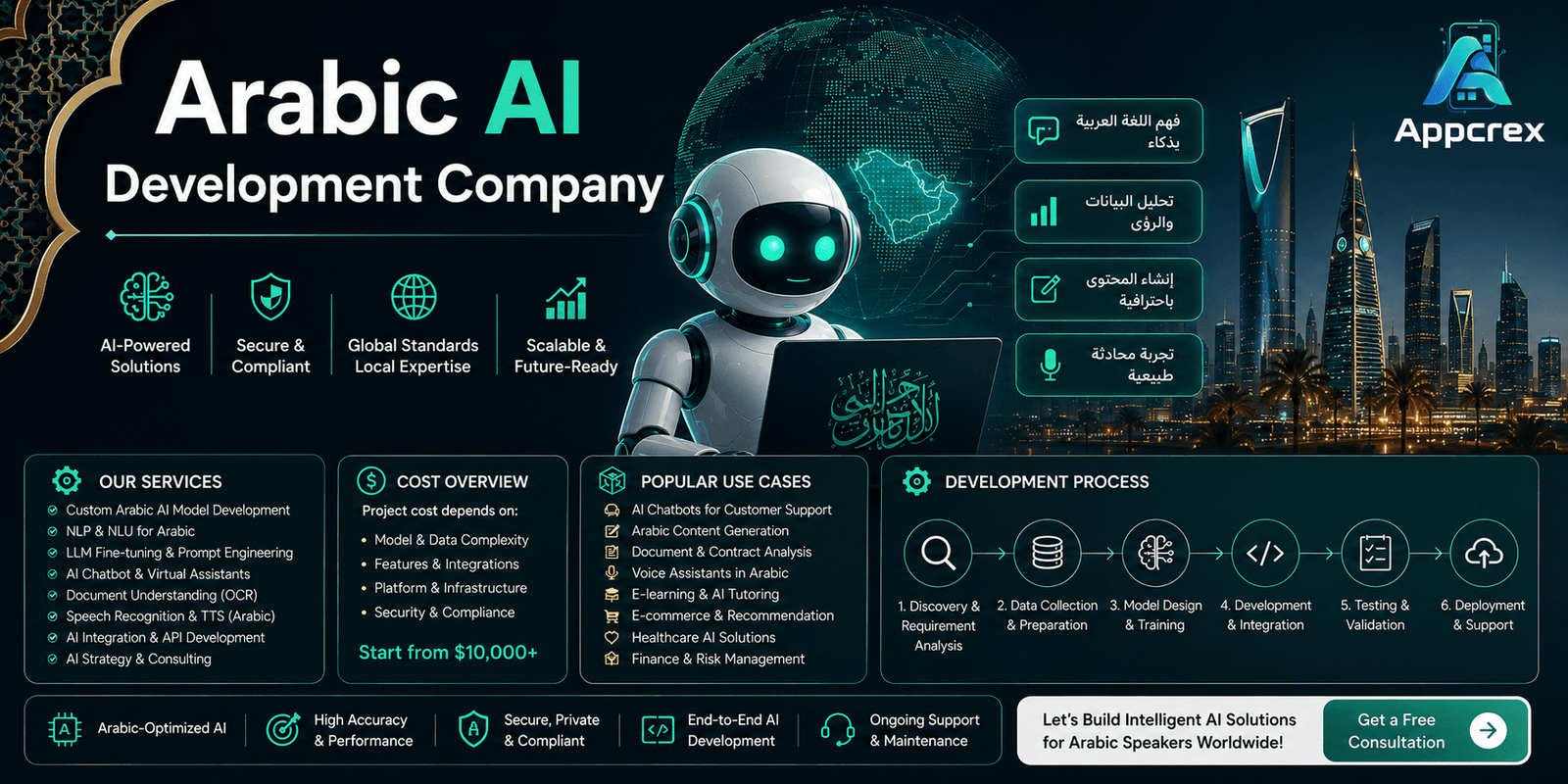
| Arabic AI Solution | Estimated Cost | Approx. Timeline |
|---|---|---|
| Basic Arabic AI Chatbot | $15,000–$30,000 | 2–3 months |
| Custom Arabic AI Assistant | $25,000–$60,000 | 3–5 months |
| Arabic RAG Platform | $40,000–$90,000 | 4–7 months |
| Arabic AI Agent | $50,000–$120,000 | 5–8 months |
| Arabic Voice AI Platform | $60,000–$150,000+ | 5–10 months |
| Enterprise Arabic AI Platform | $120,000–$250,000+ | 8–15+ months |
These are indicative development ranges, not fixed quotations.
The final price depends on the architecture, data, integrations, AI model, security requirements and scale.
What Determines the Development Cost?
The biggest factor is usually not the chatbot interface.
It is the infrastructure behind it.
Costs can increase because of:
- Custom AI models
- Arabic dataset preparation
- Model fine-tuning
- RAG
- Vector databases
- Voice AI
- AI agents
- CRM integration
- ERP integration
- Payment integration
- Mobile applications
- Admin dashboards
- Security
- Cloud infrastructure
- Analytics
- Human escalation
- Multi-language support
A simple Arabic FAQ assistant and an enterprise Arabic AI platform may look similar on the surface, but their backend architecture can be completely different.
Technology Stack for Arabic AI Development
A modern Arabic AI solution may include several layers.
AI and LLM Layer
Depending on the use case, developers may use:
- Commercial LLM APIs
- Open-source LLMs
- Arabic-focused models
- Bilingual models
- Fine-tuned models
- Embedding models
Saudi Arabia’s AI ecosystem includes locally developed Arabic and bilingual foundation-model initiatives, giving businesses more options as the ecosystem matures.
NLP
Natural Language Processing can handle:
- Intent detection
- Entity extraction
- Text classification
- Sentiment analysis
- Summarisation
- Translation
- Question answering
RAG
A RAG layer can connect the AI model to business-specific Arabic information.
Vector Database
Used for semantic search and retrieval.
Possible technologies include:
- Pinecone
- Weaviate
- Qdrant
- Milvus
- PostgreSQL with vector extensions
Backend
Common choices include:
- Python
- Node.js
- Java
- .NET
Frontend
Depending on the product:
- React
- Flutter
- React Native
- Native iOS
- Native Android
Cloud Infrastructure
Potential infrastructure includes:
- AWS
- Microsoft Azure
- Google Cloud
For Saudi deployments, infrastructure and data-handling decisions should be aligned with the project’s data, security and regulatory requirements.
How to Build an Arabic AI Solution
A successful project should start with the business problem rather than the AI model.
1. Define the Use Case
First decide what you actually want the AI to do.
For example:
- Customer support
- Arabic search
- Lead qualification
- Document analysis
- Voice assistance
- Internal knowledge management
- Content generation
2. Understand the Users
Determine how your users communicate.
Do they primarily use:
- Formal Arabic?
- Conversational Arabic?
- English?
- Arabic-English mixed language?
This affects the model, prompts, testing and interface design.
3. Collect and Prepare Data
Arabic AI may require:
- FAQs
- Documents
- Customer conversations
- Product data
- Knowledge bases
- Audio recordings
- Industry terminology
Data should be cleaned, structured and permission-controlled before being used.
4. Select the AI Architecture
The project may use:
LLM → RAG → AI Agent → Business APIs
But not every project requires all four.
A simple customer-support system may only need an LLM + RAG.
A sophisticated enterprise assistant may require agents, APIs and multiple data sources.
5. Build the Arabic Experience
The interface should support:
- RTL
- Arabic typography
- Arabic search
- Arabic error messages
- Arabic prompts
- Language switching
- Mixed-language conversations
This is where a general AI product can become a genuinely localised Arabic product.
6. Integrate Business Systems
The AI becomes much more useful when it can interact with existing systems.
For example:
Arabic AI → CRM
Retrieve customer information.
Arabic AI → ERP
Find internal business data.
Arabic AI → E-commerce
Check products and orders.
Arabic AI → Booking System
Find available appointments or reservations.
7. Test Arabic Conversations
Testing should include:
- Formal Arabic
- Conversational Arabic
- Spelling variations
- Mixed Arabic/English
- Ambiguous questions
- Industry terminology
- Incorrect requests
- Sensitive information
- Prompt injection
- Hallucinations
The system should also be tested with real users where possible.
Arabic AI Security and Governance
Language quality is only one part of enterprise AI.
Businesses also need to consider:
- Authentication
- Data encryption
- Role-based access
- API security
- Data minimisation
- Audit logs
- Prompt security
- Output filtering
- Human escalation
For Saudi businesses, AI governance should be considered alongside data governance and applicable privacy requirements.
SDAIA provides an AI Service Provider Accreditation process designed to help AI software and service providers assess alignment with ethical standards for AI development and deployment.
SDAIA also provides an AI ethics self-assessment tool for organisations.
The exact compliance obligations depend on the industry, data and deployment model, so regulated projects should obtain appropriate Saudi legal and compliance advice.
How Businesses Can Monetise Arabic AI
Arabic AI isn’t only useful for internal automation. It can also become a commercial product.
SaaS
Offer an Arabic AI platform through monthly or annual subscriptions.
Usage-Based Model
Charge customers based on:
- Conversations
- Documents
- API calls
- AI processing
Enterprise Licensing
Provide customised Arabic AI platforms to large organisations.
AI-as-a-Service
Offer specialised Arabic AI capabilities through APIs.
AI-Powered Existing Products
Add Arabic AI functionality to an existing app or SaaS platform and use it as a premium feature.
What Should You Look for in an Arabic AI Development Company?
Don’t choose a provider simply because it can integrate an LLM.
Look for experience with:
- Arabic NLP
- Generative AI
- RAG
- AI agents
- Voice AI
- LLM integration
- Arabic UX
- RTL interfaces
- API integration
- Mobile App development
- Enterprise software
- AI security
- Data governance
It is also worth asking how the development team will evaluate Arabic accuracy.
A demo that answers five simple Arabic questions isn’t enough.
A serious project needs testing across real customer language, terminology and workflows.
Why Choose AppCrex for Arabic AI Development?
AppCrex can help businesses turn Arabic AI ideas into practical products and business solutions.
Our AI development capabilities include:
- Arabic AI Development
- Arabic AI Chatbot Development
- Arabic AI Agent Development
- Generative AI Development
- Arabic RAG Development
- Arabic Voice AI
- AI Copilot Development
- AI Integration Services
- Machine Learning Development
- NLP Development
- AI Automation
- CRM AI Integration
- ERP AI Integration
- AI-powered Mobile Apps
- AI-powered Web Platforms
- API Integration
For businesses targeting Saudi Arabia and the wider Middle East, solutions can be designed around Arabic/English interaction, RTL experiences, business-specific knowledge, AI agents and secure enterprise integrations.
Final Thoughts
Arabic AI is becoming an important technology category for the Middle East—not simply because Arabic is widely spoken, but because businesses increasingly need AI systems that understand the way their customers and employees actually communicate.
Saudi Arabia is developing dedicated capabilities around Arabic NLP, linguistic data, Arabic language models and AI research.
For businesses, the opportunity is much broader than building an Arabic chatbot.
You can build:
Arabic AI Assistant → Arabic RAG → Arabic AI Agent → Arabic Voice AI → Enterprise AI Platform
The best starting point is still a specific business problem.
If customer support is overloaded, build an Arabic AI support assistant.
If employees struggle to find information, build an Arabic enterprise knowledge assistant.
If sales teams receive thousands of Arabic enquiries, build an AI lead-qualification system.
If customers prefer voice, consider Arabic voice AI.
And if you already have an app or business platform, Arabic AI can be integrated directly into the existing product.
That practical approach makes the investment easier to measure and gives businesses a clear path from an initial AI MVP to a larger intelligent platform.
FAQs
Q. How much does Arabic AI development cost?
A basic Arabic AI chatbot may cost around $15,000–$30,000, while advanced enterprise Arabic AI platforms can cost $120,000–$250,000+, depending on complexity and integrations.
Q. How long does it take to build an Arabic AI solution?
A simple chatbot may take 2–3 months, while an enterprise Arabic AI platform can take 8–15 months or longer.
Q. Can Arabic AI understand different Arabic dialects?
It can be designed and tested for different language variations, but performance depends on the model, training data, use case and target audience. Dialect-specific evaluation is important.
Q. Can Arabic AI understand Arabic-English mixed conversations?
Yes. A properly designed bilingual AI system can handle mixed-language conversations, although this should be specifically tested with real user inputs.
Q. Can I build an Arabic AI chatbot for my website?
Yes. An Arabic AI chatbot can be integrated into websites, mobile apps and customer portals.
Q. What is Arabic RAG?
Arabic RAG connects a generative AI model with approved Arabic business information so the system can retrieve relevant content before generating an answer.
Q. Can Arabic AI be integrated with CRM or ERP?
Yes. APIs can connect an Arabic AI assistant or agent with CRM, ERP, e-commerce, booking and other business systems.
Q. Can Arabic AI support voice?
Yes. Arabic speech recognition and text-to-speech technologies can be integrated to create voice-based AI assistants.
Q. Is Arabic AI useful for Saudi businesses?
Yes. It can support customer service, banking, healthcare, retail, real estate, government services, tourism and internal enterprise operations.
Q. Can AppCrex build Arabic AI solutions?
Yes. AppCrex can develop Arabic AI chatbots, AI agents, RAG platforms, voice AI, generative AI solutions and AI-powered mobile/web products.
Want to build an Arabic AI chatbot, AI agent, Arabic voice assistant, RAG platform or AI-powered mobile application?
Build Your Arabic AI Solution With AppCrex
AppCrex can help you take the project from AI strategy and architecture to development, integration, testing and deployment.
Whether you’re targeting Saudi Arabia, the UAE or the wider Middle East, we can build the solution around your business requirements and Arabic-speaking users.
Talk to AppCrex about your Arabic AI development project and turn your AI idea into a scalable product.